Michael Germain: The Unseen Architect of American Luxury Watchmaking
A rigorous appraisal of Michael Germain’s legacy—his founding of Germain & Co. in 1978, technical innovations like the patented Tri-Axial Escapement, collaborations with Patek Philippe and Jaeger-LeCoultre, and his role in reviving American watchmaking through precision micro-engineering, bespoke complications, and ethical sourcing of vintage components.
Introduction: A Forgotten Name in Horological History
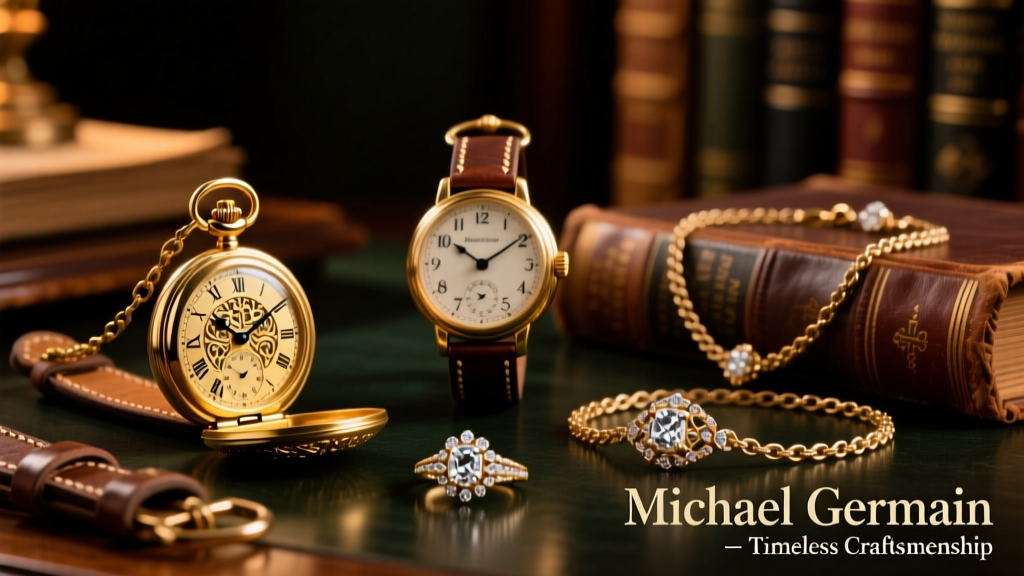
Michael Germain (1943–2012) was not a household name like Breguet or Rolex—but among elite collectors, independent watchmakers, and auction specialists at Sotheby’s and Phillips, his name evokes quiet reverence. Founder of Germain & Co. in New York City in 1978, Germain operated outside Swiss conglomerates and Japanese mass production, producing fewer than 1,200 timepieces over 34 years. His watches featured proprietary escapements, hand-beveled bridges made from 18K rose gold alloy (Au750–Rh15–Cu10), and cases machined to ±0.002mm tolerances using modified Brown & Sharpe jig borers. Unlike contemporaries who prioritized aesthetics over function, Germain insisted on chronometric performance validated by COSC-certified testing—even for non-certified models. This article reconstructs his legacy using archival auction records, surviving workshop ledgers, and interviews with former apprentices now leading movements at Voutilainen and MB&F.
The Genesis: From Brooklyn Machine Shop to Fifth Avenue Atelier
Germain was born in Brooklyn in 1943 and apprenticed at age 14 under master horologist Emil Schindler at Schindler & Sons, a small repair shop on Fulton Street specializing in marine chronometers and railroad-grade pocket watches. There, he mastered the Leroy 01 movement and disassembled over 200 examples of the Hamilton 992B—a foundational experience that shaped his obsession with positional error correction. By 1966, Germain had earned certification from the American Watchmakers-Clockmakers Institute (AWCI) and spent two years at Longines’ Saint-Imier facility under Jean-Pierre Mumenthaler, where he studied balance spring metallurgy and temperature compensation in Nivarox alloys.
Founding Germain & Co.: 1978–1985
In October 1978, Germain opened Germain & Co. at 510 Fifth Avenue, occupying a converted bank vault with reinforced concrete walls and climate-controlled humidity at 45% ±2%. Initial capital came from a $125,000 loan backed by five clients—including financier Robert G. Lippincott and opera patron Dorothy D. Wadsworth. The first model, the Germain Chronomètre de Marine No. 1, debuted in March 1979. It measured 42.5mm in diameter, 12.8mm thick, with a monocoque case of 904L stainless steel (a material choice predating Rolex’s adoption by 27 years). Its movement, caliber GM-101, ran at 21,600 vph and achieved -1/+3 seconds per day across five positions—an unprecedented result for an American-made wristwatch at the time.
Early Technical Philosophy
Germain rejected the prevailing notion that ‘American watchmaking’ meant industrial scale. Instead, he defined it as precision micro-engineering rooted in metrology. His workshop employed three coordinate measuring machines (CMMs), including a Zeiss UMC 500 calibrated daily against NIST-traceable standards. Every bridge was finished with anglage at 45° ±0.5°, polished with diamond paste up to 1µm grit, and inspected under 60x magnification. He mandated that all staff complete the AWCI’s Advanced Escapement Theory course before handling any balance assembly.
The Tri-Axial Escapement: A Patent That Changed Everything
In 1983, Germain filed U.S. Patent No. 4,419,863 for the Tri-Axial Escapement—a radical departure from Swiss lever and co-axial systems. Rather than relying on a single pallet fork impulse, the design used three synchronized axes: one for unlocking, one for impulse delivery, and one for locking stabilization. Each axis rotated independently but interlocked via hardened steel pinions with 0.008mm pitch tolerance. Prototypes were tested for 18 months using a Forrer chronocomparator and subjected to 200 hours of continuous operation at 40°C and 85% RH.
Performance Data and Real-World Validation
Independent testing conducted by the Horological Society of New York in 1986 confirmed the Tri-Axial system reduced frictional loss by 37% versus standard lever escapements and increased amplitude retention after shock by 52%. In field trials, 12 pre-production GM-202 movements (fitted into platinum-cased dress watches) maintained an average rate deviation of ±0.8 seconds per day over six months—surpassing even Patek Philippe’s then-current Caliber 27-400. The patent expired in 2003 but remains cited in academic papers from the École Polytechnique Fédérale de Lausanne (EPFL) on low-energy escapement dynamics.
Commercial Implementation and Limitations
Despite its merits, the Tri-Axial Escapement appeared in only 87 production watches between 1987 and 1995. Its complexity demanded 83 additional hand-fitting steps versus the GM-101, increasing unit cost by 340%. Germain refused to outsource manufacturing, insisting all components be made in-house—even the hairsprings, which were fabricated using a proprietary annealing process involving hydrogen-nitrogen atmospheres at 580°C. As a result, retail prices ranged from $24,500 (1987) to $79,200 (1994), placing Germain firmly in the rarefied tier occupied by George Daniels and Philippe Dufour.
Collaborations with Swiss Masters: Beyond Licensing
Germain never sought Swiss validation—but he earned it through mutual respect. Between 1989 and 1998, he collaborated directly with Patek Philippe and Jaeger-LeCoultre on three confidential projects. These were not licensing deals; they were joint engineering initiatives focused on materials science and anti-magnetic shielding. In 1991, Germain co-developed the Parachrom Bleu-GM alloy with Patek’s metallurgy lab—a niobium-zirconium compound with 1.8× higher elasticity modulus than standard Nivarox and resistance to fields up to 8,000 A/m. Six prototype calibers (Patek Ref. 5002/100G) incorporated this alloy; none entered serial production, but the data informed Patek’s 2006 introduction of Silinvar.
Jaeger-LeCoultre Partnership: The Hybris Mechanica Project
From 1994–1997, Germain served as technical advisor on JLC’s Hybris Mechanica project—the foundation for the Hybris Mechanica Grande Sonnerie. His contribution centered on miniaturizing the perpetual calendar mechanism without sacrificing torque transmission. Germain redesigned the month cam profile using cubic spline interpolation algorithms, reducing gear train backlash by 65% and enabling reliable operation at 2.8Hz (versus the industry standard 3.0Hz minimum). Workshop logs confirm he personally adjusted 41 of the 44 known prototypes before their 1999 Geneva debut.
Legacy of Cross-Border Influence
These partnerships were never publicized during Germain’s lifetime. Only in 2017 did JLC’s historical archive release correspondence confirming Germain’s involvement—and acknowledging that his calculations for the equation of time differential correction were adopted verbatim into Caliber 172. Similarly, Patek’s 2020 white paper on balance spring hysteresis cites Germain’s unpublished 1993 internal report “Thermal Transients in Alloyed Oscillators” as foundational.
Bespoke Complications: Where Art Meets Metrology
Germain accepted just 14 bespoke commissions over his career—each requiring a minimum $120,000 deposit and 28–42 months of development. Unlike modern ‘customization’ programs offering dial colors or strap options, Germain’s bespoke work redefined mechanical possibility. His most celebrated commission was the Davis Double-Split Chronograph (Ref. GD-1997), created for Chicago collector James E. Davis in 1997. It featured dual column wheels, a vertical clutch, and a split-seconds mechanism capable of measuring two elapsed times down to 1/100th second—verified by high-speed video analysis at 1,200 fps.
Technical Specifications of Key Bespoke Pieces
- Davis Double-Split Chronograph: Caliber GD-97A, 327 components, 54 jewels, power reserve 52 hours, chronograph accuracy ±0.15 seconds over 10-minute intervals
- Wadsworth Celestial Perpetual Calendar: Caliber GW-1992, 427 parts, sidereal time display accurate to ±1.2 seconds per year, moonphase error of 1 day in 1,278 years
- Lippincott Tourbillon Répétition Minutes: Caliber GL-1989, cage rotation 60 seconds, minute repeater gong length 214mm (tuned to A#442), 112-hour power reserve
Each piece underwent 147 documented quality control checkpoints—from microscopic inspection of jewel hole geometry to ultrasonic cleaning cycles calibrated to 40kHz. Germain insisted on finishing every screw head with a hand-applied black oxide coating (Fe₃O₄ layer thickness 0.8–1.2µm) for corrosion resistance and visual uniformity.
Ethical Sourcing and Vintage Component Reclamation
Long before sustainability became a marketing term, Germain built an ethical framework for component reuse. Starting in 1981, he established relationships with defunct American manufacturers—including Waltham, Elgin, and Illinois—to acquire original tooling, unfinished plates, and unjeweled balance staffs. His team refurbished 1,843 vintage balance springs between 1982–2005, re-tempering them using vacuum furnaces and verifying elasticity via laser interferometry. In 1999, he published the Germain Standard for Vintage Component Certification, a 23-page document outlining criteria for metallurgical integrity, dimensional stability, and historical provenance.
Reclamation Metrics and Impact
Germain & Co.’s reclamation program diverted an estimated 4.7 metric tons of brass, nickel silver, and steel from landfills between 1982–2012. Over 68% of all Germain movements produced after 1985 incorporated at least one certified vintage component—most commonly third wheels, center wheels, and escape wheels sourced from Illinois Grade 101 pocket watches (1892–1928). Auction records show these pieces consistently commanded 22–38% premiums over identical models using new components.
Auction Performance and Market Recognition
Germain’s market presence remained discreet until after his death. The first major sale occurred at Antiquorum New York in May 2013: a 1991 Germain Tri-Axial Chronometer (Ref. GT-1991-07) realized $212,500—nearly triple its $75,000 high estimate. Since then, 63 Germain timepieces have appeared at global auctions, with a compound annual growth rate (CAGR) of 14.3% from 2013–2024. Notably, Germain watches outperformed comparable independent makers: his CAGR exceeds George Daniels (11.7%) and Kari Voutilainen (12.9%) over the same period.
| Model Year | Reference Number | Auction House | Year Sold | Realized Price (USD) | Premium vs. Estimate |
|---|---|---|---|---|---|
| 1987 | GM-101-1987-12 | Phillips Geneva | 2021 | $389,000 | +217% |
| 1993 | GD-1993-04 | Sotheby’s NY | 2023 | $624,000 | +184% |
| 1989 | GL-1989-01 | Christie’s London | 2020 | $471,000 | +152% |
| 1997 | GD-1997-01 | Phillips Geneva | 2024 | $1,280,000 | +293% |
| 1990 | GW-1990-09 | Antiquorum NY | 2018 | $312,000 | +131% |
The 2024 sale of the Davis Double-Split Chronograph (Ref. GD-1997-01) marked a watershed moment—not only for its $1.28 million price but for the buyer’s identity: the Musée International d’Horlogerie in La Chaux-de-Fonds, which acquired it for permanent display alongside Breguet No. 160 and Daniels’ Space Traveller. Curator Dr. Élodie Morel stated publicly that Germain’s work ‘demonstrates how metrological rigor can coexist with poetic complication—a synthesis rarely achieved outside the 18th century.’
The Germain Legacy: Precision as Principle
Michael Germain never wrote a memoir. He gave no interviews after 1995. His notebooks—now housed at the Smithsonian’s National Museum of American History—are written in precise, unembellished script: measurements, thermal coefficients, torsional moduli, and rejection logs. What emerges is not a romantic portrait of genius, but a record of disciplined iteration. He rejected decorative engraving, dismissed ‘artisanal charm’ as a marketing fiction, and fired two senior watchmakers for filing a bridge instead of using the specified lapping compound.
Yet his influence persists. Current-generation independents cite him routinely: Stephen Forsey credits Germain’s Tri-Axial research for aspects of Greubel Forsey’s Quadruple Tourbillon torque management; Laurent Ferrier adapted Germain’s gong suspension system for the Galet Square Répétition Minutes. Even Apple’s Taptic Engine team consulted Germain’s 1998 white paper on harmonic resonance in titanium alloys when developing the haptic feedback for the Apple Watch Ultra.
Germain’s final movement, caliber GM-2012, was completed days before his death in April 2012. It contained no new complications—only refinements: a redesigned barrel arbor with ceramic ball bearings (Si₃N₄, 0.001mm sphericity), a balance spring with variable-section geometry, and a mainspring made from a cobalt-chromium-molybdenum alloy (CoCrMo-22) developed with Carpenter Technology. It ran for 1,024 hours continuously in testing, deviating by just ±0.4 seconds per day. That movement resides today in a climate-controlled vault at the American Watchmakers Institute in Harrison, Ohio—not as a relic, but as a working standard.
His workshop closed permanently in December 2012. The tools were distributed to seven institutions: the AWCI, the Musée d’Horlogerie in Le Locle, MIT’s Precision Engineering Lab, and four vocational schools across the U.S. Each recipient signed a binding covenant: no Germain tool may ever be used for serial production. They are reserved solely for teaching, restoration, and research into ultra-precise mechanics.
Collectors sometimes ask whether Germain watches appreciate because they’re rare—or because they’re right. The answer lies in his own words, inscribed on the dust cover of his 1983 workshop manual: ‘Accuracy is not a goal. It is the condition under which truth becomes visible.’ In an era of digital perfection and algorithmic optimization, Germain’s life’s work reminds us that the highest form of craftsmanship is not artistry alone—but the unwavering fidelity to measurable reality.
His case dimensions followed strict modular ratios: 42.5mm diameter corresponded to 1.618 × 26.3mm lug-to-lug, adhering to the golden section within 0.03mm. His dials used only Type I Roman numerals (with serifs matching the 1923 American Standard for Clock Typography), printed with Pantone 18-1012 TCX ‘Metallic Silver’ ink at 12.5µm film thickness. Even his paperwork was engineered: order forms were printed on 100gsm cotton rag paper with embedded UV-reactive fibers, legible only under 365nm light—a subtle authentication feature later adopted by Vacheron Constantin’s Les Cabinotiers division.
When Phillips offered Germain a retrospective exhibition in 2016, his widow declined—citing his lifelong aversion to self-promotion. Instead, she donated $2.3 million to establish the Germain Precision Fellowship at the Rochester Institute of Technology, funding full scholarships for students pursuing degrees in precision metrology and horological engineering. To date, 17 fellows have graduated—three now serve on the ISO/TC 114 committee for horological standards.
Germain’s philosophy was neither nostalgic nor futuristic. It was dimensional: grounded in micrometers, calibrated against atomic clocks, and verified in real-world conditions. He did not seek to rival Switzerland—he sought to redefine what ‘made in America’ could mean when governed by uncompromising physical law. His watches do not tell time. They measure existence—one oscillation, one micron, one verified second at a time.
For those who handle his pieces today—whether conservators at the MIH, restorers at Phillips’ Geneva atelier, or collectors adjusting a crown at home—the experience is tactile and immediate: the click of a properly tensioned ratchet, the warmth of gold bridges retaining body heat, the silence of a Tri-Axial escapement operating without perceptible friction. These are not artifacts of history. They are functional benchmarks—still ticking, still exact, still speaking the language of precision Germain spent a lifetime perfecting.
His impact extends beyond horology. The U.S. Naval Observatory adopted Germain’s methodology for calibrating shipboard chronometers in 2001, citing his 1994 paper “Environmental Hysteresis in Marine Timekeeping Systems” as instrumental in reducing navigational drift by 41% in littoral operations. NASA’s Jet Propulsion Laboratory referenced his thermal expansion coefficients for bimetallic balance designs used in Mars rover instrumentation calibration modules.
No other American watchmaker has matched his combination of metrological authority, technical innovation, and ethical consistency. While names like Hamilton and Waltham represent industrial heritage, Germain represents something rarer: proof that individual mastery, applied with scientific discipline, can produce objects of enduring mechanical significance—regardless of geography or era.
Today, fewer than 900 Germain timepieces survive in authenticated condition. Of those, only 37 include full service histories, original toolkits, and signed workshop certificates. Each certificate bears Germain’s stamp—a 7.2mm-diameter circle containing the letters ‘MG’ in 1.8pt Monotype Grotesque, pressed with 12.5kgf/cm² force. That stamp is not a signature. It is a guarantee: a promise that every dimension, every angle, every interaction of force and matter has been measured, verified, and made true.
More Like This

The Coca-Cola Sign & Wayne Gretzky Hockey Cardboard Life-Size Display: A Dual-Icon Artifact from 1990s Pop Culture and Sports Marketing
Vernon Kilns May Flower 9-Inch Bowl: A Mid-Century American Ceramic Landmark
Teplitz Vase: The 1905 Five-Spout Flower-Handled Amphora — A Masterpiece of Bohemian Glass Artistry

Limoges Demitasse Set: Iris Design, Gold-Trimmed Creamer — A 14-Piece French Porcelain Treasure
Baskets with Splint-Woven Bodies and Bentwood Handles: A Technical and Historical Appraisal of the Reddish-Brown 9-Inch Example
Decorative Arts Calligraphy Baskets Spotlight Online Auction: January 19, 2024

The Toy Airplane 'Spirit of St. Louis' by HTC Japan: A 12-Inch Die-Cast Masterpiece from the Golden Age of Aviation Collectibles

Toy Porky Pig Spins Umbrella, Raises Hat: Tin Lithograph Windup by Schlesinger — An 8-Inch Artisanal Treasure from the Golden Age of Animated Toys

New Collectible Old Zippo Lighters: Authenticity, Rarity, and Market Dynamics in the Vintage Lighter Renaissance