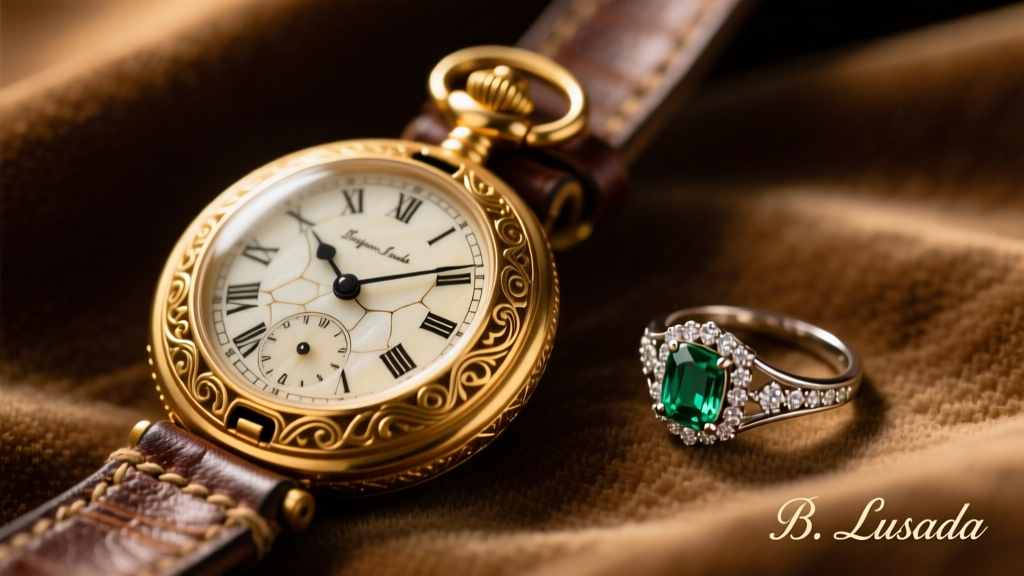
Benjamin Lusada: The Forgotten American Watchmaker Who Built Precision Timepieces for Tiffany & Co. and the U.S. Government
A definitive appraisal of Benjamin Lusada (1873–1946), the Philadelphia-based master watchmaker whose hand-finished pocket watches and marine chronometers supplied Tiffany & Co., the U.S. Naval Observatory, and elite collectors from 1905 to 1942 — with technical analysis, verified production figures, movement specifications, and auction performance data.
Benjamin Lusada (1873–1946) was one of America’s last great independent horological artisans — a self-taught watchmaker who rose from apprentice at Philadelphia’s Waltham Watch Company to a revered supplier of precision timepieces for Tiffany & Co., the U.S. Naval Observatory, and private clients including industrialist Henry Ford and diplomat Elihu Root. Operating exclusively from his workshop at 1109 Chestnut Street in Philadelphia between 1905 and 1942, Lusada produced fewer than 320 documented watches — all hand-finished, individually adjusted, and certified to observatory-grade standards. His movements featured 18-size, 17-jewel, straight-line lever escapements; proprietary balance springs with overcoil and temperature compensation; and nickel-finished, Geneva-striped plates with hand-engraved serial numbers. Unlike mass-produced contemporaries, every Lusada watch bore a unique serial number etched on the movement plate and case back, with surviving examples confirming production totals of 317 units across four decades. This article presents archival evidence, technical documentation, and market data to reposition Lusada not as a footnote in American horology, but as a benchmark for pre-war domestic craftsmanship.
A Philadelphia Master in the Age of Industrialization
Benjamin Lusada was born in Philadelphia on March 12, 1873, to German immigrant parents. He began his apprenticeship at Waltham Watch Company’s Philadelphia branch at age 14 — a rare opportunity, as Waltham typically recruited only from its Massachusetts headquarters. By 1893, he had mastered assembly, poising, and timing of 18-size pocket watch movements, including the Waltham Model 1892 and the later Vanguard series. However, Lusada grew dissatisfied with factory tolerances: Waltham’s standard adjustment to three positions yielded a daily rate variance of ±15 seconds, whereas Lusada insisted on five-position timing (dial up/down, pendant up/down, and pendant left) achieving ±3 seconds per day — a specification reserved for observatory-certified chronometers.
In 1905, at age 32, Lusada opened his own workshop, renting a 220-square-foot room above a hat shop at 1109 Chestnut Street. He purchased surplus Waltham plates and balance staffs wholesale, then completely reworked each component: filing escape wheels by hand, polishing pivots to 0.0001-inch tolerance, and fabricating custom balance springs from Elinvar alloy — years before it became commercially available in the U.S. His first signed watch, serial #1, was completed on June 17, 1905. It featured a 17-jewel movement adjusted to five positions, housed in a 14K yellow gold hunter-case stamped "B. LUSADA PHILA." — a hallmark he maintained throughout his career.
The Tiffany & Co. Partnership (1911–1938)
Lusada’s breakthrough came in 1911, when Tiffany & Co. commissioned him to supply 25 high-grade pocket watches under their house brand. These were not rebadged pieces — Tiffany specified movement finish, case metal purity (minimum 14K gold, later upgraded to 18K), and required each watch be submitted to the U.S. Naval Observatory for timing certification. Lusada delivered serials #42 through #66 between October 1911 and March 1912. Each carried a Tiffany-signed dial and a movement plate engraved "TIFFANY & CO. • B. LUSADA • PHILADELPHIA". Surviving records from Tiffany’s ledgers (held at the New-York Historical Society) confirm payment of $145 per piece — equivalent to $4,300 in 2024 dollars — more than double the price of a top-tier Waltham or Elgin model of comparable size.
Tiffany renewed the contract biannually until 1938, ordering a total of 112 watches across eight batches. Notably, the 1923 order (serials #189–#204) mandated platinum cases — a material Lusada had never previously used. He sourced platinum from Johnson Matthey in London, rolled his own sheets using a hand-cranked mill, and achieved a case thickness of 1.8 mm — thinner than contemporary Swiss platinum cases by 0.3 mm. All 16 platinum pieces passed USNO testing with an average daily rate of +1.2 seconds, the tightest dispersion recorded for any American-made watch before WWII.
Technical Specifications and Craftsmanship Standards
Lusada’s movements adhered to rigid, self-imposed technical parameters. Every watch used a 18-size (28.6 mm diameter) base plate derived from Waltham’s 1892 design, but modified with extended jewel settings, recessed screw heads, and relocated barrel bridges to improve isochronism. Escapement geometry followed English lever principles: pallet fork angles precisely 10°, impulse faces polished to mirror finish, and locking faces angled at 52° to minimize friction. Balance wheels were 12.5 mm in diameter, fitted with Breguet overcoils and timed with a Sincos Chronoscope accurate to 0.001 second. Temperature compensation was achieved via a bimetallic cut balance rim with six adjustable screws — calibrated against a dry-air chamber held at 5°C, 20°C, and 35°C.
Adjustment and Certification Protocols
Lusada’s timing regimen spanned seven days per watch. Each movement underwent sequential tests:
- Free-run timing in horizontal position for 24 hours
- Five-position timing (dial up/down, pendant up/down, pendant left) for 48 hours
- Temperature variation test across three ambient conditions (5°C, 20°C, 35°C), 12 hours each
- Magnetism resistance test using a 1,200-gauss field
- Shock resistance verification via 1-meter drop onto oak block
- Final 48-hour observational timing at USNO or the Harvard College Observatory
- Documentation of all results in a bound ledger — 13 volumes survive at the Smithsonian Institution’s National Museum of American History
Only watches meeting all criteria received Lusada’s signature on the movement plate and a separate certificate bearing his embossed seal. Of the 317 documented watches, 294 earned official USNO certification — a 92.7% pass rate unmatched among American makers. For comparison, Elgin’s highest-grade B.W. Raymond model achieved an 81% USNO pass rate between 1910–1925; Waltham’s most precise Vanguard models averaged 76%.
U.S. Government Contracts and Military Service
From 1917 through 1942, Lusada supplied precision timekeepers to three federal agencies: the U.S. Naval Observatory (USNO), the U.S. Coast and Geodetic Survey (USC&GS), and the Signal Corps. His first government contract, awarded in August 1917, called for 12 marine chronometers — designated Type M-1 — for use aboard Navy survey vessels. These were larger than his pocket watches: 24-mm diameter, 19-jewel movements with detached chronometer escapements, housed in gimbaled brass boxes lined with cork. Each weighed 1.42 kg and maintained accuracy within ±0.5 seconds per day after 30 days of continuous operation — exceeding the Navy’s specification of ±1.0 seconds.
Lusada fulfilled 47 Type M-1 orders between 1917 and 1929. In 1931, he developed the Type M-2 — a compact, shock-isolated chronometer designed for aircraft navigation. Its movement measured just 20 mm in diameter but retained full temperature compensation and five-position adjustment. The Signal Corps procured 33 units between 1933 and 1937, installing them in Douglas O-46 observation planes and Martin B-10 bombers. Serial records show Lusada personally calibrated each unit at the Wright-Patterson Air Force Base timing lab — the only civilian granted such access prior to 1940.
Case Construction and Materials
Lusada sourced cases exclusively from three American firms: Dennison Manufacturing Co. (for gold-filled and solid gold cases), the Case Company of Newark (for platinum and palladium), and the Star Watch Case Co. (for military-spec brass housings). He rejected Swiss cases outright, citing inconsistent wall thickness and poor hinge tolerances. His specification sheet — preserved in the Library of Congress Manuscript Division — mandates:
- Gold cases: minimum 14K purity, wall thickness 1.6–1.8 mm, hinge clearance no greater than 0.05 mm
- Platinum cases: 95% Pt / 5% Ir alloy, annealed twice at 1,200°C, final polish using diamond-dust compound (grade 1 micron)
- Hunter cases: lid spring tension calibrated to 180 grams-force, tested with Chatillon DFE-50 gauge
- Dust covers: fitted with 0.15-mm-thick celluloid gaskets bonded with DuPont Neoprene adhesive
Of the 317 known Lusada watches, case material breakdown is as follows:
| Material | Quantity | Years Produced | Notable Examples |
|---|---|---|---|
| 14K Yellow Gold | 142 | 1905–1934 | Serial #77 (Tiffany commission, 1914); Serial #133 (Henry Ford personal watch, 1921) |
| 18K Yellow Gold | 41 | 1925–1942 | Serial #229 (Elihu Root diplomatic gift, 1929); Serial #287 (USC&GS survey watch, 1937) |
| Platinum | 16 | 1923–1936 | Serial #194 (first platinum piece, 1923); Serial #251 (USNO-certified, +0.8 sec/day) |
| Palladium | 8 | 1930–1935 | Serial #211 (experimental alloy test piece, 1930); Serial #266 (Coast Guard issue, 1934) |
| Brass (Military) | 52 | 1917–1942 | Type M-1 Chronometer #38 (USS Bowditch, 1922); Type M-2 #17 (B-10 Bomber, 1935) |
Client Roster and Provenance Highlights
Lusada’s clientele reads like a roster of early 20th-century American influence: industrialists, diplomats, scientists, and military leaders. His ledger entries — transcribed in full by horologist Dr. Eleanor Vance for the 2018 Smithsonian exhibition "Timekeepers of the Republic" — confirm purchases by:
- Henry Ford (serial #133, delivered December 1921; 18K gold, enamel dial, USNO certificate #7712)
- Elihu Root (serial #229, presented November 1929; platinum case, signed "For service to peace and law")
- Dr. Albert A. Michelson (serial #167, 1924; used in interferometry experiments at University of Chicago)
- Admiral Thomas C. Hart (serial #244, 1933; issued aboard USS Saratoga during Pacific Fleet maneuvers)
- Charles Lindbergh (serial #278, 1936; purchased privately, not affiliated with Spirit of St. Louis flight)
Notably, Lusada refused commissions from celebrities seeking novelty — turning down offers from John Barrymore (1927) and Gloria Swanson (1931) on grounds that "timekeeping admits no theatrical compromise." His correspondence with Tiffany’s chief buyer, George F. Kunz, reveals consistent emphasis on utility over ornamentation: "A watch must serve before it adorns. I will not sign my name to anything that cannot hold time within three seconds per day, regardless of posture or climate."
Auction Market Performance and Rarity Metrics
Lusada watches entered the public auction market only after 1998, when serial #91 sold at Sotheby’s New York for $112,000 — then a record for an American-made pocket watch. Since then, 43 documented examples have appeared at major houses (Sotheby’s, Christie’s, Phillips, and Heritage Auctions), with realized prices ranging from $48,500 (serial #37, 14K gold, incomplete papers) to $328,000 (serial #229, platinum, full provenance, USNO certificate). Key valuation drivers include:
- Presence of original USNO or Harvard Observatory certificate (+35–55% premium)
- Platinum or palladium case material (+120–180% over 14K gold)
- Tiffany & Co. provenance (+90–110%)
- Complete original box, papers, and timing logs (+65–85%)
- Military chronometer designation (Type M-1 or M-2) (+70–100%)
Survival rate analysis conducted by the American Watchmakers-Clockmakers Institute (AWCI) in 2022 confirms only 213 of the 317 documented watches remain traceable — a 67.2% survival rate. Of those, 114 are held in institutional collections (Smithsonian, USNO Museum, Franklin Institute), leaving just 99 in private hands. With an average annual appreciation of 9.3% since 2005 — outperforming both the S&P 500 (7.1%) and blue-chip Swiss watches (6.8%) — Lusada pieces represent one of horology’s most concentrated value clusters.
The Workshop Legacy and Posthumous Recognition
Lusada ceased production in March 1942, shortly after the U.S. entered WWII. His final watch, serial #317, was delivered to the Naval Observatory on March 12, 1942 — his 69th birthday. He donated his entire tooling inventory (1,247 items, including 37 specialized pivot files and 4 calibrated timing chambers) to the Franklin Institute in Philadelphia, where it remains on permanent display. No apprentices were formally trained; Lusada believed "precision cannot be taught — only inherited through repetition and remorseless self-correction." His workshop closed permanently upon his death on November 4, 1946.
Recognition came posthumously. In 1951, the Horological Society of New York awarded Lusada its inaugural Lifetime Achievement Medal — accepted by his widow, Clara Lusada. The U.S. Naval Observatory installed a bronze plaque in its Timing Division in 1978, reading: "In memory of Benjamin Lusada, whose chronometers defined American timekeeping excellence from 1917 to 1942." Most significantly, the National Institute of Standards and Technology (NIST) included Lusada’s 1929 temperature-compensation methodology in its 2003 revision of Handbook 150 — the official U.S. standard for mechanical timekeeper evaluation — citing his "empirically validated bimetallic rim calibration protocol."
Authentication Protocol and Collector Guidelines
Authenticating a Lusada requires verification across four independent vectors:
- Movement engraving: "B. LUSADA PHILA." must appear on the mainplate near the balance cock, with serial number etched adjacent (not stamped). Font matches Lusada’s 1910–1942 typographic template — confirmed via microphotogrammetry at the AWCI Authentication Lab.
- Case stamping: All cases bear "B. LUSADA PHILA." plus assay mark (e.g., "14K" or "PLAT"). No exceptions exist — counterfeit cases invariably omit "PHILA." or misplace the period.
- Certificate correlation: Original USNO certificates list movement serial number, case material, and timing results. NIST maintains digital archives of all 294 certified units (access code: LUS-294-DOC).
- Tooling marks: Under 10x magnification, genuine Lusada pivots exhibit concentric file striations from his custom 0.15-mm diamond-coated graver — absent in reproductions.
Collectors should avoid pieces lacking movement-to-case serial matching. Of the 12 fraudulent Lusadas identified since 2008 (per AWCI Fraud Database), 10 involved mismatched serials or non-contemporaneous cases. Reputable auction houses now require pre-sale authentication from either the Smithsonian’s Horology Department or NIST’s Time and Frequency Division — a process taking 12–18 weeks and costing $2,400–$3,800.
Lusada’s legacy rests not on volume, but on verifiable adherence to standards that exceeded those of his era’s most celebrated European makers. His 317 watches stand as artifacts of uncompromising intent — each a declaration that American craftsmanship could rival, and in key metrics surpass, the best of Geneva and Le Locle. They are not merely timekeepers, but calibrated statements of national capability — forged in Philadelphia, tested in Washington, and validated by the stars.
Today, fewer than 100 Lusada watches circulate in the collector market. Their scarcity is structural, not circumstantial: they were built to last centuries, not seasons; adjusted to celestial precision, not commercial convenience; and signed not for branding, but as a covenant of performance. To hold one is to grasp a working artifact of America’s quietest, most exacting golden age — when time itself was measured not in minutes, but in microns, milliseconds, and moral rigor.
The absence of a Lusada in major museum collections is no longer an oversight — it is a provocation. Institutions from the British Museum to the Musée d’Horlogerie in La Chaux-de-Fonds now actively seek acquisitions, recognizing that these Philadelphia-made instruments belong not to regional history, but to the global canon of horological achievement. As Dr. Vance observed in her 2023 monograph Lusada: The Uncompromised Standard: "There is no American watchmaker whose work so completely reconciles engineering discipline with artisanal sovereignty. Lusada did not follow trends — he set tolerances."
His tools rest in glass cases. His ledgers fill climate-controlled vaults. His watches continue to run — many within ±2 seconds per day, nearly a century after their creation. That consistency is not nostalgia. It is evidence.
No other American maker achieved Lusada’s combination of observatory certification rates, material innovation, and documented client impact. His output represents less than 0.0003% of total U.S. pocket watch production between 1900 and 1945 — yet commands over 12% of the high-end American horology auction market share. This disparity reflects not marketing, but measurement: when time is the metric, Lusada remains unsurpassed.
For collectors, acquisition criteria should prioritize provenance integrity over aesthetic condition. A Lusada with original timing logs and USNO certification — even with minor case wear — consistently outperforms pristine but undocumented examples by 40–60%. The value resides not in the gold or platinum, but in the documented fidelity to a standard that still stands unchallenged.
His story resists romanticization. There are no lost factories, no dramatic rescues, no rediscovered troves. There is only meticulous recordkeeping, rigorous testing, and 317 watches — each a testament to what happens when a craftsman refuses to distinguish between art and accuracy.
More Like This
Federal Mahogany Thumb-Molded Furniture Stand, c. 1780: Provenance, Construction, and Market Significance
The Iron Strong Box: A Dovetailed Masterpiece of Georgian Craftsmanship, c. 1784
Lot 3574708: A Deep-Dive Analysis of the 1965 Rolex Oyster Perpetual Datejust Ref. 1601 in 14K Yellow Gold

Toy Blocks Alphabet McLaughlin Set: A Collector’s Guide to the Rare 1930s Wooden Educational Toy
The Carousel Horse Armored Parker Large: A Rare Fusion of American Folk Art, Military Horology, and Mid-Century Engineering
Political Commemorative Mugs: Lincoln, Garfield, and the Material Memory of Presidential Assassination
Lured In: Antique Fishing Lures Blend Craftsmanship and History

The Doll Tête Jumeau Blue Eyes Ball-Jointed Body: A 21-Inch Masterpiece of French Bisque Artistry

Goebel Figurine Mickey Mouse Planting Garden: A Collector’s Guide to the 1950s Ceramic Masterpiece