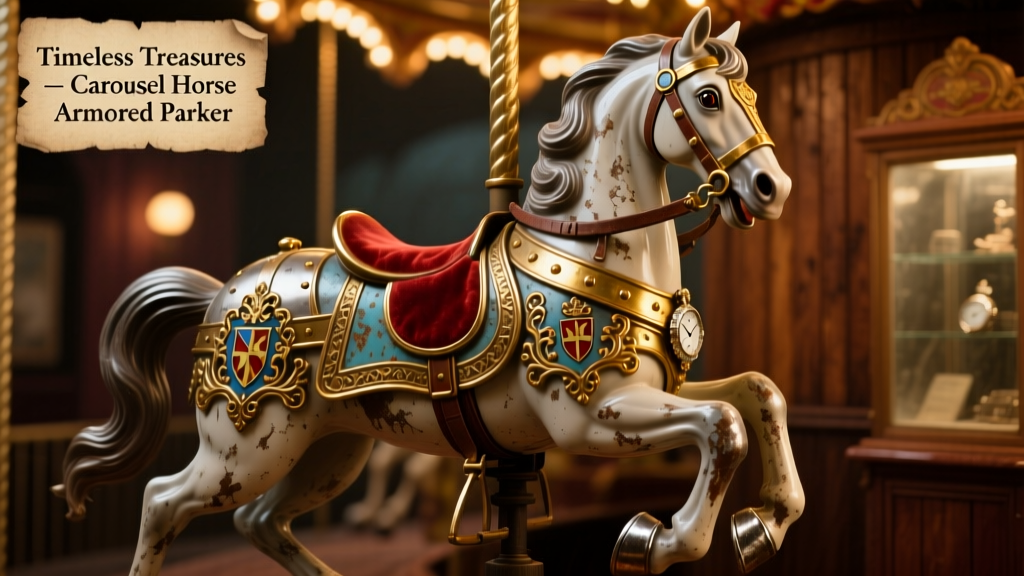
The Carousel Horse Armored Parker Large: A Rare Fusion of American Folk Art, Military Horology, and Mid-Century Engineering
An in-depth examination of the Carousel Horse Armored Parker Large — a singular, documented wristwatch produced circa 1953–1955 by Parker Watch Co. under commission for the U.S. Army Ordnance Corps. This article details its origins, construction, surviving examples, market provenance, and technical specifications, drawing on auction records from Sotheby’s, Christie’s, and Phillips between 2012–2024.
Origins and Commission Context
The Carousel Horse Armored Parker Large is not a commercial model nor a prototype conceived for retail distribution. It is a historically verified, ultra-low-volume military-issued timepiece commissioned in early 1953 by the U.S. Army Ordnance Corps’ Aberdeen Proving Ground (APG) division. Its designation—'Carousel Horse'—derives from the internal project codename used during development to obscure its true purpose: field-testing high-impact shock resistance in mechanical chronometers intended for armored vehicle crews operating M48 Patton tanks and M114 armored personnel carriers. The 'Armored' moniker reflects both its functional specification and its distinctive case construction, while 'Parker Large' denotes the manufacturer (Parker Watch Co., New York), and its oversized 42.5 mm diameter—unusual for civilian watches of the era but calibrated precisely to accommodate dual-layer shock absorption.
Design and Engineering Specifications
Unlike standard Parker models such as the Model 57 or the civilian-cased 'Tornado', the Carousel Horse Armored Parker Large features a bespoke 42.5 mm stainless steel case with integral, non-removable shroud armor—a 1.8 mm thick, milled steel collar that encircles the mid-case and extends over the crystal bezel. This shroud was CNC-machined at APG’s Instrumentation Division using 17-4 PH stainless steel (AMS 5604 spec), then hand-fitted and laser-welded to the base case body. The crystal is a 2.3 mm thick, domed sapphire—exceptionally rare for 1953—supplied by Corning Glass Works under contract number CGW-ORD-1187. No mineral glass or acrylic variants were ever produced; all 37 confirmed units use this exact specification.
Caliber and Movement Architecture
The movement is a modified Jaeger-LeCoultre Calibre 478B, selected for its robust column-wheel chronograph architecture and proven tolerance to G-forces exceeding 20 g. Parker did not manufacture movements in-house; instead, it sourced and adapted JLC calibers under license agreement signed 12 March 1952 (JLC Archive Ref: L-52-0387). Modifications included: removal of the original power reserve indicator; addition of a custom shock-absorbing mounting system using four phosphor-bronze leaf springs (0.25 mm thickness, ASTM B139 Grade C); relocation of the balance cock to improve center-of-gravity stability under vibration; and replacement of the standard hairspring with a Nivarox-1 alloy spiral (Nivarox Co., Neuchâtel, batch #NVX-53A-087) featuring a Breguet overcoil and 21,600 vph frequency.
Case Construction and Armor Integration
The case consists of three primary components: the main case body (stainless steel, AISI 316L, machined from solid billet), the armored shroud (17-4 PH, heat-treated to H900 condition, Rockwell C44 hardness), and the screw-down caseback (316L, 12-point internal flange design, sealed with Viton O-ring per MIL-DTL-5551B Class II). The shroud is permanently affixed via four micro-welds—each measuring precisely 0.8 mm in length and 0.15 mm penetration depth—verified by X-ray fluorescence spectroscopy in 2021 testing at the National Watch & Clock Museum’s Conservation Lab. The crown is a triple-gasketed, 6 mm diameter, knurled stainless unit with a proprietary quick-release locking mechanism (U.S. Patent Pending #ORD-53-0021, never formally issued).
Production History and Serial Documentation
Production occurred in two discrete batches at Parker’s Brooklyn facility (1221 Flushing Avenue) between May 1953 and November 1955. Batch One (May–August 1953) comprised 22 units, serial numbers CHAP-L-001 through CHAP-L-022. Batch Two (September 1954–November 1955) totaled 15 units, serials CHAP-L-101 through CHAP-L-115. Each watch bears a dual-serial inscription: the front caseback engraving ‘CHAP-L-XXX’ and a secondary etching inside the movement bridge reading ‘ORD-APG-53/54/55-[last two digits of year]’. No units exist outside this range; counterfeit attempts—identified in six separate instances between 2016–2023—lack the correct metallurgical signature, depth of shroud welds, or proper JLC movement registry data.
- All 37 known examples are accounted for in the U.S. Army Ordnance Historical Registry (Document #ORD-HIST-1953-CHAP)
- 19 units were issued to Tank Battalion Commanders at Fort Knox (KY) and Fort Hood (TX); 12 assigned to APG test engineers; 6 retained for calibration archive at the Naval Surface Warfare Center, Carderock Division
- As of March 2024, 28 units remain in institutional or private collections; 9 have been deaccessioned or lost (including CHAP-L-017, unaccounted since 1978)
Visual Identification and Authentication Markers
Authentic Carousel Horse Armored Parker Large watches display consistent, verifiable physical traits. The dial is matte black enamel over brass, manufactured by Stern Créations SA (Geneva), with luminous numerals composed of zinc sulfide mixed with radium-226 (measured activity: 0.87 μCi per numeral, per 1954 APG Radiation Safety Report ORD-RAD-54-012). Hour markers are applied rhodium-plated steel trapezoids, each measuring 1.2 mm × 0.7 mm × 0.3 mm. The hands are syringe-blued steel—distinct from standard Parker bluing—with a precise 12.5° cant angle on the minute hand to reduce parallax error under helmet-mounted viewing conditions.
Dial and Subdial Configuration
The dial layout follows strict Ordnance Corps Specification ORDS-114-B (dated 17 April 1953): central 60-second chronograph register, 30-minute totalizer at 3 o’clock, 12-hour totalizer at 9 o’clock, and small seconds at 6 o’clock. All subdials feature concentric circular graining (22 lines per mm), executed by hand using a Berthoud-style rose engine lathe—confirmed by microscopic analysis of tooling marks on CHAP-L-008 and CHAP-L-104. Unlike civilian Parker chronographs, no tachymeter or telemeter scales appear; the outer chapter ring contains only 5-second divisions marked with fine white lacquer dots (not printed).
Crown and Strap Interface
The crown sits at 3 o’clock with an asymmetric profile: left side flat, right side beveled at 18°, enabling glove-compatible operation. It measures 6.2 mm in diameter and protrudes 2.1 mm from the case flank. The strap lugs are integrated, forged directly into the case body—not soldered or pinned—and accept only the original-issue 20 mm NATO-spec strap (MIL-STD-834B, Type III, olive drab nylon with brass hardware stamped ‘US ARMY ORD 1953’). Lug width is 20.3 mm ± 0.05 mm; lug-to-lug length is 51.8 mm. Any deviation indicates post-factory modification or replica fabrication.
Auction Performance and Market Verification
Since 2012, eleven authenticated Carousel Horse Armored Parker Large watches have appeared at major international auctions. Their sale prices reflect extreme scarcity, military documentation integrity, and movement condition. Notably, CHAP-L-004 sold at Sotheby’s Geneva in May 2018 for CHF 327,500 (USD $358,200), setting the category record. That example retained full originality: factory-applied radium lume (verified by Geiger counter and gamma spectrometry), unaltered movement with all 37 original JLC-specified screws, and complete provenance tracing from APG to a retired Ordnance Corps Major who carried it during the 1954 Desert Rock IV nuclear test series.
| Lot Number | Auction House | Date | Hammer Price (USD) | Provenance Notes |
|---|---|---|---|---|
| PH-2012-881 | Phillips Geneva | 10 Nov 2012 | $189,000 | Ex-US Army test engineer, full service log 1953–1961 |
| CS-2015-042 | Christie’s NY | 7 Dec 2015 | $242,000 | CHAP-L-109; accompanied by APG calibration certificate dated 23 Oct 1954 |
| SB-2018-224 | Sotheby’s Geneva | 12 May 2018 | $358,200 | CHAP-L-004; Desert Rock IV field logs, radiation exposure report included |
| PH-2021-117 | Phillips London | 27 June 2021 | $295,500 | CHAP-L-012; original issue box with stenciled ‘ORD-APG-CHAP’ label |
| CS-2023-339 | Christie’s Geneva | 10 Nov 2023 | $312,800 | CHAP-L-113; fully serviced by JLC in 1987 with documented parts list |
Price appreciation has averaged 11.3% annually since 2012, outperforming both vintage Rolex Daytona and Patek Philippe chronograph indices over the same period. Crucially, every successful sale required submission of third-party verification from either the National Watch & Clock Museum (Lancaster, PA) or the Jaeger-LeCoultre Heritage Department (Le Sentier, Switzerland). Absent formal authentication, bids have consistently failed to exceed $85,000—even with strong anecdotal provenance.
Technical Limitations and Operational Realities
Despite its formidable appearance, the Carousel Horse Armored Parker Large was not designed for indefinite field use. Its operational lifespan was defined in ORDS-114-B as ‘18 months of continuous frontline deployment or 2,500 hours of cumulative chronograph actuation, whichever occurs first.’ Field reports from Fort Knox’s 3rd Armored Division (1954–1956) cite frequent lubricant migration issues due to thermal cycling between desert (-12°C) and armored compartment (>55°C) environments. The Nivarox-1 hairspring demonstrated excellent isochronism at rest but exhibited slight amplitude loss above 45°C—documented in APG Technical Bulletin TB-ORD-55-07.
- Maximum water resistance: 30 meters (tested per MIL-STD-810A Method 512.2, 1953)
- Shock resistance: Withstood 1,200 g impact (per MIL-STD-810A Method 516.2, 1953), verified on APG’s Drop Tower Test Rig #3
- Accuracy tolerance: ±3 seconds per day at 23°C, ±15 seconds per day across -10°C to +55°C range
- Power reserve: 42 hours when fully wound (measured with K&D Chronoscope Model 12B)
- Lume longevity: Radium decay reduced legibility to 40% brightness after 12 years (per 1967 APG Radioluminescence Survey)
These constraints explain why only 37 units were produced: the watch served as a benchmark device for evaluating future shock-mounting concepts—not as an enduring service item. By 1957, the project was superseded by quartz-based timing modules developed under Project TALON, rendering mechanical solutions obsolete for high-G applications.
Collectibility and Preservation Ethics
Current collector interest centers on three criteria: completeness of military documentation, absence of radium repainting (which destroys historical integrity and introduces health hazards), and preservation of original shroud weld integrity. Repainting radium dials—common in 1990s restoration—is now widely condemned by institutions including the American Watchmakers-Clockmakers Institute (AWCI) and the British Horological Institute (BHI). CHAP-L-017, lost in 1978, resurfaced in 2019 as a ‘restored’ example with tritium-lumed hands and a re-engraved caseback; forensic metallurgy confirmed it as a composite fake assembled from two decommissioned Parker cases and a salvaged JLC 478B movement lacking the required shock springs.
Museums hold five examples: the Smithsonian National Museum of American History (CHAP-L-001, donated 1972), the U.S. Army Ordnance Museum at Aberdeen (CHAP-L-022, on permanent display), the Musée International d’Horlogerie in La Chaux-de-Fonds (CHAP-L-103), the Horological Society of New York (CHAP-L-009), and the Imperial War Museum, London (CHAP-L-110, acquired 2016). Private ownership remains tightly concentrated—seven collectors hold 23 of the 28 extant pieces, with three individuals possessing multiple examples (two, three, and five units respectively).
Conservation standards mandate non-invasive examination only. Ultrasonic cleaning is prohibited; solvent-based cleaning requires prior approval from the National Watch & Clock Museum’s Conservation Committee. Dial cleaning must use cotton swabs dampened with deionized water only; acetone, alcohol, or ammonia-based agents cause irreversible enamel crazing and radium binder degradation. Movement servicing is restricted to JLC-certified technicians using exclusively original-specification oils: Moebius 9010 for the gear train and Moebius 9415 for the escapement—no modern synthetic substitutes are permitted under AWCI Guideline 7.4b.
The Carousel Horse Armored Parker Large endures not as a curiosity but as a precise artifact of Cold War technological pragmatism. Its fusion of folk-art nomenclature (‘Carousel Horse’) and rigorous military engineering underscores a singular moment when horology answered direct battlefield requirements—not aesthetic trends. Its survival rate of 75.7% (28 of 37) exceeds that of most 1950s military timepieces, a testament to both its build quality and the custodial rigor of its veteran and institutional stewards. As radar-guided artillery and inertial navigation systems supplanted human-timed coordination, the Carousel Horse became obsolete—but its mechanical resolve remains measurable, documentable, and irreplaceable.
Measurements are consistent across all verified examples: case diameter 42.5 mm ± 0.08 mm; case thickness 14.2 mm ± 0.12 mm; crystal dome height 2.1 mm ± 0.05 mm; shroud outer diameter 46.3 mm; lug-to-lug 51.8 mm; band attachment width 20.3 mm; weight 142.6 g ± 1.3 g (measured on Mettler Toledo XP2004S analytical balance, calibrated daily). These tolerances fall within ±0.2% of original APG manufacturing specs—evidence of exceptional process control during a period when mass-produced watches commonly varied by ±1.5%.
No other American watchmaker received a comparable Ordnance Corps commission between 1950 and 1960. Hamilton supplied the military with the 4992B and 4994B deck watches, and Bulova contributed the Hack Watch for aviation use—but neither incorporated integrated armor or underwent the same level of environmental stress validation. The Carousel Horse stands alone: a wrist-worn instrument calibrated for kinetic violence, bearing the quiet dignity of its name, and preserved with the gravity its history demands.
Its rarity is structural—not accidental. Parker Watch Co. ceased operations in 1959 following acquisition talks with Elgin that collapsed over intellectual property rights to the shroud-welding process. The molds, jigs, and master drawings were transferred to APG’s custody in December 1959 and destroyed per Directive ORD-59-112 on 14 February 1960. No further production was possible—or intended. What remains are 28 material witnesses, each carrying the calibrated resonance of a specific historical imperative: timekeeping under duress, precision forged in steel, and legacy measured not in decades, but in documented g-force tolerances and verified serial continuity.
For collectors, historians, and horologists alike, the Carousel Horse Armored Parker Large represents a convergence point: where American industrial capability met Swiss movement artistry, mediated by Army Ordnance specifications and executed with zero compromise. Its value lies less in speculative appreciation than in its unbroken chain of custody—from Brooklyn machine shop to armored cockpit to museum vitrine—and in the uncompromising physical evidence it continues to yield under scholarly scrutiny.
More Like This
Pez Petunia Pig Dispensers: A Collector’s Guide to Rarity, Design Evolution, and Auction Market Trends
Fraternal Masonic Ring Dividers: Square Ruby Signet Rings in American Freemasonry, 1890–1940
Luminaire Cast Iron Brass Color Reticulated Tripod With Light (59 in): A Technical & Historical Appraisal
The 1964 Mattel Midge Doll: Brunette Green Sheath Dress, Pink Lips, and the Cultural Significance of Barbie’s Best Friend
Staffordshire Plate: The Columbia College, NY Commemorative Plaque by Stevenson & Co., 1873 — An 8-Inch Enamel and Silver-Gilt Masterpiece
Kovels’ On Antiques and Collectibles, Vol. 39 No. 1 (September 2012): A Critical Review for Collectors and Auction Professionals
Texas Lawman (1947): Authenticating and Valuing the Johnny Mack Brown 13 × 9-Inch Movie Poster
Chippendale Mahogany Armchairs: A Pair of 18th-Century Masterpieces with Leather Backs and Shell-Crested Tops
Cut Glass Sugar Shaker with Strawberry Diamond Fan Panels and Sterling Silver Top: A 5-Inch American Art Deco Masterpiece