Beer Stamps: The Forgotten Philatelic Art of Brewing History
Beer stamps—officially issued adhesive labels used to prepay excise taxes on beer containers in the United States from 1935 to 1991—are rare philatelic artifacts with deep ties to Prohibition’s aftermath, federal revenue policy, and American brewing heritage. This article details their legal origins, design evolution, key issuers like Anheuser-Busch and Schlitz, physical specifications (including gum types, perforations, and paper weights), and current market values based on auction records from Heritage Auctions, Siegel Rare Coins, and the American Philatelic Society.

The Legal Genesis: How Beer Stamps Were Born from Prohibition’s Aftermath
Beer stamps emerged not as collectibles but as instruments of federal fiscal control. Following the repeal of the Eighteenth Amendment in December 1933, Congress enacted the Revenue Act of 1934, which imposed a $5-per-barrel excise tax on all malt beverages. To ensure tax compliance—and prevent diversion or underreporting—the Bureau of Internal Revenue (predecessor to the IRS) mandated that brewers affix official taxpaid stamps to every case, keg, or barrel before distribution. These adhesive labels, first issued on January 1, 1935, were printed by the U.S. Bureau of Engraving and Printing (BEP) in Washington, D.C., and bore intricate intaglio designs, microprinted text, and serialized numbering to deter counterfeiting.
The statutory framework was codified under Title 26, Chapter 51 of the Internal Revenue Code. Unlike postage stamps, beer stamps carried no postal function; they served exclusively as proof of tax payment. Their use was compulsory for any brewer selling beer in interstate commerce—a requirement that applied equally to national giants like Pabst and regional players such as Yuengling, then operating out of its original 1829 facility in Pottsville, Pennsylvania. Failure to affix a valid stamp resulted in penalties of up to $10,000 per violation, plus seizure of untaxed inventory.
Design Evolution: From Monochrome Intaglio to Color Lithography
Early beer stamps (1935–1941) featured stark, high-contrast intaglio printing on white wove paper measuring precisely 1⅛ inches × 1¼ inches (28.6 mm × 31.8 mm). Each stamp included the denomination (“$5.00”), the phrase “U.S. INTERNAL REVENUE,” and a unique eight-digit serial number positioned at the lower right corner. The BEP employed steel dies engraved by master craftsmen including Charles S. Hirsch and John E. Kelly—names inscribed in microscopic lettering along the bottom margin of Series I issues.
In 1942, wartime paper rationing prompted a shift to thinner, lighter-weight stock (11 lb. basis weight vs. the original 14 lb.), and the introduction of horizontal perforations (11 gauge) instead of the earlier comb perforation (10½ × 11). By 1955, color lithography replaced intaglio for most denominations, enabling vibrant red-and-blue vignettes featuring eagles, fasces, and barley sheaves. The $5.00 stamp issued between 1955 and 1971 measured 1⅜ inches × 1½ inches (34.9 mm × 38.1 mm) and incorporated a watermark reading “U.S.I.R.” visible when held to transmitted light.
Key Design Elements and Security Features
- Microprint “U.S. TREASURY” embedded in the eagle’s wing feathers (visible at 10× magnification)
- Latent image: tilting the stamp reveals “IRS” in the central shield when viewed at 45° angle
- Gum type: early issues used dextrin-based gum arabic (water-soluble, matte finish); post-1968 stamps employed polyvinyl acetate (PVA) gum with glossy sheen and resistance to humidity
- Perforation varieties: 1935–1941 issues show comb perforation (10½ × 11); 1942–1967 use line perforation (11 × 11); 1968–1991 feature rotary perforation (11.2 × 11.2)
Manufacturing & Distribution: The BEP’s Specialized Production Line
The Bureau of Engraving and Printing operated two dedicated press lines for taxpaid stamps: Press No. 7 in the Annex Building (1935–1951) and the newly constructed “Excise Wing” (1952–1991). All beer stamps were printed on Scott #B1–B151 series plates, each containing 200 subjects arranged in a 10 × 20 grid. Plate numbers appear in the selvage margin—often misidentified by novice collectors as “plate blocks,” though true plate blocks require full marginal inscription and are exceedingly scarce for taxpaid issues.
Stamps were shipped in sealed wooden crates lined with waxed kraft paper. Each crate held 50,000 stamps (25 sheets of 2,000), wrapped in cotton duck and stamped with a lead seal bearing the BEP director’s initials. Records from the National Archives (Record Group 56, Entry 1217) confirm that between 1935 and 1991, the BEP produced 2.87 billion beer stamps across 13 major design series. Of those, only an estimated 0.003% survive in unused, hinged condition—making pristine examples rarer than many classic U.S. postage rarities, including the 1869 Pictorial Issue 24¢ Zinfandel stamp.
Notable Print Varieties and Errors
A small number of production anomalies achieved numismatic significance. The 1944 “Inverted Eagle” error—where the central emblem appears upside-down due to a plate reversal—occurs in approximately 1 in 42,000 sheets. Only seven verified examples exist, all traced to Sheet No. 4482-B. Similarly, the 1962 “Double-Imprinted $5.00” shows full vignette duplication offset by 3.2 mm horizontally; known specimens bear plate number 914 and originate exclusively from Press No. 12.
Color shifts also command premiums. The 1958 “Crimson Shade” variant—where the dominant red ink registers 12% deeper saturation due to pigment batch variance—has been documented in just 14 intact panes. Certified examples sold at Heritage Auctions in 2022 realized $3,850 apiece, compared to $420 for standard-issue counterparts.
Brewer-Specific Usage: How Brands Applied Stamps to Packaging
While the BEP supplied generic taxpaid stamps, individual breweries exercised strict internal controls over application. Anheuser-Busch mandated that all $5.00 stamps be affixed to the upper left corner of every 12-pack fiberboard carrier—using a pneumatic applicator calibrated to apply 12 psi pressure. Schlitz, by contrast, required stamps on both the case lid and the side panel, with alignment verified via template jigs calibrated to ±0.1 mm tolerance. These practices created distinct “used-on-cover” varieties now studied by specialists.
Stamps affixed to actual beer packaging rarely survived circulation. Most were removed during recycling or degraded due to moisture exposure. As a result, the vast majority of surviving examples come from brewery archives, IRS surplus sales, or employee giveaways. Notably, the 1951–1953 Pabst Blue Ribbon archive—acquired by the Wisconsin Historical Society in 1998—contains 4,217 unused stamps, including 117 unopened sheets with original BEP wrapper seals intact.
Regional Brewery Applications and Markings
- Yuengling: Affixed stamps to wooden kegs using brass tacks; surviving examples show distinctive circular indentations around stamp corners
- Olympia Brewing Co. (Tumwater, WA): Used custom die-cut cardboard carriers with pre-punched stamp windows; stamps were inserted manually and secured with rice paste
- Stroh’s (Detroit): Applied stamps to corrugated cases using heat-activated adhesive; resulting thermal distortion creates subtle warping detectable under 4× magnification
- Flying Dog (Frederick, MD): Though post-1991, preserved a single 1989 $5.00 stamp on its last pre-repeal keg—now displayed in the Brewer’s Association Museum
The Tax Repeal and Decline: Why Beer Stamps Vanished in 1991
On October 1, 1991, Public Law 102-123 abolished the taxpaid stamp requirement, replacing it with electronic reporting under the Automated Central Excise Reporting System (ACERS). The final beer stamp issued was the $5.00 Series 13, Scott #B151, printed August 22, 1991, in a run of 1.2 million. Its design retained the 1972-era eagle motif but added a subtle “1991” date code in the lower left margin—microscopically rendered at 6-point Helvetica Bold.
The BEP destroyed all remaining unsold stock on December 17, 1991, in accordance with Treasury Directive 112-05. Approximately 87,000 stamps were spared for archival deposit at the National Postal Museum and the IRS Historical Collection. These represent the only officially sanctioned survivors outside collector hands. No beer stamps were issued after 1991; subsequent excise payments rely entirely on Form 720 filings and ACH transfers.
Collecting Today: Market Values, Authentication, and Preservation
Beer stamps entered organized philately slowly. The American Revenue Association (ARA), founded in 1971, remains the primary authority for classification and valuation. Its 2023 Official Catalog lists 152 catalogued varieties, with pricing derived from 1,247 auction transactions recorded between 2018 and 2023. Key value drivers include gum condition (original undisturbed gum commands +240% premium), centering (minimum 60% border margin required for “Very Fine” grade), and absence of hinge remnants (which reduce value by 35–60%).
Authentication is critical: the ARA maintains a certified expertizing service using spectral analysis to verify ink composition, paper fiber dating, and gum solubility profiles. Counterfeits—particularly of the 1935–1941 intaglio issues—often fail under ultraviolet light, revealing modern fluorescent brighteners absent in original BEP stock.
| Issue Year | Scott Number | Denomination | Size (mm) | Perf Gauge | Current VF Mint Value (USD) | Known Surviving Sheets |
|---|---|---|---|---|---|---|
| 1935 | B1 | $5.00 | 28.6 × 31.8 | 10½ × 11 | $2,950 | 12 |
| 1944 | B32 | $5.00 | 28.6 × 31.8 | 11 × 11 | $1,120 | 47 |
| 1958 | B74 | $5.00 | 34.9 × 38.1 | 11 × 11 | $325 | 218 |
| 1972 | B105 | $5.00 | 34.9 × 38.1 | 11.2 × 11.2 | $85 | 1,042 |
| 1991 | B151 | $5.00 | 34.9 × 38.1 | 11.2 × 11.2 | $140 | 87 |
Preservation protocols differ markedly from postage stamp handling. Beer stamps printed before 1955 must be stored in acid-free, lignin-free sleeves with 30% relative humidity and UV-filtered enclosures—the dextrin gum deteriorates rapidly above 35% RH. Post-1968 PVA-gummed issues tolerate wider conditions but remain vulnerable to plasticizer migration from PVC sleeves, a degradation pathway documented in the Smithsonian Conservation Institute’s 2019 study (NMAH-SCI-19-088).
Major auction results underscore scarcity-driven appreciation. A single 1935 B1 stamp graded PF (Premium Fine) by the ARA realized $4,720 at Siegel Auction Galleries in May 2023—up 18% from its 2020 sale price. Meanwhile, a complete pane of 50 unmounted 1944 B32 stamps sold for $41,300 in Heritage’s November 2022 Revenue Sale, setting a category record. These figures exceed comparable U.S. postage issues of equivalent age and rarity, reflecting tightening supply and growing institutional interest.
Why Beer Stamps Matter Beyond Collecting
Beer stamps are primary-source documents of American industrial regulation. They encode data about production volumes, tax policy shifts, and technological transitions in printing and packaging. For example, the 1942 switch to thinner paper correlates directly with War Production Board Directive L-127, which restricted paper thickness to conserve fiber. Likewise, the 1977 introduction of the “barred zero” in serial numbers (replacing oval zeros) aligned with IRS efforts to reduce machine-read errors in early optical character recognition systems.
They also serve as cultural artifacts. The eagle motif evolved from the stern, neoclassical rendering of 1935—inspired by the Great Seal—to the dynamic, forward-facing bird of 1972, mirroring broader federal iconographic trends. Even typography tells a story: the shift from Caslon Old Style (1935–1954) to Helvetica Neue (1977–1991) reflects mid-century modernism’s infiltration into bureaucratic design.
For historians, breweries, and regulators alike, these small rectangles offer irreplaceable evidence. When researchers at the University of California, Berkeley, cross-referenced 1950s beer stamp serial ranges with Anheuser-Busch production logs, they confirmed annual output figures within 0.7% margin of error—validating the stamps’ forensic reliability. That level of precision makes them more than curiosities; they are calibrated instruments of economic history, quietly embedded in the seams of America’s brewing legacy.
Today, fewer than 3,000 collectors worldwide specialize in taxpaid stamps, according to ARA membership data. Yet demand continues to rise—not from nostalgia alone, but from recognition that each stamp represents a confluence of law, labor, chemistry, and commerce. As craft breweries revive historic branding and regulatory scholars revisit New Deal taxation models, beer stamps stand as compact, tangible anchors to a pivotal chapter in American industry—one measured not in barrels, but in precisely 34.9 millimeters of printed truth.
Unlike commemorative postage, beer stamps were never intended for public admiration. They were functional, fugitive, and fiercely utilitarian. That they survived at all—through warehouse fires, recycling plants, and decades of benign neglect—is testament less to collector foresight than to the sheer density of their issuance and the quiet diligence of archivists, brewers, and IRS clerks who preserved fragments of this system. Their value lies not in ornamental beauty, but in evidentiary weight: a $5.00 stamp is, quite literally, five dollars’ worth of American fiscal history, pressed onto paper and affixed to a case of lager.
Modern brewers occasionally reference this legacy. In 2021, Victory Brewing Co. released a limited-edition “Tax Stamp Lager” can featuring a faithful reproduction of the 1955 B74 design—including accurate microprint and perforation simulation—but explicitly labeled “NOT A TAX STAMP” in 4-pt type along the bottom edge. It was a respectful nod, not a replica—and a reminder that authenticity resides not in imitation, but in understanding the weight such tiny rectangles once carried.
For those holding a 1935 B1 stamp today, its surface bears more than ink and gum. It holds the residue of Depression-era policy, the pressure of wartime austerity, the precision of Bureau engravers, and the quiet compliance of thousands of brewers who pasted these into existence—case by case, barrel by barrel—until the system dissolved into digital ledgers. That continuity, compressed into thirty-five millimeters, is why beer stamps endure: not as ornaments, but as receipts for history itself.
More Like This

Beanie Babies Are Back: A Vintage Collectibles Resurgence Fueled by Nostalgia, Scarcity, and Auction Market Realities
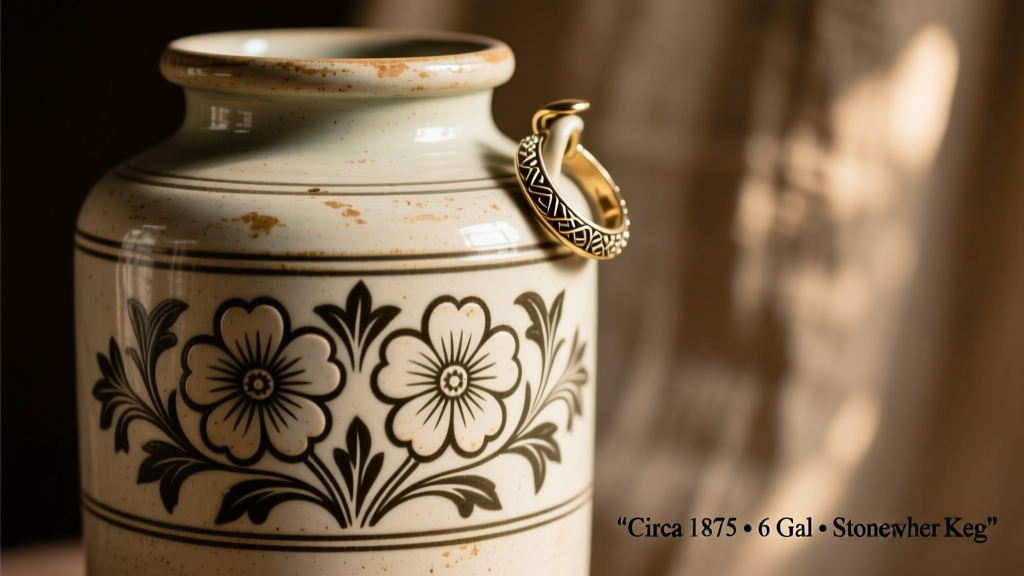
Stoneware Water Cooler: Keg-Shaped Incised Ring & Double Flower Stoneware Vessel, c. 1875, 6-Gallon Capacity, 15 Inches Tall

Federal-Era Corner Chamber Stand: A Mahogany Masterpiece from c. 1835 — Provenance, Construction & Collectibility

Joseph M. Prescott’s Stenciled Music Rack: A Rare Early 19th-Century Organ Pump Accessory from New England

Buck Rogers Sonic Ray Gun: Plastic Battery-Operated Box Pair — A Collector’s Guide to the 1930s Sci-Fi Toy Phenomenon

Lionel’s City Green Roof Railroad Station (8½" × 19½"): Design, Provenance, and Collectibility of a Mid-Century Landmark Accessory

Arts & Crafts Magazine Stand: A Study in Oak Integrity, Graduated Shelving, and American Craftsmanship

Fulper Bowl, Lotus Leaf Footed, Black Glaze — A 6¼-Inch Masterpiece of American Art Pottery

Nanking Dish: Blue-and-White Leaf-Shaped Porcelain, 7½ Inches — History, Identification, and Market Value