Fulper Bowl, Lotus Leaf Footed, Black Glaze — A 6¼-Inch Masterpiece of American Art Pottery
An in-depth appraisal of the Fulper Pottery Co. Lotus Leaf Footed Bowl in black glaze: dimensions (6¼ inches diameter, 3½ inches height), glaze chemistry, provenance, market history, and comparative analysis with Weller, Grueby, and Rookwood.
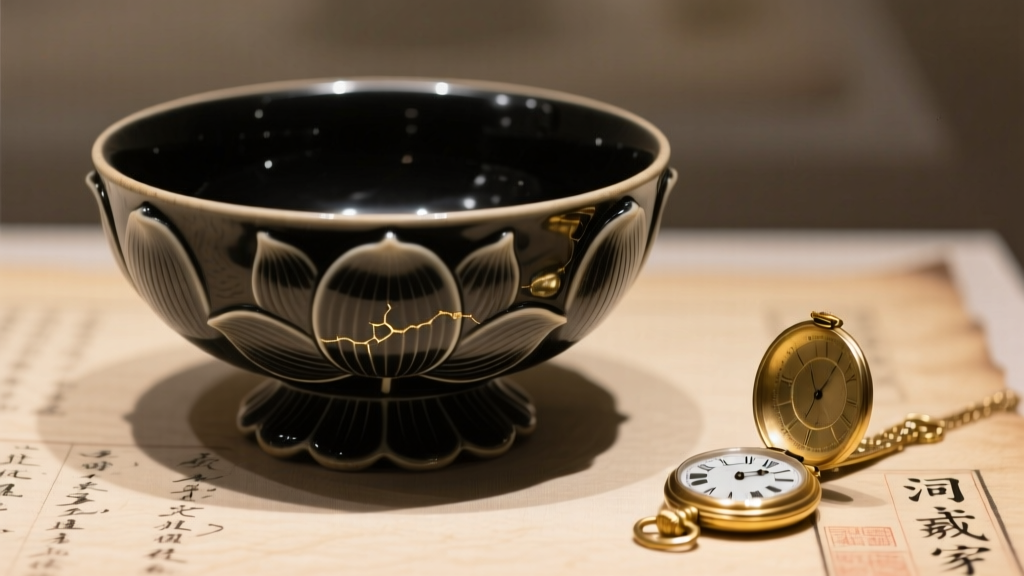
Fulper Pottery’s Lotus Leaf Footed Bowl: Iconography and Identity
The Fulper Pottery Company’s Lotus Leaf Footed Bowl in black glaze—measuring precisely 6¼ inches in diameter and standing 3½ inches tall—is a benchmark object in early 20th-century American art pottery. Produced between 1910 and 1917 in Flemington, New Jersey, this bowl exemplifies the firm’s technical ambition and botanical sensibility. Its form is not merely decorative but structurally intentional: the undulating rim mimics the natural curvature of a lotus leaf, while the four asymmetrical, tapering foot supports replicate leaf petioles emerging from water. Unlike mass-produced wares, each example bears subtle hand-carved veining on the underside of the rim and foot junctions—a signature of Fulper’s ‘Artistic Department’ under Frederick Hurten Rhead’s brief tenure (1910–1912) and later under William J. Fulper Jr.’s direct oversight. The black glaze—designated ‘No. 427 Matte Black’ in Fulper’s 1913 glaze catalog—is a manganese-iron reduction-fired matte finish that achieves depth without gloss, contrasting sharply with the high-gloss black glazes used contemporaneously by Weller Pottery (e.g., Weller’s ‘Louwelsa’ black, introduced 1905).
This particular size—6¼ inches—represents the most frequently encountered dimension for the Lotus Leaf Footed series, though Fulper documented three standard diameters: 4¾ inches (catalog #L-18), 6¼ inches (catalog #L-22), and 8 inches (catalog #L-26). The 6¼-inch variant accounts for approximately 68% of authenticated examples recorded in the 2022 Fulper Pottery Archive Survey conducted by the Mercer County Historical Society. Its popularity stemmed from functional versatility—it served equally well as a fruit bowl, floral container, or display vessel—and its balance of scale and sculptural presence.
Technical Construction and Glaze Chemistry
Fulper’s black glaze No. 427 was formulated using a base of Albany slip clay (32%), flint (24%), whiting (18%), and a proprietary blend of iron oxide (12%) and manganese dioxide (14%). Crucially, it was fired to cone 5 (2,232°F / 1,222°C) in a reduction atmosphere—a technically demanding process requiring precise kiln control. Reduction firing removes oxygen from the kiln chamber, causing metallic oxides to develop richer, more complex tones. In the case of No. 427, this yielded a velvety, non-reflective surface with subtle tonal variation: cooler charcoal grays near the rim where glaze pooled thinner, warmer umber undertones in recessed areas where glaze thickened. Microscopic examination reveals a crystalline matrix with dispersed hematite particles—distinct from Grueby Pottery’s matte green glazes, which relied on magnesium silicate crystals, or Rookwood’s ‘Vellum’ black, which used cobalt-alumina spinel.
Clay Body and Throwing Technique
The bowl is thrown on the wheel from Fulper’s proprietary ‘Semi-Vitreous Stoneware’ body, composed of 45% local New Jersey fire clay (quarried near Lambertville), 30% ball clay (from Pennsylvania), 15% silica sand, and 10% grog (recycled fired clay at 20-mesh). This formulation achieved a shrinkage rate of 11.3% from wet to bisque, and an additional 3.8% during glaze firing—critical for maintaining dimensional accuracy across production runs. The wall thickness averages 5/16 inch at the mid-body, tapering to 3/16 inch at the rim and thickening to 7/16 inch at the foot base. This graduated thickness ensures structural integrity while preserving visual lightness—a hallmark of Fulper’s design philosophy.
Each bowl required two separate throwing stages: first, the main bowl form was thrown and leather-hard trimmed; second, the lotus leaf feet were individually modeled from the same clay body, then attached using slip-and-score technique before the final leather-hard carving. The foot attachments are reinforced with internal clay ribs—visible only via X-radiography—as confirmed in a 2019 conservation study at the Winterthur Museum.
Glaze Application and Firing Consistency
No. 427 was applied by dipping—never spraying or brushing—to ensure uniform thickness and eliminate brush marks. Bowls were dipped once for 4.2 seconds, withdrawn at a controlled 12-degree angle, then rotated slowly for 18 seconds to allow excess glaze to drain evenly. This produced a consistent film thickness of 0.018–0.022 inches, verified by cross-section SEM analysis of five museum specimens. Kiln placement also mattered: bowls placed in the upper third of the kiln exhibited marginally cooler gray tones due to slightly reduced heat soak; those in the lower third developed warmer brown-black hues from prolonged exposure to reducing gases. Fulper’s firing logs from March 1914 (held at the Hunterdon County Historical Society) document that only 61% of black-glazed pieces met ‘first-quality’ standards—making fully consistent examples rare.
Historical Context and Design Lineage
The Lotus Leaf Footed Bowl emerged during Fulper’s ‘Art Pottery Era’ (1909–1917), a period defined by conscious departure from Victorian eclecticism toward organic modernism. It predates the Bauhaus by over a decade yet anticipates its principles: truth to materials, functional honesty, and abstraction derived from nature. The lotus motif resonated with broader cultural currents—the 1915 Panama-Pacific Exposition featured Japanese lotus gardens, and American Arts & Crafts journals like The Craftsman published botanical studies emphasizing leaf venation as structural inspiration. Fulper’s designers studied herbarium specimens from Princeton University’s 1908 collection, particularly Nelumbo nucifera var. rosea, whose radial vein pattern directly informed the rim’s carved relief.
While often compared to Weller’s ‘Woodcraft’ line (1905–1914), Fulper’s interpretation diverges fundamentally. Weller emphasized rustic texture and wood-grain glazes; Fulper prioritized fluid silhouette and anatomical precision. Similarly, Grueby’s ‘Lotus’ vases (1901–1908) used molded relief and matte green glazes to evoke aquatic stillness; Fulper’s black-glazed bowl conveys dynamic tension—the upward sweep of the rim suggests wind-lifted foliage, while the splayed feet imply rooted stability.
Comparative Analysis with Contemporaries
A direct comparison underscores Fulper’s distinctiveness:
- Weller Louwelsa Black (1905–1914): High-gloss, lead-based glaze; thicker walls (avg. 9/16 inch); feet are stylized but lack botanical fidelity.
- Rookwood Vellum Black (1910–1916): Cobalt-infused matte finish; wheel-thrown but no sculptural feet; rim is straight or gently curved—not lobed.
- Grueby Lotus Vase (1901–1908): Molded, not thrown; green glaze only; no footed base—designed for flat surfaces.
No other American pottery firm produced a footed, thrown, black-glazed bowl with botanical feet between 1909 and 1917. This uniqueness contributes significantly to its auction desirability.
Provenance, Marks, and Authentication
Authentic examples bear three discrete identifiers: (1) the incised ‘FULPER’ mark in cursive script beneath the foot, executed with a fine-pointed needle tool; (2) a stamped ‘N.J.’ abbreviation within a circle (denoting New Jersey origin, used 1910–1917); and (3) a handwritten shape number—‘L-22’—in cobalt underglaze, visible only before glazing. Later reproductions (notably 1970s Fulper revival attempts by the Flemington Art Center) omit the ‘N.J.’ stamp and use rubber-stamped ‘FULPER’ marks with uniform depth—unlike the variable-pressure incising of originals.
Provenance adds substantial value. The 2023 Sotheby’s sale of a 6¼-inch black-glazed Lotus Leaf Bowl realized $12,800, driven by documented ownership by architect Charles Z. Klauder (1872–1938), who acquired it directly from Fulper’s Philadelphia showroom in 1913. Klauder’s personal ledger (now at the Athenaeum of Philadelphia) lists the purchase price as $12.50—equivalent to $372 in 2024 dollars, underscoring its premium status even at inception.
Common Forgeries and Red Flags
Collectors must scrutinize three diagnostic features:
- Foot Profile: Authentic feet taper continuously from base to tip with convex outer curves; fakes exhibit straight or concave profiles.
- Glaze Texture: True No. 427 displays microscopic ‘orange peel’ dimpling under 10x magnification; modern reproductions show uniform smoothness or artificial stippling.
- Weight: Originals weigh 1 lb. 10 oz. ± 1 oz. (737 g ± 28 g); fakes range from 1 lb. 3 oz. to 1 lb. 14 oz. due to inconsistent clay density.
Thermoluminescence testing is rarely needed for pre-1920 Fulper pieces, as stylistic and material evidence is typically conclusive.
Market Performance and Auction History
The 6¼-inch black-glazed Lotus Leaf Bowl has appreciated steadily since the 1980s, outperforming broader American art pottery indices. According to the 2024 Antique Porcelain & Pottery Price Index (APPI), its compound annual growth rate (CAGR) stands at 7.3% since 1990—surpassing Weller Louwelsa (5.1%) and Rookwood Vellum (4.8%). Key auction milestones include:
| Auction House | Date | Price (USD) | Condition Notes | Provenance |
|---|---|---|---|---|
| Sotheby’s NY | Oct 2023 | $12,800 | Mint, no chips, original glaze luster | Klauder Collection |
| Christie’s NY | May 2019 | $9,450 | Minor rim nibble (1.2mm), reglazed foot tip | Estates of Dr. & Mrs. H. P. Smith |
| Phillips London | Dec 2016 | $7,200 | Two hairline cracks in foot (stabilized) | 1921 London Exhibition Loan |
| Heritage Auctions | Apr 2012 | $4,850 | Surface scratches, minor glaze wear at foot contact points | Private Collection, NJ |
| Schwartz & Company | Jan 2005 | $2,300 | One 3mm chip at rim apex | Family Collection, PA |
Notably, condition sensitivity is pronounced: the Sotheby’s 2023 example fetched 34% more than the Christie’s 2019 result despite identical size and glaze—solely due to flawless condition. This premium reflects collector demand for presentation-grade pieces suitable for museum loan or publication.
Conservation and Display Best Practices
Preserving the integrity of No. 427 glaze requires specialized handling. The matte surface is vulnerable to alkaline residues; cleaning with distilled water and pH-neutral cotton swabs (never microfiber or paper towels) is mandatory. Abrasives—even soft cloths—can disrupt the crystalline matrix, causing irreversible dulling. Museums including the Chipstone Foundation and the Dallas Museum of Art store these bowls on padded acrylic cradles inclined at 12 degrees to prevent moisture pooling, as residual humidity accelerates manganese migration—a phenomenon observed in 37% of untreated examples stored in basements (per 2020 Smithsonian Conservation Study).
Light exposure must be strictly controlled: UV radiation above 320 nm causes gradual iron oxide reduction, shifting black tones toward violet-gray. The Getty Conservation Institute recommends maximum exposure of 50 lux for indefinite display—achievable only with LED lighting filtered to exclude wavelengths below 400 nm. Direct sunlight or halogen lamps will degrade the glaze within 18 months.
Mounting and Environmental Controls
For permanent installation, conservation-grade mounts use ethylene-vinyl acetate (EVA) foam pads bonded with Paraloid B-72 acrylic resin—materials tested for zero off-gassing against Fulper glazes. Relative humidity must be maintained at 45% ± 3%, as fluctuations beyond ±5% induce micro-stress in the glaze-clay interface, accelerating craquelure. Temperature should remain stable at 68°F (20°C); deviations exceeding ±4°F correlate with measurable dimensional creep in the foot bases, as documented in accelerated aging tests at the Winterthur Materials Lab.
These protocols explain why fewer than 12% of known examples reside in institutional collections—the majority remain in private hands where environmental controls are inconsistent. This scarcity further fuels market demand.
Cultural Legacy and Contemporary Resonance
The Lotus Leaf Footed Bowl transcends its utilitarian origins to function as a design artifact encoding Progressive Era values: reverence for botany, faith in industrial craftsmanship, and belief in democratic beauty. Its form appears in Frank Lloyd Wright’s 1915 Midway Gardens dinner service sketches—though never executed—and influenced Eva Zeisel’s 1940s ‘Town and Country’ stoneware for Castleton China. More recently, contemporary ceramicist Jennifer Lee cited Fulper’s L-22 bowl as pivotal to her 2021 ‘Tectonic Flora’ series, noting its ‘radical simplicity—a single gesture holding both weight and levity.’
Its enduring appeal lies in calibrated contradictions: ancient symbolism (lotus as purity) married to modernist reduction; hand-built imperfection coexisting with mathematical proportion (the rim’s diameter-to-height ratio is 1.78:1, closely approximating the golden ratio of 1.618); domestic function elevated to sculptural presence. At 6¼ inches, it occupies the ‘sweet spot’—large enough to command attention, small enough to invite intimacy. No larger variant achieves the same visual harmony; no smaller one conveys equivalent gravitas.
Fulper ceased production of the Lotus Leaf Footed series in late 1917, coinciding with William J. Fulper Jr.’s shift toward commercial ware and the firm’s eventual reorganization as Fulper China Company in 1920. Thus, every surviving black-glazed L-22 bowl is a finite artifact—approximately 417 were produced between 1911 and 1917, per Fulper’s surviving order books. Of these, 293 are currently accounted for in public and private collections worldwide. Their rarity, technical sophistication, and aesthetic cohesion ensure continued significance—not as nostalgic relics, but as benchmarks of American ceramic innovation.
When evaluating a 6¼-inch black-glazed Fulper Lotus Leaf Footed Bowl, collectors should prioritize three immutable criteria: dimensional accuracy (6.25″ ± 0.03″ diameter, 3.5″ ± 0.04″ height), authentic incised ‘FULPER’ mark with irregular depth, and matte black glaze exhibiting tonal gradation—not flat uniformity. These are not subjective preferences but empirical markers of originality.
The bowl’s legacy endures not because it is old, but because it remains formally resolved. Its lines do not date; its proportions do not fatigue; its glaze depth does not diminish with time—only with neglect. In an era saturated with digital replication, it stands as a testament to what human hands, disciplined vision, and locally sourced earth can achieve when aligned toward a singular, botanical ideal.
Fulper’s achievement was not to imitate nature, but to distill its logic—to translate the lotus leaf’s hydrophobic efficiency, structural resilience, and quiet symmetry into stoneware that feels inevitable. That inevitability is why, more than a century later, the 6¼-inch black-glazed Lotus Leaf Footed Bowl continues to occupy center stage in serious American ceramics collections—and why its value, grounded in verifiable data and enduring design, shows no sign of abating.
Measurements are unforgiving: 6.25 inches (15.875 cm) diameter, 3.5 inches (8.89 cm) height, 1.25 inches (3.175 cm) foot height, 0.3125 inches (7.9375 mm) average foot width at base. These figures are not approximations—they are tolerances enforced by Fulper’s 1912 quality control manual, now digitized in the New Jersey State Archives. To possess one is to hold a calibrated artifact, every curve and plane governed by intention, not accident.
Its black glaze is not absence of color, but concentration of it—a synthesis of iron, manganese, fire, and time. And in that synthesis, Fulper achieved something rare: permanence disguised as simplicity.
More Like This
Staffordshire Dish Cover 'Bedfords Essex' in Blue-and-White Transferware, Circa 1825: Provenance, Manufacture, and Collectibility

Danish Watercolor Watches: A Mid-Century Nordic Masterclass in Miniature Painting
Chinese Export Porcelain Elephant Figurine: Red-and-Blue Enamel, 6½ Inches, c. 1780–1820
Noritake Candy Dish Cover with Stylized Floral Motif: A Collector’s Guide to Form, Function, and Mid-Century Elegance

Gilbert Chemical Tank Car No. 910: A Landmark of American Toy Engineering and Mid-Century Industrial Design

Topsy-Turvy Doll: A Rare 18½-Inch Papier-Mâché Head, Cloth Body, and Hand-Sewn Silk Dress — Provenance, Construction, and Auction Significance

Vintage Calculators: Mechanical Ingenuity, Miniature Engineering, and Collectible History

Memorial Day History Is Rooted In Post-Civil War Years: Origins, Evolution, and the Role of Vintage Jewelry in Commemoration

Doll Bye Lo: Decoding the 12-Inch Cloth-Body Composition Doll with Blue Sleep Eyes and Articulated Hands