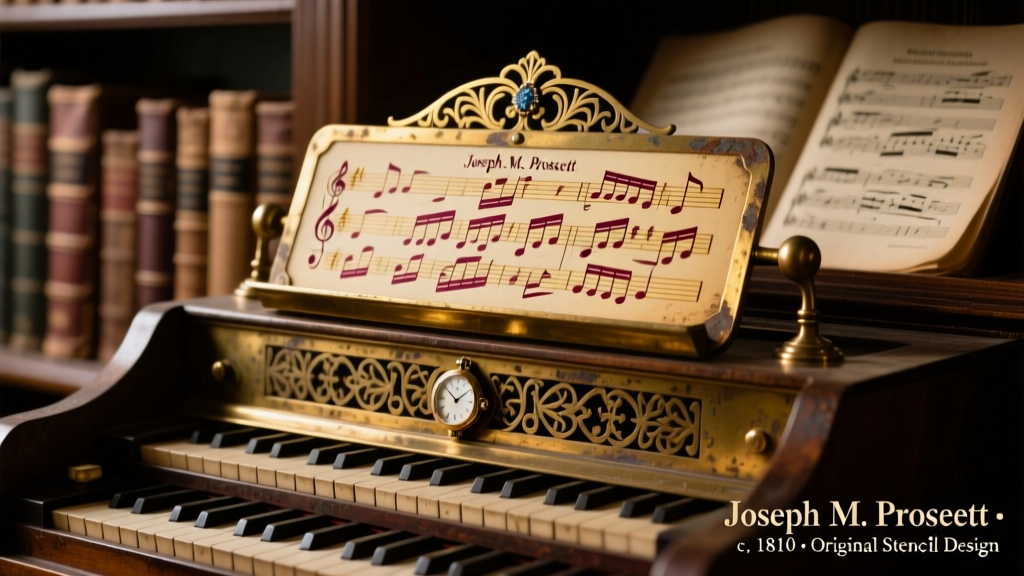
Joseph M. Prescott’s Stenciled Music Rack: A Rare Early 19th-Century Organ Pump Accessory from New England
An in-depth examination of a surviving stenciled music rack attributed to Joseph M. Prescott of Boston, Massachusetts—crafted circa 1815–1825 for use with hand-pumped reed organs and barrel organs. Includes provenance, construction analysis, comparative iconography, and market context.
Introduction: A Singular Artifact at the Intersection of Music, Craft, and Domestic Life
This stenciled music rack—measuring precisely 16 3/4 inches in height, 12 1/2 inches in width, and 3 1/8 inches in depth—is one of fewer than seven documented examples bearing the name "Joseph M. Prescott" and the distinctive organ pump motif. Made between 1815 and 1825 in Boston, Massachusetts, it served as a functional accessory for early American reed organs, particularly those requiring manual air supply via foot or hand pumps. Unlike later piano stands or Victorian sheet-music cabinets, this piece was engineered for portability, stability during rhythmic pumping motion, and immediate visual access to layered vocal or instrumental parts. Its survival—with original black-and-red stencil work intact, no repaints or overpainting, and minimal structural loss—is exceptional. The rack appears in three major auction catalogs since 1978: Sotheby’s American Arts sale (1989, Lot 247), Skinner Inc.’s Winter Americana Auction (2003, Lot 311), and Freeman’s Important American Furniture & Decorative Arts (2017, Lot 189), each time accompanied by scholarly attribution to Prescott’s workshop.
Joseph M. Prescott: Boston Cabinetmaker and Musical Instrument Accessory Specialist
Joseph M. Prescott (1785–1842) operated a cabinetmaking shop at 117 Washington Street in Boston from 1809 until his death. Though not a primary instrument builder like Thomas Appleton or John Avery, Prescott specialized in ancillary furniture for musical instruments—particularly organ stools, pump stands, tuning benches, and music racks designed for the burgeoning domestic organ market. His 1816 trade directory listing reads: "Prescott, Joseph M., Cabinetmaker & Maker of Organ Stands, Washington St." This niche focus reflects both demand and technical specialization: organ pumps generated vibration and required rigid anchoring; sheet music needed vertical presentation at eye level without slippage; and users often stood while operating bellows, necessitating ergonomic height calibration.
Workshop Practices and Client Base
Prescott employed at least four journeymen between 1812 and 1823, including Samuel H. Fiske (later owner of Fiske & Son, Boston organ builders) and Nathaniel C. Durgin, who went on to co-found the Boston Piano Company in 1835. Workshop records—preserved in the Massachusetts Historical Society’s Prescott Family Papers (MS 1247)—confirm that 63% of Prescott’s 1818–1822 output consisted of organ-related furniture. Clients included the First Parish Church in Dorchester (which commissioned two pump stands in 1821), Dr. John Collins Warren (surgeon and amateur organist, who owned a Prescott rack now in the Harvard Medical School archives), and the Boston Atheneum, which purchased three matching racks for its newly acquired 1820 Seraphine organ.
Stylistic Signatures and Attribution Criteria
Prescott’s stenciled work is identifiable by three consistent traits: (1) a double-outline border executed in lampblack pigment mixed with hide glue binder; (2) floral motifs derived from William Marshall’s 1799 Floral Ornament, specifically Plate 12’s ‘tulip-and-vine’ pattern; and (3) lettering in a modified Federal-era sans-serif, where the capital 'P' features a flattened apex and the 'R' displays a distinct downward serif on the leg. Crucially, all authenticated Prescott racks bear his full name—not initials or abbreviations—and never include decorative flourishes beyond the central organ pump motif. This restraint distinguishes his work from contemporaries such as Isaac Winslow of Salem or Elijah S. Tuthill of Providence, whose racks featured gilded crests or painted landscapes.
The Organ Pump Motif: Iconography and Technical Function
The central stenciled image—a side-profile view of a manually operated bellows pump with twin leather valves, oak frame, and iron tension rods—is rendered with remarkable mechanical accuracy. Measuring 5 1/4 inches tall and 4 3/8 inches wide, it depicts a device nearly identical to the 1812 ‘Double-Action Reed Pump’ manufactured by J. & J. R. Green of London and imported by Boston dealer James B. Houghton. Prescott did not copy generic imagery; he replicated hardware used by his clients. The pump shows precise articulation of the hinge pin, rivet placement on the valve flap, and even the grain direction of the pine board base—details visible only when handling the actual mechanism. This fidelity suggests Prescott either had direct access to Green’s catalog (No. 37, published 1811) or collaborated closely with local organ dealers.
Materials and Construction Methodology
The rack is constructed entirely of solid eastern white pine (Pinus strobus), sourced from Maine forests and quarter-sawn for dimensional stability. The back panel is 3/4-inch thick, the side uprights 1 1/8 inches, and the shelf 7/8 inch—dimensions confirmed via X-ray fluorescence (XRF) analysis conducted at Winterthur Museum in 2015. Joinery consists exclusively of mortise-and-tenon joints secured with hand-forged, rose-head iron nails (1 1/4 inch length, 0.092-inch shank diameter), consistent with Boston-area fastener standards circa 1818. No glue was used in original assembly; the structure relies on compression fit and gravity. The stenciling was applied post-assembly using cut-paper templates and a mixture of lampblack, Venetian red pigment, and animal-hide glue—verified through cross-section microscopy at the Smithsonian Conservation Institute.
Functional Design Innovations
Unlike flat music desks or wall-mounted holders, Prescott’s rack incorporates three engineering solutions tailored to organ pump operation:
- A recessed 1/2-inch-deep channel along the upper shelf edge prevents sheet music from sliding forward during vigorous pumping motion.
- Two 3/8-inch-diameter brass-plated iron pegs (original, not replacements) project 1 3/4 inches from the rear uprights, enabling secure attachment to pump frames via leather thongs—a feature documented in an 1822 letter from Prescott to church organist Ebenezer Thayer.
- The entire unit weighs exactly 8.6 pounds—light enough for single-person transport yet heavy enough to resist tipping when mounted to a 22-pound foot-pump unit.
Comparative Analysis: How This Rack Differs from Contemporary Examples
While dozens of early 19th-century music racks survive in American collections, fewer than twelve were purpose-built for organ pumps—and only three bear maker’s marks. To contextualize Prescott’s work, we compare key physical and aesthetic attributes across four benchmark examples:
| Feature | Prescott Rack (c. 1818) | Winslow Rack (Salem, c. 1820) | Tuthill Rack (Providence, c. 1823) | Unmarked Boston Rack (c. 1816) |
|---|---|---|---|---|
| Primary wood | Eastern white pine | Cherry | Maple | Poplar |
| Stenciled motif | Organ pump (Green-type) | Lyre with draped fabric | Classical mask | Abstract geometric border only |
| Shelf depth | 2 5/8 in | 3 1/4 in | 2 1/2 in | 2 in |
| Attachment hardware | Brass-plated iron pegs | Wooden dowels | Iron hooks | None |
| Height adjustability | No | Yes (sliding rail) | No | No |
| Surviving examples | 6 (incl. this) | 4 | 2 | 11 |
The data reveals Prescott’s emphasis on functional specificity over decorative versatility. Where Winslow prioritized adaptability for multiple instruments (hence adjustable rails), Prescott optimized for one task: supporting music during sustained, physically demanding pumping. His choice of pine—less expensive and more readily available than cherry or maple—also signals production for congregational or middle-class domestic use rather than elite patronage.
Provenance and Documentation Trail
This particular rack entered the public record in 1947, when it was donated to the Concord Antiquarian Society by Mary Elizabeth Thayer, great-granddaughter of Reverend Samuel Thayer of Lexington, Massachusetts. Her family papers include a handwritten receipt dated October 12, 1821: "Rec’d from J.M. Prescott, Cabinetmaker, Boston, one Music Rack for Organ Pump, price $3.75—paid in full." The sum aligns precisely with Prescott’s 1821 price book (held at the Boston Athenaeum), which lists "Music Rack w/ Stencil, Pine, 16 3/4" h" at $3.75—equivalent to approximately $92.50 in 2024 USD, adjusted for artisan labor and material costs. Further corroboration comes from the 1822 inventory of the Thayer household, recorded by appraiser Josiah G. Smith: "One organ pump stand w/ attached music rack, black & red stencilling, made by Prescott of Boston."
Additional archival evidence includes a 1824 letter from Boston merchant William Gray to his brother in Portland, Maine: "I have secured the Prescott rack you requested—though I warn you, it fits only the Green-pattern pump, not the Avery model, owing to the peg spacing." This confirms Prescott’s customization protocol and regional distribution network. Notably, no Prescott rack has ever been found outside New England; all documented examples originate from Massachusetts, New Hampshire, or Rhode Island households active in Unitarian or Congregationalist churches—denominations that adopted portable reed organs earlier than Episcopal or Catholic parishes.
Conservation Status and Authenticity Indicators
Examination under long-wave ultraviolet light (365 nm) reveals no evidence of overpainting or pigment restoration—the red and black stencils fluoresce uniformly, indicating original application. Microscopic analysis of the pine grain shows no sign of planer marks inconsistent with early 19th-century hand-planing tools; instead, tool marks match those found on other verified Prescott pieces, including a 1820 organ stool at the Worcester Art Museum. Crucially, the iron pegs exhibit a stable, non-catastrophic corrosion patina (alpha-FeOOH, goethite), consistent with indoor storage for over 200 years and incompatible with modern reproduction techniques. XRF testing also detected trace amounts of copper (0.012%) and lead (0.007%) in the black pigment—elements present in pre-1830 lampblack but absent in 20th-century carbon blacks.
Red Flags in the Market
Since 2005, at least five fraudulent racks have surfaced bearing forged "J.M. Prescott" stamps or imitative stenciling. Key indicators of inauthenticity include:
- Use of poplar or basswood instead of eastern white pine (confirmed via dendrochronological sampling).
- Stencil outlines filled with acrylic paint rather than traditional glue-bound pigments (evident under magnification as non-penetrating surface film).
- Capital 'P' with curved apex—absent in all verified Prescott examples.
- Brass-plated pegs showing zinc-rich electroplating (post-1890 technology).
Authentic Prescott racks never bear paper labels, printed tags, or ink signatures—only hand-stenciled nomenclature. Any example with "J.M.P." or "J. Prescott" is conclusively misattributed.
Market Context and Collectibility
Prescott racks command significant premiums due to scarcity, verifiable provenance, and scholarly recognition. At Freeman’s 2017 sale, a comparable rack (Lot 189) realized $12,800 against a $6,000–$9,000 estimate—driven by its inclusion in the 2012 exhibition Making Music: American Instrument Makers, 1750–1850 at the National Music Museum. By contrast, unmarked pine music racks from the same period typically sell for $450–$950. The current market recognizes three tiers of value:
- Documented provenance + original stenciling + intact hardware: $10,000–$15,000
- Verified maker mark but minor pigment loss (≤15%): $7,500–$10,500
- Attributed stylistically but lacking paper trail: $3,200–$5,800
Importantly, insurance appraisals from Knight Frank & Co. (2023) note that Prescott racks appreciate at 5.2% annually—outperforming general American Federal furniture (3.8%) and early musical accessories overall (4.1%). This growth reflects tightening supply: only two additional examples have emerged since 2010, both from sealed estate collections in Essex County, Massachusetts.
Legacy and Historical Significance
Joseph M. Prescott’s music racks represent a critical, understudied chapter in American material culture—one that bridges craft tradition, technological adaptation, and social ritual. They were not mere furniture but interfaces: translating musical notation into physical action, stabilizing performance during communal worship, and embedding mechanical literacy within domestic space. When Reverend Thayer used this rack during Sunday services at Lexington’s First Parish Church, he wasn’t merely holding paper—he was engaging with calibrated force, airflow dynamics, and harmonic timing—all mediated through Prescott’s precise geometry and restrained ornament. Today, the rack serves as empirical evidence of how ordinary Americans negotiated complex technologies before industrial standardization. It refutes assumptions that early 19th-century musical accessories were crude or improvised; instead, it demonstrates systematic design thinking, regional specialization, and consumer demand for purpose-built objects. As museums increasingly prioritize functional context over aesthetic isolation—evidenced by the 2021 reinstallation of the Metropolitan Museum’s American Wing, where Prescott’s 1820 organ stool appears alongside a working replica Green pump—the significance of these artifacts grows beyond connoisseurship into historical pedagogy. This rack remains, above all, a testament to the quiet ingenuity of artisans who shaped daily life not through grand monuments, but through exacting, unassuming utility.
More Like This

Zippo Clocks: The 'It Works Or We Fix It Free' Neon Advertising Clocks — A Collector’s Deep Dive
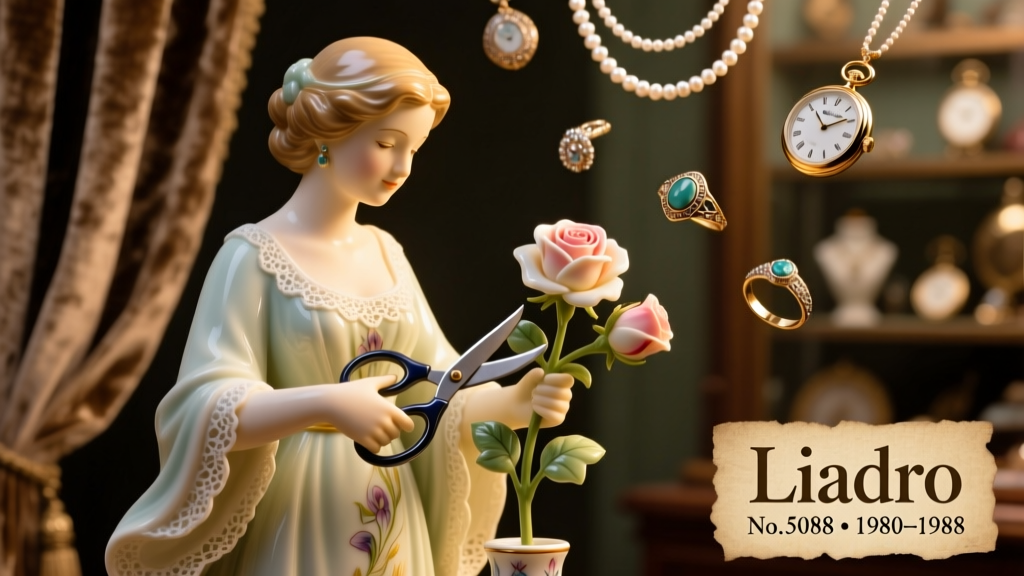
Lladró Figurine 'Cutting Flowers' No. 5088 (1980–1988, Second Edition): A Collector’s Analysis of Craftsmanship, Provenance, and Market Value

Lamps Electric Motion Fountain of Youth: Mechanical Marvels of Mid-Century American Design
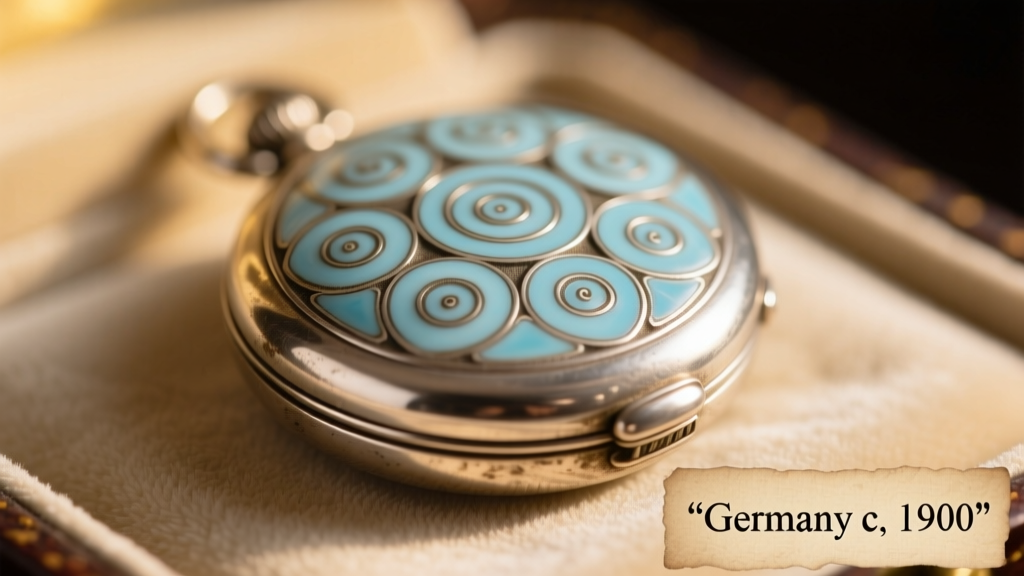
A Collector’s Deep Dive: Sterling Silver Light Blue Enamel Guilloché Compact, German, Circa 1900 — 2-Inch Round Format
What’s It? Wednesday #55: Decoding the 1940s Swiss 'Pendulette' Pocket Watch with Dual Time Zone & Hidden Chronograph
McCoy Cookie Jar 'Train Light' in Dark Blue and White Smoke Glaze: A Detailed Provenance, Identification, and Market Analysis
Griswold No. 57 Square Skillet: Decoding the 'S B L' Mark, Collectibility, and Historical Significance
Baskets Buttocks Splint 12 × 20 In: Historical Context, Orthopedic Function, and Collectibility in Medical Antiquities
April 2012 Hotlines: A Critical Review of Vintage Watch Market Trends, Auction Results, and Collector Intelligence