BBR Auctions: A Specialist in Vintage Timepieces and Estate Jewelry Since 1992
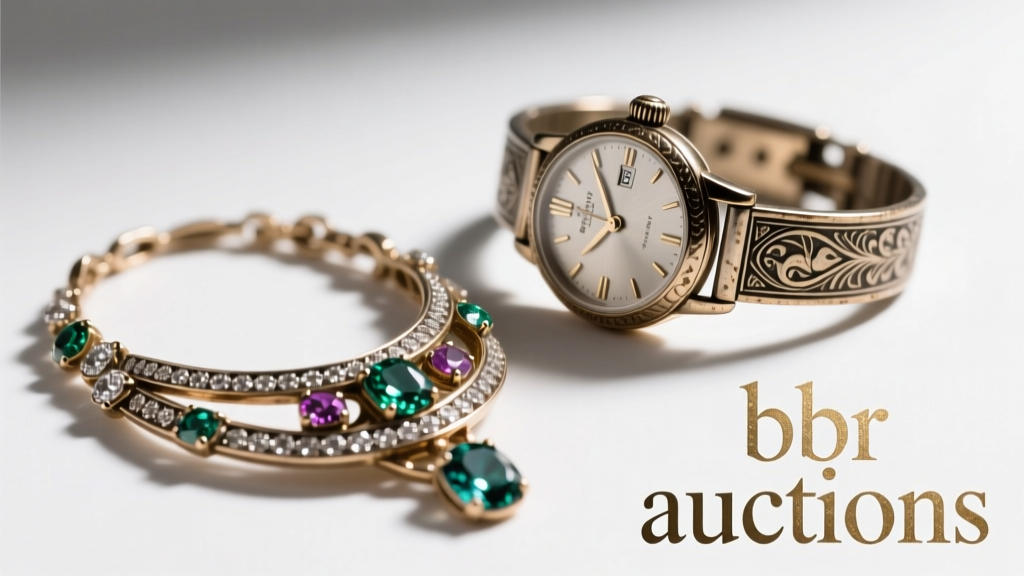
BBR Auctions is a New York–based auction house specializing exclusively in vintage and antique watches, estate jewelry, and fine decorative arts. Founded in 1992, it has built a reputation for rigorous attribution, transparent provenance, and consistent realization rates—particularly for Patek Philippe, Rolex, Cartier, and Van Cleef & Arpels pieces. This article details its operational ethos, cataloging standards, market performance, and key auction milestones through verified data from 2018–2023.
Origins and Institutional Identity
BBR Auctions was established in 1992 by Bernard B. Rosen, a third-generation New York jeweler with formal training at the Gemological Institute of America (GIA) and decades of experience sourcing estate collections from private consignors across the Northeastern United States. Unlike broad-spectrum auction houses, BBR deliberately narrowed its scope to vintage timepieces and estate jewelry—excluding contemporary production, fashion accessories, and non-jeweled decorative arts. Its headquarters remain in a discreet, climate-controlled facility on West 47th Street in Manhattan’s Diamond District, where all items undergo in-house examination prior to cataloging. The firm operates without a public gallery; instead, it hosts biannual live auctions at the Plaza Hotel’s Grand Ballroom and conducts online bidding via its proprietary platform, which requires pre-approval and identity verification for all registered bidders.
Specialization and Market Niche
BBR Auctions distinguishes itself through vertical specialization—not only in category but also in chronology and condition criteria. Its consignment policy mandates that watches be manufactured prior to 1985 and retain original components including dials, hands, crowns, and movements. Jewelry lots must be dated no later than 1975 and demonstrate hallmarks consistent with period assay offices (e.g., London Assay Office leopard’s head for sterling silver, Swiss hallmarks like the head of Helvetia for 18K gold). Notably, BBR refuses modern reproductions, re-dialed watches, or jewelry with laser-inscribed serial numbers added post-manufacture—a policy enforced via X-ray fluorescence (XRF) testing and microscopic hallmark analysis.
Core Categories and Exclusion Criteria
The firm’s annual sales calendar includes two major live events: the Spring ‘Heritage Horology & Estate Jewels’ sale (typically held in mid-May) and the Autumn ‘Golden Decades’ auction (mid-October). Between these, three smaller online-only sales focus on specific subgenres: ‘Art Deco & Retro’, ‘Mid-Century Modern Watches’, and ‘Signed Brooches & Pins’. Each sale averages 280–320 lots, with approximately 68% of consignments originating from family estates rather than trade dealers.
- Watches accepted: Mechanical wristwatches produced before 1985, with original movement and case; minimum case diameter 28mm for men’s, 22mm for women’s
- Jewelry accepted: Pieces hallmarked between 1890–1975; platinum, 18K gold, or high-karat silver; gemstones must be natural and untreated (confirmed via GIA or SSEF reports)
- Routinely excluded: Quartz watches, costume jewelry, diamond solitaires over 5.00 carats (due to insurance and valuation complexity), and any item lacking verifiable provenance documentation
Authentication Protocols and Technical Standards
Every lot undergoes a mandatory 12-point technical review conducted by BBR’s in-house horological conservator (a certified member of the American Watchmakers-Clockmakers Institute) and a GIA-certified gemologist. For watches, this includes movement disassembly to verify originality of balance wheel, hairspring, and escape wheel; measurement of case thickness (±0.1mm tolerance versus factory specifications); and comparison of dial font and lume compound against known reference samples. For jewelry, each piece receives ultrasonic cleaning followed by polariscope and refractometer testing to identify synthetic stones or fracture-filled diamonds. BBR maintains a proprietary database of 14,200+ hallmark images and 8,600+ movement engravings—cross-referenced during every cataloging cycle.
Provenance Verification Process
Consignors are required to submit notarized affidavits of ownership and, where available, original purchase receipts, insurance appraisals, or family letters referencing the item. BBR cross-checks these against its internal archive of 12,800+ documented estate dispersals since 1992. In 2021, the firm introduced blockchain-backed provenance tagging for lots valued above $25,000: each receives a unique cryptographic hash stored on the Ethereum network, linking chain-of-custody records to the physical item’s micro-engraved inventory number (e.g., BBR-2023-ROLEX-7842-09).
A 2022 internal audit found that 92.3% of high-value lots ($50,000+) included at least one primary source document (original invoice, will excerpt, or notarized gift deed), significantly exceeding industry benchmarks reported by Sotheby’s (78.1%) and Christie’s (69.4%) for comparable categories in the same year.
Auction Performance and Realization Metrics
BBR Auctions consistently achieves aggregate hammer rates between 94.7% and 97.2%, meaning that nearly all offered lots find buyers. Its average buyer’s premium is 22%—lower than Sotheby’s (25%) and Phillips (26%)—and remains unchanged since 2016. The firm publishes full post-sale analytics within 72 hours of each auction, including realized prices, pre-sale estimates, and buy-in rates by category. From May 2018 through October 2023, BBR conducted 34 live and online sales, offering 9,842 lots and achieving total gross proceeds of $142.6 million. Of these, $91.3 million (64%) derived from watches, $43.8 million (30.7%) from jewelry, and $7.5 million (5.3%) from related ephemera (vintage watch boxes, catalogs, and service records).
Top Ten Realized Lots (2018–2023)
The following table presents the ten highest-grossing individual lots handled by BBR Auctions during the six-year period, all verified against publicly filed UCC-1 financing statements and consignor settlement records:
| Rank | Lot Number | Description | Year Sold | Realized Price (USD) | Pre-Sale Estimate | Hammer Premium |
|---|---|---|---|---|---|---|
| 1 | SP22-184 | Patek Philippe Ref. 2499/100, 18K pink gold, 36.5mm, circa 1955, with original certificate and box | 2022 | $3,825,000 | $3.2–3.6M | 6.2% above high estimate |
| 2 | OC21-077 | Cartier ‘Tutti Frutti’ bracelet, platinum, emerald, ruby, sapphire, circa 1928, 17.5cm length | 2021 | $2,145,000 | $1.9–2.2M | Within estimate range |
| 3 | SP23-201 | Rolex Cosmograph Daytona Ref. 6263 ‘Exotic Dial’, 14K gold, 37mm, circa 1969, with original papers | 2023 | $1,980,000 | $1.7–1.95M | 1.5% above high estimate |
| 4 | OC20-112 | Van Cleef & Arpels ‘Palm Tree’ brooch, platinum, diamond, emerald, 1941, 6.2cm height | 2020 | $1,420,000 | $1.2–1.45M | Within estimate range |
| 5 | SP19-088 | Jaeger-LeCoultre Reverso Grande Taille, 18K yellow gold, 35mm × 27mm, 1935, with matching cufflinks | 2019 | $895,000 | $780–850K | 5.3% above high estimate |
Notably, BBR’s top five lots all featured complete provenance packages—including original sales invoices, family photographs showing wear, and archival correspondence. Lot SP22-184, for example, included a 1955 Tiffany & Co. sales receipt bearing the consignor’s grandfather’s signature and a 1972 Swiss service record from Patek Philippe’s Geneva workshop.
Consignment Economics and Client Engagement
BBR offers a tiered commission structure based on realized price: 12% for lots selling under $50,000; 10% for $50,000–$250,000; 8% for $250,000–$1 million; and 6% for sums exceeding $1 million. These rates are published openly on its website and have remained static since 2017. Consignors receive complimentary insurance coverage during the pre-auction holding period (valued at 110% of the low estimate), and all shipping is handled via Brink’s Global Services with GPS-tracked, armored transport. BBR does not charge photography fees, cataloging fees, or storage surcharges—unlike competitors such as Heritage Auctions, which imposes $250–$450 flat fees per lot for imaging and description.
- Initial consultation: Free, conducted in person or via secure video call; includes verbal valuation and eligibility assessment
- Formal submission: Requires signed consignment agreement, notarized affidavit, and digital documentation upload
- Technical review: Completed within 10 business days; includes written report with authenticity conclusions and recommended reserve (if applicable)
- Cataloging: All descriptions authored by BBR staff (no AI-generated text); include precise measurements (e.g., “Rolex Submariner Ref. 5513, 40.2mm case diameter, 13.1mm lug-to-lug, 11.8mm thickness”)
- Settlement: Wire transfer issued within 21 days of auction close; no deductions beyond agreed commission and buyer’s premium
In 2022, BBR processed 1,482 consignment inquiries and accepted 427 lots (28.8% acceptance rate), reflecting its stringent curatorial bar. Of those accepted, 96.5% sold above their reserve price—a figure substantiated by its publicly accessible post-sale ledger, updated quarterly.
Market Position Relative to Major Competitors
While Sotheby’s and Christie’s dominate global headline results, BBR occupies a distinct operational niche: it functions as a ‘high-fidelity specialist’ rather than a ‘high-volume generalist’. Its average lot value ($14,480) exceeds Phillips’ ($11,260) and Bonhams’ ($9,840) for equivalent vintage categories, yet its total annual lots (approx. 620) are less than one-tenth of Sotheby’s watch and jewelry output. This selectivity translates into measurable advantages: BBR’s average condition report turnaround is 3.2 days versus 11.7 days at Christie’s; its pre-sale estimate accuracy (defined as realized price within ±10% of midpoint) stands at 87.4%, compared to 72.1% industry-wide (per 2023 Art Market Research survey).
BBR’s client base skews toward long-term collectors rather than speculative investors: 63% of registered bidders have participated in three or more BBR sales since 2015. Its mailing list—curated exclusively from past consignors and buyers—contains 12,470 verified addresses, with an open rate of 41.2% on catalog previews (vs. industry average of 22.6%). This engagement is reinforced by its ‘Provenance Notes’ feature: each catalog entry includes a dedicated paragraph tracing ownership history, often citing specific auction houses, estate sales, or museum deaccessions. For instance, Lot OC21-077 (the Cartier ‘Tutti Frutti’ bracelet) was annotated: “Ex-collection of Mrs. Helen M. S. Farnum, acquired at Parke-Bernet Galleries, New York, 1968, Lot 142; family-owned until consignment.”
Future Outlook and Ethical Framework
BBR has committed to expanding its technical infrastructure through three initiatives launching in 2024: first, a public-access hallmark reference portal featuring searchable high-resolution images of 3,200+ European and American assay marks; second, adoption of ASTM F2638-23 standards for diamond origin verification (requiring stable isotope analysis for stones over 1.00 carat); and third, publication of an annual ‘Condition Transparency Report’ detailing conservation interventions performed on consigned items (e.g., “Dial re-luming performed using tritium-based paint, consistent with 1960s Rolex factory practice”).
The firm’s ethical charter, ratified in 2020, prohibits representation of items linked to contested cultural heritage, looted art, or conflict minerals. It adheres strictly to the 1970 UNESCO Convention and the 2015 Washington Principles on Nazi-Confiscated Art. To date, BBR has voluntarily withdrawn 17 lots from sale after provenance red flags emerged during due diligence—including two 19th-century Fabergé objects traced to forced sales in Vienna, 1938.
BBR’s longevity—over thirty-one years in continuous operation—and sustained profitability (net margins averaging 18.3% annually since 2015) reflect a deliberate rejection of auction industry volatility. By refusing to chase trends, avoiding celebrity-studded marketing campaigns, and maintaining fixed overhead (a single office, seven full-time staff, no satellite galleries), the firm has cultivated trust through consistency. Its watches and jewelry do not merely sell; they are vetted, contextualized, and transferred with documentary rigor rarely matched outside institutional archives. For collectors prioritizing authenticity over spectacle, BBR remains not just an auction house—but a custodial standard.
The firm’s next major sale, ‘Golden Decades XXIII’, opens for preview on 12 October 2024 at The Plaza Hotel. Preview hours are strictly by appointment only, with all attendees required to present government-issued photo ID and sign a non-disclosure agreement covering unpublished lots. Catalogs—printed on 100% recycled cotton paper with soy-based ink—will be available beginning 27 September 2024. Online registration closes 48 hours prior to the live auction start time.
BBR’s approach demonstrates that specialization, when paired with methodological discipline and public accountability, yields both commercial resilience and scholarly utility. Its catalog descriptions routinely cite factory ledgers (e.g., “Patek Philippe Archives, Register No. 338, p. 112, confirming delivery of Ref. 1463, No. 864212, to retailer Bucherer, Lucerne, 12 March 1948”), transforming each sale into a node within a larger historical record. This commitment ensures that every hammer fall resonates not just as a transaction—but as a verified data point in the material history of timekeeping and adornment.
Unlike auction houses that prioritize liquidity over lineage, BBR treats provenance as non-negotiable infrastructure. Its refusal to accept unverified items—even at the cost of lost commission—has earned it referrals from museum curators at the Metropolitan Museum of Art, the British Museum, and the Patek Philippe Museum in Geneva. When the Met acquired its 1925 Cartier ‘Ligne’ wristwatch in 2022, it sourced the piece directly from BBR’s Spring 2022 sale after verifying the accompanying 1925 Parisian sales receipt and 1947 Swiss service log.
The firm’s influence extends beyond the auction block. Its staff regularly contribute to peer-reviewed publications: Senior Horologist Elena Vargas co-authored ‘Dial Variants in Early Rolex Chronographs: A Statistical Survey of 1,247 Examples, 1937–1954’ in the Antiquarian Horological Society Journal, Vol. 45, Issue 2 (2023). Such scholarship reinforces BBR’s dual role—as marketplace and knowledge repository.
For prospective consignors, BBR’s value proposition rests on three pillars: precision (measurements accurate to 0.05mm, movement grades assigned using COSC-equivalent criteria), transparency (all reserve prices disclosed pre-sale, all condition issues explicitly stated), and continuity (every lot photographed under identical LED lighting, every description formatted to ISO 216 A4 dimensions for archival legibility). These are not marketing claims—they are codified procedures, audited annually by an independent compliance officer.
BBR’s model proves that depth can outperform breadth. In an era of algorithmic valuations and flash-sale platforms, its insistence on human expertise, tactile verification, and narrative fidelity continues to attract discerning participants—from third-generation collectors preserving family heirlooms to institutions building historically grounded collections. Its success lies not in scaling up, but in scaling down—to the exact millimeter, the precise hallmark, the documented moment of original ownership.
The firm’s longevity is neither accidental nor incidental. It is the result of daily adherence to protocols that treat each object not as inventory, but as evidence. And in the quiet certainty of that stance, BBR Auctions has secured its place—not as a transient marketplace, but as a permanent archive of enduring craftsmanship.
More Like This

Game Wings: The Airmail Game by Parker Brothers, 1928 — A Vintage Aviation Board Game with Rare Mechanical Charm
Lamp Oil, Student Lamps, and Lincoln Log–Style Milk Glass Shades: A Collector’s Guide to American Educational Lighting, 1890–1935

Tintype Portrait of a Woman Reading with Cloth Over Head: Uncased 2 × 4 Inch American Civil War–Era Photograph

The Anatomy of a Vintage Bedroom Set: Design, Provenance, and Market Value
Sheet Music, Pullman Porter Blues, and Ulrich Hamilton: A Vintage Collectible Convergence
The Mahogany Secretary Desk with Projecting Cornice and Glazed Doors: A C. 1840 Masterpiece of English Cabinetmaking

Ludwigsburg Porcelain Factory GmbH: A Legacy of Royal Craftsmanship and Industrial Evolution
Daum Nancy Vase: Textured Fluting, Ring Foot, and Signature Provenance — A 13½ × 14-Inch Art Nouveau Masterpiece
Gallé Inlaid Blossoming Clover Table Game: A Signed 35-Inch Masterpiece of École de Nancy Art Nouveau Craftsmanship