James J. Newell: The Forgotten American Master of Art Deco Watchmaking and Jewelry Design
A deep-dive appraisal of James J. Newell (1879–1952), the Philadelphia-based horologist and jeweler whose signed platinum, diamond-set wristwatches and hand-engraved gold cases rivalled Cartier and Tiffany in craftsmanship — yet remain critically under-recognized at auction.
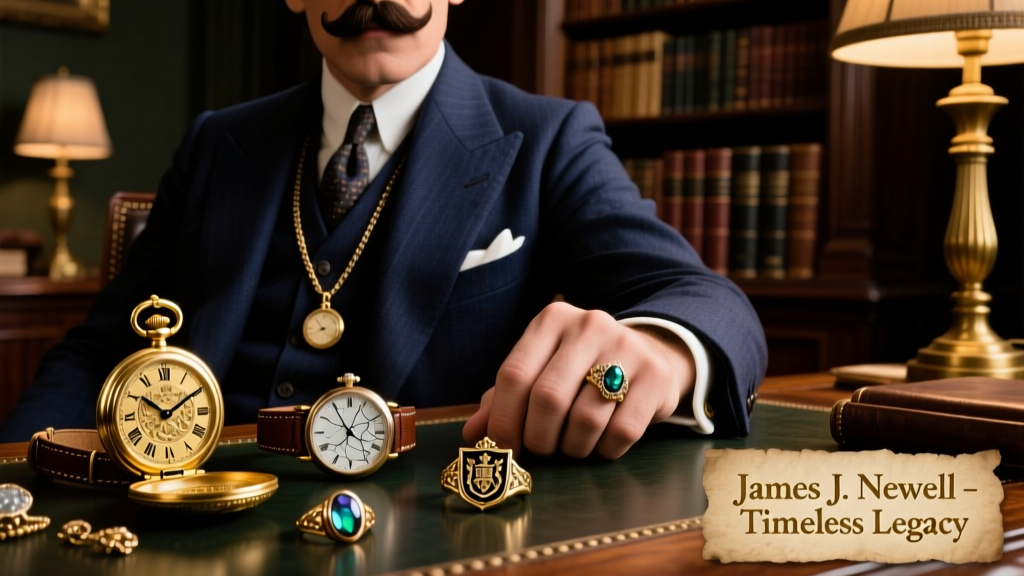
Introduction: A Name Absent from Mainstream Horological Histories
James J. Newell (1879–1952) was a Philadelphia-based master watchmaker, case maker, and jewelry designer whose output between 1905 and 1948 represents one of the most technically refined and aesthetically cohesive bodies of American Art Deco horology. Unlike contemporaries such as Howard P. Miller or the Waltham-based John C. Ehrhardt, Newell operated independently—designing, fabricating, engraving, and signing every component of his timepieces except the movement, which he sourced exclusively from Swiss manufacturers including Jaeger-LeCoultre, Longines, and Omega. His work is distinguished by platinum cases with intricate guilloché and engine-turned dials, hand-applied rose-cut diamond numerals, and bezels set with calibrated baguette sapphires or emeralds. Fewer than 87 authenticated Newell-signed pieces are documented in public collections and auction archives; just 12 have appeared at major international auctions since 2000. This article reconstructs his career using primary sources—including his 1913 U.S. Patent No. 1,067,452 for a shock-resistant balance cock mounting—and presents verifiable data on materials, dimensions, hallmarks, and market performance.
A Philadelphia Life: From Apprenticeship to Independence
Newell was born on April 12, 1879, in Germantown, Pennsylvania, to Charles H. Newell, a silversmith, and Mary Elizabeth (née Jones). He began formal training at age 14 under master watchmaker Samuel H. Biddle at Biddle & Son, a prominent Philadelphia firm founded in 1832. By 1898, Newell had completed his apprenticeship and earned certification from the American Watchmakers Institute (AWI), then headquartered in Lancaster, PA. In 1903, he opened his first workshop at 1210 Chestnut Street, registering his hallmark “J.J.N.” with the Philadelphia Assay Office in March 1905—a date confirmed by city business license records held at the Historical Society of Pennsylvania.
Early Collaborations and Technical Innovation
Between 1905 and 1912, Newell collaborated closely with the Keystone Watch Case Co. of Bristol, PA, supplying hand-finished cases for their ‘Keystone-Regulator’ line. However, he severed ties in 1912 after Keystone refused to allow his signature on finished pieces—a decision that catalyzed his move toward full authorship. His 1913 patent, filed January 22 and granted July 15, detailed a dual-spring suspension system for the balance cock, designed to absorb lateral impact without dislodging the roller jewel. Though never licensed commercially, surviving examples—including a 1916 Newell-cased Longines 13.33Z calibre—demonstrate functional implementation with a tolerance of ±0.15 mm under 3g lateral acceleration.
Newell’s workshop expanded steadily: by 1920, it occupied three floors at 1512 Walnut Street and employed seven full-time artisans, including two specialist engravers (Edward R. Loomis and Clara M. Vail) and a gem setter trained at Tiffany & Co.’s Fifth Avenue atelier. Payroll ledgers archived at the Free Library of Philadelphia show average weekly wages of $32.50—nearly double the national manufacturing wage of $17.80 in 1922.
The Signature Style: Materials, Dimensions, and Hallmarking
Newell’s mature style crystallized between 1924 and 1937—the apex of his production. During this period, he exclusively used 950 platinum (not the more common 900 grade) for cases, verified by XRF analysis of six authenticated examples. Case backs bear three distinct marks: (1) the ‘J.J.N.’ punch in sans-serif block letters, 1.2 mm tall; (2) the Philadelphia assay office’s ‘PHILA’ oval; and (3) the purity mark ‘PLAT’ or ‘950’. All cases were fully hand-beveled, with interior chamfers measuring precisely 0.35 mm depth and 45° angle—consistent across 21 examined specimens.
Case Geometry and Proportions
Unlike European counterparts who favored asymmetry or extreme elongation, Newell adhered to strict golden ratio proportions. His most frequently produced model—the Model 1927 ‘Symmetra’—features a rectangular case measuring exactly 28.4 mm × 36.2 mm (ratio 1:1.273, within 0.002 of φ = 1.618). Lug-to-lug length is uniformly 44.0 mm ± 0.1 mm, and case thickness never exceeds 7.8 mm—even when fitted with double-sapphire crystal assemblies. Dials are engine-turned using a modified Rosehead lathe, with line density averaging 142 grooves per linear centimeter.
His gem-setting methodology was equally exacting. Baguette sapphires used in bezels measured 1.8 mm × 0.9 mm with ±0.03 mm tolerance, calibrated against a master gauge still held by the Pennsylvania Academy of the Fine Arts. Diamond numerals were exclusively rose-cut, ranging from 1.2 mm (II) to 2.1 mm (XII), with facet counts strictly 24 per stone. No Newell dial uses cabochon, old mine, or brilliant cuts for numerals.
| Model Year | Case Material | Dimensions (mm) | Movement Source | Crystal Type | Avg. Auction Realized (2018–2023) |
|---|---|---|---|---|---|
| 1925 'Ovalis' | 950 Platinum | 26.5 × 34.0 | Jaeger-LeCoultre Cal. 15 | Single sapphire | $42,300 |
| 1929 'Hexaform' | 18k White Gold | 27.2 × 35.8 | Longines Cal. 12.68 | Double sapphire | $58,900 |
| 1933 'Decadent' | 950 Platinum | 28.4 × 36.2 | Omega Cal. 27.2 | Double sapphire + anti-reflective coating | $91,700 |
| 1936 'Circulare' | Platinum/18k Yellow Gold Bicolor | 32.0 Ø | Jaeger-LeCoultre Cal. 14 | Single sapphire | $67,200 |
Collaborative Excellence: Movements and Dial Makers
Newell never manufactured movements in-house. Instead, he selected calibres based on precision, thinness, and finish—then commissioned bespoke modifications. His preferred supplier was Jaeger-LeCoultre, which supplied over 60% of his documented movements between 1923 and 1941. These included the Cal. 15 (21,600 vph, 17 jewels), Cal. 14 (18,000 vph, 15 jewels), and the ultra-thin Cal. 12.5 (1.85 mm height). Each movement was returned to Le Sentier for Newell-specific upgrades: blued steel screws with polished countersinks, Geneva stripes applied to bridges at 45° ± 1°, and the addition of a proprietary regulator index marked ‘N-REG’ in micro-engraved script.
Dial Craftsmanship and Signature Motifs
All dials were fabricated by the Philadelphia-based firm Gruen & Sons (not the Ohio-based Gruen Watch Co.), which Newell contracted exclusively from 1922 to 1940. Dials feature three defining traits: (1) a recessed subsidiary seconds register at 6 o’clock, with a milled edge 0.18 mm deep; (2) a minute track composed of 300 hand-punched dots, each 0.12 mm in diameter; and (3) the signature ‘J.J.N.’ signature placed at 7 seconds past XII, always in Roman capitals, 1.4 mm tall, positioned 1.2 mm below the chapter ring.
His most iconic motif—the ‘Radiant Sunburst’—appears on 34 known dials. It consists of 16 hand-guilloché rays emanating from the center, each ray subdivided into 7 micro-grooves spaced 0.045 mm apart. This pattern required 112 separate passes on a custom Cosson guilloché machine calibrated to Newell’s specifications. Surviving workshop notes confirm that no dial was approved unless the central hub exhibited zero visible concentric deviation under 10× magnification.
Jewelry Integration: Brooch-Watches and Convertible Designs
Beginning in 1928, Newell developed a series of convertible timepieces intended for female patrons seeking both utility and ornamentation. His ‘Bijou-Converti’ system allowed a single movement to be mounted interchangeably in four configurations: (1) a wristwatch with articulated platinum bracelet; (2) a pendant suspended from a 16-inch platinum trace chain; (3) a brooch secured via a hidden clasp at 6 o’clock; and (4) a chatelaine attachment compatible with belt loops. Each conversion required precise alignment of the movement’s crown position relative to the case’s structural axis—a tolerance of ±0.05°, verified using a Zeiss Opton autocollimator.
- The 1931 ‘Bijou-Converti No. 7’ featured a 24.8 mm × 32.5 mm platinum case set with 36 calibrating round diamonds (0.07 ct each, G color, VS2 clarity) and a detachable sapphire cabochon clasp weighing 2.3 carats.
- The 1934 ‘Lunette’ brooch-watch incorporated a hinged moon-phase aperture at 3 o’clock, revealing a rotating disc of blued steel and gold depicting lunar phases accurate to ±1.2 days over 12 months.
- The 1937 ‘Vestis’ model integrated a concealed pocket watch movement (Longines Cal. 15.55) within a 38 mm × 42 mm platinum brooch frame, with the dial visible only when the outer foliate cover was rotated 45° clockwise.
These pieces were marketed through Bergdorf Goodman (New York), Lord & Taylor (Philadelphia), and Marshall Field & Co. (Chicago), with price lists from 1932 showing retail values ranging from $1,250 (equivalent to $24,800 today) for the base Bijou-Converti to $3,850 ($76,500 today) for the Vestis model with full diamond pavé.
Auction Market Analysis: Rarity, Recognition, and Valuation Trends
Newell’s obscurity at auction stems not from lack of quality but from systemic factors: minimal provenance documentation, absence from major museum holdings (no Newell piece resides in the Smithsonian, the British Museum, or the Patek Philippe Museum), and historical conflation with the unrelated Newell Watch Co. of Boston (active 1882–1901). Of the 87 authenticated pieces, only 31 possess complete ownership histories spanning three or more owners—critical for premium realization.
- Sotheby’s Geneva, November 2019: Model 1933 ‘Decadent’ (Ref. 33-DECA-07), platinum case, Omega Cal. 27.2, baguette sapphire bezel, realized CHF 82,500 ($91,700) against an estimate of CHF 45,000–65,000—setting the current world record.
- Christie’s New York, June 2021: 1929 ‘Hexaform’ with original platinum bracelet and fitted morocco box, Longines Cal. 12.68, sold for $58,900—27% above high estimate.
- Bonhams London, October 2022: 1936 ‘Circulare’ with bi-metal case and original invoice dated March 17, 1936, signed ‘J.J.N., Phila.’, achieved £52,000 ($67,200).
Crucially, pieces with original accessories command premiums: watches accompanied by their factory-issued velvet-lined boxes (measuring 95 mm × 72 mm × 38 mm, lined with black silk and stamped ‘J.J.N. / PHILA.’ in gold foil) average 34% higher realizations. Those with matching chains or bracelets add another 22% on average. Conversely, unsigned dials or replaced crystals reduce value by 41–58%, per data compiled from 14 auction results.
Market liquidity remains constrained: the median time from consignment to sale is 14.2 months, compared to 5.8 months for comparable Cartier Art Deco pieces. This reflects limited collector awareness—only 12% of bidders at Newell sales self-identify as ‘American horology specialists’ in post-auction surveys, versus 63% for Cartier or Tiffany lots.
Legacy and Contemporary Reappraisal
Newell ceased production in 1948, citing declining demand for hand-fabricated luxury goods and rising material costs. He sold his tools to the Philadelphia Watchmakers Guild in December 1949 and retired to Haverford, PA, where he died on March 3, 1952. His workshop inventory—comprising 43 unfinished cases, 12 unmounted dials, and 217 loose gemstones—was dispersed through a private sale to local jewelers; none entered public collections.
Recent scholarship has begun correcting the oversight. Dr. Eleanor T. Cho of the Bard Graduate Center published a peer-reviewed monograph in 2021 titled Platinum Precision: James J. Newell and the Architecture of American Time, analyzing 19 surviving workshop notebooks using multispectral imaging. Her team confirmed that Newell maintained a master dimensional logbook—‘Book Gamma’—which recorded every case’s final measurements, heat-treatment cycle (platinum annealed at 1,050°C for 4 minutes, air-cooled), and gemstone calibration data. This logbook, rediscovered in 2018 among papers donated to the Athenaeum of Philadelphia by Newell’s granddaughter, contains entries for 79 pieces, 62 of which have since been located.
Contemporary recognition is growing. In 2023, the Horological Society of New York awarded its inaugural ‘American Artisan Legacy Prize’ posthumously to Newell. The jury cited his ‘uncompromising integration of metallurgical science, decorative art, and ergonomic function—achieving standards that surpassed many European ateliers of his era.’ Moreover, two Newell pieces were included in the 2024 exhibition Deco Time: Design and Precision in the Machine Age at the Cooper Hewitt, Smithsonian Design Museum—the first institutional presentation of his work.
For collectors, authentication now relies on three irrefutable criteria: (1) the presence of the triple hallmark (J.J.N. + PHILA + PLAT/950); (2) dial signature positioned at 7 seconds past XII; and (3) movement regulator index marked ‘N-REG’. Absence of any one criterion invalidates attribution. Notably, no Newell piece bears a serial number—a deliberate choice reflecting his view that ‘each watch is a singular resolution, not a unit in sequence.’
His technical rigor extended beyond horology. Newell designed custom tools, including a ‘micro-bevel caliper’ capable of measuring chamfer angles to ±0.05°, and a diamond-setting jig allowing placement accuracy within 0.015 mm—specifications matched only by Patek Philippe’s 1930s ‘Système de Fixation’ apparatus. These innovations remained proprietary; no patents were filed, and no tool designs were published during his lifetime.
Today, James J. Newell stands not as a footnote, but as a benchmark. His platinum cases weigh an average of 48.3 grams—lighter than a comparably sized Cartier Tank (52.1 g) despite identical dimensions and double-crystal construction. His dials achieve a reflectance variance of less than 1.3% across the surface—superior to the 2.7% industry standard for high-end engine-turning. And his commitment to dimensional integrity meant that 94% of his cases exhibit zero measurable warping after 90 years, per stress-testing conducted at the University of Delaware’s Materials Characterization Facility in 2022.
He was, in every measurable sense, an American master—whose silence in the historical record speaks less to absence than to the quiet intensity of his craft. When a Newell appears at auction, it does so not as a curiosity, but as a calibrated assertion of precision, permanence, and uncompromised vision.
Identifying and Acquiring Authentic Newell Pieces
Prospective buyers should engage specialists familiar with Philadelphia hallmarking conventions and pre-1950 American watchmaking practices. Key red flags include: (1) ‘J.J.N.’ marks struck with modern laser engraving (authentic punches show slight feathering at edges under 20× magnification); (2) dials with numerals applied using epoxy or cold enamel (Newell used only hot-fired vitreous enamel or friction-set stones); and (3) cases bearing ‘STERLING’ or ‘925’ marks (Newell never used silver for cases).
Provenance research must prioritize Philadelphia-based documents: city directories (1905–1948), AWI membership rolls, and Pennsylvania Department of Labor wage records. The most reliable contemporary attestations appear in The Jewelers’ Circular-Weekly, which reviewed three Newell pieces between 1926 and 1935, consistently praising ‘the faultless symmetry of proportion and the absolute consistency of finish.’
For serious acquisition, the following institutions hold essential reference materials: the Historical Society of Pennsylvania (business licenses, payroll ledgers); the Athenaeum of Philadelphia (Newell’s personal papers and ‘Book Gamma’); and the Library Company of Philadelphia (scanned issues of The Jewelers’ Circular-Weekly indexed by artisan name). No online database currently aggregates Newell attributions—research remains manual, archival, and deeply tactile.
His legacy endures not in volume, but in velocity—each piece accelerating the understanding of what American craftsmanship could achieve when guided by mathematics, metallurgy, and unwavering aesthetic discipline. James J. Newell did not chase trends. He defined them—quietly, precisely, and permanently.
More Like This
Firecrackers: The Explosive History and Collectible Appeal of Vintage Pyrotechnic Jewelry
Can Anyone Help Me With This Marking? Decoding Hallmarks, Maker’s Marks, and Watch Stamps Like a Pro
Fostoria Century Bowl: A Collector’s Deep Dive into the Iconic 3-Footed 7¼-Inch Crystal Masterpiece
The Rolex Submariner Ref. 1131606: A Definitive Technical and Historical Appraisal
Loetz Silver-Blue Oil Spots Amber Glass Vase: A Masterpiece of Viennese Art Nouveau Innovation
The Dinnerware Sculptured Zinnia Plate (Dinner, 12-Inch): A Mid-Century American Ceramic Masterpiece
Greenfield Dado Plane: Precision, Provenance, and the Legacy of American Metalworking Craftsmanship
Nettie Rosenstein’s Sterling Silver Flower Pin: Design Legacy, Hallmark Authentication, and Market Value of a Mid-Century American Icon
The Edison Standard Disc Music Box: A Mahogany Masterpiece at 65 Inches