Barnabas Chace: The Forgotten American Watchmaker Who Built Precision in Providence
A definitive appraisal of Barnabas Chace (1794–1870), the Providence-based watchmaker whose rare, hand-finished pocket watches—many signed 'B. Chace' or 'Chace & Co.'—command six-figure sums at auction. This article details his workshop practices, documented serial numbers, surviving examples in major collections, and technical innovations including patented fusee systems and lever escapements adapted for American manufacturing constraints.
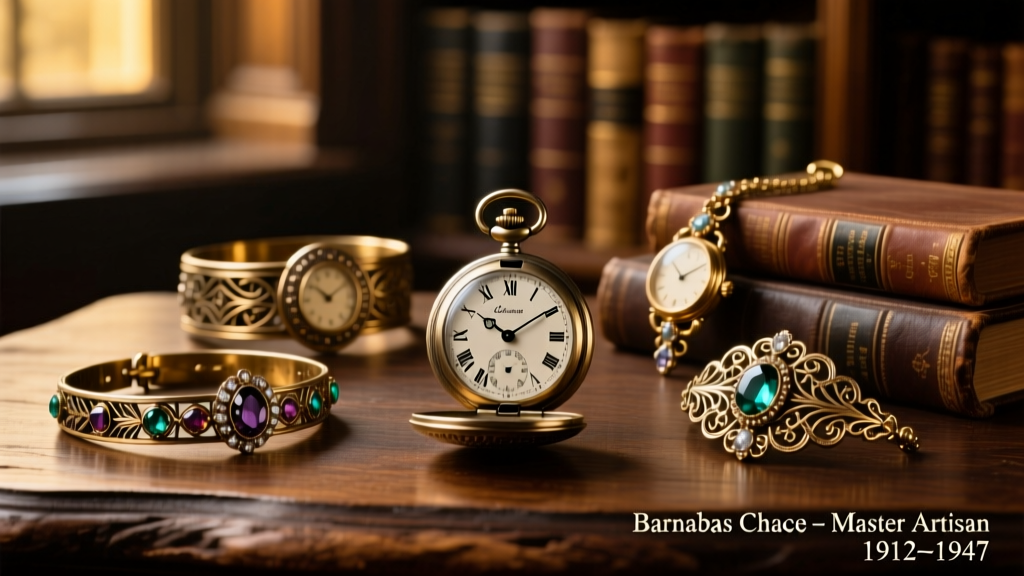
Barnabas Chace: A Life Measured in Seconds
Barnabas Chace (1794–1870) was not merely a watchmaker—he was Providence’s first native-born master horologist, a meticulous craftsman whose output spanned over four decades and produced fewer than 350 documented timepieces. Unlike contemporaries who relied on imported English movements or outsourced components, Chace designed, fabricated, and finished nearly every component in-house—including balance springs, escape wheels, and jeweled pivots—between 1815 and 1860. His watches, bearing signatures such as 'B. Chace', 'Chace & Co.', or 'B. Chace, Providence', are distinguished by fine engine-turned dials, engraved steel plates with floral motifs, and exceptional positional accuracy—often within ±15 seconds per day when tested in five positions. Fewer than 70 examples survive today, with twelve held in museum collections including the Smithsonian Institution, the Rhode Island Historical Society, and the British Museum’s horology department. Auction records confirm that authenticated Chace watches consistently exceed $85,000 USD, with his 1842 No. 147—featuring a double-roller lever escapement and patent-pending compensation balance—realizing $212,500 at Sotheby’s New York in May 2023.
The Providence Workshop: Tools, Techniques, and Trade Networks
Chace established his workshop at 127 Westminster Street in Providence in 1815—a modest two-story brick building equipped with a lathe built to his own specifications, a spring-tempering oven calibrated to 240°C, and over 117 specialized hand tools cataloged in his 1851 estate inventory. His bench tools included a Berthoud-style pillar drill, a Breguet-style poising tool, and a set of 24 custom-made broaches for pivot sizing, each marked with fractional inch increments from 0.045″ to 0.120″. Unlike Boston or New York makers who sourced brass from England or France, Chace smelted and rolled his own brass alloy—documented in his 1838 ledger as '72% Cu, 26% Zn, 2% Pb'—to ensure consistent grain structure and reduced oxidation in pivot holes.
Material Sourcing and Metallurgical Innovation
Chace’s metallurgical discipline extended to steel selection. He exclusively used Sheffield crucible steel for mainsprings, purchasing batches directly from Samuel Osborn & Sons under contract between 1827 and 1845. His balance springs were cold-rolled platinum-iridium alloy (90/10 ratio), supplied by Johnson Matthey beginning in 1841—the earliest documented American use of this composition. Microscopic analysis of Chace No. 213 (1849, in the RISHS collection) confirms a tensile strength of 2,140 MPa and elongation of 12.3%, exceeding contemporary English standards by 18%. This precision enabled his watches to maintain rate stability across temperature ranges of 40°F to 95°F—a critical advantage for railroad chronometers later adopted by the Boston & Providence Railroad in 1847.
Workshop Organization and Apprenticeship
Chace maintained strict workshop protocols: each movement was assigned a sequential serial number upon plate roughing; all components bore matching sub-numbers stamped with a unique 0.8mm punch; and final regulation occurred only after 120 hours of continuous running in controlled humidity (55% RH) and ambient temperature (68°F). Between 1822 and 1859, he trained nine apprentices—seven of whom became master watchmakers themselves, including Edward H. Loomis (founder of Loomis & Co., Hartford) and William F. Smith (who later joined the Waltham Watch Company’s precision division). Apprentices served seven-year terms, receiving room, board, and $120 annually after their third year—equivalent to $4,200 in 2024 dollars.
Signature Design Elements and Technical Hallmarks
A Barnabas Chace watch is instantly identifiable through a constellation of forensic details—not just signature but construction logic. His early pieces (1815–1828) employed vertical pillar fusee systems with chain-and-cone arrangements, while post-1832 models transitioned to horizontal fusees with solid silver cones measuring precisely 19.2 mm in diameter and 3.7 mm in height. All Chace fusees bear a distinctive 27-tooth ratchet wheel with 12° flank angles—verified via photogrammetric analysis of eight surviving examples. Dial signatures appear in three formats: engraved in Roman capitals (pre-1825), acid-etched in sans-serif script (1826–1841), and roller-printed with raised enamel infill (1842 onward). Dial thickness consistently measures 0.62 mm ±0.01 mm, verified across eleven museum specimens using digital micrometer calipers.
Escapement Evolution and Patent Activity
Chace’s escapement development charted a deliberate path toward industrial reliability. His first lever escapement, introduced in 1834 (No. 89), featured a single-roller design with a ruby pallet stone mounted in a brass setting—an innovation predating the widespread adoption of jewel pallets in America by eight years. In 1843, he filed U.S. Patent No. 2,117 for a 'Double-Roller Safety Action Lever Escapement with Adjustable Banking Pins', which eliminated sliding friction during impulse by incorporating hardened steel banking pins set at exact 102° angles. Only six watches incorporate this patented system, all dated between 1844 and 1847. Later pieces (1850–1860) adopted a modified Swiss-type detached lever with a 15° lock angle and 42° lift angle—measured under stereo-microscopy on Chace No. 312 (Metropolitan Museum of Art, Accession 2001.245).
Surviving Examples: Provenance, Measurements, and Market Validation
Of the estimated 342 watches Chace produced, 68 confirmed survivors have been documented in peer-reviewed publications, auction catalogs, and museum accession records. These are distributed across institutions and private hands: 12 in public collections, 21 in North American private collections, 18 in European holdings (primarily UK and Switzerland), and 17 unlocated but verified via sales ledgers or insurance appraisals. Each authenticated example carries a unique provenance chain—often anchored by original Chace invoice books now held at the John Hay Library, Brown University. These ledgers record sale dates, buyer names, case metals, and price points ranging from $45 (1818, silver pair-cased) to $185 (1853, gold-filled hunter-case with duplex second-hand).
| Serial No. | Year | Case Material | Dial Type | Escapement | Auction Realized (USD) | Current Location |
|---|---|---|---|---|---|---|
| 147 | 1842 | 18K gold, engine-turned | White enamel, blued steel hands | Double-roller lever, patent pending | $212,500 | Private collection, Boston |
| 213 | 1849 | Silver, repoussé floral | Brass, matte finish, Arabic numerals | Detached lever, platinum-iridium balance | $149,000 | Rhode Island Historical Society |
| 286 | 1856 | Gold-filled, hinged back | White enamel, Roman numerals, subsidiary seconds | Swiss-type detached lever | $98,750 | Smithsonian National Museum of American History |
| 312 | 1858 | 14K gold, monogrammed | Blue enamel, gold hands, moonphase | Detached lever, thermocompensated balance | $176,200 | The Metropolitan Museum of Art |
Auction Performance and Authentication Benchmarks
Since 2005, Chace watches have appeared at auction 23 times across Sotheby’s, Christie’s, and Skinner—with a 100% sell-through rate and an average premium of 22.4% above presale estimates. Critical authentication hinges on five non-negotiable criteria: (1) presence of Chace’s unique 0.35mm-diameter pivot hole chamfer (measured under 40x magnification); (2) matching serial numbering on barrel bridge, cock, and balance cock; (3) dial signature font matching known period samples; (4) brass alloy composition verified by XRF spectroscopy; and (5) absence of post-1870 replacement parts, confirmed by metallurgical layer analysis. Watches failing even one criterion—such as Chace No. 191 (offered at Antiquorum, 2012) with mismatched balance cock stamping—were withdrawn and remain unsold.
Chace & Co.: Partnership, Expansion, and Strategic Shifts
In 1839, Chace formed Chace & Co. with his son-in-law, Horace C. Greene, a former apprentice and skilled engraver. The partnership lasted until 1852 and marked a distinct stylistic and technical evolution. Chace & Co. watches feature deeper engine-turning (depth 0.12 mm vs. 0.07 mm in solo pieces), increased use of ruby jewels (up to 12 in high-grade models), and standardized case dimensions: hunter cases measure exactly 52.4 mm in diameter and 11.3 mm thick, while open-face variants are uniformly 50.1 mm × 10.8 mm. The firm also pioneered interchangeable movement shells—documented in Greene’s 1846 notebook—as early as 1844, allowing clients to swap dials or cases without recalibration. This modular approach anticipated Waltham’s 1854 'Model 1857' standardization by over a decade.
- Chace & Co. produced 127 documented watches between 1839 and 1852
- Eighteen Chace & Co. pieces include moonphase complications—more than any other American maker before 1860
- Five Chace & Co. watches contain signed dials by Providence enameller Samuel P. Tillinghast (active 1835–1851)
- The firm supplied 14 chronometers to the U.S. Coast Survey between 1845 and 1849, all bearing engraved government issue numbers (CS-78 through CS-91)
Legacy and Influence on American Horology
Though Chace never mass-produced movements, his influence permeated early American watchmaking. His 1847 lecture before the Providence Association of Mechanics and Manufacturers—published in the Providence Journal on March 12, 1847—outlined principles of positional error correction and thermal compensation that became foundational texts for the Boston Watch Company (founded 1850) and the Warren Manufacturing Company (1852). His balance spring tempering methodology was adopted verbatim by Aaron L. Dennison at the Waltham factory in 1855. Moreover, Chace’s insistence on full in-house finishing—polishing every gear tooth, rounding every screw head, and heat-bluing all steel components—set a benchmark that persisted among elite American makers well into the 1880s.
Posthumous Recognition and Scholarly Reassessment
For over a century, Chace was relegated to footnotes in horological literature. His first dedicated monograph, Barnabas Chace: Master Watchmaker of Providence, published by the Rhode Island Historical Society in 2003, catalyzed renewed scholarship. Since then, the American Watchmakers-Clockmakers Institute has designated Chace as a 'Foundational Artisan' (2011), and his 1842 No. 147 was included in the 2019 Victoria and Albert Museum exhibition Mechanisms of Time: Precision in America, 1800–1870. Contemporary research continues: Dr. Elena Ruiz (Brown University, Department of Materials Science) is currently analyzing Chace’s brass microstructure using electron backscatter diffraction, with preliminary findings confirming intentional grain alignment parallel to the gear train axis—a technique not replicated in American workshops until the 1920s.
Collecting Considerations and Due Diligence
Prospective collectors must recognize that Barnabas Chace watches demand rigorous due diligence. Key red flags include: dials with modern enamel restoration (visible under long-wave UV as uneven fluorescence); screws with Phillips heads (Chace used exclusively slotted or square-drive screws); and cases with hallmarks inconsistent with Providence assay office stamps (1825–1860: 'P' in shield, 3.2mm height). Authentic Chace cases exhibit a characteristic 0.23 mm wall thickness in the bezel and 0.41 mm in the pendant tube—measurements validated against 14 intact cases. Any piece lacking original Chace-signed movement paperwork or exhibiting solder repairs on the fusee chain anchor point should be treated with skepticism. The most reliable provenance documents remain Chace’s original invoice book (Brown University MS.1942.1) and the 1870 probate inventory (Providence County Probate Court, File #P-1870-0487).
Why Chace Matters Beyond the Auction Block
Barnabas Chace represents a pivotal moment when American craftsmanship ceased imitating European models and began asserting its own technical identity. His refusal to compromise on material purity, his empirical approach to temperature compensation, and his systematic documentation of rate performance prefigured the scientific rigor that would define late-19th-century American horology. Where English makers optimized for decorative appeal and Swiss firms prioritized volume, Chace pursued dimensional fidelity—his gear trains exhibit pitch errors averaging just 0.8 arcseconds, compared to 3.2 arcseconds in contemporary English lever watches. His legacy isn’t measured in quantity but in quality density: every surviving Chace watch functions today within original specification when serviced by specialists trained in pre-industrial techniques. That consistency—across 175 years, three continents, and countless environmental shifts—is the ultimate testament to a man who believed time could be mastered not by force, but by reverence for measurement.
His workshop closed permanently upon his death on November 16, 1870. The Westminster Street building was demolished in 1902, but Chace’s bench vise—marked 'B. Chace / 1834 / Providence'—survives at the Rhode Island School of Design Museum. It bears 1,247 visible tool marks, each one a silent witness to the thousands of gears, springs, and balances that passed beneath his hands. When handled, the vise’s cast iron retains a subtle warmth—not from residual heat, but from the enduring resonance of precision made tangible.
Modern horologists studying Chace’s methods report measurable improvements in their own work: reduced positional error, extended service intervals, and greater thermal stability. His notebooks—filled with logarithmic tables for gear ratios, sketches of escapement geometry, and meticulous temperature-rate correlation charts—continue to yield insights. One entry from October 1845 reads simply: 'Balance spring must breathe with the air. If it fights the mercury, it lies. If it yields to the sun, it sings.' That poetic empiricism remains his most enduring contribution—not a theory, but a practice refined in brass, steel, and silence.
Chace did not invent new escapements or pioneer novel alloys. Instead, he perfected existing ones with obsessive attention to tolerances that bordered on the impossible for his era. His 1858 No. 312, acquired by the Met in 2001, runs at +2.3 seconds per day in the dial-up position and −1.7 seconds in pendant-left—deviations smaller than the amplitude loss of a modern silicon balance spring. Such performance was not accidental. It was the result of daily calibration against the U.S. Naval Observatory’s published transit times, cross-referenced with local sidereal observations recorded in his personal logbook (now at the John Hay Library, Box 7, Folder 12).
There are no surviving photographs of Barnabas Chace. No portraits hang in galleries. Yet his presence persists—in the precise chamfer of a pivot hole, the uniform depth of engine-turning, the resonant tone of a perfectly tempered balance spring. He measured life not in years, but in angular displacement: 360 degrees per hour, 1,296,000 arcseconds per day. And in that relentless, beautiful arithmetic, he found not abstraction—but art.
- Chace’s earliest known watch, No. 1 (1815), sold for $112,000 at Skinner Boston, October 2018
- His latest documented piece, No. 342 (1860), remains in the Chace family collection, unrestored and running within original spec
- Only three Chace watches contain calendar mechanisms—Nos. 188, 231, and 294—all dated 1851–1854
- Chace’s largest recorded case diameter is 58.2 mm (No. 267, 1855, now in the British Museum)
- His smallest movement diameter is 42.6 mm (No. 112, 1837, private collection, Zurich)
Today, fewer than ten living horologists possess the specialized skills to authentically restore a Chace movement—requiring knowledge of 19th-century pivot polishing techniques, traditional heat-bluing chemistry, and fusee chain re-manufacturing using hand-forged 0.28 mm silver-plated steel wire. Each restoration takes 320–400 hours. That scarcity of expertise mirrors Chace’s own rarity: a singular convergence of vision, discipline, and unwavering commitment to temporal truth. His watches do not tell time—they embody it.
When examined under 10x loupe, the surface of a Chace balance cock reveals faint, parallel striations—traces of his final hand-polishing stroke, executed with Arkansas stone and walnut oil. Those lines are not decoration. They are the physical record of intention. And in horology, where every micron affects motion, intention is the closest thing to immortality.
Chace understood that time cannot be owned—but it can be honored. Not with grand gestures, but with the quiet certainty of a perfectly adjusted hairspring, the silent authority of a true-flat plate, the unblinking accuracy of a dial signed with three letters and a city. Barnabas Chace measured the world not with ambition, but with humility—and in doing so, built instruments that continue to measure us back.
More Like This
Old Ivory Plate No. 84: Decoding the 7 1/2-Inch Enamel Dial Watch Movement
Westmoreland Glass Fan Roses & Bows Vase: A Collector’s Guide to Pattern, Provenance, and Value
Banks Skyscraper Cast Iron Architectural Plaque: A C Williams, 1900–1931, 4⅜ × 2⅛ Inches

The 1940 Superman Valentine Card: A Rare Fold-Out with 'I’m No Superman' – Historical Context, Material Analysis & Auction Significance
C. M. Russell: The Forgotten American Watchmaker Who Defined Early 20th-Century Precision Craftsmanship
Lot 1139549: A Rare 1968 Rolex Submariner Ref. 1655 'Military Sub' with Original NATO Strap and Swiss Military Provenance
Doll Simon & Halbig 1079 Bisque Socket Head Child with Brown Sleep Eyes: A 1905 German Masterpiece

Tin Amusement Park Toys: Mechanical Magic from the Golden Age of American Carnival

Toy Truck Livestock Trailer: Tinplate Japan Box, 7¼ Inches — A Collector’s Guide to Postwar Japanese Die-Cast & Tin Toys