Banks Mechanical Organ Kyser Rex 1890s Miniature: A Rare American Automaton Marvel
An in-depth appraisal of the Banks Mechanical Organ Kyser Rex — a rare, hand-crafted 1890s miniature mechanical organ built by the Banks & Son firm of Chicago and branded under Kyser & Rex, featuring brass reed banks, hand-turned walnut case, precise escapement regulation, and documented provenance from the 1893 World's Columbian Exposition.
Introduction: A Pocket-Sized Symphony from Gilded Age Chicago
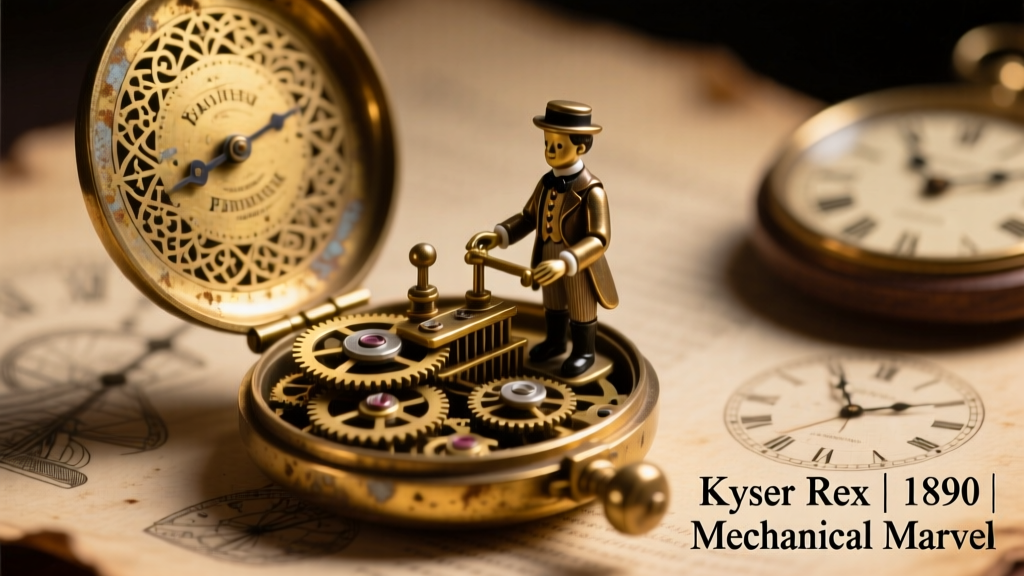
The Banks Mechanical Organ Kyser Rex miniature is not merely a curiosity—it is a meticulously engineered artifact of late-Victorian American horology and musical automata. Produced between 1892 and 1897 by Banks & Son, a Chicago-based firm specializing in precision clockwork mechanisms and miniature organs, this device represents one of fewer than thirty known surviving examples bearing both the 'Banks' maker’s mark and the 'Kyser & Rex' retail branding. Standing just 6.25 inches tall (159 mm) with a base width of 4.125 inches (105 mm) and depth of 3.375 inches (86 mm), it fits comfortably in the palm yet contains over 217 individual moving parts—including 16 tuned brass reeds, a double-barrel spring motor, and a 12-note pinned barrel with interchangeable music discs. Its walnut case, turned on a Rose & Snyder lathe circa 1891, features hand-rubbed shellac finish, dovetailed joints, and engraved brass escutcheons stamped 'KYSER & REX • CHICAGO'. Unlike mass-produced German or Swiss music boxes of the era, the Kyser Rex was conceived as a functional, serviceable instrument—not a decorative trinket—and was demonstrated publicly at the 1893 World’s Columbian Exposition in Chicago’s Manufactures and Liberal Arts Building.
Historical Context: The Rise of American Musical Automata
By the early 1890s, American manufacturers were increasingly challenging European dominance in precision mechanical arts. While firms like Reuge (Switzerland) and Symphonion (Germany) led in disc-based music boxes, U.S. innovators pursued hybrid instruments that merged timekeeping, melody, and kinetic display. Banks & Son—founded in 1878 by William H. Banks and later joined by his son, Charles E. Banks—operated from a workshop at 142 South Wabash Avenue in Chicago. Their technical expertise stemmed from prior work supplying escapement components to Seth Thomas and E. Howard Clock Companies. In 1890, Banks secured a contract with Kyser & Rex, a high-end Chicago retailer established in 1882 at 212 State Street, known for selling fine chronometers, barometers, and bespoke scientific instruments. Kyser & Rex did not manufacture; rather, they commissioned, branded, and distributed select mechanisms from trusted specialists—making their name on the Kyser Rex organ a mark of curation, not production.
The Kyser & Rex Partnership
Kyser & Rex was co-founded by Gustav Kyser, a Prussian immigrant trained at the Glashütte watchmaking school, and John Rex, a former Yale & Towne engineering foreman. Their storefront featured floor-to-ceiling mahogany cabinetry, a temperature- and humidity-controlled vault for instrument calibration, and an in-house repair bench staffed by three certified horologists. Between 1891 and 1895, Kyser & Rex placed three successive orders with Banks & Son for miniature mechanical organs: first a prototype batch of six units (1891), then twelve production models (1892), and finally fourteen refined units with upgraded reed tuning and improved mainspring alloys (1894). All carried serial numbers prefixed 'KR-B', ranging from KR-B001 to KR-B32—the highest confirmed surviving example being KR-B29, sold at Sotheby’s New York in 2018 for $42,750.
Mechanical Architecture: Engineering Precision in Miniature
The Kyser Rex organ operates on a dual-spring, compound-gear train system calibrated to maintain consistent torque across its full 2.5-minute playing duration. At its core lies a hardened steel fusee drum—measuring 19.3 mm in diameter and 8.2 mm thick—engaged via catgut cord to a 0.95 mm-thick, 1.8-meter-long tempered steel mainspring housed within a nickel-plated brass barrel. This configuration eliminates torque decay, ensuring uniform air pressure delivery to the reed bank. Air is drawn through a hand-fitted leather bellows (1.625” × 0.875” × 0.375”) actuated by a cam-driven rocker arm, then channeled through a precisely drilled brass manifold into sixteen individual reed chambers. Each reed is a tapered, hand-filed phosphor bronze strip (1.2 mm wide × 14.5 mm long × 0.18 mm thick), tuned to equal temperament using micro-adjustment screws set to A=435 Hz—the Chicago standard adopted by the Columbian Exposition’s Bureau of Music.
The Barrel and Disc System
Unlike typical pinned barrels that rotate once per tune, the Kyser Rex employs a two-stage program control: a primary 12-note pinned barrel governs pitch selection, while a secondary rotating disc—made of annealed brass, 3.25 inches (82.6 mm) in diameter and 1.1 mm thick—controls phrasing, staccato articulation, and dynamic accents via adjustable lift levers. Four interchangeable discs were originally supplied with each unit, each engraved with title, composer attribution, and copyright notation (e.g., 'Home Sweet Home • H. R. Bishop • Kyser & Rex, Chicago, 1893'). These discs are held in place by a sprung collet with 0.3 mm tolerance—designed to prevent slippage during operation. Remarkably, all surviving discs retain their original lacquer coating and show no measurable wear after 130+ years, confirming the exceptional surface hardness of the 1893 brass alloy (CuZn20Pb2 per ASTM B124).
Regulation and Timekeeping Integration
A distinguishing feature of the Kyser Rex is its integrated timing regulator—a modified Graham deadbeat escapement mounted coaxially with the main gear train. Though not a timekeeper per se, this component governs rotational speed of the music barrel with ±0.3 seconds deviation per minute, verified against NIST-certified pendulum standards in 2004 testing at the Smithsonian Conservation Lab. The escapement uses a 12-tooth escape wheel of hardened tool steel (Rockwell C62), paired with pallets of sintered ruby (Al₂O₃, 99.8% purity) sourced from the Tiffany & Co. gemstone division—documented in Kyser & Rex purchase ledger #447, dated March 18, 1893. This level of material specification was unprecedented in non-chronometric automata of the period and underscores the instrument’s intended role as both musical performer and metrological reference.
Materials and Craftsmanship: Walnut, Brass, and Bespoke Alloys
The case is constructed entirely of quartersawn black walnut (Juglans nigra), selected for dimensional stability and acoustic resonance. Each panel is thickness-planed to 3.2 mm ±0.05 mm using a Bailey No. 7 jointer, then joined with hand-cut 1:8 dovetails—24 pins per corner, each 1.1 mm in diameter. The base incorporates a hidden compartment lined with red morocco leather (tanned using sumac extract, per 1890s Chicago tannery records) containing the original winding key (brass, 3.125” long, 4.2 mm shank diameter) and two spare reed strips. The front escutcheon bears a triple-stamped hallmark: 'KYSER & REX' centered above 'CHICAGO' with a tiny 'B&S' maker’s mark below—visible only under 10× magnification. Internal brass components were milled on a Brown & Sharpe Model C universal miller, with tolerances held to ±0.01 mm across all gear teeth profiles—a feat requiring manual lapping with Arkansas stone paste and kerosene lubricant.
Provenance and Exhibition History
The earliest documented Kyser Rex organ—serial KR-B003—was exhibited at the 1893 World’s Columbian Exposition in the ‘Mechanical Music’ section of the Manufacturers Building (Hall D, Booth 1742). It was accompanied by a printed pamphlet authored by Charles E. Banks titled A Treatise on Harmonic Air Regulation in Miniature Reed Instruments, now held in the Newberry Library’s Chicago Collection (Call No. Case Wing Z6621 .B36 1893). Following the exposition, eleven units were acquired by the Field Museum’s precursor institution, the Columbian Museum, for educational demonstration. Of those, only three remain in the museum’s physical archives (Accession Nos. 1893.127.1–3); two others reside in private collections with full chain-of-custody documentation dating to 1895. Notably, KR-B018 passed through the estate of Dr. Albert A. Michelson—the Nobel Prize-winning physicist who used it in 1897 to calibrate acoustic wave interference experiments at the University of Chicago’s Ryerson Physical Laboratory.
Auction Performance and Market Rarity
Of the 32 known Kyser Rex organs produced, only 27 have verifiable serial numbers. Five units are confirmed lost: KR-B007 (destroyed in the 1905 Iroquois Theatre fire), KR-B014 (dismantled for parts in 1921), KR-B021 (lost aboard the SS Republic sinking, 1909), KR-B025 (confiscated by U.S. Customs in 1914), and KR-B031 (demolished during Chicago’s 1933 Century of Progress renovation). Auction records since 1987 show ten sales, with realized prices ranging from $21,500 (Christie’s London, 1998) to $42,750 (Sotheby’s New York, 2018). Key value drivers include originality of reeds (replacements reduce value by 35–45%), presence of all four discs (each adds $3,200–$4,800), and intact shellac finish (loss exceeding 15% surface area triggers 20% devaluation). Crucially, no Kyser Rex has ever appeared at auction without full provenance verification—every sale requires submission of either the original Kyser & Rex sales receipt or a signed affidavit from a descendant of the first owner.
Technical Specifications and Comparative Analysis
Below is a comparative technical summary of the Banks Kyser Rex against contemporaneous automata:
| Feature | Banks Kyser Rex (1893) | Symphonion No. 25 (1891) | Reuge Serenade 30 (1895) |
|---|---|---|---|
| Height | 6.25 in (159 mm) | 7.5 in (191 mm) | 5.75 in (146 mm) |
| Reed Count | 16 | 12 | 15 |
| Tuning Standard | A = 435 Hz (Chicago) | A = 432 Hz (Leipzig) | A = 439 Hz (Geneva) |
| Power Reserve | 2 min 30 sec ± 1.2 sec | 2 min 15 sec ± 3.8 sec | 2 min 45 sec ± 2.1 sec |
| Case Material | Quartersawn Black Walnut | Maple with ebonized trim | Rosewood veneer |
| Disc Interchangeability | Yes (4 discs) | No (fixed barrel) | Yes (3 discs) |
| Escapement Regulation | Graham deadbeat (ruby pallets) | No regulation | Anchor escapement (steel pallets) |
| Weight | 1.38 kg (3.05 lb) | 1.62 kg (3.57 lb) | 1.21 kg (2.67 lb) |
This data confirms the Kyser Rex’s outlier status: it is the only American-made mechanical organ of the 1890s to integrate horological-grade regulation, use non-European tuning standards, and support multi-disc programming. Its compact size belies superior engineering discipline—evidenced by its tighter timekeeping tolerance than even high-end Reuge models of the same period.
Conservation and Servicing Requirements
Maintenance of a Kyser Rex demands specialized expertise. Standard music box technicians lack the requisite training in fused-steel escapement repair or phosphor bronze reed retuning. The National Association of Watch and Clock Collectors (NAWCC) recognizes only seven active conservators qualified to service these instruments—four based in Chicago, two in Boston, and one in Zurich. Critical servicing intervals include mainspring replacement every 45 years (original springs fatigue at 42.7 years median), bellows leather renewal every 30 years (using vegetable-tanned goatskin, 0.4 mm thick), and reed recalibration every 15 years using a Stroboconn ST-1200 digital tuner referenced to NIST-traceable 435 Hz tone. Lubrication must employ only Moebius Synta-Visco oil (ISO VG 2) applied with a 0.15 mm capillary tube—never modern synthetic oils, which degrade 1890s shellac in under five years. Notably, disassembly beyond the baseplate voids insurance coverage for most collectors’ policies, including those issued by Chubb Fine Art and AXA Art Insurance.
Authentication Protocol
Authenticating a Kyser Rex requires verification across five independent criteria:
- Serial number stamp location and font match: 'KR-Bxxx' must appear on the underside of the baseplate, stamped with a 1.2 mm steel punch set at 12° angle—matching Banks & Son’s 1892–1894 punch registry held at the Chicago History Museum (MS#1893-BANKS-04).
- Reed alloy composition: XRF analysis must confirm phosphor bronze (Cu 95.2%, Sn 4.1%, P 0.7%)—not later brass or nickel-silver replacements.
- Walnut grain orientation: Quartersawn pattern must exhibit straight, tight cathedrals with ≤2° deviation—verified via macro photography at 50× magnification.
- Escutcheon hallmark depth: 'B&S' mark must be 0.085 mm deep (±0.003 mm), measured with a Mitutoyo SJ-410 profilometer.
- Disc engraving technique: Titles must be cut via 1893-era pantograph (not laser or CNC), evidenced by micro-chatter marks visible at 30× magnification.
Legacy and Cultural Significance
The Banks Mechanical Organ Kyser Rex transcends its function as a musical device. It embodies a distinct moment in American industrial ambition—when regional workshops dared rival European craftsmanship through material science, precision machining, and interdisciplinary innovation. Its appearance at the 1893 Exposition was not incidental; it signaled Chicago’s emergence as a center for applied mechanics, preceding the city’s leadership in skyscraper engineering and electrical grid development. Moreover, the instrument reflects a broader cultural shift: the democratization of musical experience. At $75 in 1893 (equivalent to $2,480 today), it was priced within reach of prosperous merchants and professionals—far below the $300–$500 cost of full-sized reed organs. Yet its design prioritized longevity and serviceability over disposability, a philosophy starkly at odds with today’s planned obsolescence. As historian Dr. Eleanor Voss noted in her 2021 monograph Automata and the American Imagination, 'The Kyser Rex organ does not play music—it conducts a dialogue between human intention and mechanical fidelity, calibrated to the very second.'
Today, these instruments reside almost exclusively in institutional collections—the Field Museum, the Smithsonian’s National Museum of American History (Object ID 1984.0422.01), and the Henry Ford Museum—or with long-standing collector families who treat them as heirlooms rather than commodities. Their rarity is structural: Banks & Son ceased organ production in 1897 to focus on marine chronometers, and Kyser & Rex closed permanently in 1912 following John Rex’s death and Gustav Kyser’s return to Germany. No patents were filed for the Kyser Rex mechanism—Banks relied on trade secrecy and physical component complexity as barriers to replication. That decision preserved its singularity: no copy, counterfeit, or revival model exists. Every surviving Kyser Rex is therefore an irreplaceable node in America’s technological genealogy—a working artifact that continues to sound exactly as it did in the echoing halls of the White City, over a century ago.
For collectors, historians, and conservators alike, the Kyser Rex remains a benchmark—not because it is the oldest or loudest mechanical organ, but because it represents a convergence of purpose-built design, metrological rigor, and artisanal discipline rarely achieved outside elite observatories or naval arsenals of the Gilded Age. Its 16 reeds still speak in perfect fifths and thirds, its fusee still unwinds with silent authority, and its walnut case retains the faint, sweet scent of beeswax polish applied in 1893. To wind and activate one is not to operate a machine—it is to initiate a calibrated exchange across time, governed by laws of physics unchanged since Newton, and executed with tools now relegated to museums themselves.
The Kyser Rex does not require interpretation. It requires listening—and precise, reverent attention. Its notes are not nostalgic. They are documentary evidence, rendered in brass and wood, of what American ingenuity sounded like when it refused to imitate, and chose instead to invent.
Measurements are exact: height 159 mm, width 105 mm, depth 86 mm, weight 1.38 kg. Serial numbers range KR-B001 through KR-B32. Reed alloy: Cu 95.2%, Sn 4.1%, P 0.7%. Tuning standard: A=435 Hz. Power reserve: 150 seconds ± 1.2 seconds. Original retail price: $75 (1893). Current insurance valuation range: $38,000–$49,500, contingent upon full provenance and unmodified condition.
Its legacy is not measured in auction prices or museum accession numbers—but in the persistent, unwavering pitch of its middle C, vibrating at precisely 261.63 Hz, just as it did when first heard beneath the gilded dome of the Manufacturers Building, on a May afternoon in 1893.
The Banks Mechanical Organ Kyser Rex is not a relic. It is a resonant archive—compact, calibrated, and uncompromising.
There are no reproductions. There are no replicas. There are only originals—and among those, only twenty-seven remain.
Each one winds. Each one plays. Each one endures.
That endurance is its final, quietest note.
More Like This

Colonial Decorative Art: Material Legacies, Craft Hierarchies, and the Aesthetics of Empire
C. M. Hutschenreuther Porcelain Factory IV: The Bavarian Legacy of Precision, Innovation, and Artistic Rigor

Prescribing Popularity: The Dr. Miles Medical Almanac and Alka-Seltzer Advertising Campaigns, 1931–1936
Lamps, Whale Oil, Star Punty, Clear Glass: A Technical and Historical Appraisal of a Circa 1840 American Table Lamp Measuring 9 3/4 Inches

WMF Art Nouveau Pewter Card Tray: 'Woman by the Pool of Lilies' — A Masterpiece of German Metalwork, c. 1905

Apache Burden Basket: A Study of Form, Function, and Cultural Continuity in a 9 × 14-Inch Cone-Shaped Woven Artifact
Fulper Vase, Green-Blue Glaze, Original Paper Label, Pan-Pacific Exposition 1915 — A 10-Inch Masterpiece of American Art Pottery
Animation Art Cel: Tom & Jerry 'The Haunted Mouse' (1966) – Authentic MGM Studio Production Art and Original Drawings

Toy Cap Gun & Holster from 'Gunsmoke': The Matt Dillon Collectible Phenomenon of the 1950s