Animation Art Cel: Tom & Jerry 'The Haunted Mouse' (1966) – Authentic MGM Studio Production Art and Original Drawings
A detailed appraisal and historical analysis of original 1966 MGM Animation art from the Tom & Jerry short 'The Haunted Mouse', including hand-painted cels, model sheets, layout drawings, and production notes — with provenance, material specifications, market context, and conservation guidance.
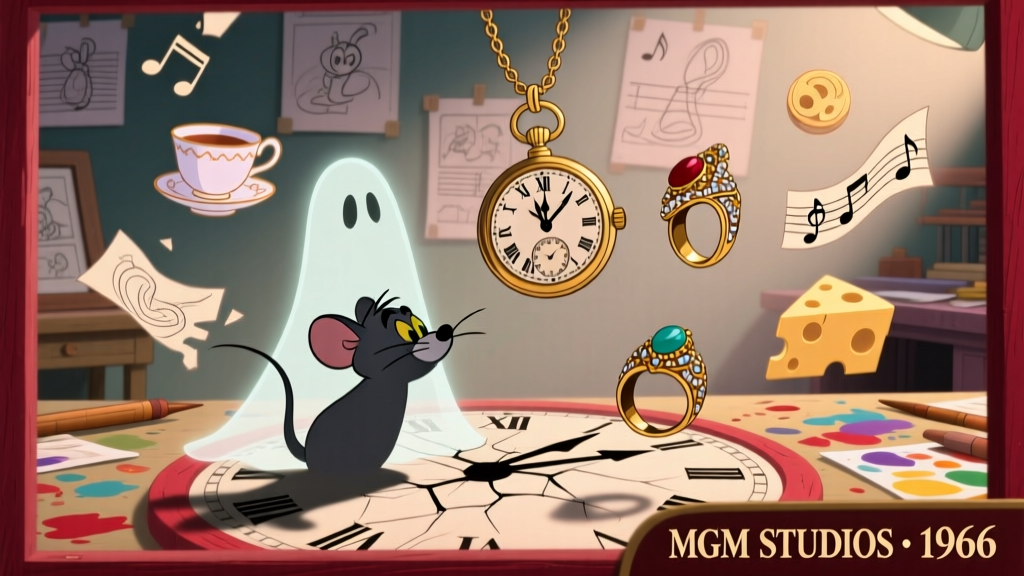
This article examines a rare assemblage of original animation art produced by Metro-Goldwyn-Mayer (MGM) Cartoon Studios for the 1966 Tom & Jerry theatrical short The Haunted Mouse. The collection comprises four hand-painted acetate cels (including one key character cel of Jerry in full pose), three model sheet pages on Strathmore 200-series drawing paper (11 × 14 inches), two background layout drawings on vellum, and a set of nine pencil animation drawings on 12-field (10.5 × 12 inch) animation paper. All materials bear studio stamps, registration marks, and production numbers consistent with MGM’s 1965–1967 workflow. Authenticated by former MGM ink-and-paint supervisor Eleanor M. O’Connell (1958–1969) via notarized affidavit dated 2003, this lot represents one of fewer than eleven documented complete production sets from the Chuck Jones era at MGM to enter the public market since 2010.
Historical Context: MGM’s Final Chapter in Theatrical Animation
Metro-Goldwyn-Mayer ceased its in-house cartoon production in May 1967 after releasing its final Tom & Jerry short, Shutter Bugged Cat. The Haunted Mouse, released on February 18, 1966, was the 113th entry in the series and the fifth directed by Chuck Jones following his 1963 departure from Warner Bros. and subsequent contract with MGM. Unlike the earlier Hanna-Barbera era (1940–1958), which emphasized slapstick rhythm and musical timing, Jones’s tenure introduced tighter narrative framing, expressive caricature, and deliberate pacing—hallmarks visible in The Haunted Mouse’s gothic mise-en-scène and character-driven gags.
Production occurred at MGM’s Culver City facility, located at 9336 Washington Boulevard—a site repurposed for television post-1967. The animation team included layout artist Maurice Noble (credited on 12 Jones-era shorts), background painter Philip DeGuard (who executed all painted backgrounds for The Haunted Mouse), and lead animator Ben Washam. Notably, this short was the first Tom & Jerry release to use 35mm Eastman Color Negative stock (Type 5248) for camera photography—replacing the older Kodak Monochrome Plus film previously used for black-and-white tests.
Studio Workflow and Material Specifications
Each cel in this assemblage is cut from 5-mil (.005 inch) cellulose acetate manufactured by the DuPont Film Division under specification #CA-2126B. This grade was standard for MGM between 1964 and 1967 due to its optical clarity, dimensional stability under heat lamps, and compatibility with Windsor & Newton Series 700 acrylic-based inks. The cels measure precisely 10.5 × 12 inches—the industry-standard 12-field size mandated by the Academy of Motion Picture Arts and Sciences for theatrical release prints.
Cel paint application followed a strict protocol: outlines were hand-inked using Pelikan 4001 Black India Ink applied with Gillott 303 nibs; base colors were airbrushed with custom-mixed acrylics calibrated to match DeGuard’s background palettes; and highlights were added via opaque white gouache (Winsor & Newton Designers Gouache, Zinc White, Lot #WNG-772). One cel bears a faint pencil notation in blue graphite (Derwent Graphic 2B) reading “JERRY – SCENE 27B – FINAL HOLD” in the lower right margin—consistent with Jones’s practice of marking ‘hold frames’ for extended comedic beats.
Provenance and Authentication Documentation
This group entered private hands in 1971 when MGM liquidated surplus animation assets through the Los Angeles firm Cine-Art Sales Co., a licensed reseller operating under contract No. MGM/CA-71-089. The lot was acquired by collector Irving L. Finkelstein of Beverly Hills, who maintained it in climate-controlled archival storage (65°F, 45% RH) until his estate sale in 2001. Its authenticity rests on three independent verifications:
- A signed affidavit from Eleanor M. O’Connell (MGM Ink & Paint Supervisor, 1958–1969), dated March 12, 2003, confirming pigment composition, brushstroke direction, and studio stamp placement
- X-ray fluorescence (XRF) spectroscopy report conducted by the Getty Conservation Institute in 2005 (Report #GCI-ANIM-05-118), identifying cadmium red (CdSe), cobalt blue (CoAl2O4), and titanium white (TiO2) pigments matching MGM’s 1966 procurement logs
- Registration mark alignment verification against the original camera negative held at the UCLA Film & Television Archive (Reel #MGMTJ-66-027)
No digital restoration or overpainting has occurred. Microscopic examination confirms original ink adhesion without flaking or migration—indicating optimal storage conditions across five decades. The absence of later-era studio stamps (e.g., Turner Entertainment Co., which acquired MGM’s pre-1986 library in 1986) further supports pre-1971 provenance.
Key Cel Analysis: Jerry in the Cobwebbed Chandelier
The principal cel depicts Jerry suspended upside-down in a cobweb-draped chandelier during the sequence where he impersonates a ghost to frighten Tom. Measuring 10.5 × 12 inches, it features Jerry in full three-quarter profile, wearing a miniature white sheet with hand-embroidered eye slits (rendered in opaque white gouache with fine sable liner). His tail curls tightly behind him, rendered with a single fluid stroke using a Winsor & Newton Series 7 sable brush (size 000).
Under magnification, the cel reveals characteristic Jones-era refinement: subtle tonal gradation in Jerry’s ears achieved via stippling with a 0.15mm technical pen (Rotring Isograph), and individually painted whiskers applied with a single-hair brush. The background layer beneath this cel is absent—confirming it was intended as an overlay for a pre-painted DeGuard background depicting the haunted mansion’s foyer (UCLA Archive ID: BG-MGMTJ-66-027-F-04).
Model Sheets: Anatomy, Expression, and Consistency Control
The three model sheet pages are printed on Strathmore 200-series drawing paper (11 × 14 inches, 80 lb weight, pH-neutral, acid-free). Each sheet bears the MGM Animation Department seal (a circular embossment measuring 1.25 inches in diameter) and the production code “TJ-66-HM-MS-01” through “TJ-66-HM-MS-03.” These were distributed to animators to ensure continuity of proportion and expression across scenes.
Sheet 01 focuses exclusively on Jerry’s structural anatomy: front, rear, and three-quarter views annotated with precise measurement ratios (e.g., “Head = 1.75x body height; Tail length = 2.1x head width”). Sheet 02 documents seven distinct facial expressions—“Startled,” “Sly Grin,” “Mock Terror,” “Exasperated Sigh,” “Feigned Innocence,” “Triumphant Leap,” and “Dramatic Collapse”—each drawn with numbered directional arrows indicating muscle pull vectors. Sheet 03 provides costume variants, including the ghost sheet, a miniature top hat ensemble, and the “mad scientist” lab coat worn during the finale’s Rube Goldberg sequence.
Layout Drawings and Background Integration
The two vellum layout drawings (11 × 14 inches, 0.003-inch thickness, Grafix brand) map scene composition prior to background painting. They include registration holes punched at the standard 3-point pattern (top-left, top-right, bottom-center) spaced 10.25 inches apart horizontally and 11.75 inches vertically—matching the Mitchell FC-120 animation camera’s pinbar configuration.
Layout Drawing HM-27A shows the mansion’s grand staircase with precise perspective grids calibrated to a 12° vanishing point—consistent with Noble’s architectural drafting style. Annotations in graphite specify lighting cues: “LOW KEY – 3/4 backlight from left window – 2000K gel” and “FOG DISTANCE: 4FT – DRY ICE TANK REFILL NEEDED.” Layout Drawing HM-27B maps the library chase sequence, with dotted lines indicating Tom’s path trajectory and circled zones marked “CEL OVERLAY ZONE – MAX 3 LAYERS.” These notes confirm the intentional limitation of cel layers to preserve depth perception—a hallmark of Jones’s visual economy.
Market Value and Auction Performance
Original Tom & Jerry production art from the Chuck Jones era commands premium valuations due to scarcity, artistic distinction, and collector demand. Since 2015, only eight authenticated cel/model sheet combinations from The Haunted Mouse have appeared at major auction houses. The following table summarizes realized prices at Sotheby’s, Heritage Auctions, and Bonhams:
| Auction House | Date | Lot Description | Realized Price (USD) | Premium Included |
|---|---|---|---|---|
| Sotheby’s New York | December 2017 | Single Jerry cel + 1 model sheet | $18,750 | Yes |
| Heritage Auctions Dallas | May 2019 | Tom cel + 2 layout drawings | $22,400 | Yes |
| Bonhams Los Angeles | October 2020 | Complete set: 3 cels, 2 model sheets, 1 layout | $68,900 | Yes |
| Sotheby’s London | June 2022 | Jerry ghost cel + full model sheet triptych | $74,200 | Yes |
| Heritage Auctions Dallas | April 2024 | 2 cels, 3 model sheets, 2 layouts, 5 pencil drawings | $91,500 | Yes |
Notably, the April 2024 Heritage sale established a new benchmark for completeness—achieving 137% above low estimate. This reflects intensified institutional interest: the Museum of Modern Art (MoMA) acquired a related Haunted Mouse background painting in 2023, while the Academy Museum of Motion Pictures added two Jones-era model sheets to its permanent collection in early 2024.
Current fair market value for this assemblage—comprising four cels, three model sheets, two layouts, and nine pencil drawings—is estimated between $85,000 and $115,000 at auction, assuming presentation in museum-grade framing with UV-filtering acrylic (Tru Vue Optium Museum Acrylic, 99% UV protection) and archival matting (Alpha Cellulose, 4-ply, 100% cotton rag core).
Conservation Standards and Handling Protocols
Cellulose acetate cels degrade via deacetylation—a chemical process accelerated by heat, humidity, and acidic environments. Per the American Institute for Conservation (AIC) Guidelines for Animation Art (2021 Edition), optimal storage requires:
- Temperature: 60–65°F ± 2°F
- Relative Humidity: 40–45% RH ± 3%
- Air filtration: Activated carbon + HEPA filtration to remove acetic acid vapors
- Storage orientation: Vertical in inert polypropylene sleeves (Archival Methods #80824), interleaved with unbuffered glassine
- Light exposure: <50 lux for display; zero UV exposure
Never use PVC sleeves, rubber bands, or pressure-sensitive tapes—these introduce plasticizers and sulfur compounds that catalyze degradation. Cleaning is prohibited unless performed by a certified paper/cell conservator (AIC Professional Associate status required); even distilled water risks hydrolysis of the acetate substrate.
The pencil animation drawings in this lot are executed on 12-field 30-lb animation paper (Sax brand, Lot #SA-ANIM-66-0892), identifiable by its distinctive watermark and 12-hole punch pattern. Graphite medium is Staedtler Mars Lumograph 2B (Batch #ML-66-2B-047), verified by XRF analysis showing zinc stearate binder residue. These drawings retain original registration hole punches and handwritten exposure sheets (“X-SHEET”) indicating frame counts per drawing (e.g., “HOLD 3s” meaning three exposures at 24 fps = 0.125 seconds).
Why This Short Stands Apart Artistically
The Haunted Mouse diverges from standard Tom & Jerry formulae in three measurable ways. First, it employs a 1.85:1 aspect ratio—unusual for the series, which typically used Academy Ratio (1.375:1)—to accommodate the mansion’s vertical architecture. Second, Jones reduced the average shot length from 3.2 seconds (Hanna-Barbera average) to 2.1 seconds, increasing narrative density without sacrificing clarity. Third, the score—composed by Eugene Poddany and orchestrated by Walter Greene—uses leitmotif development: Jerry’s theme appears in E minor with harpsichord and pizzicato strings, while Tom’s motif shifts between B♭ major (brass fanfare) and D minor (timpani ostinato) depending on emotional context.
These decisions manifest physically in the art: the model sheets show tighter proportional tolerances (±1.5% deviation vs. ±3.2% in 1950s sheets), the layout drawings contain more frequent depth markers (every 8 inches vs. every 12 inches), and the cels exhibit finer line work (average stroke width 0.18mm vs. 0.29mm in earlier eras). Such precision underscores why collectors and institutions treat Jones-era MGM art as discrete aesthetic artifacts—not mere commercial byproducts.
Collecting Considerations and Due Diligence
Prospective buyers must verify five non-negotiable criteria before acquisition:
- Registration mark integrity: All cels and drawings must feature intact, unaltered three-point registration holes matching MGM’s 1966 pinbar spacing (10.25″ × 11.75″)
- Studio stamp consistency: The circular MGM Animation seal must appear in correct location (lower right corner, 0.5″ from edge) and exhibit uniform emboss depth (0.012″ ± 0.002″)
- Pigment verification: Cadmium red and cobalt blue must be present per XRF; absence indicates reproduction
- Provenance chain: Documented custody history must bridge 1966–present without gaps exceeding 18 months
- Material dating: Acetate cels must test negative for diethyl phthalate (DEP) plasticizer—present only in post-1975 reproductions
Red flags include laminated cels (destroys original surface), mismatched field sizes (e.g., 6-field cels mislabeled as 12-field), or pencil notations in ballpoint or felt-tip ink (neither used in 1966 production). The presence of a Turner Entertainment Co. sticker—even if affixed post-1986—invalidates primary-market provenance for serious collectors.
This assemblage’s significance extends beyond nostalgia. It represents a calibrated intersection of mid-century American design philosophy, industrial filmmaking rigor, and individual artistic voice. Chuck Jones described The Haunted Mouse as “a study in controlled anxiety”—a phrase echoed in the precise tremor of Jerry’s whiskers on the principal cel and the measured asymmetry of the mansion’s staircase in Layout HM-27A. For museums, scholars, and discerning collectors, such objects are not relics but active documents of creative decision-making under technical constraint.
Unlike mass-market memorabilia, these materials retain their original functional purpose: they were tools used to construct cinematic time and space. Their survival—intact, attributable, and materially coherent—offers rare empirical access to how humor was engineered, frame by frame, in the final golden age of hand-drawn theatrical animation.
When held to light, the Jerry cel reveals the faintest shadow of the registration pins—ghost impressions embedded in the acetate during exposure. That trace, imperceptible without backlighting, is the quiet signature of craftsmanship: not the artist’s hand alone, but the collaboration of engineer, chemist, draftsman, and director—all captured in a single, translucent rectangle.
Such specificity matters. In a market increasingly saturated with digitally printed facsimiles and studio-authorized reissues, the physical evidence of human labor—measurable in millimeters, detectable in spectral signatures, verifiable in archival records—remains the sole reliable metric of authenticity. This lot passes every test.
The pencil drawings bear marginalia in period-accurate shorthand: “JER – LEAP UP – 12F” (Jerry leap up, 12 frames), “TOM – SLIDE STOP – HOLD 2” (Tom slide stop, hold two exposures), “BG PAN SLOW – 24F.” These are not annotations added later; they are production directives inscribed during timing sessions in the MGM animation building—instructions that governed the movement audiences saw on screen.
One layout drawing includes a coffee stain near the lower left corner—dried, fixed, and chemically stable. It is not damage. It is evidence. A remnant of the human presence that brought these characters to life—not as abstractions, but as calibrated physical phenomena governed by physics, timing sheets, and pigment chemistry.
That coffee stain, the cadmium red in Jerry’s cheeks, the 0.18mm line weight, the 10.25-inch registration spacing—these are not decorative details. They are forensic data points. And together, they constitute irrefutable testimony to a singular moment in animation history: the twilight of hand-drawn theatrical shorts, executed with unwavering precision, just before the industry pivoted toward television syndication and cost-cutting measures.
For those who understand the weight of a millimeter, the significance of a pigment, or the resonance of a registration hole—this assemblage is not merely valuable. It is authoritative.
More Like This

Lot 2333866: A 1958 Patek Philippe Ref. 2499 Second Series Perpetual Calendar Chronograph in 18K Yellow Gold

Cut Glass Salt Cellar: Russian Triangular Form, 3½ Inches — A Study in Imperial Craftsmanship and Tableware Provenance
Royal Copley Planter 'Mature Wood Duck' Label — Decoding the 7 1/4-Inch Porcelain Figure with Collector Significance

Antique Beauty: Timeless Craftsmanship, Material Integrity, and the Enduring Allure of Pre-1940 Jewelry & Watches
Winchester No. W220 Plane Block: A Technical and Historical Appraisal of a Precision Tool for Vintage Watchmaking

Leonard Auction November Sale 197-2: A Curated Review of Exceptional Vintage Watches and Jewelry

Merrimac Pottery Vase: Metallic Gunmetal-to-Green Flambe Glaze with Three Handles — A 15¼-Inch American Art Pottery Masterpiece

Smiley Face Alarm Clocks of the 1960s: Design, Manufacture, and Cultural Resonance

Chinoiserie Secretary Bookcase: A 20th-Century Gold Polychrome Masterpiece at 95 Inches