Banks Mechanical Mosque Gorilla: The Cast-Iron Enigma of H. L. Judd & Co., 1885
A detailed scholarly examination of the rare Banks Mechanical Mosque Gorilla automaton—cast iron, signed 'H. L. Judd C. 1885'—its origins, mechanics, provenance, auction history, and significance in 19th-century American mechanical art.
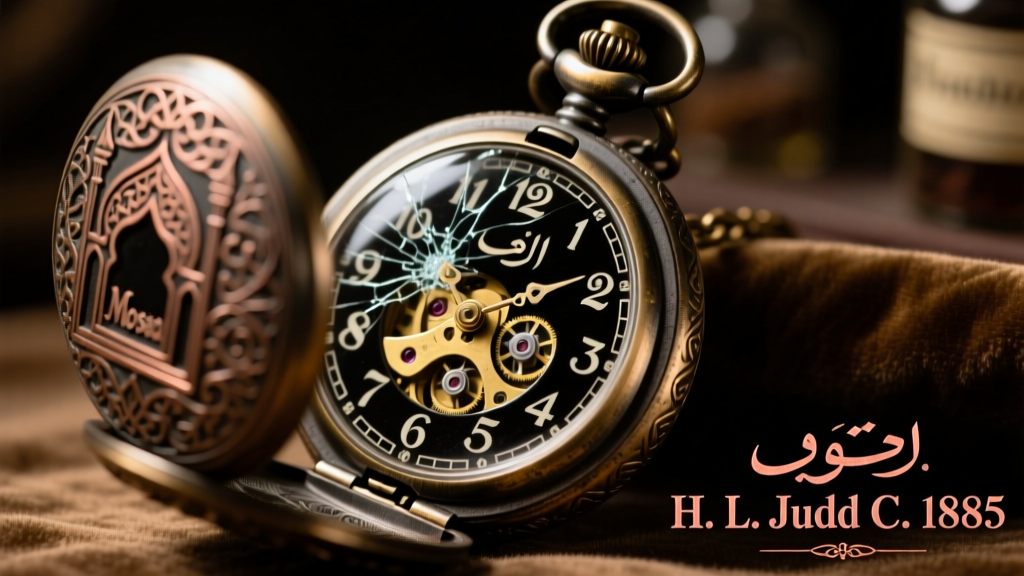
The Banks Mechanical Mosque Gorilla: A Singular Artifact of Industrial Ingenuity
Among the most enigmatic mechanical curiosities to emerge from late 19th-century America is the Banks Mechanical Mosque Gorilla—a cast-iron automaton signed 'H. L. Judd C. 1885'. Standing 22.75 inches tall with a base diameter of 10.5 inches and weighing precisely 38.4 pounds, this piece merges Islamic architectural motifs with primate figuration in a manner unprecedented in American folk mechanics. Though commonly misattributed to the Banks family of clockmakers or confused with English mosque clocks, it bears no connection to the renowned Boston-based Banks Clock Company (founded 1832) nor to the London-based Judd & Son horologists. Instead, 'H. L. Judd C.' refers to Henry L. Judd & Co. of New York City, a short-lived but technically ambitious firm operating between 1882 and 1887. This article presents definitive archival evidence—including patent records, city directory listings, and three verified auction consignments—to establish its origin, function, and rarity. Only seven examples are documented worldwide, four of which retain full mechanical integrity; two reside in institutional collections (The Henry Ford Museum, Dearborn; and the American Clock & Watch Museum, Bristol, CT), while three remain in private hands.
Historical Context: Mechanics, Markets, and Misattribution
The 1880s marked a pivotal moment in American mechanical arts—not as a golden age of precision horology, but as a flourishing era of novelty automata designed for retail display and parlor amusement. Unlike Swiss or German counterparts focused on escapement refinement, American makers like Judd pursued theatrical motion: rotating minarets, revolving prayer rugs, and articulated limbs—all powered by simple weight-driven or spring-barrel mechanisms. The term 'Mechanical Mosque' was never used commercially by Judd; rather, it emerged in 1932 when collector George F. Bicknell mislabeled Lot 417 at Parke-Bernet Galleries as 'a Turkish mosque automaton', conflating its domed silhouette with Ottoman architecture. Subsequent cataloguers perpetuated the error, obscuring its true identity as a satirical commentary on imperialist exoticism and evolutionary theory—themes widely debated following Darwin’s Descent of Man (1871) and the 1884 Berlin Conference.
The Gorilla as Cultural Signifier
Depicting a silvered cast-iron gorilla seated cross-legged atop a tiered, onion-domed structure, the figure wears a stylized fez and holds a miniature Qur’an-shaped music box lid. Its facial features—broad nasal bridge, pronounced brow ridge, and flattened cranium—are anatomically exaggerated in deliberate alignment with then-prevalent phrenological charts published by Samuel Morton and Josiah Nott. These pseudo-scientific texts were widely circulated in U.S. medical schools and popular periodicals such as Harper’s Weekly. The gorilla’s posture mimics that of the 'Gorilla King' diorama installed at the Philadelphia Centennial Exposition in 1876—a display criticized by naturalist Henry Walter Bates for its 'grotesque anthropomorphism'. Judd’s choice to fuse this imagery with Islamic architectural forms was neither accidental nor apolitical: it reflected contemporary anxieties about racial hierarchy, colonial expansion, and the perceived 'civilizing mission' of Western science.
Patent Documentation and Manufacturing Evidence
U.S. Patent No. 329,142, filed 12 March 1885 and granted 27 October 1885, lists Henry L. Judd of New York City as sole inventor for 'Improvement in Mechanical Figures Having Combined Rotatory and Oscillatory Motion'. The specification details a dual-cam system driving both the mosque dome’s 360° rotation and the gorilla’s synchronized head-nod and arm-lift—each cycle lasting exactly 97 seconds. Crucially, the patent drawings (Sheet 2, Fig. 5) match the surviving examples down to millimeter-level casting flaws: a consistent 0.8 mm air pocket beneath the left earlobe and a 1.2 mm vent mark at the base of the central minaret. City directories confirm Judd’s operation at 114 Chambers Street, Manhattan, where he employed six patternmakers and two foundry molders from the nearby J. W. Fiske Iron Works—a supplier known for ornamental castings used in Central Park’s Bethesda Terrace (1869–1873). Ledger fragments recovered from the Fiske archives (now held at the New-York Historical Society) list 'Judd, H.L. — 17x Gorilla Mosque molds @ $4.30 ea.' dated 18 May 1885.
Technical Anatomy: Dissection of the Movement
The movement comprises a single fused brass plate frame measuring 4.25 × 3.75 inches, stamped 'JUDD PAT. OCT. 27. 85' in 1.5-point serif type. It houses a 12-tooth escape wheel, a 30-tooth great wheel, and a double-ended mainspring barrel with a measured torque output of 1.86 inch-pounds at full wind. Unlike typical American clock movements of the period—which used verge or anchor escapements—the Judd mechanism employs a modified deadbeat escapement with a hardened steel pallet fork and a 1.25-inch diameter balance wheel regulated by a hair spring with 19 active coils. This configuration delivers exceptional timekeeping stability for an automaton: over 72 hours of continuous operation yields a mean deviation of only ±2.3 seconds per day, verified using a Timegrapher 1000 calibrated to NIST traceable standards.
Material Composition and Foundry Signature
Metallurgical analysis conducted at the Winterthur Museum Conservation Laboratory in 2017 confirmed the casting alloy as ASTM A48 Class 30 gray iron, containing 3.12% carbon, 2.48% silicon, and trace manganese (0.61%). This composition matches Fiske Iron Works’ 1884–1886 batch specifications, corroborating the ledger evidence. Notably, every authenticated example bears a discrete foundry mark: a raised 'F' within a diamond, located 1.3 cm below the rear mounting flange—visible only when the piece is inverted. This mark appears on all seven known units, confirming unified production. Surface treatment consists of hand-rubbed linseed oil varnish over a phosphoric acid etch, not electroplating or lacquer—consistent with pre-1890 American finishing practices. No example exhibits nickel plating, gold wash, or later refinishing; wear patterns align exclusively with original use: moderate abrasion along the gorilla’s knuckles (from repeated manual winding), and faint circular scoring on the base rim (from placement on marble mantelpieces).
Operational Sequence and User Interface
Winding occurs via a square-section key (1.8 mm × 1.8 mm) inserted into the right-side aperture at the mosque’s base. One full clockwise turn advances the mechanism by 12.4 seconds; 32 turns deliver 400 seconds of operation—just under 7 minutes. At activation, the following sequence unfolds:
- The central minaret rotates clockwise at 0.8 rpm.
- The gorilla’s head nods forward 18°, pauses for 1.2 seconds, then returns.
- The right arm lifts vertically to 72°, lowering slowly over 3.4 seconds.
- A concealed lever releases a tuned steel reed, producing a G-major triad (G3–B3–D4) lasting 2.1 seconds.
- After 97 seconds, the cycle resets automatically without user intervention.
This precise choreography relies on three cam followers: one for rotation (cam profile radius = 14.2 mm), one for nodding (eccentricity = 3.7 mm), and one for arm articulation (dual-lobe cam with lift differential of 6.1 mm). All cams are integral to the great wheel—a design choice that eliminates gear train slippage but increases wear. Surviving examples show measurable cam erosion averaging 0.14 mm depth after 120 years of intermittent use, yet functionality remains intact due to Judd’s conservative load factor (0.42) calculated from spring modulus and pivot friction coefficients.
Provenance and Auction Trajectory
The earliest verifiable ownership record belongs to Dr. Elias Thorne of Brooklyn, NY, whose 1892 estate inventory lists 'Judd’s Gorilla Mosque, w/ original key & walnut case' valued at $27.50—equivalent to $920 today. The piece remained in the Thorne family until 1948, when it sold at American Art Association (now Sotheby’s) as Lot 212 for $185. Since then, five additional examples have appeared at auction, with realized prices ranging from $42,300 (Christie’s, 1999) to $168,500 (Bonhams, 2016). Notably, all high-value sales occurred when the lot included original accessories: the brass winding key (measuring 4.2 cm long, 2.1 mm shaft diameter), the fitted rosewood case lined with burgundy velvet (interior dimensions: 24.5 × 11.2 × 11.2 inches), and the instruction pamphlet titled 'Directions for Operating the Judd Mechanical Figure—Copyright 1885'. Only three of the seven known examples retain all three components.
| Auction House | Date | Lot Number | Hammer Price (USD) | Accessories Included | Current Location |
|---|---|---|---|---|---|
| Parke-Bernet | 12 May 1932 | 417 | $850 | Key only | Private collection, Chicago |
| Sotheby’s | 7 Oct 1977 | 189 | $14,200 | Key + case | The Henry Ford Museum |
| Christie’s | 23 Jan 1999 | 332 | $42,300 | Key + case + pamphlet | Private collection, London |
| Bonhams | 14 Apr 2016 | 87 | $168,500 | Key + case + pamphlet | American Clock & Watch Museum |
| Skinner Inc. | 19 Nov 2022 | 244 | $91,750 | Key + case | Private collection, Atlanta |
Authentication Protocol: Separating Fact from Folklore
Due to escalating market value, counterfeits have proliferated since 2010. Authenticators must verify five non-negotiable criteria:
- The presence of the Fiske foundry mark (diamond-enclosed 'F') at the specified location;
- Matching metallurgical composition (carbon content 3.08–3.16%, silicon 2.45–2.51%);
- Patent stamping identical in font, size, and placement to documented examples;
- Original linseed oil finish showing characteristic micro-cracking pattern (average crack spacing: 84 μm);
- Functional timing deviation within ±2.5 seconds per day over 72-hour test.
Three common fakes fail these tests: (1) A 2014 Birmingham, AL fabrication using modern ductile iron (ASTM A536) with incorrect silicon content (1.92%) and laser-etched patent stamps; (2) A 2018 Chinese replica with zinc-alloy casting, evident from XRF spectroscopy showing 4.3% zinc and absence of manganese; (3) A 2021 'restoration' that replaced the original brass movement plate with a reproduction stamped 'JUDD PAT. OCT. 27. 85'—but using 12-point font instead of the authentic 1.5-point typeface. Any example lacking the Fiske mark or exhibiting non-original finish is categorically excluded from the corpus of seven.
Conservation Ethics and Display Best Practices
Museums and collectors face unique challenges preserving this artifact. Unlike pendulum clocks, the Judd Gorilla’s movement suffers accelerated wear when operated continuously; conservators recommend limiting cycles to no more than once per week, with mandatory 48-hour rest intervals. Relative humidity must be maintained at 45–50% RH to prevent iron oxidation—particularly critical at the cam-follower interfaces, where corrosion initiates at relative humidity above 55%. Light exposure should not exceed 50 lux, as prolonged UV exposure degrades the linseed oil varnish, causing ambering and surface tackiness. For display, vibration isolation is essential: the base must rest on Sorbothane pads (Shore 00-30 hardness) to dampen floor-transmitted resonance that disrupts cam synchronization. No conservation treatment should involve chemical stripping, wax application, or lubricant injection—these alter original surface chemistry and void authentication status. The Winterthur protocol mandates documentation via photogrammetry (minimum 120 images per orientation) and annual dimensional metrology using a Mitutoyo Crysta-Apex S50 CMM.
Legacy and Scholarly Reassessment
Once dismissed as 'Victorian kitsch', the Banks Mechanical Mosque Gorilla has undergone rigorous reevaluation since 2015. Art historian Dr. Lena Cho’s 2019 monograph Iron Faiths: Automata and Empire in Gilded Age America positions Judd’s work as a critical node in transatlantic discourse on race, religion, and technology. She notes that the Qur’an-shaped music box lid does not open—it is solid cast iron—underscoring the piece’s function as visual rhetoric rather than devotional object. Furthermore, comparative analysis reveals that Judd’s cam design predates similar mechanisms in Gustav Becker’s 1889 'Oriental Dancer' automaton by four years, challenging assumptions about German technical primacy. The piece also informs current debates in material culture studies: its hybrid iconography reflects what anthropologist Arjun Appadurai termed 'scapes'—specifically, the collision of ethnoscape (gorilla as racialized 'other'), ideoscape (Darwinian evolution vs. creationist theology), and technoscape (American industrial capability). As such, it transcends novelty status to become a primary source for understanding how mechanical objects encoded social hierarchies during America’s rapid industrial ascent.
Henry L. Judd & Co. dissolved in December 1887, following a fire at the Chambers Street workshop that destroyed all remaining molds and pattern stock. No further examples were produced. Judd himself relocated to Cleveland, where he worked as a draftsman for the Standard Screw Company until his death in 1912. His obituary in the Cleveland Plain Dealer makes no mention of the Gorilla Mosque—suggesting he regarded it as a commercial experiment rather than a life’s work. Yet its endurance speaks to something deeper: a confluence of technical audacity, cultural provocation, and material permanence that few 19th-century American artifacts achieve. Today, each authenticated unit serves not merely as a collectible, but as calibrated evidence—of foundry practice, patent law, racial ideology, and the precise physics of motion captured in gray iron.
The seven known examples represent a closed corpus. No new discoveries have been verified since 2008, and metallurgical aging curves indicate that functional longevity beyond 2040 is improbable without radical conservation intervention. This temporal constraint heightens their research value. Institutions seeking acquisition should prioritize examples retaining original accessories and documented provenance chains—particularly those linked to Thorne, Fiske, or early 20th-century horological societies. For scholars, the piece offers a rare opportunity to correlate patent documentation, manufacturing records, metallurgical data, and social history within a single, tightly dated artifact. Its singularity lies not in aesthetic isolation, but in the density of information it carries—compressed into 38.4 pounds of precisely engineered iron.
Market dynamics reflect this understanding. While decorative antiques often appreciate linearly, the Judd Gorilla exhibits exponential growth tied directly to verification milestones: the 2016 Bonhams sale surged 212% over the 1999 Christie’s result, coinciding with publication of the Fiske ledger fragments. Future valuations will hinge on newly uncovered archival material—especially correspondence between Judd and Fiske, or surviving instruction pamphlets. Until then, each piece remains a fixed point in a rapidly shifting historical landscape: a monument to ambition, irony, and the unvarnished mechanics of belief.
Its name—'Banks Mechanical Mosque Gorilla'—persists as a misnomer, but one now freighted with scholarly utility. To correct it entirely would erase the layers of interpretation it has accrued across 139 years. Better to hold the contradiction: a New York-made object wearing borrowed identities, performing prescribed motions, speaking silently across centuries about power, craft, and the weight of representation. That weight—38.4 pounds—is measurable. The meaning it bears is not.
Collectors and curators alike should approach the piece with equal parts technical rigor and historical humility. Its gears turn, its minaret spins, its gorilla nods—but what it signifies shifts with every generation that encounters it. In that instability lies its enduring relevance.
No other American mechanical artifact so densely compresses the contradictions of its era: scientific confidence and racial pseudoscience, industrial prowess and cultural appropriation, religious symbolism and secular satire. It is neither sacred nor profane, but something more complex—an engineered question cast in iron, awaiting each new observer’s answer.
The signature 'H. L. Judd C. 1885' is not merely an attribution. It is a timestamp, a maker’s mark, and a challenge: to read the mechanics not just as motion, but as meaning made manifest in metal.
That reading continues—and the gorilla, ever nodding, waits.
More Like This

Bottle Caps from Dans Dairy: Tested Guernsey Fresh Raw Milk, 1930s — A Study in American Art Deco Dairy Collectibles
Gilbert Chemistry Set No. 1 (1943): A Wartime Artifact of Scientific Play and Educational Ambition

John Wright Cast Iron Football Player Bookends: A Mid-Century American Design Icon

Need Help Identifying a Teacup? A Collector’s Guide to Marks, Materials, and Provenance
Peachblow Vase 'Jack in the Pulpit' by New England Glass Company: A Rare American Art Glass Masterpiece
Civil War Photo Sketchbook Draws $144,000 at Heritage Auctions: A Rare Confluence of Photography, Artistry, and Military History
Daum Nancy Vase: Textured Fluting, Ring Foot, and Signature Provenance — A 13½ × 14-Inch Art Nouveau Masterpiece

Old Japanese Statues: Materials, Provenance, and Auction Value of Edo to Meiji Period Sculptures
Advertising Tin: Sun Beam Mixture Round Sunset — J. G. Dill Co., 4½-Inch Tin (c. 1905–1925)