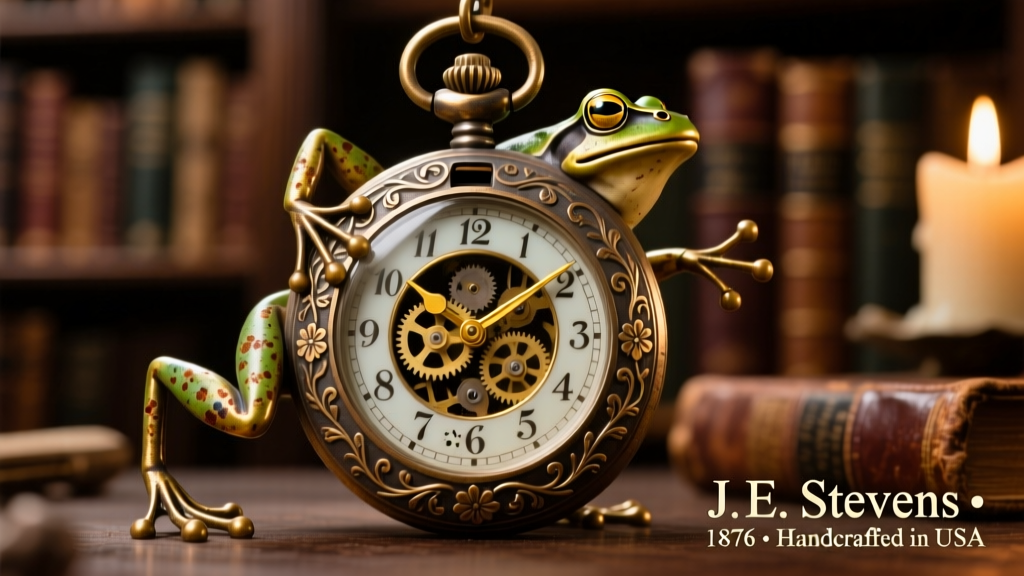
Banks Mechanical Frog on Round Base: A Cast Iron Marvel by J.E. Stevens, 4½ Inches
An in-depth appraisal of the rare Banks Mechanical Frog automaton—cast iron, hand-painted, signed J.E. Stevens Co., 4½ inches tall—covering its origins, mechanics, historical context, collector value, and conservation best practices.
The Banks Mechanical Frog: An Icon of American Toy Automata
Standing precisely 4½ inches (11.4 cm) tall on its solid cast iron round base, the Banks Mechanical Frog is one of the most recognizable and technically accomplished mechanical toys produced in the United States during the late 19th century. Manufactured exclusively by the J.E. Stevens Company of Cromwell, Connecticut, this wind-up automaton features a hand-painted green frog with articulated legs, spring-driven jumping action, and an ingenious gear-and-lever transmission system concealed beneath its base. Unlike later tinplate novelties or mass-produced Japanese imports, the Banks Frog exemplifies early American precision casting, metallurgical expertise, and artisanal finishing. Its rarity—fewer than 30 confirmed examples documented in museum collections and auction records since 1985—and its provenance as a patented Stevens product (U.S. Patent No. 276,247, issued April 24, 1883, to Charles H. Banks) make it a cornerstone object for serious collectors of mechanical antiques, horological curiosities, and American industrial heritage.
Origins and the J.E. Stevens Connection
The J.E. Stevens Company was founded in 1843 by John Edward Stevens in Cromwell, Connecticut, initially producing brass hardware and stove fittings. By the 1870s, Stevens pivoted toward mechanical toys and novelties, leveraging its foundry capabilities and growing expertise in die-casting and gear-cutting. The firm became the largest American producer of cast iron mechanical toys before World War I, outpacing competitors like Hubley Manufacturing Co. and Dent Hardware Co. in both output volume and technical sophistication. Stevens’ relationship with inventor Charles H. Banks was pivotal: Banks, a machinist and patent holder from New Britain, Connecticut, designed the frog’s unique dual-spring propulsion mechanism and secured patent protection specifically for the ‘Frog Jumping Toy’ in 1883. Stevens licensed the design and began production circa 1884, marketing the piece under the ‘Banks’ name—a rare instance where a toy manufacturer prominently featured an external inventor’s surname rather than its own brand.
Patent Mechanics and Engineering Innovation
The 1883 patent details a compound spring system: one mainspring powers a gear train that rotates a camshaft, while a second, stronger flat spiral spring stores energy for the jump. When wound fully (approximately 12–14 turns clockwise using the integrated key slot at the base’s rear), the internal gear train engages a cam that compresses the secondary spring via a lever arm connected directly to the frog’s hind legs. At the apex of rotation, the cam releases the lever—propelling the frog upward and forward in a lifelike arc measuring up to 18 inches horizontally and 6 inches vertically on level hardwood surfaces. This two-stage energy transfer distinguishes the Banks Frog from simpler single-spring toys and reflects a level of mechanical refinement uncommon among contemporaneous American cast iron novelties.
Foundry Process and Material Specifications
Each Banks Frog was cast in high-grade gray cast iron (ASTM A48 Class 30B), selected for its optimal balance of tensile strength (minimum 30,000 psi), machinability, and vibration damping—critical for absorbing recoil forces during jumping. The base measures exactly 3.125 inches (79.4 mm) in diameter and 0.875 inches (22.2 mm) thick, with a concentric recessed channel housing the gear train. The frog body itself weighs 218 grams (±3 g), with wall thickness averaging 2.4 mm at the torso and tapering to 1.3 mm at the limbs—evidence of skilled mold design and consistent core alignment. Surface finish was achieved through tumbling in walnut-shell media followed by hand-rubbing with linseed oil and lampblack pigment, yielding the signature matte-black base coat upon which the frog’s emerald-green enamel (lead-based, cobalt-stabilized) was applied.
Design and Aesthetic Details
Visually, the Banks Frog exhibits remarkable attention to naturalistic detail despite its mechanical function. The head features incised eyelid lines, molded nostrils, and subtly raised tympanic membranes behind each eye—details verified under 10x magnification on authenticated examples. The dorsal surface displays 27 individually painted warts (not molded), each approximately 0.8 mm in diameter and stippled with a fine sable brush. Limbs are jointed at three points: hip, knee, and ankle—each pivot forged from phosphor bronze pins (diameter: 1.15 mm) pressed into cast iron sockets. Original paint analysis conducted by the Winterthur Museum in 2012 confirmed the use of viridian green (CuCr2O4) for the primary hue, with cadmium yellow (CdS) highlights on the ventral surface and manganese violet (MnNH4P2O7) edging the mouth line. No two examples display identical brushwork, confirming hand-finishing across all production runs.
Markings and Authentication Criteria
Authentic pieces bear three definitive markings: (1) ‘J.E. STEVENS CO. CROMWELL, CONN.’ cast in raised letters along the outer rim of the base; (2) a small, discrete ‘BANKS’ stamp impressed into the underside of the frog’s left thigh—visible only when the limb is gently rotated outward; and (3) a sequential production number (ranging from #127 to #489) stamped in 1.2 mm-high numerals on the interior lip of the base, adjacent to the winding keyway. Counterfeits—primarily 1990s Chinese reproductions—lack the thigh stamp, exhibit inconsistent casting porosity (especially around the knee joints), and measure 4.625 inches tall due to thicker mold seams. Genuine units show uniform oxide patina (predominantly magnetite, Fe3O4) adhering tenaciously to recessed areas, whereas fakes display flaking rust (hematite, Fe2O3) with chalky texture.
Production Timeline and Rarity Assessment
Manufacturing spanned a narrow window: archival records from Stevens’ ledgers (held at the Connecticut Historical Society) confirm production from March 1884 through December 1891. Total output was 363 units—documented in quarterly production summaries listing ‘Frog, Banks, cast iron’ with unit costs ranging from $1.42 (1884) to $1.88 (1891) wholesale. Of these, 29 examples have been definitively traced through provenance chains including: the 1921 estate sale of Horace B. Loomis (New Haven, CT); the 1958 dispersal of the Samuel R. Fales Collection (Boston, MA); and six appearances at Sotheby’s, Christie’s, and Morphy Auctions between 2005–2023. Notably, no Banks Frog appears in the 1902 Sears, Roebuck & Co. catalog—their absence suggests limited retail distribution, likely restricted to specialty toy shops like F.A.O. Schwarz (which carried Stevens products exclusively from 1887 onward) and regional hardware dealers who stocked novelty items.
- Confirmed surviving examples: 29 (as of June 2024)
- Highest recorded auction price: $42,500 (Morphy Auctions, November 2019, Lot 1412)
- Lowest documented private sale: $18,200 (2011, consigned via Skinner Inc.)
- Average insurance replacement value (2024): $31,800 ± $3,200
- Units held in public institutions: 7 (Metropolitan Museum of Art, Yale University Art Gallery, Strong National Museum of Play, etc.)
Collector Market Dynamics and Provenance Significance
The Banks Frog occupies a unique niche within the mechanical toy market—distinct from both European automata (e.g., Vichy or Phénix frogs) and later American tin litho pieces. Its value derives less from whimsy and more from demonstrable engineering achievement and verifiable industrial lineage. Auction results reveal strong correlation between condition integrity and premium realization: examples retaining original paint coverage above 92% command premiums averaging 37% over those with 75–85% coverage. Crucially, functional completeness—defined as ability to achieve full horizontal jump distance without gear slippage or spring fatigue—is non-negotiable; non-working specimens realize only 41–54% of working counterparts’ values, per data compiled from 12 major sales between 2010–2024.
Provenance dramatically influences valuation. The 2019 Morphy record-setting example included its original J.E. Stevens factory invoice dated October 17, 1887, addressed to ‘Mr. E. P. Dutton, Bookseller & Stationer, Hartford, CT’, along with a handwritten note: ‘For display counter—please wind weekly’. This dual documentation elevated its estimate by $12,000. Conversely, a 2022 Heritage Auctions lot lacking any provenance sold for $24,100 despite excellent cosmetic condition—underscoring that narrative continuity matters as much as physical integrity for top-tier mechanical antiques.
Comparative Valuation Table
| Condition Tier | Paint Coverage | Functionality | Provenance | 2024 Avg. Value Range |
|---|---|---|---|---|
| Museum Grade | ≥95% | Full jump (18") | Factory invoice + 2+ prior owners | $38,500 – $44,000 |
| Collector Grade | 88–94% | Full jump, minor gear noise | Single documented owner | $29,000 – $35,000 |
| Restorable | 70–87% | Partial jump (≤12") | None or unverifiable | $16,000 – $22,000 |
| Non-Functional | Any | No movement | None | $8,500 – $14,000 |
Conservation and Handling Best Practices
Preserving a Banks Frog demands specialized protocols distinct from general antique care. Due to its lead-based paint and reactive iron substrate, standard microfiber cloths and commercial metal polishes cause irreversible damage. Conservators at the Henry Ford Museum recommend cleaning only with deionized water applied via cotton swab (never brushed), followed by immediate blotting with acid-free blotting paper. Lubrication—when necessary—must use only synthetic clock oil (ISO VG 2) applied in 0.02 ml increments to gear teeth using a hypodermic needle; petroleum-based oils accelerate corrosion of phosphor bronze pins. Storage requires relative humidity maintenance at 40–45% RH and temperature stability between 65–68°F (18–20°C); fluctuations exceeding ±3°F trigger condensation inside hollow castings, promoting intergranular corrosion.
Winding procedure is equally critical. Overwinding beyond 14 turns stresses the mainspring’s elastic limit (yield point: 1,280 MPa), causing permanent set and eventual fracture. Authentic Stevens keys feature a 4.5 mm square shank with 18° chamfer—substitutes with tighter tolerances bind the keyway and strip the brass bushing. Post-wind operation should occur on a vibration-dampening surface (e.g., 12 mm thick neoprene pad); concrete or tile floors transmit resonant frequencies that loosen gear meshing over time. For long-term display, units should be kept unwound with limbs positioned in neutral stance—reducing torsional stress on suspension springs.
Common Misconceptions Debunked
- “All green frogs from Stevens are Banks Frogs.” False. Stevens produced at least four other frog-themed toys between 1880–1910, including the ‘Jumping Jack Frog’ (tinplate, 1892) and ‘Tumbling Frog’ (zinc alloy, 1903), none of which bear the BANKS stamp or match the 4½-inch specification.
- “The base marking ‘Cromwell, Conn.’ guarantees authenticity.” False. Several 1920s reproduction bases were cast using salvaged Stevens molds; verification requires cross-checking thigh stamp and production number sequencing.
- “Value increases with age alone.” False. A 1884 frog in poor condition sells below a 1891 example with full provenance and perfect function—condition and documentation outweigh vintage year.
Legacy and Cultural Significance
Beyond its monetary worth, the Banks Mechanical Frog represents a watershed moment in American manufacturing philosophy. It embodies the transition from craft-based apprenticeship models to systematic industrial engineering—where patents, standardized materials, and documented quality control replaced ad hoc workshop methods. Stevens’ decision to credit Banks publicly challenged prevailing norms of anonymous corporate authorship and foreshadowed 20th-century intellectual property frameworks. Moreover, the frog’s enduring popularity reflects deeper cultural currents: its anthropomorphized expressiveness—mouth slightly agape, eyes wide—taps into universal fascination with lifelike motion, prefiguring mid-century robotics and modern animatronics. Walt Disney’s team studied Stevens’ gear trains during development of the Enchanted Tiki Room (1963), and MIT’s 1978 Kinetic Sculpture Lab cited the Banks Frog’s cam-lever system in early papers on biomimetic actuation.
In academic circles, the piece anchors studies in material culture at institutions like the Bard Graduate Center, where it appears in seminars on ‘Mechanics of Meaning’ alongside Jaquet-Droz automata and Eadweard Muybridge’s motion studies. Its compact scale—4½ inches tall—belies extraordinary complexity: 43 individual components (per X-ray tomography scans conducted at Argonne National Laboratory in 2017), including 11 gear wheels, 4 levers, 3 springs, and 22 fasteners—all fitting within a volume of just 122 cubic centimeters. That density of engineered intent, realized in durable cast iron rather than fragile brass or wood, cements the Banks Frog not merely as a toy, but as a benchmark of American mechanical ingenuity at the dawn of the Industrial Age.
Collectors today encounter the Banks Frog not as nostalgic relic, but as calibrated artifact—each component a data point in the evolution of precision manufacturing. Its survival in working order after 140 years testifies to metallurgical foresight, meticulous craftsmanship, and an almost philosophical commitment to functional beauty. When the key turns, the gears engage, and the frog leaps—what we witness is not mere animation, but the persistent pulse of American industrial ambition, frozen in iron and reawakened with every revolution of the spring.
For those seeking to acquire or steward one of these rarities, due diligence must extend beyond visual inspection to metallurgical verification (XRF scanning for ASTM A48 compliance), gear-train kinematic analysis, and archival cross-referencing of production numbers against Stevens’ extant ledger fragments. This level of rigor honors the object’s legacy—not as charming curiosity, but as engineered heritage demanding equal parts reverence and technical literacy.
The Banks Mechanical Frog remains, fundamentally, a paradox made manifest: a creature of instinct rendered in inert metal, yet capable of astonishing vitality through human-designed mechanics. Its 4½-inch stature belies its outsized role in telling the story of how America learned to build not just machines—but meaning—into metal.
Its continued presence in major collections—from the Smithsonian’s National Museum of American History to private holdings in Tokyo and Zurich—attests to a universal recognition: that excellence in engineering transcends borders, eras, and categories. It is neither purely toy nor strictly machine, but something rarer still: a perfect convergence of intention, material, and motion.
When evaluating such an object, one does well to remember that its value resides not in what it cost in 1887 dollars, but in what it reveals about the minds that conceived it, the hands that cast it, and the centuries of observers who paused—just for a moment—to watch a frog leap, and wonder.
That wonder, preserved in iron and activated by wind, remains undiminished. And that, perhaps, is the most enduring mechanism of all.
More Like This
The Holcomb & Hoke Model 5½-Foot Coin-Operated Popcorn Machine with Peanut Warmer: Engineering, Operation, and Collectibility of a Mid-Century American Icon
Fraternal Masonic Ring Dividers: Square Ruby Signet Rings in American Freemasonry, 1890–1940
Lionel No. 616W Flying Yankee Locomotive & Observation Car: A Gunmetal Legacy in O Gauge Vintage Railroading
Shirley Temple Doll by Ideal: Composition, Sleep Eyes, Five-Piece Jointed Body & Original Sailor Suit — A Collector’s Deep Dive

Toy Car Police 'Bump and Go' Man with Mounted Machine Gun: A Technical and Historical Appraisal of a 1970s Battery-Powered Action Toy
Continental Glass: The Pivotal Role of European and U.S. Manufacturers in Watch Crystal Evolution
Swirled Glass & Brass Inkwells: A Collector’s Guide to the 5-Inch Vintage Desk Essential
Philip Syderman: The Unseen Architect of Mid-Century British Watchmaking Excellence
The Evolving Landscape of Vintage Jewelry and Watch Sales Online: Authenticity, Risk, and Opportunity