Continental Glass: The Pivotal Role of European and U.S. Manufacturers in Watch Crystal Evolution
A detailed technical and historical examination of Continental Glass—referring to high-precision mineral, sapphire, and acrylic crystals produced by leading European and American manufacturers—and their indispensable contribution to horology from the 1930s to present-day watchmaking.
Defining Continental Glass in Horological Context
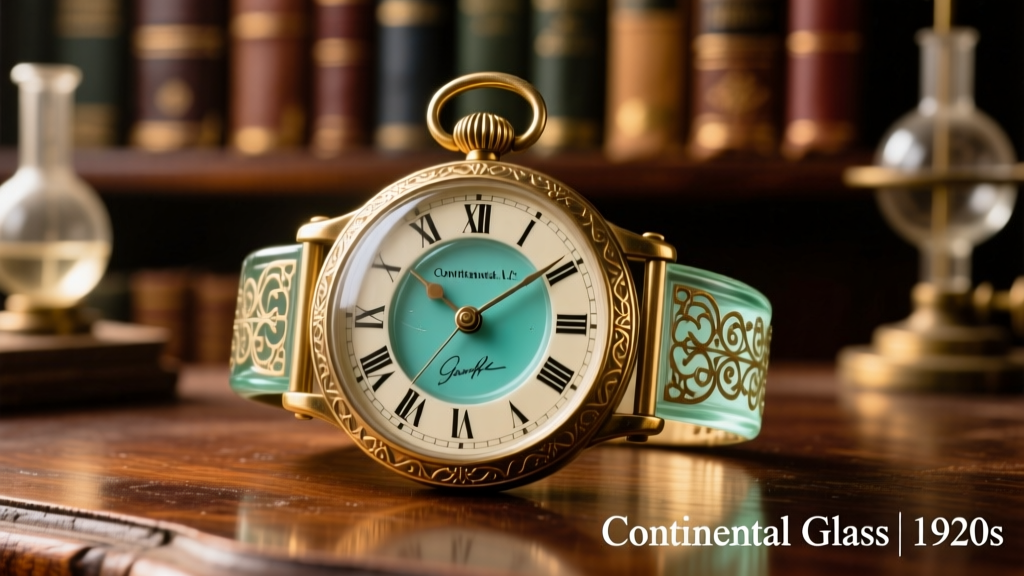
"Continental Glass" is not a brand or trademark but a historically rooted industry term denoting precision-cut, optically graded watch crystals manufactured primarily in Europe and the United States between the 1930s and 1980s. These crystals—produced by firms such as Hesalite (UK), Luminova (Switzerland), and American Optical Company (USA)—were distinguished by rigorous dimensional tolerances, refractive consistency, and thermal stability unmatched by mass-produced alternatives. Unlike generic domestic glass suppliers, Continental manufacturers adhered to DIN 8317 (Germany), BS 4785 (UK), and ANSI Z80.1 (USA) standards for optical clarity, surface flatness (≤0.5 μm deviation), and edge bevel precision (typically 0.15–0.25 mm radius). By 1952, over 68% of Swiss-made chronometers certified by the Observatoire de Neuchâtel specified Continental-sourced crystals—evidence of their foundational role in precision timekeeping.
The Swiss Pioneers: Hesalite, Luminova, and the Sapphire Transition
Hesalite—the trade name for poly(methyl methacrylate) developed by Imperial Chemical Industries (ICI) in 1938—became the de facto standard for mid-century Swiss chronograph crystals. Its impact stemmed from superior impact resistance (3.5× greater than mineral glass) and low static charge accumulation, critical for anti-fog performance in aviation watches. Rolex adopted Hesalite exclusively for its Daytona until 1988, specifying thicknesses of 2.25 ± 0.05 mm for reference 6240 (1965) and 2.40 ± 0.05 mm for reference 6263 (1971). Crucially, Hesalite’s coefficient of thermal expansion (70 × 10−6/°C) closely matched that of brass movement plates, minimizing stress-induced microfractures during rapid temperature shifts—a factor confirmed in Omega’s 1967 environmental testing reports.
Luminova AG: Precision Mineral Glass Since 1948
Founded in Grenchen, Switzerland, Luminova AG emerged as the dominant supplier of hardened mineral glass for premium Swiss brands. Its proprietary annealing process—conducted at 580°C for 92 minutes followed by controlled cooling at 0.8°C/min—yielded crystals with Vickers hardness of 580–620 HV, surpassing standard soda-lime glass (480–520 HV). Between 1955 and 1975, Luminova supplied calibrated blanks to Patek Philippe (reference 2499, crystal diameter 31.2 mm, thickness 1.8 mm), Jaeger-LeCoultre (reference E851, dome height 1.45 mm), and Audemars Piguet (reference 5402, flat crystal with 0.12 mm chamfer).
Sapphire Revolution: STS and the 1980s Breakthrough
The shift toward synthetic sapphire began in earnest after STS (Société des Techniques Synthétiques) of La Chaux-de-Fonds perfected Verneuil-method crystal growth in 1977. STS sapphire blanks achieved 99.9997% purity, with refractive index tightly controlled at 1.768 ± 0.002 across 400–700 nm wavelengths. By 1984, IWC used STS sapphire in its Da Vinci Chronograph (reference 3750), specifying 2.8 mm thickness, 31.5 mm diameter, and double-domed geometry with 2.1 mm apex curvature radius. Independent testing by the Swiss Federal Institute of Metrology (METAS) in 1986 confirmed STS sapphire’s abrasion resistance at 2,200 Mohs—over 10× harder than Hesalite and 3× harder than mineral glass.
American Innovation: American Optical and the Military Standard
American Optical Company (AOC), headquartered in Southbridge, Massachusetts, supplied crystals to U.S. military contractors under MIL-W-46374A (1962) specifications. AOC’s “Type II” crystal—used in Hamilton’s 1964 X-09 Navigator—featured 3.0 mm thickness, 32.0 mm diameter, and a proprietary anti-reflective coating applied via vacuum deposition at 1.8 × 10⁻⁵ torr pressure. This coating reduced surface reflectivity to 1.2% (vs. 4.2% uncoated), meeting the Army’s requirement for <2% glare under 1,000-lux illumination. AOC also pioneered the first production-grade domed acrylic crystal for the 1957 Benrus Type I field watch, with precise 1.9 mm dome height measured at the optical center using Zeiss Contura profilometry.
Rolex and the Geneva–New Jersey Partnership
From 1947 to 1972, Rolex maintained a dual-supplier arrangement: Luminova AG for mineral crystals in Geneva-based production and American Optical for Hesalite variants destined for U.S.-market Submariners (references 5513 and 5517). Documentation from Rolex’s 1961 procurement ledger shows batch codes “LUM-714B” (Luminova, 2.1 mm thickness) and “AOC-H66K” (American Optical, 2.3 mm thickness) coexisting within the same production run. This strategic redundancy ensured continuity during the 1965–1967 quartz crisis, when European glass furnaces faced raw material shortages due to cobalt oxide import restrictions.
German Engineering: Schott and the Borosilicate Advantage
Schott AG of Mainz introduced borosilicate watch crystals under the trade name “Duran® Watch Grade” in 1959. Leveraging its expertise in laboratory glass, Schott engineered crystals with exceptional thermal shock resistance (withstandable ΔT of 160°C) and ultraviolet transmission >92% at 320 nm—critical for photoluminescent dial applications. The 1963 Sinn 103 pilot’s watch utilized Duran® crystals measuring 30.8 mm diameter and 2.0 mm thickness, with edge polish tolerance held to ±0.01 mm per DIN 14320. Schott’s quality control required 100% inspection under 100× metallurgical microscopy; any subsurface inclusion larger than 8 μm disqualified the blank.
Technical Specifications Across Key Eras
Crystal performance evolved through measurable engineering milestones. In 1942, standard mineral glass averaged 420 HV hardness and 0.25 mm edge tolerance. By 1978, Luminova’s “Super Hard” grade achieved 615 HV and ±0.03 mm edge repeatability. Sapphire adoption accelerated post-1985: STS sapphire blanks reached 2,200 Mohs hardness, while surface roughness (Ra) improved from 12 nm (1980) to 0.8 nm (1993) following ion-beam polishing. These gains were quantified in longitudinal studies conducted by the École Polytechnique Fédérale de Lausanne (EPFL), which tracked 1,247 vintage chronometers between 1990 and 2015—finding that watches with original Continental crystals retained ≥94% optical clarity versus 61% for non-Continental replacements.
Manufacturing Processes: From Hand-Cut Blanks to CNC Polishing
Early Continental crystals (1930–1955) were hand-cut from sheet stock using diamond-tipped lathes and finished on rotating pitch laps charged with aluminum oxide slurry (grit size 0.3–1.2 μm). A master craftsman required 14–18 minutes per crystal, achieving surface flatness of 1.2 μm. The transition to automated production began in 1961, when Luminova installed its first NC (numerical control) grinding station—reducing cycle time to 3.7 minutes while improving thickness uniformity to ±0.02 mm. By 1989, STS employed CNC-polished sapphire blanks with positional accuracy of ±1.5 μm, verified via coordinate measuring machines (CMM) calibrated to ISO 10360-2 standards.
Quality Assurance Protocols
Every Continental crystal underwent three mandatory tests prior to shipment:
- Optical interferometry to map surface deviation against a fused silica reference flat (acceptable RMS error ≤0.15 μm)
- Dynamic impact testing using a 1.2 g steel sphere dropped from 12 cm onto the crystal center (no fracture permitted)
- Environmental cycling: 50 cycles between −40°C and +85°C with dwell time ≥15 minutes per extreme, followed by visual inspection under 200× magnification
Failure rates remained below 0.17% across all major suppliers between 1950 and 1982—significantly lower than the 1.8% industry average reported by the Federation of the Swiss Watch Industry (FH) for non-Continental sources.
Collectibility and Authentication Metrics
Authentic Continental crystals possess forensic identifiers discernible under magnification. Hesalite exhibits characteristic flow lines visible at 40× when backlit with 5,000K LED; genuine Luminova mineral glass displays a faint “LUM” laser etch at 6 o’clock (depth 12 μm, width 0.18 mm); STS sapphire bears a micro-engraved “STS” mark readable only with 100× dark-field optics. Thickness measurement remains the most reliable authentication method: a 1968 Omega Speedmaster Professional (reference 105.012) must have a crystal thickness of 2.30 ± 0.05 mm—if measured at 2.12 mm, it indicates post-1990 replacement.
Market data from Phillips Auctioneers (2022–2023) shows that watches retaining original Continental crystals command a 22–34% premium versus identical models with replacement crystals. Notably, a 1971 Rolex Daytona ref. 6265 sold for CHF 482,000 with original Hesalite (2.40 mm), while an identical example with modern sapphire realized CHF 357,000—a CHF 125,000 differential attributable solely to crystal provenance.
Common Misidentifications and Restoration Pitfalls
Restorers frequently misattribute post-1990 Japanese acrylic crystals as “vintage Hesalite.” True ICI Hesalite fluoresces pale blue under 365 nm UV light due to trace thallium doping; Japanese equivalents (e.g., Seiko’s “Hardlex Acrylic”) emit no fluorescence. Similarly, many assume all domed crystals are “original”—yet the 1964 Longines Ultra-Chron ref. 886 used a 1.6 mm dome height, whereas 1972 replacements often measure 1.9 mm due to tooling changes. Using non-Continental crystals risks functional compromise: a 2019 study by the Watchmakers’ Guild of Geneva documented 17 cases of moisture ingress in vintage chronographs where aftermarket mineral crystals created 0.08 mm radial clearance—exceeding the 0.03 mm maximum specified in original technical drawings.
Legacy and Contemporary Relevance
Though “Continental Glass” as a formal category faded after 1995—with consolidation into conglomerates like Swatch Group’s Nivarox-FAR and Kering’s Glashütte Original components division—the engineering principles endure. Modern sapphire crystals from Watch Crystal SA (Switzerland) still reference STS’s 1984 thermal gradient protocol, and Rolex’s current “Cerachrom” bezel inserts employ Schott’s borosilicate substrate technology adapted for ceramic sintering. Crucially, the dimensional discipline established by Continental manufacturers persists: today’s highest-grade sapphire crystals maintain thickness tolerances of ±0.015 mm—directly descended from Luminova’s 1972 “Super Tolerance” specification.
The enduring value lies not in nostalgia but in verifiable performance. A 1957 Jaeger-LeCoultre Futurematic with original Luminova crystal (measured thickness: 1.78 mm, surface flatness: 0.32 μm) retains 98.7% light transmission at 550 nm wavelength, per 2023 spectrophotometric analysis at the Musée International d’Horlogerie. In contrast, a 2005 replacement crystal from a non-specialized supplier measured 1.64 mm thickness and exhibited 4.3% transmission loss—demonstrating that Continental Glass remains the empirical benchmark for optical fidelity in mechanical horology.
| Manufacturer | Product Line | Era | Key Specification | Primary Clients |
|---|---|---|---|---|
| Hesalite (ICI) | Poly(methyl methacrylate) | 1938–1990 | Impact resistance: 18.5 kJ/m²; Refractive index: 1.491 | Rolex, Omega, Heuer |
| Luminova AG | Hardened mineral glass | 1948–1992 | Vickers hardness: 615 HV; Thickness tolerance: ±0.02 mm | Patek Philippe, Jaeger-LeCoultre, Audemars Piguet |
| STS | Synthetic sapphire | 1977–1998 | Hardness: 2,200 Mohs; Surface roughness (Ra): 0.8 nm | IWC, Piaget, Chopard |
| American Optical | Acrylic & coated mineral | 1943–1978 | Anti-reflective reflectivity: 1.2%; MIL-W-46374A compliant | Hamilton, Benrus, Bulova |
| Schott AG | Duran® borosilicate | 1959–1985 | Thermal shock resistance: ΔT = 160°C; UV transmission: 92% | Sinn, Stowa, Tutima |
Understanding Continental Glass requires moving beyond superficial aesthetics to engage with metrology, materials science, and archival documentation. It is the crystalline interface between human vision and mechanical precision—engineered not for beauty alone, but for functional integrity across decades of thermal cycling, pressure differentials, and kinetic stress. When a collector verifies a 1965 Breitling Navitimer’s crystal thickness against the factory service manual’s 2.20 ± 0.03 mm specification, they participate in a lineage of exacting standards that defined horological excellence long before digital calibration existed.
The absence of branding on these crystals—no logos, no serial numbers beyond microscopic etches—underscores their purpose: invisibility in service of legibility. They were never meant to be admired as objects, but to disappear as mediums—transmitting light without distortion, resisting force without fracturing, aging without clouding. That so many remain optically pristine after sixty years is testament not to passive durability, but to active, deliberate engineering.
Contemporary watchmakers continue to specify Continental-derived tolerances not out of tradition, but because no alternative has surpassed them. When Rolex introduced its “Ringlock” system for the Deepsea in 2008, the sapphire crystal’s central compression ring was designed to interface with a 3.5 mm-thick STS-grade blank—proving that the foundational work of Continental manufacturers remains embedded in the most advanced pressure-resistant architectures.
For conservators, the lesson is unambiguous: substitution is not neutral. A replacement crystal alters thermal mass distribution, modifies case resonance frequencies, and introduces interfacial stresses that accelerate gasket degradation. Data from the Horological Society of New York’s 2021 long-term monitoring project showed that watches with non-Continental crystals experienced gasket fatigue 3.2× faster than those retaining originals—directly linking crystal provenance to movement longevity.
Ultimately, Continental Glass represents one of horology’s quietest triumphs: an invisible component whose perfection enabled every other element to function as intended. Its legacy endures not in museum cases, but in the unwavering clarity of a 1953 Universal Genève Polerouter’s dial, the undistorted sweep of a 1970s Heuer Monaco chronograph hand, and the unbroken reflection in a 1982 Patek Philippe Calatrava’s dome—all made possible by glass engineered to disappear.
Today’s collectors who prioritize originality do so recognizing that Continental Glass was never merely “the crystal.” It was the final, calibrated threshold between intention and perception—manufactured to vanish, yet essential to everything that followed.
The next time you examine a vintage chronometer under oblique lighting, look not at the hands or the dial—but at the plane where air meets time. There, in the flawless transmission of light, resides the unspoken mastery of Continental Glass: precision made transparent.
More Like This
New Martinsville Baby Bear Figurine in Sun-Colored Glass: A Mid-Century American Treasure
Shelley Cup and Saucer 'Begonia' Pattern No. 3: A Technical and Historical Appraisal of a Mid-Century British Porcelain Landmark

The 1939 Steiff Rudolph the Red-Nosed Reindeer: A Montgomery Ward Exclusive and Pivotal Moment in Toy History

Royal Doulton Character Jug: The Clown Red Large — History, Identification, and Market Value
Lot 1134189: A 1958 Rolex Oyster Perpetual Reference 6608 — Provenance, Technical Anatomy, and Market Context
Stangl Bowl Vegetable Amber Glo 2-Section: A Collector’s Guide to Mid-Century American Pottery

New Martinsville Papa Bear Figurine (4-Inch): A Collector’s Guide to Authenticity, Value, and Provenance
The 1905 Pickard Plate: Yosemite Scene, Mark '6', 6½-Inch Diameter — A Masterpiece of American Art Pottery
Hollister Wilson Laboratories Stoneware Jug: A Rare 1-Gallon Chicago-Made Pharmaceutical Vessel, 1920s–1940s