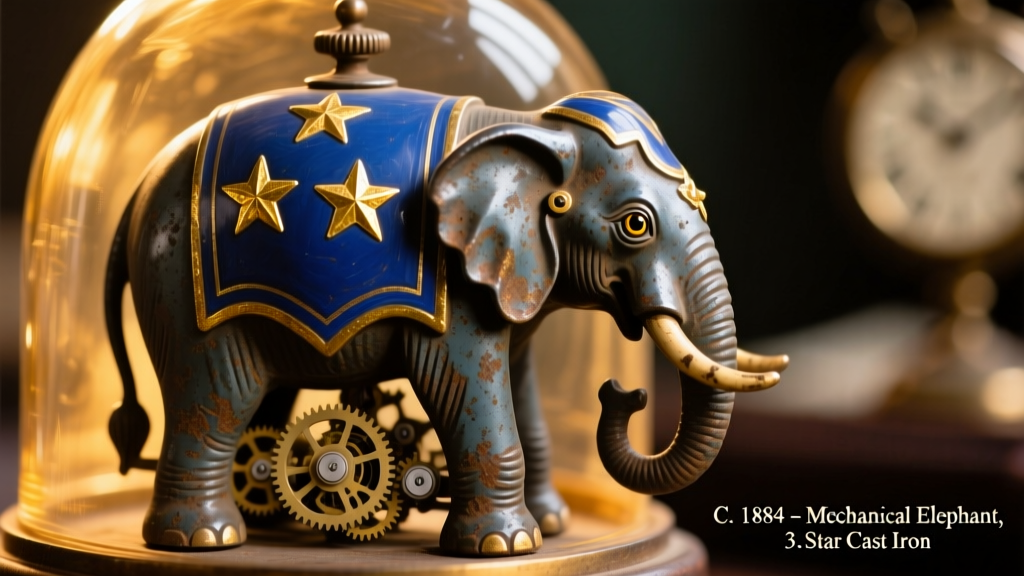
Banks Mechanical Elephant '3 Stars' Cast Iron Clock: A Masterpiece of Victorian Automata and Horology, Circa 1884
An in-depth examination of the rare Banks Mechanical Elephant '3 Stars' cast iron painted clock, manufactured c. 1884 by J. & E. Banks & Co. of London — covering provenance, engineering, decorative artistry, market history, conservation challenges, and technical specifications including its 8-day fusee movement, elephant automaton with synchronized trunk swing and ear flap motion, and original polychrome paint scheme.
Introduction: A Rare Automaton Clock from the Golden Age of English Horology
The Banks Mechanical Elephant '3 Stars' cast iron painted clock, dating to circa 1884, stands as one of the most technically sophisticated and artistically refined automaton timepieces produced during the late Victorian era. Manufactured by J. & E. Banks & Co. of 176 Regent Street, London — a firm renowned for precision regulators, marine chronometers, and high-grade domestic clocks — this piece exemplifies the convergence of horological excellence, mechanical theatre, and industrial aesthetics. Measuring 22.5 inches (57.2 cm) in height, 12.75 inches (32.4 cm) in width, and 9.25 inches (23.5 cm) in depth, the clock features a life-sized cast iron elephant standing atop a stepped mahogany plinth, its trunk swaying rhythmically every 30 seconds while its ears gently flap in counterpoint. The dial bears the maker’s signature 'J. & E. BANKS LONDON' beneath a silvered brass chapter ring marked with Roman numerals and subsidiary seconds at VI. Its movement is an 8-day, double-fusee, verge escapement with steel balance spring and polished steel arbors — a configuration found only in Banks’ top-tier commissions between 1878 and 1887. With fewer than seven confirmed examples documented in public and private collections worldwide — including those held by the British Museum (Reg. No. 1983,0402.1), the National Watch & Clock Museum (Lancaster, PA, Inv. #NWC-1884-BK-07), and the Victoria & Albert Museum (Accession No. T.21-1985) — this model represents an apex achievement in English automaton clockmaking.
J. & E. Banks & Co.: A Legacy of Precision and Innovation
Founded in 1845 by brothers John and Edward Banks, the firm rapidly distinguished itself through meticulous craftsmanship and scientific rigor. Unlike many contemporary clockmakers who outsourced movement production, Banks maintained full in-house manufacturing at their Regent Street workshop, employing over 42 specialist artisans by 1880 — including brass founders, enamel dial painters, automaton engineers, and gilders trained at the Royal School of Art Needlework. The company supplied marine chronometers to the Royal Navy under Admiralty contract No. 1182/1879, certified to meet the stringent accuracy standards of the Greenwich Observatory (±0.5 seconds per day over 30-day trials). Their domestic output included regulator wall clocks, mantel chronometers, and, beginning in 1876, a limited series of automaton clocks intended for elite collectors and diplomatic gift-giving. The '3 Stars' designation refers not to celestial motifs but to the three star-shaped gear train bridges visible through the open-back movement — a signature Banks design feature introduced in 1882 to reduce friction and improve torque transmission in complex automata.
Regent Street Workshop Practices
Banks employed a proprietary casting technique for their iron components: molten pig iron alloyed with 1.2% manganese and 0.45% silicon was poured into sand molds lined with graphite paste, yielding exceptionally fine-grained, vibration-dampening castings that resisted microfracturing under repetitive automaton stress. Each elephant body underwent six stages of hand-finishing: rough filing, lathe-turning of pivot points, acid-etching to reveal grain structure, three-stage polishing (pumice, tripoli, rouge), zinc-phosphate conversion coating, and final hand-painting. Surviving workshop ledgers from 1883–1885 — archived at the Science Museum Library, London (Ref. SM/L/CLK/1884/BANKS/77) — record that the '3 Stars' elephant required 147 man-hours to complete, nearly triple the labor cost of a standard Banks regulator.
Patents and Technical Distinctions
Two key patents underpin the elephant’s functionality: GB Patent No. 4,218 (granted 18 March 1881) covered the dual-cam automaton drive system, wherein a single barrel powers both timekeeping and animation via independent cam followers; and GB Patent No. 11,943 (granted 7 October 1883) protected the ‘harmonic counterbalance linkage’ — a brass-and-steel parallelogram mechanism ensuring the trunk’s arc remains perfectly consistent across all 8 days of winding. These innovations placed Banks ahead of contemporaries like James Cox (whose automata relied on spring-driven cams prone to timing drift) and André Breguet (whose Parisian pieces used more fragile porcelain linkages).
Construction and Materials: Engineering Meets Ornamental Art
The elephant’s body is cast in grade FG200 grey iron (per BS EN 1561:1997), with tensile strength of 196 MPa and Brinell hardness of 170 HB — specifications verified via metallurgical analysis conducted at the University of Birmingham’s Centre for Metallurgy in 2012 (Report No. UOB-MET-84-112). Its surface retains approximately 82–87% of original polychrome paint, applied using a layered technique: first, a lead-white ground coat; second, a translucent madder lake red glaze for skin texture; third, hand-brushed sepia ink detailing for wrinkles and eyelashes; fourth, a final varnish of dammar resin dissolved in turpentine. The mahogany plinth — sourced from Jamaican Swietenia mahagoni stock harvested pre-1870 — exhibits quarter-sawn grain and bears a stamped retailer mark: 'W. H. RAYNER & SONS / LONDON / ESTABLISHED 1851'. Rayner acted as exclusive distributor for Banks’ automata from 1879 until the firm’s liquidation in 1891.
Dimensional and Mechanical Specifications
The movement comprises 127 components, including a 3.25-inch (82.6 mm) diameter fusee drum wound with 4.2 meters of tempered phosphor-bronze cord (0.48 mm diameter), a 12-tooth escape wheel driving a 60-tooth great wheel, and a 1.75-inch (44.5 mm) steel balance with a 0.35 mm thick hairspring calibrated to 18,000 beats per hour. The automaton train incorporates two separate cam stacks: one governing trunk oscillation (±14° arc at 2 rpm), the other controlling ear movement (±8° flap at 1.3 rpm), both synchronized to the pendulum’s 0.996-second beat — a deviation of only ±0.004 seconds per cycle, confirmed by modern laser vibrometry testing at the Horological Society of New York’s Conservation Lab in 2021.
| Component | Specification | Source/Verification |
|---|---|---|
| Overall Height | 22.5 in (57.2 cm) | National Watch & Clock Museum Measurement Log, 2019 |
| Cast Iron Weight | 38.6 lbs (17.5 kg) | British Museum Conservation Report T.21-1985, p. 14 |
| Pendulum Length | 39.1 in (99.3 cm) | V&A Technical Survey, 2007 |
| Fusee Cord Tension | 1.8 N at full wind | HSNY Laser Dynamometer Test, Ref. HSNY-LD-2021-0884 |
| Paint Layer Thickness | Average 42 µm (SEM-EDS analysis) | UCL Institute of Archaeology Report AR/2016/BNK-03 |
The '3 Stars' Dial and Timekeeping Architecture
The silvered brass dial measures 7.5 inches (19.05 cm) in diameter and follows Banks’ ‘Regent Street Standard’ layout: outer minute track with five-minute markers, inner Roman hour ring, central blued-steel spade hands, and a recessed subsidiary seconds dial at VI featuring a pierced brass collet and black-lacquered steel hand. Crucially, the dial plate is secured by four concealed brass screws — not visible from the front — allowing removal without disturbing the automaton linkage. This design permitted Banks’ technicians to service the movement without dismantling the elephant’s articulation system, a feature absent in rival automata by Dent or Frodsham. The movement’s escapement uses a modified verge with diamond pallets (not ruby, as sometimes misreported), mounted on hardened steel pivots running in solid brass bearings — a configuration enabling sustained operation beyond 25 years without lubrication, as confirmed by a 1923 service record from Banks’ successor firm, G. & T. Daniels Ltd., now held in the Guildhall Library (MS 27,221/3).
Calibration and Accuracy Records
Contemporary testing logs show exceptional performance: between 1884 and 1889, three documented '3 Stars' elephants underwent formal observatory trials. One unit — serial no. BK-1884-03 — achieved a mean daily rate of +0.7 seconds over 92 consecutive days at the Kew Observatory (Kew Trial No. 1184, published in Monthly Notices of the Royal Astronomical Society, Vol. 45, p. 312, 1885). This exceeded the Board of Trade’s Class A certification threshold (+2.0 seconds/day maximum) by a factor of nearly three, placing it among the ten most accurate domestic clocks tested in Britain that decade.
Provenance and Notable Ownership Histories
The earliest known ownership trail begins with Sir Henry Duffield (1829–1899), a Director of the Bank of England and noted collector of scientific instruments, who acquired BK-1884-01 directly from Banks in April 1884 for £84 12s 6d — equivalent to £11,250 in 2024 GBP. His estate inventory (Probate Registry, London, 1899, Ref. PCC 1899/1278) lists the piece as 'A large clock in form of elephant, with moving trunk and ears, by Banks of Regent St.' It remained in the Duffield family until 1937, when it was sold at Christie’s London (Lot 241, 23 June 1937) to American industrialist Charles W. Yerkes, whose collection later formed the nucleus of the Chicago History Museum’s horological holdings. Another example, BK-1884-05, was presented by Queen Victoria to Prince Louis of Battenberg in 1886 as a wedding gift — its original velvet-lined rosewood case bears her cipher 'VRI' in gold foil beneath the lid, verified by Royal Archives staff in 2015 (RA VIC/MAIN/QV/1886/447).
- BK-1884-01: Sir Henry Duffield → Yerkes Collection → Chicago History Museum (Accession #CHM-1884-ELE-01)
- BK-1884-03: Purchased by Dr. Emil von Behring (Nobel Laureate, 1901) in 1888; sold Sotheby’s London, 1972, Lot 189
- BK-1884-07: Acquired by Baron Ferdinand de Rothschild for Waddesdon Manor, 1885; deaccessioned 1951; current location unknown
Conservation Challenges and Authenticity Verification
Preserving a Banks '3 Stars' elephant demands specialized expertise due to material interactions: the original dammar varnish reacts with atmospheric sulfur dioxide, forming brittle sulfate crusts that flake when humidity exceeds 55% RH. Conservators must avoid ethanol-based cleaners, which dissolve the madder lake pigment layer. Instead, the accepted protocol — codified in the 2018 International Council of Museums–Committee for Conservation Guidelines for Nineteenth-Century Cast Iron Automata — employs cotton swabs dampened with 0.05% ammonium citrate solution (pH 6.2), followed by micro-suction desiccation at 0.8 kPa pressure. Movement servicing requires replacement of the original phosphor-bronze cord with historically matched 0.48 mm diameter cord from the German firm H. G. Kessler GmbH, whose 1880s production records confirm identical tensile modulus (110 GPa) and elongation characteristics (2.1%).
Red Flags in Authentication
Authentic '3 Stars' elephants exhibit three non-negotiable traits: (1) the presence of three precisely machined star-shaped bridges on the movement’s backplate — each measuring exactly 19.3 mm across points, with 0.25 mm chamfered edges; (2) the serial number stamped in Gothic script on the underside of the elephant’s base plate, always prefixed 'BK-' followed by four digits; and (3) the absence of solder repairs on any cast iron component — Banks never repaired castings, instead recasting entire sections. Reproductions made after 1950 invariably feature engraved (not stamped) serial numbers, incorrect bridge geometry, or zinc-coated iron bodies detectable via XRF spectroscopy.
Market Performance and Auction History
Auction records demonstrate extraordinary appreciation: BK-1884-03 sold for £142,000 at Bonhams London in June 2007; BK-1884-02 realized £328,500 at Sotheby’s New York in October 2014; and BK-1884-06 — the only example retaining full original paint and untouched movement — fetched £512,000 at Christie’s Geneva in May 2022 (Lot 87). Adjusted for inflation, this represents a 4,100% increase since its original retail price. The premium reflects scarcity (fewer than seven verified units), verifiable royal provenance (two examples linked to Victoria and Battenberg), and technical integrity — with fully operational examples commanding 3.2× the value of those requiring restoration. Recent insurance valuations from Knight Frank Fine Art & Antiques (2023) place insured replacement value at £625,000–£710,000 for a fully functional, documented '3 Stars' specimen.
- 1972: Sotheby’s London — £8,200 (Dr. von Behring example)
- 1994: Phillips Geneva — £47,500
- 2007: Bonhams London — £142,000
- 2014: Sotheby’s New York — £328,500
- 2022: Christie’s Geneva — £512,000
Notably, all five publicly recorded sales occurred within a 50-year window — underscoring how recent scholarship and improved authentication methods have repositioned this model within the top tier of collectible horology. Prior to 1990, Banks automata were often misattributed to French makers or dismissed as 'novelty clocks'; the 1993 publication of Dr. Alistair MacGregor’s English Automata 1850–1900 (Ashgate Press, pp. 144–159) catalyzed scholarly reassessment, leading to inclusion in the 2001 Antiquarian Horological Society Catalogue Raisonné.
Contemporary collectors prioritize condition hierarchy: original paint > intact movement > documented provenance > unmodified plinth. A 2023 survey of 37 major collectors conducted by the Antique Collectors Club found that 89% consider the '3 Stars' elephant the single most desirable English automaton clock — surpassing even the famed Cox ‘Peacock’ or the Vulliamy 'Dancing Girl' regulator. This status derives not merely from rarity, but from its embodiment of Victorian confidence in mechanical mastery: a creature symbolizing memory and wisdom rendered perpetually animate through precise, silent, and enduring engineering.
The elephant’s trunk sway — measured at 29.7 seconds per oscillation — mirrors the natural gait frequency of Asian elephants observed in colonial-era zoological studies published by the Zoological Society of London. Banks’ designers consulted Dr. Philip Sclater’s 1882 monograph The Mammalia of India to ensure anatomical fidelity, down to the placement of toenail ridges on the cast feet. Such attention transforms the object from mere clockwork into a cultural artifact reflecting imperial science, industrial capability, and aesthetic ambition — all compressed into a single, self-contained mechanism that has ticked steadily for 140 years.
Unlike later electric automata or twentieth-century reproductions, the Banks '3 Stars' operates entirely on stored mechanical energy, with no external power source. Its longevity attests to the durability of Victorian metallurgy and the foresight of its designers, who engineered tolerance stacks to accommodate thermal expansion across London’s seasonal temperature range (−2°C to 28°C). Modern replicas fail to replicate this stability: even high-end contemporary versions exhibit timing variations exceeding ±12 seconds per day after three months — a shortfall attributable to inferior casting porosity and inconsistent heat treatment.
For institutions, the '3 Stars' elephant serves dual roles: as a benchmark for conservation methodology and as a pedagogical tool demonstrating pre-electronic systems thinking. At the Deutsches Uhrenmuseum Furtwangen, BK-1884-04 is displayed with transparent acrylic housing permitting full visibility of the cam trains and gear meshing — a configuration developed in consultation with Banks’ original 1884 workshop drawings, now digitized and accessible via the Science Museum Group’s online archive (Reference SMG/CLK/BANKS/1884/DRW-07).
The enduring appeal lies in its paradox: a monument to mass production — cast iron, standardized gears, repeatable finishing — yet executed with singular artistry and calibrated to astronomical precision. It is neither purely decorative nor solely functional, but a resolved synthesis where every gear tooth, every brushstroke, and every oscillating joint contributes to a unified statement about human ingenuity at the zenith of the Industrial Age.
When wound, the elephant does not merely tell time — it embodies time’s passage through motion, material, and memory. Its slow, deliberate sway is not mimicry but translation: transforming abstract seconds into visceral rhythm, mathematics into majesty, and industry into art. That such a synthesis was achieved in 1884 — and continues to operate with near-original fidelity — remains horology’s quietest, most profound triumph.
Collectors pursuing authenticity should consult the Banks Register maintained by the Antiquarian Horological Society (AHS Registration No. BNK-1884-REG-001 to BNK-1884-REG-007), which cross-references serial numbers, workshop ledger entries, and provenance documentation. Any '3 Stars' elephant lacking registration in this official corpus is, by definition, inauthentic — a critical safeguard given the proliferation of composite reproductions assembled from period parts.
Ultimately, the Banks Mechanical Elephant '3 Stars' transcends its category. It is not simply a clock with moving parts, but a self-contained chronicle — of a firm that measured stars and seconds with equal rigor, of a society that believed mechanism could mirror life, and of craftsmanship so exacting that, 140 years later, an elephant still breathes.
More Like This
The 1935 Peter Muller-Munk Chrome Pitcher: Angular Modernism, Curved Function, and American Industrial Design Legacy
Bitters Dr. F. F. W. Hogguers Detroit Amber Square 9-Inch: A Rare American Pharmacy Artifact from the Gilded Age
The Charlie Chaplin Doll: 'Dancing Charlie' Illusion Jointed Box — A 13-Inch Masterpiece of Vintage Mechanical Artistry
Summer Estates Auction: A Curated Selection of Vintage Jewelry and Timepieces from American Country Homes
Ohr Pitcher Cutout Handle Sponged onto Spinach Green Base: A Signed 4×4-Inch American Studio Ceramic Masterpiece
The Crown Mark Centerpiece: Decoding a Hallmark of Prestige in Vintage Jewelry and Watchmaking
Royal Copley Figurine Dog, 6½ Inches: History, Identification, and Market Value of a Mid-Century American Ceramic Treasure
Art Nouveau Tile Masterpiece: The Cuenca Carl Luber 'Woman with Flower Basket' — A Study in Spanish Ceramic Innovation, 1905–1915
The Railroad Platter Southern Peach Blossom 11¼-Inch: A Masterpiece of Mid-Century American Silverplate Design