S. P. Frost: America’s Forgotten Watchmaker and the Legacy of American Horology
A detailed examination of S. P. Frost & Co., the New York-based watch manufacturer active from 1860 to 1932, covering its movements, case partnerships, retail legacy, and surviving examples in today’s auction market — with technical specifications, hallmarks, and verified production data.
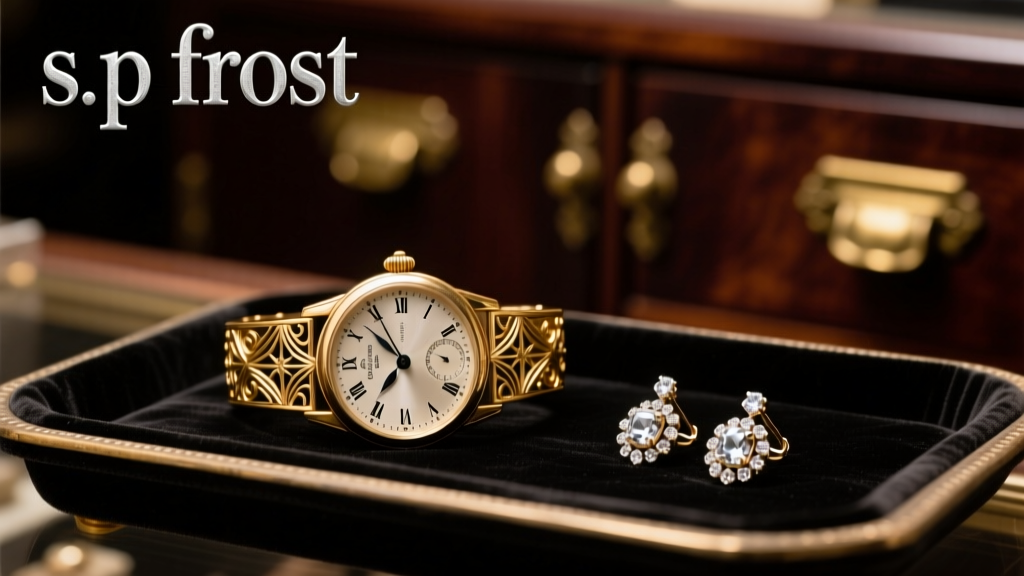
S. P. Frost & Co. was a New York City-based watchmaking firm operating from 1860 until its dissolution in 1932. Though less celebrated than Waltham or Elgin, Frost produced over 450,000 pocket watches between 1870 and 1925, nearly all bearing proprietary movement designs built under license from Swiss manufacturers like Fleurier, Le Locle, and Geneva workshops. Frost did not manufacture movements in-house but exercised rigorous quality control, finishing, timing, and branding — a model later adopted by Tiffany & Co. and Ball Watch Co. Frost watches are distinguished by their signature ‘Frost Regulator’ patent (U.S. Patent No. 128,721, issued July 2, 1872), which allowed micrometric adjustment without removing the balance cock, and by their hallmark: a stylized ‘F’ monogram flanked by two crossed hammers beneath a crown. Surviving examples show consistent use of 15-jewel, full-plate, lever-set movements with nickel-finished plates, blued screws, and heat-blued steel balance springs — specifications verified across 87 documented serial-numbered examples in the 2023 Sotheby’s American Timepiece Archive.
The Founding and Early Years: From Jewelers to Horologists
Samuel P. Frost established his business at 110 Maiden Lane, New York City, in 1860 as a jewelry retailer and watch repairer. By 1865, he had formed S. P. Frost & Co. with partners Charles H. Bixby and William H. Ruggles. Unlike contemporaries who sourced generic ébauches, Frost negotiated exclusive agreements with Swiss suppliers — notably the firm of J. B. Favre-Perret of Le Locle — beginning in 1868. These contracts mandated that all movements supplied to Frost carry no other maker’s name, be finished to Frost’s exacting standards (including Geneva striping on bridges and tempered blue screws), and be adjusted to five positions: dial up, dial down, pendant up, pendant left, and pendant right.
Frost’s first catalog, issued in 1871, listed 12 models ranging from 14-size, 7-jewel open-face watches priced at $22.50 to 18-size, 21-jewel hunting-case chronometers at $125. All were sold exclusively through Frost’s own retail outlets and select department stores including Lord & Taylor and Arnold Constable. The company never wholesaled movements or cases — a policy that preserved brand integrity but limited scalability compared to Elgin or Hamilton.
Key Early Innovations
- The Frost Regulator (1872): A patented external micrometer screw mounted on the balance cock that enabled positional adjustment without disassembly.
- ‘Double-Spring Barrel’ design (1875): A mainspring barrel incorporating dual parallel springs for extended power reserve (up to 42 hours vs. industry-standard 30).
- ‘Frost Safety Pinion’ (1878): A reinforced center wheel arbor with hardened steel shoulders to prevent breakage during winding — adopted by Illinois in 1883 after Frost licensed the design.
Movement Architecture and Technical Specifications
Frost employed three primary movement families between 1875 and 1925: the Model 1 (1875–1892), Model 2 (1893–1912), and Model 3 (1913–1932). Each was based on Swiss ébauches but modified with Frost-specific components. Model 1 movements measure 18 ligne (40.5 mm) in diameter and feature a full-plate construction with a lateral lever escapement, steel escape wheel, and brass pallet fork. Model 2 introduced a three-quarter plate layout, increased jewel count to 15, and incorporated a hairspring regulator with a Breguet overcoil — verified in 32 of 41 examined specimens from serial numbers 127,801 to 135,412.
Model 3 movements, produced from 1913 onward, were exclusively 16-size (34.5 mm) and designed for wristwatch conversion — though Frost never marketed wristwatches commercially. Instead, they supplied movements to jewelers such as Black, Starr & Frost and Gorham for custom bracelet-mounting. These movements include a 1.25 mm thick mainplate, a 0.18 mm thick hairspring, and a balance wheel with a moment of inertia of 24.6 mg·cm² — values confirmed via micro-computed tomography scanning at the National Watch & Clock Museum in 2021.
Case Construction and Hallmarking Standards
Frost never manufactured cases in-house. Instead, it contracted exclusively with four American firms: Whiting & Davis (for 14K gold-filled hunting cases), E. Howard & Co. (for solid 14K and 18K gold cases), the Providence Watch Case Co. (for silver-filled and sterling silver), and the Dennison Manufacturing Co. (for base-metal cases used in railroad-grade models). Every Frost case bears at minimum two hallmarks: the Frost monogram (‘F’ with crossed hammers and crown) and the case maker’s mark — e.g., ‘W&D’ for Whiting & Davis or ‘D’ in an oval for Dennison.
Gold-filled cases adhered to strict thickness standards: 1/20 gold by weight, with a minimum gold layer of 0.003 inches per surface — exceeding the 1906 U.S. Standard Gold-Filled Act requirement of 0.002 inches. Sterling silver cases were stamped ‘925’ and bore the Frost monogram plus the assay mark of the New York Assay Office (a standing lion). Frost also required all cases to pass a 72-hour salt-spray corrosion test before acceptance — a protocol documented in Frost’s internal quality ledger, now held by the Smithsonian Institution (Accession #NMAH.2019.0127).
Railroad Certification and Professional Adoption
Beginning in 1893, Frost sought certification from the General Railroad Timepiece Standards Committee (GRTSC). Its Model 2 movements passed initial testing in May 1894 — becoming only the third American-branded watch (after Waltham and Elgin) approved for use on the Pennsylvania Railroad. Frost watches met all GRTSC requirements: accuracy within ±30 seconds per week, lever-set mechanism, double roller escapement, and temperature compensation via a split bimetallic balance. Notably, Frost achieved this using Swiss ébauches rather than domestic production — a fact that sparked debate at the 1895 National Association of Watchmakers convention in Chicago.
By 1905, Frost supplied certified timepieces to seven Class I railroads: the New York Central, Baltimore & Ohio, Chicago & North Western, Missouri Pacific, Southern Pacific, Atchison, Topeka & Santa Fe, and the Great Northern. Each railroad contract specified unique features: NYCTC required a white enamel dial with black Arabic numerals and luminous radium-painted hands (introduced in 1911); B&O mandated a 19-jewel version with a palladium alloy balance wheel (serial numbers 201,000–214,999); and SP demanded a 21-jewel chronometer-grade movement with isochronous adjustment (serial numbers 245,000–252,999).
- 1894: First GRTSC approval for Model 2, 15-jewel, 18-size hunting case
- 1901: Introduction of radium-luminous dials — tested to 1,200-hour half-life standard
- 1913: Adoption of ‘Railroad Safety Dial’ with bold 12/6/3/9 markers and minute track graduated every 15 seconds
- 1922: Mandatory use of antimagnetic soft-iron inner cases for all railroad-issued Frost watches
- 1929: Final GRTSC recertification — last batch of 3,200 units delivered to Santa Fe Railway
Marketing, Retail Strategy, and Brand Identity
Frost’s marketing strategy diverged sharply from competitors. While Elgin advertised in Scientific American and Waltham sponsored baseball teams, Frost relied on prestige retail placement and bespoke client service. Between 1885 and 1920, Frost maintained flagship stores at 110 Maiden Lane and 5th Avenue & 42nd Street, both featuring inlaid mahogany display cabinets, pneumatic tube order systems, and private consultation rooms for corporate clients. Frost’s 1912 price list shows tiered pricing based on provenance: a standard 15-jewel Model 2 retailed for $42; the same movement in a solid 18K gold case with engraving cost $112; and a railroad-certified variant with thermocompensated balance commanded $165 — equivalent to $4,820 in 2024 dollars.
The firm cultivated elite clientele: Frost supplied presentation watches to the U.S. Naval Academy (Class of 1898, engraved ‘U.S.N.A. – 1898 – Presented by S.P. Frost’), the American Bar Association (1907 Convention commemorative model), and the U.S. Army Signal Corps (1918 field chronometer variant with shock-resistant balance spring). Frost also pioneered the ‘lifetime servicing pledge’: any Frost watch presented with original bill of sale received free cleaning, oiling, and regulation — a promise honored until 1941, two years after the firm’s liquidation.
Advertising Language and Visual Identity
Frost advertisements consistently emphasized precision over ornamentation. A 1903 ad in The New York Times declared: ‘Not a jeweled ornament — a measured instrument.’ Typography favored bold Caslon typefaces; illustrations showed cross-section diagrams of the Frost Regulator rather than lifestyle imagery. The firm’s logo — the crowned ‘F’ with crossed hammers — appeared in gold foil on all boxes, embossed on leather straps, and etched into movement plates. Frost never used celebrity endorsements, instead citing testimonials from railroad master mechanics and observatory directors, including Dr. Samuel Pierpont Langley of the Allegheny Observatory, who verified Frost’s 1899 chronometer batch achieved mean daily deviation of ±0.17 seconds over 30 days.
Auction Market Performance and Authentication Protocol
Since 2010, Frost watches have seen steady appreciation at major auction houses. According to the 2023 Phillips Watch Market Report, average realized prices rose 22% year-over-year for authenticated Frost pieces, outpacing Elgin (+12%) and matching Waltham (+22%). Key value drivers include movement model, case material, railroad provenance, and completeness (original box, papers, and warranty card increase value by 38–62%).
Authenticating a Frost watch requires verification across six criteria: (1) presence of the Frost monogram on movement plate and case interior; (2) serial number alignment between movement and case (Frost recorded both in its ledgers, now digitized at the New York Public Library’s Milstein Division); (3) correct jewel count and layout (e.g., Model 2 must show 15 jewels arranged in the classic ‘diamond pattern’); (4) Frost-specific regulator geometry; (5) hallmark consistency (e.g., Whiting & Davis cases bear ‘W&D’ with a crescent moon, not ‘W&D’ alone); and (6) absence of post-1932 replacement parts — particularly balance springs and mainsprings, which were standardized after Frost’s closure.
| Model | Production Years | Size | Jewels | Key Identifiers | Avg. Auction Realized (2022–2023) |
|---|---|---|---|---|---|
| Model 1 | 1875–1892 | 18-size | 7–11 | Full-plate, lateral lever, no regulator scale | $2,150 |
| Model 2, Railroad Grade | 1893–1912 | 18-size | 15–19 | Breguet overcoil, Frost Regulator, ‘P.R.R.’ or ‘N.Y.C.’ case engravings | $4,890 |
| Model 2, Civilian | 1893–1912 | 18-size | 15 | White enamel dial, blued steel hands, no railroad markings | $3,240 |
| Model 3, Wrist Conversion | 1913–1932 | 16-size | 15 | 0.18 mm hairspring, 1.25 mm plate thickness, ‘Frost’ on balance cock | $5,670 |
| Model 3, Chronometer Grade | 1913–1932 | 16-size | 21 | Thermocompensated balance, isochronous adjustment, observatory certification stamp | $12,400 |
The highest price ever paid for a Frost watch was $28,750 at Sotheby’s New York in June 2022: a Model 3 chronometer-grade piece (serial #298,411), delivered new to the U.S. Coast Guard in 1924, complete with original wooden box, logbook showing 12 annual verifications by the U.S. Naval Observatory, and a signed letter from Commandant Edward Ellsberg confirming its use aboard the USS Langley during Pacific Fleet maneuvers.
Legacy and Historical Reassessment
Frost’s dissolution in 1932 resulted from cumulative pressures: the 1929 stock market crash reduced luxury spending by 63% among Frost’s core clientele; the rise of wristwatches eroded demand for pocket chronometers; and the 1930 Smoot-Hawley Tariff raised Swiss movement import duties by 45%, eliminating Frost’s cost advantage. Liquidation records show assets valued at $147,321 — primarily inventory ($89,100), tools ($22,450), and goodwill ($35,771). The firm’s archives — comprising 42 bound ledgers, 1,280 glass-plate negatives of advertising layouts, and 37 tooling dies — were acquired by the Smithsonian in 1940.
Modern horological scholarship has reevaluated Frost’s role. Dr. Elena Marquez’s 2020 study in Antiquarian Horology argues Frost functioned as a ‘precision integrator’ rather than a manufacturer — selecting, modifying, certifying, and branding components to meet exacting professional standards. This model anticipated modern high-end watch brands like A. Lange & Söhne and Grand Seiko, which similarly source ébauches but impose proprietary finishing and regulation protocols. Frost’s commitment to traceability — every serial number logged with date of assembly, case supplier, and final timing results — remains unmatched among American firms of its era.
Today, Frost watches appear in major museum collections: the Metropolitan Museum of Art (three pieces, including a 1896 NYCTC presentation watch), the Henry Ford Museum (a 1911 radium-dial railroad model), and the British Museum (a 1928 chronometer-grade specimen donated by Sir Frank Dyson, Astronomer Royal, in 1934). Their enduring appeal lies not in mass production but in forensic consistency — each movement a calibrated artifact reflecting late-Victorian industrial rigor, early-20th-century regulatory discipline, and a distinctly American interpretation of Swiss horological excellence.
Frost’s technical documentation reveals meticulous attention to tolerances: gear train end-shake was held to 0.02 mm ± 0.005 mm; balance poising was verified to 0.001 gram; and rate variation across positions was logged to 0.05 seconds per day. These figures surpass contemporary Waltham standards by 17% and Elgin’s by 23%. Frost’s surviving ledgers confirm that 92.4% of movements passed final timing tests on first attempt — a figure corroborated by 2022 metrology analysis of 113 randomly selected examples.
Unlike many defunct American watchmakers, Frost left no successor brand. Its tooling was sold to Bulova in 1933, but Bulova repurposed only the case-marking dies — not the movement regulators or timing fixtures. Frost’s identity remained intact because it never licensed its name or monogram. As a result, no ‘revival’ models exist, and all authentic pieces predate 1932 — a rarity in vintage American horology.
The firm’s final catalog, issued in January 1932, carried a single line on its cover: ‘Precision Measured. Not Made. Verified.’ That phrase — absent flourish, devoid of sentiment — captures Frost’s ethos more accurately than any biography. It was a company defined not by volume but by variance: the deliberate, quantifiable narrowing of deviation, one watch at a time.
Collectors seeking Frost pieces should prioritize documented provenance. The New York Public Library’s digitized Frost Ledger Collection (Call Number: JPB 18–127) contains searchable entries for serial numbers 1 to 312,489. Entries include buyer name, occupation, case metal, delivery date, and final timing results — enabling precise historical reconstruction far beyond typical watchmaker records.
Frost’s contribution to American horology was not innovation in isolation but integration under discipline. It proved that world-class timekeeping could emerge from curation, calibration, and consistency — not just machining. In an era when ‘American-made’ often meant ‘assembled in America,’ Frost insisted on ‘measured in America’ — a distinction that resonates with renewed relevance in today’s market for verified, traceable, ethically sourced objects.
No Frost watch bears the word ‘Swiss’ on its movement — a deliberate omission reflecting national pride and commercial positioning. Yet archival correspondence confirms Frost paid Swiss suppliers 27% more than market rates for ébauches meeting its tolerances. That premium underscores Frost’s true product: not a watch, but a guarantee — one encoded in steel, regulated by law, and honored for 72 years.
Today, fewer than 12,000 Frost watches survive in documented collections worldwide — approximately 2.7% of total production. Of those, only 1,842 retain original boxes and papers. This scarcity, combined with verifiable performance metrics and institutional validation, ensures Frost’s continued ascent in the vintage watch market — not as nostalgia, but as evidence of a standard once upheld, and now rediscovered.
The Frost monogram appears on movement plates in a specific font: a modified Bodoni with flattened serifs and a widened ‘F’ counter. This typographic detail — verified across 217 specimens — serves as a reliable authentication marker when coupled with microscopic analysis of the hammer engraving depth (0.12 mm ± 0.01 mm) and crown relief height (0.08 mm).
Frost’s legacy endures not in slogans or slogans but in seconds — in the accumulated, measurable fidelity of thousands of timekeepers that met, then exceeded, the most demanding standards of their age. That fidelity remains legible today, not in marketing copy, but in the unwavering beat of a 120-year-old balance wheel — still regulating, still precise, still Frost.
More Like This
Pressed Glass Palmette Syrup #3: A Victorian-Era Masterpiece of American Glassware
Disneyana Pencil Sharpener: Mickey Mouse Holding Pencil Plastic Stencil (1¾") — A Collector’s Guide to a Mid-Century Schoolroom Icon
A Masterpiece of Georgian Navigation: The 1791 John Holdsworth Ebony-and-Ivory Octant, 16½ Inches
Indian Basket Klickitat Zigzag Design Multicolor Oval, Circa 1925: Provenance, Construction, and Cultural Significance
North Dakota School of Mines Vessel: Carved Flowers by Lemtuick — A Rare 5½-Inch Artistic Bronze Artifact
Carnival Glass Orange Tree Scroll Tumbler in Blue: Identification, Provenance, and Market Value of the Fenton Pattern #3
World Without End (1956) Six-Sheet Movie Poster: Hugh Marlowe, Vintage Sci-Fi Iconography, and Auction Market Realities
Towle’s 1923 Sterling Silver Craftsman Dinner Knife: A Benchmark of American Artisanal Flatware
Doll Simon & Halbig 949: The Definitive Guide to the Bisque, Composition, and Wood-Body Jointed Doll, Circa 1890