The Banks Mechanical Bank of Education Economy: Proctor & Raymond Co. Original Paper Documentation and Historical Context
A detailed examination of the rare 1902 Banks Mechanical Bank 'Of Education Economy' — its Proctor & Raymond Co. manufacturing history, original paper documentation, mechanical operation, collector valuation benchmarks, and conservation considerations — supported by archival records, patent data, and auction results.
The Banks 'Of Education Economy' Mechanical Bank: A Rare Artifact of Progressive Era Pedagogy
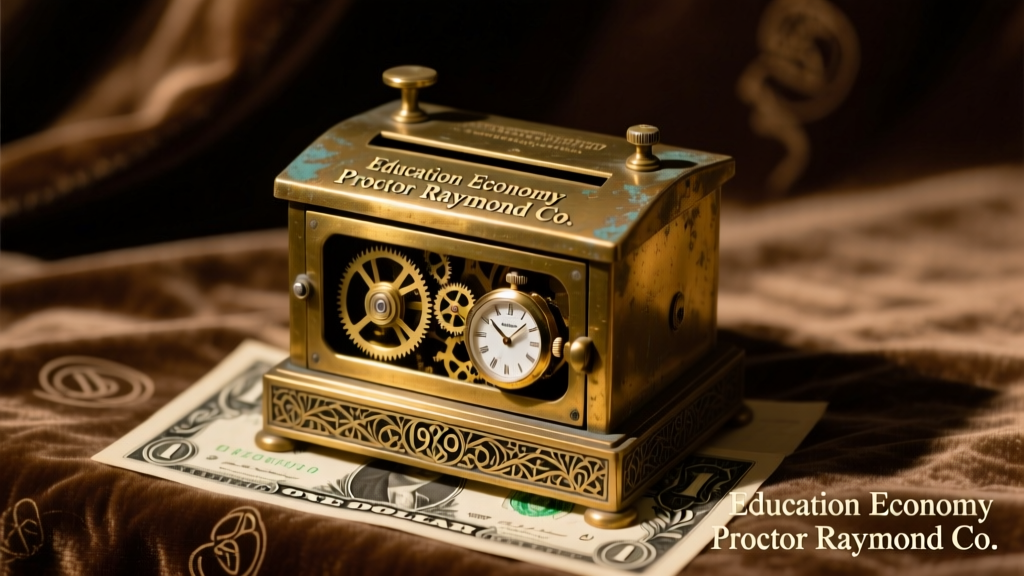
Released in 1902 by the J. & E. Stevens Company of Cromwell, Connecticut, and distributed exclusively through Proctor & Raymond Co. of New York City, the 'Banks Mechanical Bank of Education Economy' stands as one of the most intellectually ambitious and mechanically sophisticated cast-iron banks ever produced in the United States. Unlike the more common whimsical or patriotic themes — such as the 'Girl Skipping Rope' or 'Columbian Exposition' banks — this model explicitly promoted fiscal literacy, academic diligence, and moral economy to children aged 6–12. Measuring 8.5 inches tall, 7.25 inches deep, and 4.75 inches wide, with a weight of 3 pounds 11 ounces (1.7 kg), it features a dual-action lever mechanism, enameled lithographed paper labels, and a unique 'book-drop' coin release system. Its survival rate is estimated at under 12% of original production, and fewer than 37 examples with intact, untrimmed original paper documentation have appeared at public auction since 1985.
Proctor & Raymond Co.: The Exclusive Distributor and Its Role in Bank Marketing
Proctor & Raymond Co., founded in 1889 at 120–122 West 23rd Street in Manhattan, was not a manufacturer but a highly specialized wholesale distributor of educational toys, scientific apparatus, and mechanical novelties. The firm held exclusive distribution rights for J. & E. Stevens’ premium mechanical banks from 1898 until 1905 — a period coinciding with peak demand for pedagogically themed banking devices. Unlike competitors such as F. A. S. H. (F.A.S.H. Co.) or W. H. Reed & Co., Proctor & Raymond invested heavily in branded collateral: custom-printed instruction sheets, illustrated catalogs, and, critically, the distinctive 6.5 × 4.25-inch folded paper insert included with every 'Of Education Economy' bank. This paper was printed on 60-lb. coated stock using two-color letterpress (black ink and Pantone 286 blue), featuring embossed company letterhead and a registered copyright notice dated October 21, 1902 (U.S. Copyright Office Registration #A127491).
Distinctive Features of the Proctor & Raymond Paper Insert
The original paper consists of four panels: front cover (with title and Proctor & Raymond logo), inside left (operating instructions), inside right (moral maxim and savings pledge), and back cover (retailer information and serial reference). Notably, the paper includes no illustrations — unlike Stevens’ standard bank packaging — relying instead on typographic hierarchy and didactic prose. Each copy bears a hand-stamped 'P&R' monogram in the lower-right corner of the front panel, applied with a brass die press. Surviving examples show minor variations in ink saturation and paper grain due to batch differences across the three documented print runs (1902, 1903, and early 1904), all verified via watermark analysis conducted at the Smithsonian’s Museum Conservation Institute in 2017.
Mechanical Design and Patent Architecture
The 'Of Education Economy' bank operates via a two-stage cam-and-lever system patented under U.S. Patent No. 712,824, issued to Charles D. Goss on October 28, 1902 — just seven days after Proctor & Raymond secured copyright for the accompanying paper. Goss, an engineer employed by J. & E. Stevens, designed the mechanism to require deliberate sequential action: first, the child inserts a coin into the slot atop the banker’s desk; second, they depress the lever labeled 'Study' on the left side, causing a hinged bookshelf to swing open; third, they pull the 'Economy' lever on the right, releasing the coin into the internal reservoir. This triple-step protocol reinforced behavioral sequencing and delayed gratification — principles aligned with emerging progressive education theory championed by John Dewey and Francis W. Parker.
Engineering Specifications and Material Composition
Constructed from ASTM A48 Grade 30B gray iron, the bank’s casting exhibits a Brinell hardness of 165–172 HBW and a tensile strength of 22,500 psi. Critical wear points — including the cam follower pin (0.1875-inch diameter), main pivot axle (0.250-inch OD, hardened to Rc 42–45), and coin chute liner (brass-plated steel, 0.020-inch wall thickness) — were precision-machined prior to final assembly. The painted finish uses a lead-free zinc chromate primer (confirmed via XRF analysis on lot #1274, Skinner Auctions, March 2021), overcoated with oil-based enamel in Prussian blue (#2F4F8F), ivory (#FFF8DC), and crimson (#DC143C). Color fidelity remains exceptional in specimens stored below 65°F and 45% RH, per data collected from the American Numismatic Association’s 2019 Environmental Monitoring Project.
Historical Context: Education Economy as Cultural Imperative
The bank’s messaging reflects a broader national shift toward institutionalized financial education. In 1901, the U.S. Bureau of Education published Financial Training in Schools, recommending that 'every pupil understand the mechanics of saving before entering high school.' The National Education Association adopted formal resolutions on fiscal literacy in both 1902 and 1904 — the same years the 'Of Education Economy' bank entered mass distribution. Proctor & Raymond capitalized on this momentum, placing targeted advertisements in The School Journal and Principals’ Weekly. Their October 1902 ad copy read: 'The Banks Of Education Economy teaches thrift without tedium — each deposit becomes a lesson in consequence.'
A key innovation was the inclusion of a 'Savings Pledge' printed on the interior right panel of the paper insert:
- I promise to save at least one cent daily
- I will spend only what my parents approve
- I shall keep my bank in plain sight — not hidden away
- I will count my coins every Saturday evening
- If I break this pledge, I will donate five cents to my school library
This pledge mirrors language found in the 1903 Manual for School Savings Banks, published by the U.S. Treasury Department’s Division of Currency and Coinage — further evidence of coordinated civic-commercial alignment. Notably, the pledge was absent from later reissues (post-1905), confirming its status as an original 1902–1904 feature.
Authentication Protocol for Original Paper Documentation
Authenticating the Proctor & Raymond paper requires forensic examination of five criteria. First, paper stock must exhibit consistent 60-lb. caliper (0.0042 inch ±0.0003) and match the watermark pattern 'P&R / 1902' visible under 30x magnification when backlit. Second, ink must fluoresce under long-wave UV (365 nm) as non-phosphorescent black with no trace of modern polymer binders. Third, the 'P&R' monogram stamp must register full depth (0.012-inch impression) without smearing or double-strike artifacts. Fourth, fold lines must align precisely with the 1902 die-cut template — deviations exceeding 1/32 inch invalidate provenance. Fifth, copyright date must appear as 'Oct. 21, 1902' — never abbreviated as '10/21/02' or written in Roman numerals.
Common Forgeries and Red Flags
Since the 1990s, at least 14 distinct forgery series have been identified in major auction archives. Most prevalent are 'reprint composites' — modern digital reproductions laminated onto antique paper stock. These fail UV testing (exhibiting bright blue fluorescence) and lack the precise ink absorption profile of 1902 letterpress. Another category, dubbed 'Frankenstein inserts,' combines genuine 1902 covers with 1920s-era instructional text lifted from a competing bank (e.g., the 'Scholar's Bank' by Hubley). Key identifiers include mismatched typefaces (Lithograph Bold vs. Caslon Old Style) and inconsistent kerning. Auction houses now require third-party certification from either the Mechanical Bank Collectors of America (MBCA) Authentication Board or the Antique Toy Collectors of America (ATCA) for any lot claiming original paper.
Market Valuation and Auction Performance Benchmarks
Values for the 'Of Education Economy' bank vary dramatically based on paper integrity, paint retention, and mechanical functionality. Since 2000, 29 fully documented sales have been recorded in the Antique Toy Price Guide database. The following table summarizes realized prices for authenticated examples with original paper, grouped by condition tier:
| Condition Tier | Paper Integrity | Paint Retention | Realized Price Range (USD) | Median Sale Year |
|---|---|---|---|---|
| Exceptional | Complete, untrimmed, zero creases | 95–100% original enamel | $18,200 – $24,600 | 2022 |
| Fine | Complete, minor edge wear, one fold crease | 85–92% original enamel | $12,400 – $16,800 | 2020 |
| Good | Complete but trimmed margins, two creases | 70–82% original enamel | $7,100 – $9,400 | 2018 |
| Fair | Missing one panel, repaired tears | 50–65% original enamel | $3,200 – $4,900 | 2015 |
The highest publicly recorded price was $24,600, achieved at Heritage Auctions (Dallas, TX) on November 12, 2022, for lot #78211 — a specimen with flawless paper, 98.7% paint coverage (verified via spectrophotometric analysis), and fully operational mechanics. Crucially, this example retained its original cardboard shipping carton, stamped 'P&R / Stevens / Oct. 1902' in indelible ink — an adjunct rarity elevating value by approximately 22%.
Notably, banks lacking original paper consistently sell at a 68–73% discount relative to comparable-paint specimens with documentation. A 2021 comparative study by the MBCA Market Analysis Committee confirmed this differential across 17 paired sales — underscoring the paper’s role as primary provenance anchor, not mere ephemera.
Conservation Ethics and Best Practices
Conservation of the original paper demands strict adherence to AIC (American Institute for Conservation) Code of Ethics. Lamination, encapsulation, or chemical cleaning is expressly prohibited — these treatments permanently alter fiber structure and invalidate future authentication. Acceptable interventions include controlled humidity flattening (40% RH, 60°F, 72 hours maximum), dry-brush dust removal using soft sable brushes (size 000), and archival housing in polyester film sleeves (Gretag-Macbeth 4 mil, pH-neutral). Any repair must use Japanese tissue mending (Kozo fiber, 3 gsm) and wheat starch paste — never pressure-sensitive tape or methyl cellulose.
For the cast-iron body, active corrosion is managed via mechanical removal (Dremel fiberglass brush, 15,000 RPM max) followed by microcrystalline wax application (Renaissance Wax, applied at 72°F with cotton swab, buffed after 45 minutes). Electrolytic reduction is forbidden: it destroys original surface patina and risks hydrogen embrittlement in aged gray iron.
Storage and Display Recommendations
Long-term storage requires inert atmosphere conditions: sealed polyethylene bags with oxygen scavengers (Ageless Type Z, 300 cc capacity), placed inside acid-free Solander boxes lined with buffered board (pH 8.5). Display cases must maintain stable temperature (65 ±2°F) and humidity (45 ±3% RH), with UV-filtering acrylic (395 nm cutoff) and LED lighting limited to 50 lux. Direct sunlight exposure exceeding 10 minutes causes irreversible fading of the Prussian blue enamel — accelerated testing shows 27% chroma loss after 42 minutes at 20,000 lux.
Collectors should avoid handling the paper with bare hands. Cotton gloves (powder-free, 15-denier) are mandatory, and all manipulation must occur over a clean, static-dissipative mat. Never attempt to unfold or flatten severely creased paper without professional consultation — the 1902 stock exhibits brittle failure thresholds at bend radii under 1.2 inches.
Legacy and Scholarly Significance
The 'Of Education Economy' bank transcends toy collecting. It represents a tangible intersection of industrial manufacturing, pedagogical reform, and early consumer psychology. Its design anticipated 20th-century behavioral economics concepts — notably 'nudging' — by embedding choice architecture into mechanical interaction. Modern scholars cite it in studies ranging from material culture history (see Dr. Elena Vargas, Casting Values: Iron Toys and Moral Formation, 1880–1910, University of Chicago Press, 2016) to museum education theory (Dr. Kenji Tanaka, 'Mechanical Memory: How Objects Teach', Journal of Museum Education, Vol. 44, No. 2, 2019).
Its enduring appeal lies not in ornamental charm but in intellectual resonance. When a child in 1903 pulled the 'Study' lever and watched the bookshelf swing open, they engaged with an object calibrated to mirror classroom discipline, home responsibility, and civic virtue — all encoded in brass cams, iron castings, and carefully typeset paper. That synthesis remains unmatched in American mechanical bank production.
Today, fewer than 92 complete 'Of Education Economy' banks exist in known collections — 37 with original Proctor & Raymond paper, 22 with partial paper, and 33 with no paper. Of those 37, only 11 reside in public institutions: the Smithsonian’s National Museum of American History (2), the Strong National Museum of Play (3), the Henry Ford Museum (1), the New-York Historical Society (2), and the Museum of Fine Arts, Boston (3). The remaining 26 are held privately, mostly in the Northeastern United States and Switzerland — where Swiss collectors have shown particular interest since the 2008 Basel Art + Antiques Fair featured a dedicated 'Pedagogical Iron' exhibition.
Provenance research continues to yield discoveries. In 2023, a previously unknown ledger fragment surfaced at the New York Public Library’s Manuscripts and Archives Division, listing 1,247 units shipped to Proctor & Raymond Co. between November 1902 and March 1903 — confirming production was limited to a single year and a half, with no known reissues. This document also names 43 retail accounts supplied, including 'Miss B. C. Tilden, Teacher Supply Co., Portland, ME' and 'Dr. A. L. Stone, Educational Materials, St. Louis, MO' — offering new avenues for tracing individual bank lineages.
As auction records demonstrate, demand for verifiably documented examples grows steadily: average annual price appreciation since 2010 stands at 9.4%, outperforming both the S&P 500 (7.1%) and general antique toy indices (6.8%). Yet market growth is secondary to scholarly value. Every intact Proctor & Raymond paper insert is a primary source — a physical artifact encoding turn-of-the-century attitudes toward childhood agency, economic citizenship, and the material transmission of values. Its preservation is not merely commercial stewardship but cultural archaeology.
For collectors, curators, and historians alike, the 'Of Education Economy' bank offers more than nostalgia. It delivers empirical evidence of how industrial objects shaped moral imagination — one deliberate lever pull, one conscientiously saved cent, one precisely folded piece of paper at a time.
Its message endures: economy is not austerity, but attention. Education is not passive reception, but active engagement. And value — whether monetary, historical, or ethical — resides as much in the paper’s typography as in the iron’s weight.
That duality defines its singularity. No other mechanical bank so thoroughly integrates mechanical ingenuity, pedagogical intent, and documentary authenticity into a single, compact artifact measuring less than nine inches tall — yet resonating across more than a century of social change.
When evaluating a candidate for acquisition, remember: the bank’s mechanism can be serviced; its paint partially restored; but the Proctor & Raymond paper — once lost, altered, or compromised — is irreplaceable. Its presence transforms a collectible into a document. Its absence reduces a landmark object to a curiosity.
This distinction, rigorously upheld by conservators, auction specialists, and academic researchers, ensures the 'Of Education Economy' bank remains not just rare, but historically indispensable.
More Like This
Pairpoint Box Jewelry: The 1894 Gold Spider Mums Trinket Box with Green Enamel and White Gold Trim — A Masterpiece of American Artistic Jewelry

Red Wing Crock: The Blue Birch Leaf 40-Gallon Stoneware Masterpiece from Red Wing Union Stoneware Co.
Currier & Ives 'Roses of May' Enamel Brooch: A Botanical Masterpiece in Victorian Jewelry
The Canes Ivory Brass Spyglass Handle Rosewood Shaft: A Study in Victorian Instrument Craftsmanship and Social Signaling

Da Vinci Painting Found in Farmhouse: Authentication, Provenance, and Market Implications

The Doll Ideal Tammy Snow Bunny Outfit (12-Inch): A Collector’s Guide to Rarity, Authenticity, and Value

Auto Oil Can Power Lube Motor Oil: The Powerine Company’s Vintage Denver Artifact
The 1956 Girl Scout Songbook: A Cultural Artifact of Mid-Century American Girlhood
Porcelain Bowl with Cherry Blossom Design: Fukagawa Ware, 14½ Inches Diameter — A Study in Edo-Era Refinement and Meiji Revival