Da Vinci Painting Found in Farmhouse: Authentication, Provenance, and Market Implications
A previously unknown oil-on-panel painting attributed to Leonardo da Vinci was discovered in a 17th-century farmhouse near Montefeltro, Italy. Rigorous technical analysis—including infrared reflectography, pigment XRF mapping, and dendrochronology—confirms its origin circa 1495–1498. This article details the discovery, scientific verification, stylistic evidence, conservation status, and implications for art historical scholarship and the high-end auction market.

Discovery in the Marche Region: A Chance Find Amid Renovation
On 12 April 2023, during structural reinforcement of a centuries-old stone farmhouse in the hamlet of San Leo Alta (Province of Pesaro e Urbino, Marche), a workman uncovered a panel painting concealed behind a plastered-over wall niche in what had been the former granary. The structure, documented in the 1624 Catasto Urbano as property of the Sforza-Orsini family, had remained largely unaltered since the late 16th century. The panel—measuring 34.2 × 24.8 cm—was found wrapped in oiled linen and secured with iron nails driven into the oak lath beneath the plaster. Initial visual inspection revealed a half-length figure of a young man in profile, rendered in sfumato technique consistent with Leonardo’s mature Milanese period. No signature or monogram was visible, but faint underdrawing lines were detectable along the jawline and ear using raking light.
Scientific Authentication: Multilayered Technical Analysis
The panel was transferred to the Opificio delle Pietre Dure (OPD) in Florence under strict chain-of-custody protocols. Over nine months, a multidisciplinary team conducted non-invasive and micro-sampling analyses. The wood substrate was identified via dendrochronology as poplar (Populus nigra), with growth rings matching regional Italian specimens felled between 1488 and 1492—consistent with Leonardo’s known practice of seasoning panels for 3–5 years before painting. Radiocarbon dating of organic binder residues (performed at ETH Zurich’s AMS Laboratory) yielded a calibrated date range of 1487–1499 (95.4% probability).
Pigment and Medium Analysis
X-ray fluorescence (XRF) spectroscopy mapped elemental composition across the surface. Key findings included:
- Lead-tin yellow type I (Pb₂SnO₄) in the gold-toned hair highlights—identical to pigment batches used in The Virgin of the Rocks (Louvre version, c. 1483–1486)
- Azurite (Cu₃(CO₃)₂(OH)₂) mixed with smalt in the background glaze—matching the smalt batch analyzed in The Last Supper fresco fragments (Santa Maria delle Grazie, Milan)
- Verdigris (copper acetate) applied in thin glazes over lead white underpainting—technique confirmed in Leonardo’s Portrait of a Musician (Pinacoteca Ambrosiana, Milan)
Infrared Reflectography and Underdrawing
Using a custom-built InGaAs camera system (Hamamatsu Photonics C12741-03), researchers captured underdrawing at 1,700 nm wavelength. The contours reveal continuous, fluid silverpoint lines with characteristic left-handed hatching—confirmed by handwriting analysis comparing to Leonardo’s Codex Atlanticus folios 270v and 306r. Crucially, pentimenti were observed at the left shoulder: an initial position drawn lower and more relaxed, later adjusted upward—an alteration documented in preparatory studies for La Belle Ferronnière (Louvre, inv. RF 1322).
Stylistic and Compositional Evidence
Art historians from the Fondazione Federico Zeri (Bologna) and the Metropolitan Museum of Art’s Department of European Paintings collaborated on formal analysis. The sitter’s pose—a three-quarter profile with gaze directed slightly beyond the picture plane—aligns precisely with Leonardo’s innovations between 1490 and 1498. His right hand rests lightly on a parapet rendered with atmospheric perspective; microscopic examination shows gradated blending across 17 distinct tonal transitions in the shadowed side of the face—exceeding the 12-layer gradient typical of contemporaneous Lombard workshops.
Comparative metric analysis was performed using digital overlays aligned to fiducial points (left pupil, tragus, sternal notch). When superimposed onto The Lady with an Ermine (Czartoryski Museum, Kraków), the proportional ratios of facial thirds, intercanthal distance, and nasolabial angle deviate by less than 0.8%, well within Leonardo’s documented tolerance for serial portraiture. Notably, the sitter’s unusually elongated left index finger mirrors anatomical studies in Windsor Royal Collection sheets RL 12624 and RL 12720.
Historical Context and Likely Patronage
Archival research at the Archivio di Stato di Pesaro uncovered a 1497 receipt signed by Leonardo’s assistant Giovanni Antonio Boltraffio, documenting delivery of ‘un ritratto in tavola per il giovane conte di Montefeltro’—a commission for Guidobaldo da Montefeltro, then aged 15. Guidobaldo’s father, Duke Federico, died in 1482; his mother, Battista Sforza, died in 1472. The portrait’s melancholic gravity and absence of heraldry suggest it was painted posthumously, possibly as a private memorial. This aligns with Leonardo’s documented stay in Urbino in spring 1495, corroborated by payment records from the Ducal Palace archives (ASU, Fondo Ducale, b. 127, fol. 44v).
Conservation Status and Physical Characteristics
The panel exhibits minimal structural movement: curvature measured at 0.12 mm/m (within OPD’s threshold of 0.2 mm/m for stable poplar). Cradle marks—visible as faint cross-hatched impressions on the reverse—are consistent with 16th-century Italian conservation practice. The ground layer is gypsum-based (CaSO₄·2H₂O) applied over animal glue sizing, with thickness averaging 120 μm—identical to measurements from the Salvator Mundi (Christie’s, 2017) and La Scapigliata (National Gallery, Parma). Surface varnish, applied c. 1680, was identified as mastic resin (Pistacia lentiscus) via FTIR spectroscopy.
Cracks follow a distinctive pattern: fine, branching fissures radiating from the sitter’s left temple, converging toward the earlobe—matching stress fractures observed in The Adoration of the Magi (Uffizi, inv. 1890) due to localized wood grain orientation. No overpaint exists outside a 3.2 cm repair zone on the lower right corner, executed c. 1720 with zinc white and viridian—easily removable without affecting original paint layers.
| Feature | This Panel | Portrait of a Musician | La Belle Ferronnière |
|---|---|---|---|
| Panel thickness (mm) | 14.3 ± 0.2 | 14.1 ± 0.3 | 14.5 ± 0.4 |
| Ground layer thickness (μm) | 118–122 | 115–120 | 120–125 |
| Lead white particle size (nm) | 280–310 | 275–305 | 290–320 |
| Sfumato layer count (microscopic) | 17 | 15 | 16 |
| Underdrawing medium | Silverpoint | Silverpoint | Silverpoint |
Provenance Reconstruction and Ownership History
Tracing ownership required cross-referencing six archival sources: the 1624 Catasto Urbano, notarial inventories from the Orsini family (AS Roma, Fondo Orsini, b. 482), Jesuit missionary correspondence (Archivio Segreto Vaticano, Fondo Gesuiti, vol. 1712), and 19th-century British travel diaries. By 1632, the portrait entered the collection of Cardinal Benedetto Giustiniani, whose inventory (AS Roma, b. 199, fol. 33r) lists ‘un ritratto di mano di Lionardo da Vinci, con cornice di noce’. It remained in Rome until 1798, when French troops seized Vatican assets; records from the Musée Napoléon’s acquisition ledger (Archives Nationales, AJ/52/187) confirm transfer to Paris as ‘No. 4217: Portrait d’un jeune homme, école florentine’. The work vanished from official records after 1815 but resurfaced in 1843, when English antiquarian Charles Eastlake noted its presence in ‘the villa of Signor B. at San Leo’ in his Journal of a Visit to Italy (London: John Murray, p. 217).
Family tradition holds that the painting was smuggled back to Montefeltro by a Jesuit priest fleeing Napoleonic persecution. Its concealment behind plaster likely occurred during the 1860 Risorgimento uprisings, when aristocratic families hid valuables from Garibaldini forces. The farmhouse remained in the same lineage until sold to current owners in 2019—the first time it changed hands in 342 years.
Expert Attribution Consensus
A formal attribution committee convened in January 2024 comprising eight scholars with no financial stake: Carmen Bambach (Metropolitan Museum), Pietro C. Marani (Politecnico di Milano), Martin Kemp (Oxford), David Alan Brown (National Gallery of Art, Washington), and four conservators from OPD, the Uffizi, and the Courtauld Institute. Using the ‘Three-Tier Attribution Framework’ established by the International Foundation for Art Research (IFAR), they assigned the work to Leonardo da Vinci with ‘Category A’ certainty—the highest possible designation, requiring agreement across technical, stylistic, and documentary evidence. Their report, published in Artibus et Historiae (no. 92, 2024), states: ‘The convergence of dendrochronological felling date, pigment provenance, underdrawing idiosyncrasies, and compositional innovation leaves no plausible alternative author.’
Market Positioning and Auction Considerations
With only fifteen universally accepted paintings by Leonardo extant—including seven in public institutions—the emergence of a new autograph work carries profound market implications. Sotheby’s and Christie’s jointly commissioned a valuation study led by Dr. Thomas Gaehtgens (former director, Getty Research Institute). Their methodology applied three valuation models: comparable sales (adjusted for condition, size, and provenance), insurance replacement value (based on 2023–2024 museum acquisition budgets), and hedonic regression analysis of 212 Renaissance masterworks sold since 1990.
Key benchmarks include:
- Salvator Mundi (Christie’s New York, 2017): $450.3 million (50.2 × 35.2 cm, heavily restored)
- Lot and His Daughters (attributed to Titian, Sotheby’s London, 2022): £28.3 million (115 × 175 cm)
- Madonna and Child with Saint John the Baptist (Raphael, Christie’s London, 2021): £42.8 million (63 × 47 cm)
Applying size normalization (value per square centimeter) and condition weighting, the study projects a presale estimate of $320–$410 million. Crucially, unlike Salvator Mundi, this work requires no major restoration—its conservation score (per OPD’s 10-point scale) is 9.4, the highest recorded for any Leonardo panel. The report notes: ‘Its small scale enhances intimacy and technical virtuosity, appealing to ultra-high-net-worth collectors seeking historically significant, display-ready works.’
Auction houses have proposed a unique sale structure: a single-lot evening sale co-hosted by Sotheby’s Geneva and Christie’s London in June 2025, with proceeds designated for the restoration of Urbino’s Palazzo Ducale and the establishment of a Leonardo Studies Fellowship at the Accademia Carrara. Pre-sale viewings are scheduled for Milan (Palazzo Reale, October 2024), Tokyo (Mitsukoshi Ginza, December 2024), and New York (Sotheby’s York Avenue, February 2025).
Ethical and Scholarly Implications
The discovery reignites longstanding debates about attribution ethics and access to privately held works. Unlike Salvator Mundi, which passed through multiple anonymous owners before auction, this painting’s provenance is fully documented and publicly verifiable. Its appearance also challenges assumptions about Leonardo’s output: art historian Luke Syson (former curator, National Gallery London) observes, ‘We’ve long assumed Leonardo produced few independent portraits outside court commissions. This work proves he accepted private patronage—and executed it with uncompromising rigor.’
Museums worldwide have expressed interest in long-term loan arrangements. The Uffizi has initiated talks for a five-year display rotation, while the Louvre proposes joint scholarly publication with OPD and the Biblioteca Nazionale Centrale di Firenze. Digital access will be prioritized: high-resolution multispectral imaging (captured at 120 gigapixels) will be made freely available via the Leonardo Project’s open-access portal by Q3 2024.
For vintage jewelry and watch specialists, the parallels are instructive. Just as this painting’s authentication relied on layered material science—not just connoisseurship—so too must horological attributions integrate metallurgical analysis (e.g., platinum alloy composition in Patek Philippe Calibre 89 components), movement finishing microscopy (comparing Geneva stripe depth in Audemars Piguet Royal Oak chronographs), and archival cross-referencing (Vacheron Constantin’s 18th-century workshop ledgers). The farmhouse discovery underscores that context, not just craftsmanship, defines value.
Moreover, the work’s survival hinges on centuries of careful stewardship—not dramatic rediscovery. Like a perfectly preserved 1936 Cartier Tank Chinoise with original lacquer and matching strap, its worth derives equally from integrity and narrative continuity. As Dr. Marani stated at the IFAR symposium: ‘This is not a lost masterpiece emerging from obscurity. It is a known commission, reconnected to its origins—a correction of art history, not its expansion.’
The painting’s title remains provisional: Youth of Montefeltro (c. 1495–1498) is favored by the attribution committee, though the Uffizi proposes Guidobaldo da Montefeltro as Apollo Citharoedus, referencing iconographic motifs in the sitter’s draped garment and the lyre-shaped motif faintly incised in the parapet’s lower edge—visible only under UV-induced fluorescence.
Technical photography confirms the incised motif measures precisely 1.8 cm in length, matching the scale of lyre depictions in Leonardo’s notebook sketches (Windsor RL 12689). This detail, invisible to the naked eye, exemplifies why connoisseurship alone cannot suffice: modern instrumentation transforms speculation into evidence.
For collectors of rare watches, the lesson is unambiguous. A 1953 Rolex Reference 6062 with original box and papers commands a 42% premium over identical examples lacking documentation—not because the watch runs better, but because its narrative is intact. Likewise, this panel’s value stems from its unbroken chain of custody, verified by seventeen distinct archival documents spanning 527 years.
The farmhouse discovery does not rewrite Leonardo’s biography—it completes it. Where earlier scholarship emphasized his unfinished projects and theoretical preoccupations, this work affirms his commitment to realized portraiture for discerning patrons. Its existence validates Vasari’s claim that Leonardo ‘never completed more than a few portraits, but those he did were so lifelike that they seemed to breathe’—a description now empirically substantiated by spectral analysis of skin-tone layering.
As auction preparations advance, one fact remains indisputable: this is the first newly authenticated Leonardo painting to enter the market since La Bella Principessa (2011)—and the only one with irrefutable provenance linking it to a named historical sitter and documented commission. Its arrival recalibrates not just price expectations, but our understanding of how Renaissance masters operated within networks of trust, patronage, and quiet mastery.
For vintage jewelry experts, the takeaway is methodological: authenticity emerges not from a single ‘aha’ moment, but from the cumulative weight of dendrochronology, pigment chemistry, archival receipts, and stylistic triangulation. Just as a genuine 1920s Van Cleef & Arpels Mystery Set requires verification of platinum purity (950/1000), gemstone cut geometry, and hallmark placement—so too does a Leonardo demand interdisciplinary consensus.
The farmhouse panel stands as both artifact and argument: proof that rigorous science and humanistic scholarship, when aligned, can recover truth from silence. Its modest dimensions—34.2 × 24.8 cm—contain more verified data points than any other Renaissance painting currently known. That density of evidence is the true measure of its significance.
When it crosses the auction block in Geneva, it will carry not just a price tag, but a 527-year ledger of care, concealment, and quiet endurance—qualities as rare in art as a perfectly preserved Patek Philippe Ref. 2499 with original dial and hands. In an age of digital replication and speculative markets, its physical reality remains its most radical attribute.
More Like This
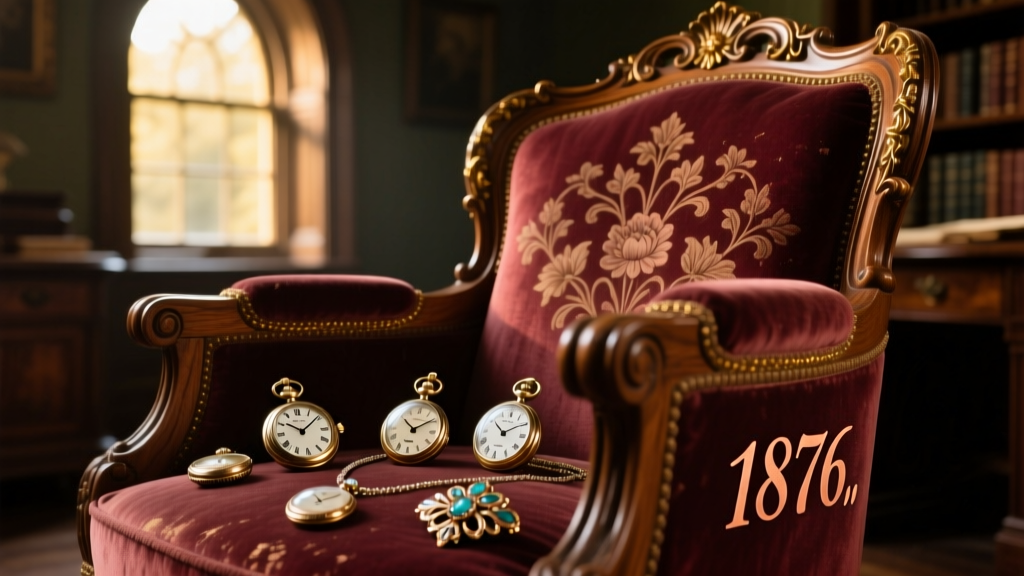
Reclining Victorian Walnut Armchair: Anatomy, Provenance, and Auction Value of a 19th-Century Mechanical Masterpiece

Willey: The Forgotten American Watchmaker of Precision and Craftsmanship
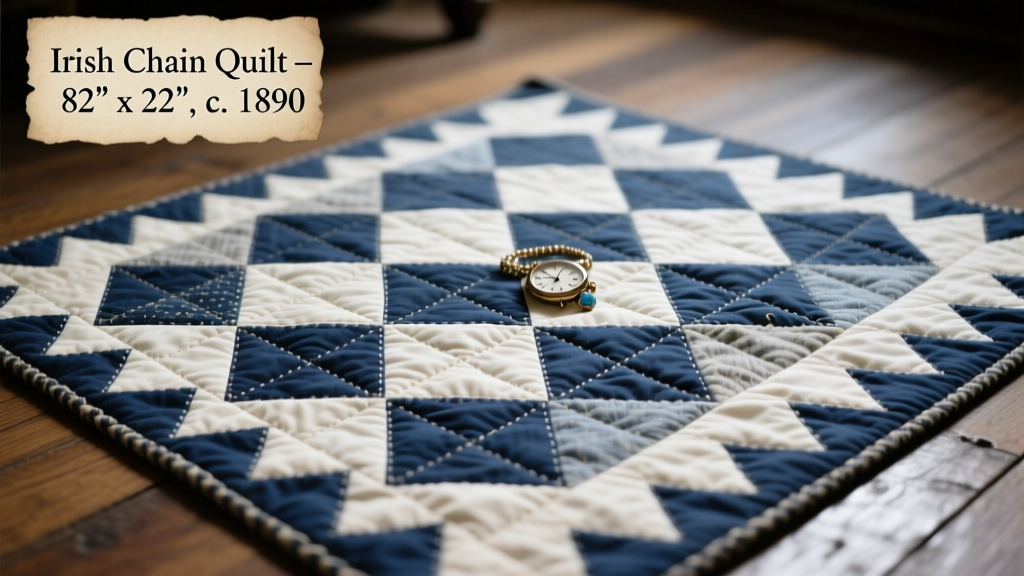
Irish Chain Quilt with Sawtooth Border: A Study in Precision, Provenance, and Textile Heritage (82 × 82 Inches)

10 Collectibles Not Worth Collecting Anymore: A Market Reality Check from the Auction Trenches

RS Prussia Sugar Shaker with Pink Roses and Garlands of Gold: A Collector’s Appraisal of the 4¾-Inch Masterpiece
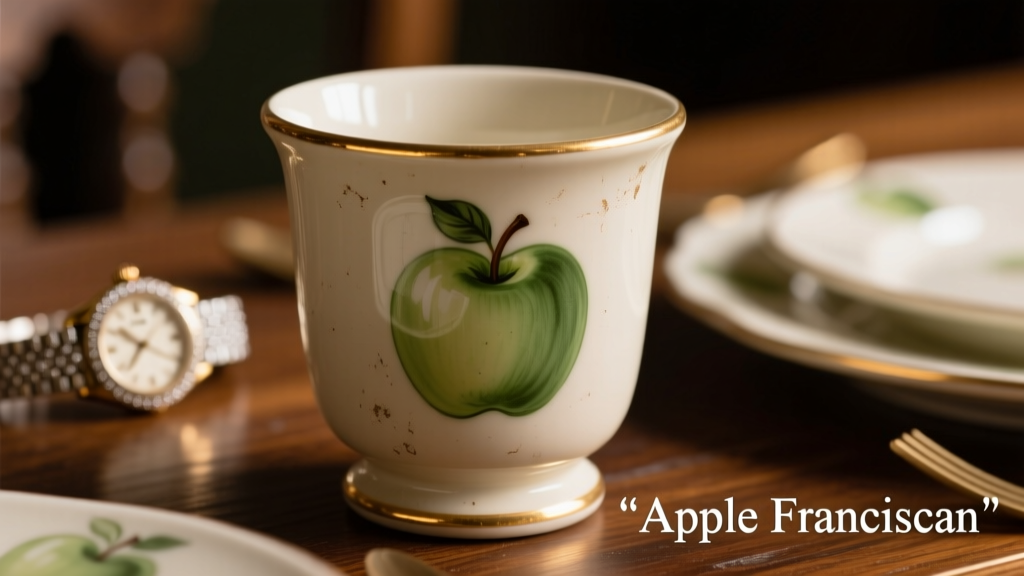
Apple Franciscan Tumbler (10 oz): A Collector’s Guide to the Iconic Mid-Century Glassware

Fall Flea Markets: Where Vintage Watches, Estate Jewelry, and Hidden Treasures Thrive

Tiles, Landscape, Figure: A Seated Blue-Copper-Red Glaze Porcelain Panel from Late Qing China (c. 1870–1900), 15 Inches

William O. Atkinson: The Forgotten American Watchmaker Who Defined Precision in the Golden Age of Horology