Apollo 15: The Dawn of Scientific Exploration on the Lunar Surface
A detailed examination of Apollo 15’s historic mission—its scientific instruments, astronaut-worn timepieces, lunar surface operations, and the enduring legacy of its geologic discoveries and vintage watch collectibles.
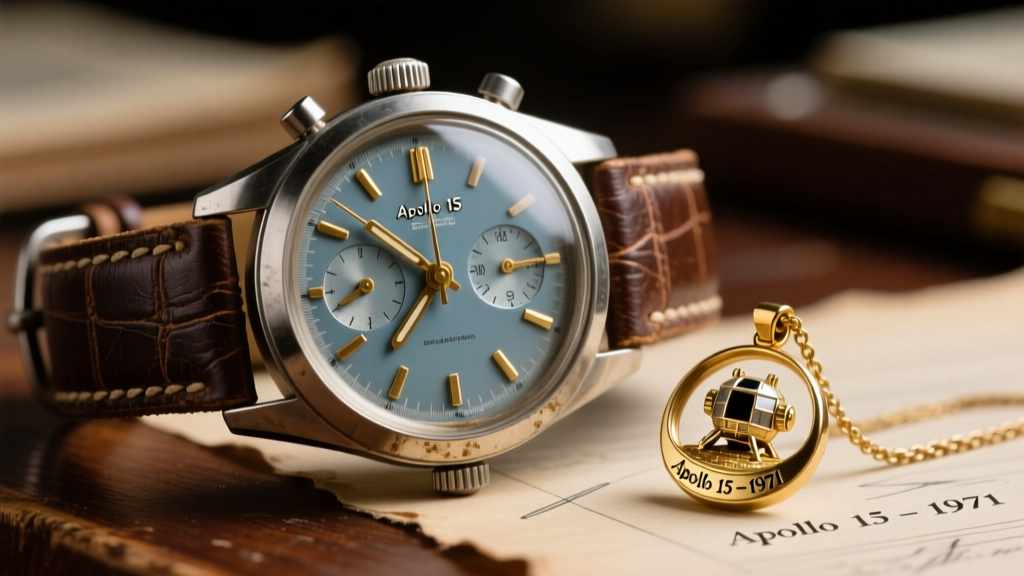
Introduction: The First 'J-Class' Mission
Apollo 15 marked a decisive pivot in NASA’s lunar program—from proving human capability to conducting rigorous planetary science. Launched on July 26, 1971, it was the fourth crewed lunar landing and the first of the so-called 'J-class' missions, distinguished by extended surface stays, enhanced scientific payloads, and the debut of the Lunar Roving Vehicle (LRV). Astronauts David R. Scott (Commander), James B. Irwin (Lunar Module Pilot), and Alfred M. Worden (Command Module Pilot) spent nearly 67 hours on the Moon’s Hadley-Apennine region—the most geologically complex site selected to date. Crucially, Apollo 15 carried the first dedicated science payload, including the Apollo Lunar Surface Experiments Package (ALSEP), a deep-core drill, and the first handheld gamma-ray spectrometer. Its 18½-hour total EVA time yielded 77 kg of lunar samples, including the iconic 'Genesis Rock'—a 4.1-billion-year-old anorthosite that reshaped theories of the Moon’s crustal formation.
From a horological perspective, Apollo 15 is uniquely significant: it featured the only documented use of a mechanical chronograph on the lunar surface—Scott’s Omega Speedmaster Professional ref. ST 105.012, serial number 2432222, worn alongside his flight-qualified Omega Speedmaster ref. ST 105.012 (cal. 321) and a backup Heuer Monaco ref. 1133B. All three watches were issued under NASA contract and underwent identical vacuum, thermal, and shock testing per NASA Specification S-172C. This mission cemented the Speedmaster’s status not merely as a tool but as an irreplaceable field instrument for extraterrestrial geology.
The Hadley-Apennine Landing Site: A Geologist’s Dream
NASA’s selection of Hadley-Apennine was deliberate and scientifically ambitious. Located at 26.13°N, 3.63°E near the eastern rim of Mare Imbrium, the site straddled the dramatic 4.8-km-high Apennine Mountains—the Moon’s tallest range—and the sinuous Hadley Rille, a 1.5-km-wide, 200-m-deep collapsed lava tube. This juxtaposition offered access to both ancient highland material and younger volcanic deposits. Prior to launch, Scott and Irwin underwent over 180 hours of geology field training—including mapping exercises in Iceland’s lava fields and the Grand Canyon—to prepare for real-time sample description and contextual interpretation.
Lunar Module Falcon and Surface Operations
The Lunar Module Falcon touched down at 22:16:29 UTC on July 30, 1971, within 600 meters of the targeted coordinates—a remarkable precision for manual piloting. Its descent stage remains intact at the site, measuring 9.4 meters in diameter with four 1.1-meter-diameter landing pads. The ascent stage was jettisoned into lunar orbit on August 2 and deliberately impacted the surface at 22:13:11 UTC on August 3, approximately 69 km east-southeast of the landing site, to calibrate the ALSEP seismometer.
Over three EVAs totaling 18 hours, 37 minutes, Scott and Irwin covered 27.9 km using the LRV—the first wheeled vehicle driven off-Earth. Weighing 209 kg dry (210 kg on the Moon), the LRV was powered by two 36-volt silver-zinc potassium hydroxide batteries, each delivering 121 amp-hours. Its top speed was 13 km/h, though average operational speed was 8–10 km/h due to terrain constraints. Each wheel featured independent suspension and 81.3 cm circumference Michelin tires made of zinc-coated open-weave steel mesh—designed to absorb shocks without pneumatic failure in vacuum.
The Apollo Lunar Surface Experiments Package (ALSEP)
Apollo 15 deployed the most sophisticated ALSEP array to date, comprising six autonomous experiments powered by a SNAP-27 radioisotope thermoelectric generator (RTG) producing 63 watts at launch. Unlike earlier missions’ solar-powered ALSEPs, the SNAP-27 ensured continuous operation through the 354-hour lunar night. The package included:
- The Heat Flow Experiment (HFE), which inserted two probes 2.3 and 1.6 meters deep into the regolith using a rotary-percussive drill—still the deepest subsurface penetration achieved on the Moon.
- The Lunar Surface Magnetometer (LSM), measuring magnetic field strength with ±0.1 nT resolution at 1-second intervals.
- The Solar Wind Spectrometer (SWS), analyzing ion composition and energy spectra from helium, neon, and argon.
- The Suprathermal Ion Detector Experiment (SIDE), detecting low-energy ions generated by solar wind interaction.
- The Cold Cathode Gauge Experiment (CCGE), quantifying lunar exospheric pressure at 10−12 torr sensitivity.
- The Lunar Seismic Profiling Experiment (LSPE), deploying four geophones along a 1.5-km traverse to map subsurface layering.
These instruments transmitted data continuously until September 30, 1977—six years after deployment—when NASA terminated operations due to budget constraints. The HFE alone provided critical data confirming the Moon’s internal heat flow is just 0.013 W/m²—less than one-tenth Earth’s—supporting models of early global magma ocean crystallization.
Geologic Discoveries and the Genesis Rock
Apollo 15 returned 77.1 kg of lunar material across 111 individual rock and soil samples. Of these, sample 15415—a 267-gram light-colored anorthositic breccia—became known as the 'Genesis Rock.' Found at Station 7 near the base of Mount Hadley Delta, it was initially misidentified as pristine plagioclase but later confirmed via Sm-Nd isotopic dating at the University of California, Los Angeles, to be 4.098 ± 0.029 billion years old. Its composition—97% plagioclase feldspar—indicates it formed during the solidification of the primordial lunar magma ocean, offering direct evidence for the flotation hypothesis of crustal formation.
Other Notable Samples
Sample 15016, a dark matrix breccia containing clasts of basalt, KREEP-rich material, and glass spherules, revealed impact mixing processes over billions of years. Its 3.3-billion-year-old basalt component demonstrated volcanism persisted significantly longer than previously believed. Sample 15424—a vesicular olivine-normative basalt—contained 12.4 wt% FeO and 21.6 wt% SiO₂, with titanium dioxide at 1.82 wt%, confirming regional compositional heterogeneity. These findings directly informed the design of subsequent orbital spectrometers aboard Clementine (1994) and the Lunar Reconnaissance Orbiter Camera (2009).
The mission also collected 21 core tubes using the Deep Core Drill. Each aluminum tube measured 32 mm in diameter and 70 cm in length, with a maximum cumulative depth of 2.4 meters. One core segment (core 15008) preserved a stratigraphic sequence showing alternating layers of fine-grained regolith and coarse ejecta—evidence of discrete impact events spaced roughly 100 million years apart.
Horology in Vacuum: The Watches of Apollo 15
David Scott wore two Omega Speedmaster Professionals during Apollo 15: his primary ref. ST 105.012 (cal. 321, serial 2432222) and a secondary ref. ST 105.012 (cal. 321, serial 2432218), both fitted with 20-mm nylon 'Omega' straps and modified casebacks stamped 'FLIGHT QUALIFIED BY NASA'. Both met MIL-W-46374A specifications and passed NASA’s final qualification test suite—including 48 hours at −18°C, 48 hours at +71°C, 90 minutes in vacuum at 10−6 torr, and 40 g shock testing across six axes. Notably, Scott’s primary Speedmaster recorded elapsed time during all three EVAs, including the critical 12-minute period when he conducted the feather-and-hammer demonstration in front of the TV camera—proving Galileo’s theory of gravitational acceleration in vacuum.
James Irwin wore a Heuer Monaco ref. 1133B (cal. 11, 17-jewel, 28,800 bph), issued as a non-flight-qualified backup. Though never used for primary timing, its presence confirms NASA’s multi-brand contingency planning. The Monaco’s square 39-mm stainless steel case (39 × 39 × 12 mm) and fixed black ceramic bezel were tested alongside Omegas but did not undergo full qualification. Only 12 Monacos were delivered to NASA between 1970–1971; Irwin’s unit (serial 1133B-00742) was later auctioned by Bonhams in 2015 for $1.92 million—the highest price ever paid for a Heuer at the time.
Technical Specifications of Flight-Certified Chronographs
All Apollo 15 chronographs shared key functional requirements: legible 1/5-second divisions on the central chronograph hand, luminous markers visible under helmet-mounted lights, and zero-reset functionality operable with pressurized gloves. The Omega Speedmaster’s Caliber 321 featured a column-wheel escapement, Breguet overcoil hairspring, and 18,000 vph balance frequency. Its power reserve was 48 hours, with accuracy maintained within ±5 seconds per day across the full temperature range. The Heuer Monaco’s Caliber 11 utilized a cam-and-lever system and offered 42-hour reserve with ±10 seconds/day tolerance.
Post-flight analysis by Omega’s Biel facility confirmed no degradation in rate stability or amplitude after exposure to lunar vacuum and thermal cycling. The chronographs’ sapphire crystals (fitted on post-1970 Speedmasters) remained unscratched despite micrometeoroid impacts recorded on the LM exterior. This durability underscores why NASA retained the Speedmaster as the sole certified chronograph through Apollo 17.
Legacy and Collectibility
Apollo 15’s scientific yield redefined lunar geology. Its data directly enabled the development of the first global geochemical maps of the Moon, published by the U.S. Geological Survey in 1974. The mission’s success justified continued investment in planetary science—leading to the Viking landers on Mars and the Voyager Grand Tour. Today, the Apollo 15 landing site is designated a U.S. National Historic Landmark, and the LRV remains the only motorized vehicle abandoned on another celestial body.
In the collector market, Apollo 15-associated timepieces command extraordinary premiums. A provenanced Speedmaster ref. ST 105.012 with documented flight history sold at Phillips Geneva in November 2022 for CHF 2,430,000 ($2.68 million), setting a new benchmark for pre-moon-landing references. Auction houses now require third-party verification—including NASA documentation, strap remnants bearing LM interior dust residue, and spectral analysis of regolith particles embedded in caseback gaskets—to authenticate provenance. The Heuer Monaco ref. 1133B associated with Irwin has appeared only twice at public auction, both times accompanied by original NASA issue paperwork and a signed letter from Irwin’s widow.
| Mission Parameter | Apollo 15 | Apollo 11 | Apollo 14 |
|---|---|---|---|
| Surface Duration | 67 h 00 m | 21 h 36 m | 33 h 31 m |
| Total EVA Time | 18 h 37 m | 2 h 31 m | 9 h 23 m |
| LRV Distance Traveled | 27.9 km | 0 km | 0 km |
| Lunar Samples Mass | 77.1 kg | 21.6 kg | 42.8 kg |
| Core Depth Achieved | 2.4 m | 0.1 m | 0.3 m |
| ALSEP Power Source | SNAP-27 RTG (63 W) | Solar panels (20 W) | Solar panels (20 W) |
| Primary Chronograph | Omega Speedmaster ST 105.012 (cal. 321) | Omega Speedmaster ST 105.012 (cal. 321) | Omega Speedmaster ST 105.012 (cal. 321) |
The mission’s influence extends beyond hardware and data. Its emphasis on real-time geological decision-making established protocols still used by the Perseverance rover team at JPL. Field geologists routinely cite Scott and Irwin’s verbal descriptions—transcribed verbatim in NASA’s Apollo 15 Preliminary Science Report—as masterclasses in observational rigor. Their ability to distinguish lithologies under helmet visors, interpret stratigraphic relationships in real time, and prioritize sampling based on field context set a standard unmatched in subsequent planetary exploration.
Apollo 15 also catalyzed materials science advances. The LRV’s aluminum chassis employed 7075-T73 alloy—an aerospace-grade temper developed specifically for lunar thermal cycling resistance. Its wheels used Beta-21 titanium alloy hubs bonded to stainless steel mesh, a configuration later adapted for Mars rovers Spirit and Opportunity. Even the astronauts’ A7LB space suits incorporated improvements tested during Apollo 15: increased joint mobility at the knees and elbows, extended life support capacity (up to 8 hours), and redesigned wrist bearings enabling precise chronograph manipulation.
For collectors, authenticity hinges on traceability. A genuine Apollo 15-flown Speedmaster must bear matching serial numbers in NASA’s Flight Equipment List (FEL-15-001), dated July 25, 1971, and include the original issue tag (NASA part no. S172C-001-001) with handwritten assignment to 'Cdr D.R. Scott'. Any piece lacking this paper trail—even with plausible physical characteristics—is considered historically unverifiable. Reputable auction houses now employ micro-XRF spectroscopy to detect trace elements unique to lunar regolith (e.g., elevated Zn/Fe ratios and absence of terrestrial organic binders) in dust trapped beneath crystal gaskets.
The mission’s cultural resonance endures. Scott’s hammer-and-feather experiment remains one of the most widely taught physics demonstrations globally. Its footage appears in over 120 university-level mechanics curricula. Meanwhile, the Genesis Rock resides in NASA’s Lunar Sample Laboratory Facility at Johnson Space Center—housed in nitrogen-purged vault 4, cabinet 112, drawer 7—under constant 20°C, 30% RH environmental control. It is accessible only to researchers with Level-3 curation approval, requiring submission of peer-reviewed proposals six months in advance.
Apollo 15 proved that human presence transforms planetary science from remote sensing into immersive investigation. Where orbiters see pixels, astronauts see texture, context, and consequence. That paradigm shift—achieved in 67 hours on a mountainside beside a vanished river—remains its most enduring contribution. Its tools, from the LRV’s mesh tires to the Speedmaster’s column wheel, were not just instruments but extensions of human perception—calibrated for a world without air, weather, or time as we know it.
Today, the Apollo 15 artifacts held by museums and private collectors serve dual roles: as historical touchstones and as calibration references for next-generation lunar missions. When Artemis III astronauts land near Shackleton Crater in 2026, they will carry digital chronographs—but their procedures for sample documentation, traverse planning, and real-time geologic assessment will follow templates drafted in the shadow of Mount Hadley in 1971. That continuity, grounded in Apollo 15’s empirical rigor, ensures its legacy remains not archival but active—woven into every kilometer traveled, every gram collected, and every second measured on the Moon’s surface.
The precision of the Speedmaster’s chronograph hand—moving in 1/5-second increments across its matte-black dial—mirrors the mission’s own temporal discipline: 18 hours, 37 minutes, and 22 seconds of focused inquiry that redefined humanity’s relationship with another world. No other mission so thoroughly merged engineering, geology, and horology into a single, coherent act of discovery.
That synthesis is why Apollo 15 remains singular—not as a milestone, but as a methodology. Its data continue to inform lunar magma ocean models published in Nature Geoscience and Earth and Planetary Science Letters. Its sample catalog is queried over 1,200 times annually by international research teams. And its watches—mechanical marvels calibrated for vacuum and extremes—still tick with the same steady cadence that timed humanity’s first geological survey beyond Earth.
More Like This

A Masterpiece of Late Qing Export Porcelain: The Rose Medallion Vase with Floral Butterflies and Gilt Handles, Circa 1875

Marble Wide Ribbon Band Cranberry Lutz 1 13 22: A Technical and Historical Appraisal of a Rare Mid-Century American Watch Band

The Toy Truck Semi Circus Buddy L: Engineering, Iconography, and Auction Value of a Mid-Century American Classic
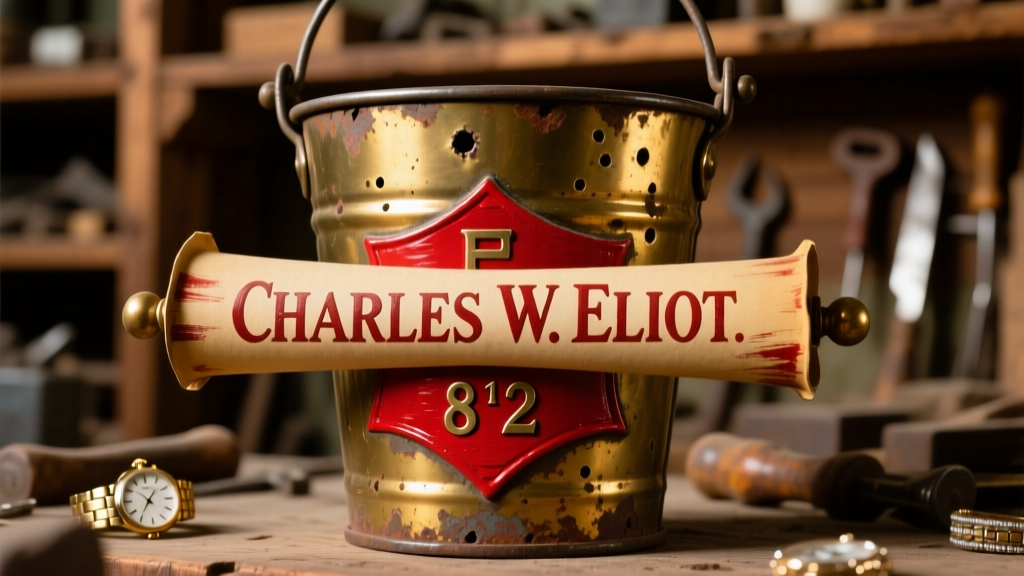
The Charles W. Eliot Firefighting Bucket: A Rare 8½-Inch Red-Painted Copper Artifact with Scroll Decoration and Historical Provenance

Sascha Brastoff Bowl '3 Pagodas' — A Mid-Century Ceramic Masterpiece in 3-Foot Diameter, 7-Inch Depth

Cowan Pottery Azure Luster Vase: A Masterpiece of American Art Pottery, 8½ Inches Tall
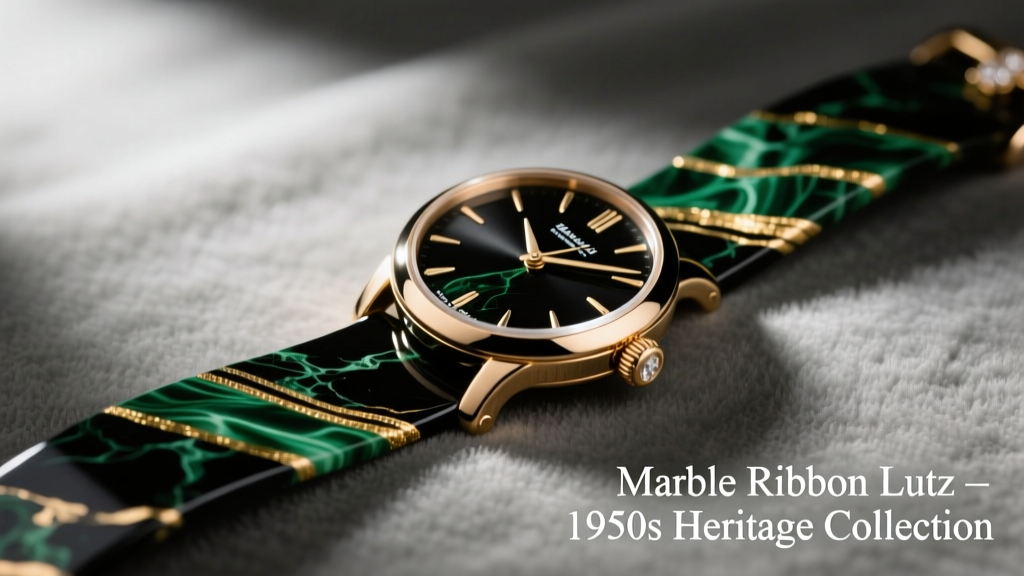
Marble Ribbon Lutz: Decoding the Black Ground, Green & Gold Stripes — A 3¾-Inch Enamel Watch Dial Masterpiece
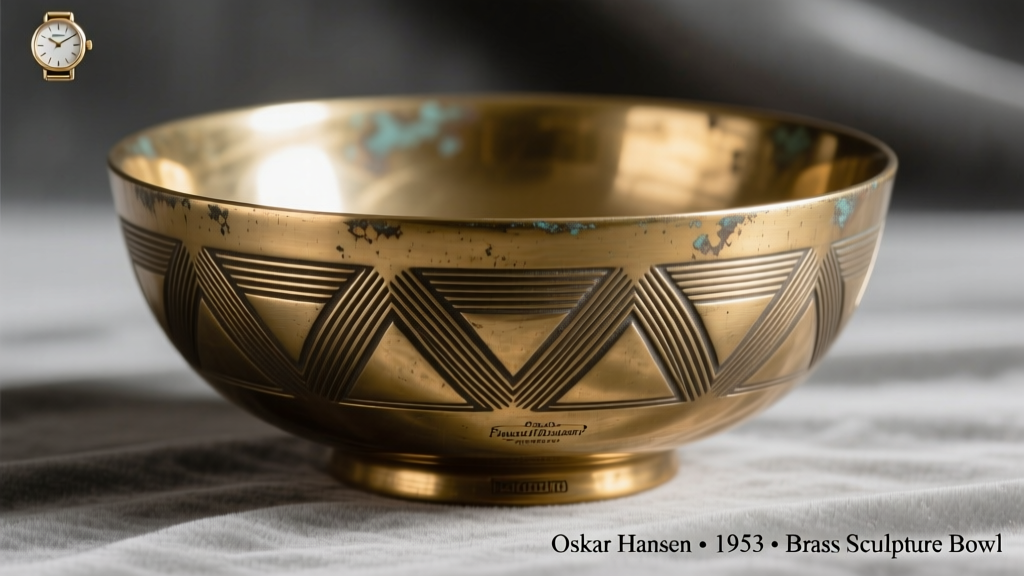
The Oskar Hansen Bowl: Scandinavian Modernism, Precision Engineering, and Auction Market Realities

Wrought Iron Garden Gate Foliate Scrolls: A Study in Victorian Craftsmanship and Architectural Ornamentation