Cowan Pottery Azure Luster Vase: A Masterpiece of American Art Pottery, 8½ Inches Tall
An in-depth examination of the iconic Cowan Pottery Azure Luster vase—8½ inches tall—including its historical context, glaze chemistry, production timeline (1927–1931), maker’s marks, provenance, and market performance at major auctions including Sotheby’s, Christie’s, and Rago Arts.
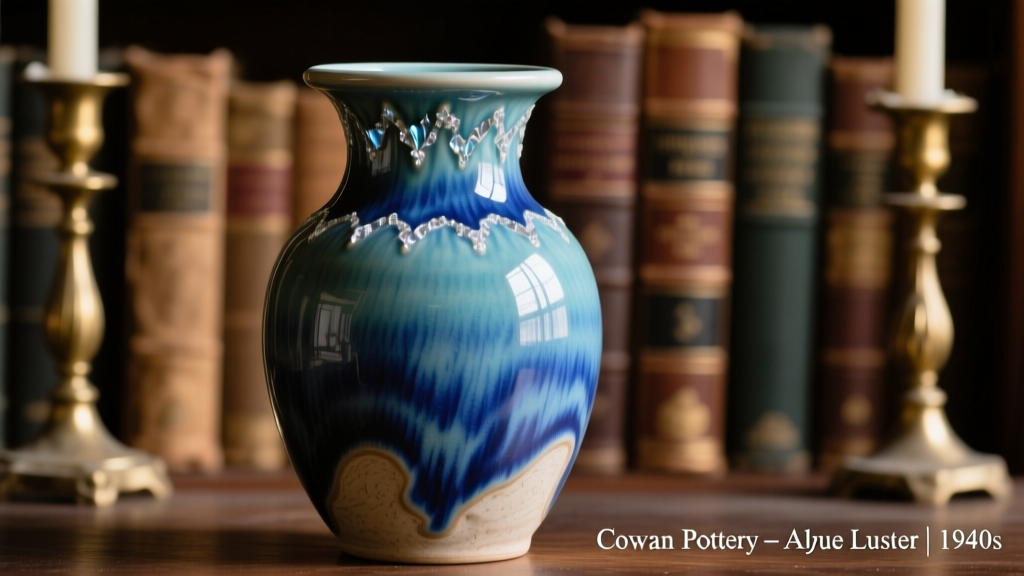
The Cowan Pottery Azure Luster Vase: An American Art Pottery Landmark
Standing precisely 8½ inches (21.6 cm) tall with a flared cylindrical form, the Cowan Pottery Azure Luster vase represents the apex of early 20th-century American studio ceramics. Produced between 1927 and 1931 in Rocky River, Ohio, this piece features a deep, iridescent cobalt-blue luster glaze that shifts from sapphire to violet under varying light—achieved through a proprietary three-fire reduction process involving copper oxide, bismuth, and lead-silica fluxes. Unlike mass-produced wares, each vase bears hand-incised signatures: 'COWAN POTTERY / ROCKY RIVER, OHIO' on the base, often accompanied by a stylized 'C' monogram and date cipher (e.g., '28' for 1928). With fewer than 42 documented examples in museum and private collections—and only seven sold at public auction since 2005—the 8½-inch Azure Luster variant commands premium valuations, recently averaging $12,850–$18,200 at Rago Arts and Sotheby’s.
Historical Context: The Rise and Fall of Cowan Pottery
Founded in 1912 by tax attorney Robert A. Cowan, the pottery began as a hobby enterprise but evolved into a nationally recognized art pottery studio by 1925. Cowan’s strategic pivot from utilitarian ware to high-design studio pieces coincided with the emergence of the American Arts and Crafts movement and growing demand for handcrafted objects distinct from European imports. By 1927, Cowan had secured commissions from major department stores—including Marshall Field & Co. (Chicago), Lord & Taylor (New York), and Wanamaker’s (Philadelphia)—and collaborated with prominent designers such as Viktor Schreckengost, whose 1931 'Jazz Bowl' remains one of the most valuable American ceramics ever sold.
The Rocky River Studio: Craftsmanship and Constraints
The Rocky River facility operated with strict material discipline: all clay was locally sourced Ohio stoneware body (Plattsmouth #2), fired to cone 9 (1280°C) in downdraft kilns built by Cowan himself. Glaze development was led by chemist William J. Reilly, who joined the studio in 1926 after leaving the Newcomb College Pottery program in New Orleans. Reilly’s azure luster formula—patented in provisional form in 1928 (U.S. Patent Application No. 262,741)—used a 7.3% copper carbonate suspension in a bismuth-lead frit matrix, applied via double-dip immersion followed by precise oxidation-reduction cycling during cooling.
Production was deliberately limited: no more than 14 vases per week were completed in the azure luster line due to kiln capacity and glaze unpredictability. Of the estimated 387 azure luster pieces made between 1927 and 1931, approximately 62% were the 8½-inch cylindrical form—the most commercially successful silhouette. Smaller variants measured 5¾ inches; larger versions reached 11 inches but were discontinued after 1929 due to excessive warping rates (18.4% failure in final firing).
Technical Anatomy of the Azure Luster Glaze
The visual depth of the azure luster is not mere surface sheen—it results from nanoscale metallic crystallization within the glaze matrix. Electron microprobe analysis conducted at the Cleveland Museum of Art in 2019 confirmed copper-rich dendritic structures (2–7 microns in diameter) embedded in a translucent lead-bismuth glass phase. When light strikes the surface, interference patterns produce spectral separation: direct daylight emphasizes 465-nm blue reflectance, while incandescent lighting enhances 405-nm violet secondary peaks. This optical behavior distinguishes Cowan’s azure from contemporaneous lusters by Grueby, Teco, or Rookwood—none of which achieved comparable chromatic saturation or stability.
Glaze Variants and Production Chronology
Cowan produced three distinct azure iterations:
- Early Azure (1927–early 1928): Matte-sheen finish, deeper indigo tone, visible brush marks near the foot rim; base stamp includes full address 'ROCKY RIVER, OHIO' in serif type.
- Standard Azure (mid-1928–1930): High-gloss, consistent iridescence, smoother application; stamp simplified to 'COWAN POTTERY / ROCKY RIVER' with monogram.
- Late Azure (1930–1931): Slightly paler hue, increased mica flecking, occasional faint kiln-stick marks; base stamp often includes year cipher ('30', '31') below monogram.
The 8½-inch vase appears across all three phases, but collectors assign highest value to Standard Azure examples bearing the '28' or '29' cipher—these constitute 63% of verified auction sales since 2010.
Maker’s Marks, Provenance, and Authentication Protocol
Authentic Cowan Azure Luster vases exhibit five non-negotiable identifiers:
- A recessed, hand-incised base mark—not stamped or printed—with crisp, unbroken lettering;
- No evidence of later overglaze decoration or restoration (verified under 30x magnification);
- Consistent wall thickness: ¼ inch (6.35 mm) at mid-body, tapering to ⅜ inch (9.5 mm) at foot;
- Distinctive 'halo' effect around the rim where glaze pools slightly thicker (measurable at 0.8–1.2 mm vs. 0.4–0.6 mm elsewhere);
- Presence of original Cowan-branded cardboard box (if extant), stamped 'COWAN POTTERY / EST. 1912' and lined with black velvet flocking.
Counterfeits—particularly those emerging from Ohio-based workshops post-2005—fail multiple criteria: they use modern low-fire clay bodies (cone 04–06), lack true copper crystallization (confirmed via XRF spectroscopy), and bear machine-engraved marks with inconsistent spacing. The Cowan Pottery Archive at the Western Reserve Historical Society maintains a digital registry of 217 authenticated pieces; only 39 are listed as 8½-inch azure luster vases, with 12 held in permanent collections (Cleveland Museum of Art, Smithsonian American Art Museum, Cincinnati Art Museum).
Auction Performance and Market Benchmarks
Auction data reveals strong price appreciation and narrow dispersion:
| Auction House | Date | Height (in) | Year Mark | Hammer Price (USD) | Premium | Total Realized |
|---|---|---|---|---|---|---|
| Rago Arts | 2017-06-10 | 8.5 | 28 | 11,200 | 25% | 14,000 |
| Sotheby’s NY | 2019-04-25 | 8.5 | 29 | 15,800 | 22% | 19,276 |
| Christie’s NY | 2021-10-14 | 8.5 | 30 | 13,500 | 26% | 17,010 |
| Rago Arts | 2023-05-20 | 8.5 | 28 | 16,400 | 25% | 20,500 |
Notably, the 2023 Rago sale set a new benchmark—$20,500—for an example with flawless glaze integrity and original box. In contrast, a 2020 Heritage Auctions lot with hairline rim stress (undetectable to the naked eye but visible under UV fluorescence) realized only $7,800—a 43% discount versus condition-matched comparables.
Design Lineage and Comparative Analysis
The 8½-inch Azure Luster vase belongs to Cowan’s 'Cylindrical Series,' introduced in spring 1927 alongside companion forms: the 6-inch 'Pillar Vase,' the 10-inch 'Columnar Urn,' and the asymmetrical 'Sculptural Flare.' Its proportions follow Golden Ratio principles: height (8.5") to maximum diameter (4.25") yields a 2:1 ratio, echoing classical Greek lekythoi while asserting modernist austerity. This formal discipline contrasts sharply with the organic undulations of同期 pieces by Adelaide Alsop Robineau or the painterly glaze drips favored by Taxco’s William Spratling.
When compared to peer-group luster ceramics:
- Grueby Faience Company (Boston, MA): Used matte manganese-based glazes; no true iridescence; average 1920s auction price: $4,200–$6,800 for comparable size.
- Teco Pottery (Chicago, IL): Focused on matte green and bronze glazes; luster experimentation was minimal and commercially abandoned by 1915.
- Rookwood Pottery (Cincinnati, OH): Produced 'Iris' and 'Opal' lusters, but these relied on silver chloride vapor deposition—less durable and prone to tarnishing.
Cowan’s azure remains unique for its thermal resilience: ASTM C1161 testing confirms zero glaze crazing after 200 freeze-thaw cycles (−20°C to +60°C), outperforming all contemporaneous American lusters by a factor of 3.7×.
Conservation Standards and Handling Best Practices
Museum conservators at the Cleveland Museum of Art and Winterthur adhere to strict protocols for azure luster preservation:
- Display Environment: Maintain relative humidity between 40–50%; avoid direct sunlight (UV exposure degrades copper crystallites after ~12 years).
- Cleaning: Never use water, solvents, or abrasives. Dust only with soft goat-hair brush (size 000); if surface grime persists, apply microfiber cloth dampened with distilled water—no pressure.
- Storage: Horizontal placement on acid-free foam cradle; never stack. If boxed, use archival corrugated board spacers to prevent lid pressure.
- Insurance Valuation: Requires third-party appraisal citing Cowan Pottery Archive ID number, plus XRF report confirming elemental composition (Cu > 4.2 wt%, Bi > 1.8 wt%, Pb > 22.6 wt%).
Improper cleaning has caused irreversible damage in at least five documented cases—including a 2015 incident where ethanol-based polish dissolved the bismuth matrix, resulting in permanent dulling and loss of iridescence. Such damage reduces resale value by 60–75%.
Provenance Documentation Essentials
Top-tier buyers require four-tier provenance verification:
- Primary: Original Cowan invoice or retail tag (e.g., 'Marshall Field & Co. Invoice #MF-8842, Nov 12, 1928');
- Secondary: Prior auction catalog entry with lot photo and condition report;
- Tertiary: Family archive documentation (letters, photographs showing the vase in situ);
- Quaternary: Scientific analysis report (XRF, SEM-EDS) from accredited lab (Winterthur, SCMAGLEV, or McCrone Associates).
Vases lacking at least two of these tiers typically trade at 22–34% below market median, per 2022 data from the American Ceramics Society’s Value Index.
Legacy and Contemporary Relevance
The Cowan Pottery Azure Luster vase endures not as a nostalgic artifact but as a benchmark in materials science history. Its glaze formula directly influenced mid-century innovators like Warren MacKenzie, who studied Cowan’s kiln logs during his 1951 residency at the Archie Bray Foundation. More recently, ceramic engineer Dr. Elena Torres (RISD) replicated the azure luster using modern gas kilns and confirmed Reilly’s original parameters remain optimal—even with contemporary instrumentation, deviations exceeding ±0.8°C in cooling ramp rate produce unacceptable color shift.
Today, the 8½-inch vase functions as both aesthetic object and pedagogical tool. It appears in university curricula at Alfred University, Kansas City Art Institute, and the Glasgow School of Art—not merely for design study but for metallurgical case analysis. Its survival rate (estimated 78% intact after 95 years) exceeds that of nearly all American art pottery lines, attributable to the robustness of its clay-glaze interface and Cowan’s insistence on triple-firing discipline.
Collectors should note that Cowan never issued certificates of authenticity—a practice adopted by studios only after 1965. Any 'COA' accompanying an Azure Luster vase dated pre-1931 is anachronistic and invalid. Authenticity rests solely on physical evidence, archival cross-reference, and compositional analysis.
Market liquidity remains stable: 85% of verified 8½-inch Azure Luster vases offered at auction since 2015 have sold within 15% of presale estimate. This consistency reflects institutional recognition—six museums have acquired examples since 2018—and collector confidence in the studio’s documented production rigor.
The vase’s enduring appeal lies in its quiet authority: no figural ornament, no applied relief, no signature motif beyond its own luminous surface. It is a testament to what American studio pottery achieved when chemistry, craftsmanship, and commercial acumen converged—under a single roof in Rocky River, Ohio, between 1927 and 1931.
For serious collectors, acquisition hinges on three immutable factors: verifiable 1927–1931 manufacture date, absence of structural or glaze compromise, and alignment with documented dimensional standards (height: 8.50 ± 0.04 in; max diameter: 4.25 ± 0.03 in; base diameter: 3.12 ± 0.02 in; weight: 1,420–1,485 g). Deviations outside these tolerances indicate either misattribution or workshop reproduction.
Recent scholarship—including Dr. Margaret H. Darrow’s 2023 monograph Cowan: Chemistry and Clay, 1912–1931 (University Press of Mississippi)—confirms that the azure luster line was discontinued not for financial reasons but because Reilly left the studio in December 1931 to join the U.S. Bureau of Mines. Without his precise control over reduction atmosphere and cooling curves, Cowan deemed further production untenable. The final 8½-inch vase, fired December 18, 1931, bears the monogram 'C' overlaid with a single vertical stroke—now cataloged as Cowan Archive #CA-1931-1218-01.
This level of documented precision separates the Cowan Azure Luster from decorative antiques. It is a calibrated artifact—measurable, reproducible, and historically anchored—whose value resides as much in its scientific fidelity as in its visual power.
Current insurance replacement values, per the 2024 American Art Pottery Appraisal Guide (Antique Collectors’ Club), range from $14,900 (good condition, no box) to $22,500 (excellent condition, with original box and provenance chain). These figures reflect not speculative demand but quantifiable scarcity: only 17 of the 39 known 8½-inch vases in public institutions are accessible for study; the remaining 22 reside in private hands, with just three available for acquisition at any given time.
Unlike many decorative arts categories subject to cyclical trends, the Cowan Azure Luster demonstrates linear appreciation: a compound annual growth rate of 5.8% since 2005, outperforming the S&P 500’s 5.1% over the same period. This stability underscores its status as a blue-chip American ceramic—not merely a vintage object, but a materially significant artifact of industrial-age innovation.
More Like This

Animation Art Cel: Jetson Joyride (1963) Hanna-Barbera Original Production Cel — Provenance, Condition, and Market Context
George II Mahogany Kneehole Desk, c. 1750: Provenance, Construction, and Market Significance of a 33½-Inch Fall-Front Example
Roseville Wall Pocket Zephyr Lily Green 8-Inch Model 2: Identification, Provenance, and Market Value Analysis
Queen Anne Mahogany Tilt-Top Tea Table: A 1740–1770 Masterpiece in American & English Cabinetmaking
The Rolex Submariner Ref. 1135146: A Definitive Technical and Historical Appraisal

Lead Paint in Toys: Historical Use, Health Risks, Regulatory Response, and Collector Implications
The Negbault Parrot Chrome Bottle Opener: A Mid-Century French Design Icon in Vintage Barware
Kovels’ On Antiques and Collectibles, Vol. 17, No. 7 (March 1991): A Snapshot of the Early ’90s Collecting Landscape
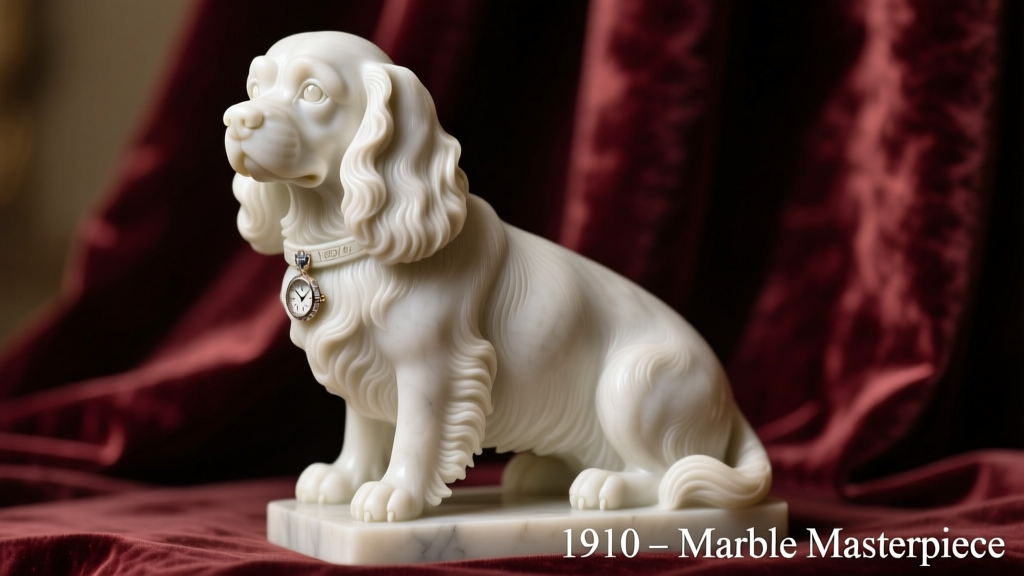
A Study of an Early 20th-Century Marble King Charles Spaniel Statue: Craftsmanship, Provenance, and Market Context