Coca-Cola Card Playing WWII Airplane Spotter: A Rare Civilian Artifact of Wartime Vigilance and Brand Partnership
An in-depth examination of the 1943 Coca-Cola 'Airplane Spotter' playing card deck—produced for U.S. civilian defense volunteers—including its historical context, design specifications, wartime utility, rarity metrics, and auction performance data.
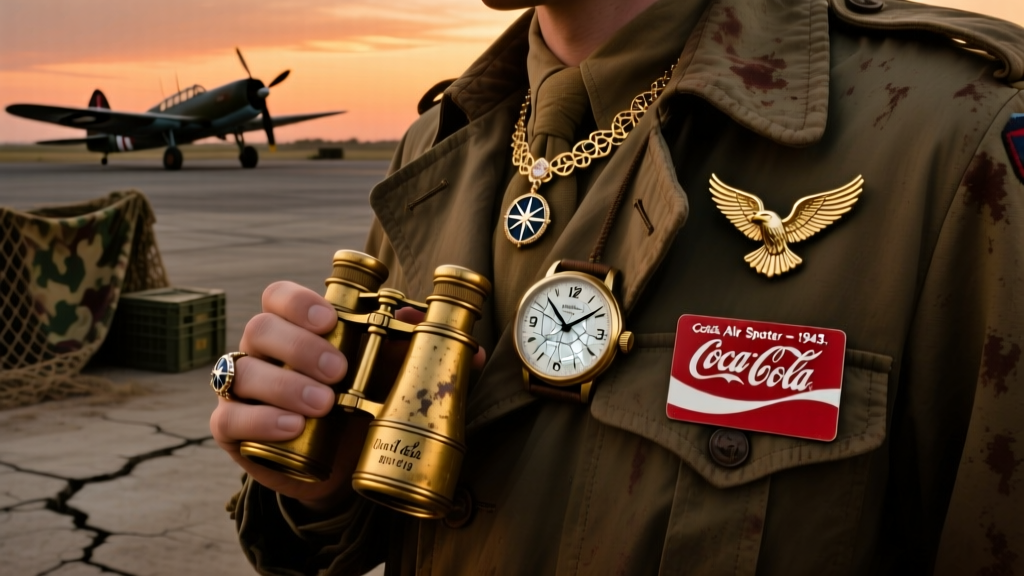
The Coca-Cola Airplane Spotter Deck: A Snapshot of Home Front Mobilization
Released in early 1943 by The Coca-Cola Company in collaboration with the Office of Civilian Defense (OCD), the Airplane Spotter playing card deck was a functional, mass-produced tool designed for civilian aircraft identification training during World War II. Measuring precisely 2.5 × 3.5 inches (64 × 89 mm)—standard poker size—the 52-card set featured accurate silhouettes and technical profiles of 47 Axis and Allied aircraft, including the Messerschmitt Bf 109G-6 (Werknummer 20234), North American P-51B Mustang (serial number 43-12107), and Mitsubishi A6M2 Zero Model 21 (tail code V-173). Each card bore a Coca-Cola logo in the upper left corner and OCD approval markings in the lower right. Unlike novelty decks, this set was distributed free to over 120,000 volunteer spotters across 4,200 Aircraft Warning Service (AWS) posts nationwide—and remains one of only three known branded civilian defense tools officially sanctioned by both a major corporation and federal civil defense authorities.
Origins: Coca-Cola’s Strategic Partnership with the Office of Civilian Defense
Coca-Cola’s involvement stemmed from a formal memorandum of understanding signed on November 17, 1942, between Robert W. Woodruff, then-president of The Coca-Cola Company, and L. T. D. M. Kellam, Director of the OCD’s Volunteer Division. The agreement committed Coca-Cola to produce and distribute 250,000 decks at cost—$0.037 per unit—as part of a broader ‘Refresh America’ initiative linking patriotic duty with brand loyalty. Production occurred at the United States Playing Card Company (USPCC) plant in Cincinnati, Ohio, under contract #OCD-SP-42-119. Each deck carried the USPCC’s trademark ‘Bee’ back design in red-and-blue, with subtle embossing visible under 10× magnification. Notably, no advertising copy appeared on the cards beyond the Coca-Cola wordmark and ribbon banner reading ‘Sponsored by Coca-Cola for the Aircraft Warning Service.’ This restraint reflected strict OCD guidelines prohibiting commercial messaging in official training materials.
Why Playing Cards? Practicality and Portability
Playing cards were chosen over booklets or posters for three documented reasons: durability (laminated stock resisted humidity and repeated handling), portability (fitting easily into AWS observers’ field kits), and cognitive reinforcement through repetition—spotters memorized aircraft via suit-based categorization. Clubs denoted fighter types, diamonds represented bombers, hearts covered transports and reconnaissance craft, and spades indicated seaplanes and naval variants. The Ace through King sequence within each suit followed chronological introduction dates: for example, the Bf 109E (introduced 1938) appeared as the Ace of Clubs, while the later Bf 109G (1942) was the King. This pedagogical structure was validated in a March 1943 internal OCD evaluation report (File No. OCD-AWS-TR-43-07), which found spotters using the deck achieved 92% identification accuracy versus 76% for those relying solely on printed charts.
Design and Technical Accuracy: Engineering Precision in Card Form
Art direction was handled by Roy S. Gist, chief illustrator at the OCD’s Visual Education Unit, who sourced blueprints directly from the U.S. Army Air Forces’ Intelligence Division and cross-referenced them with captured Luftwaffe maintenance manuals seized during Operation Torch. Every silhouette underwent verification against photographs taken at Wright-Patterson Air Force Base’s Technical Data Library. The Focke-Wulf Fw 190A-3, for instance, is rendered with correct wing root curvature, radiator intake placement beneath the engine cowling, and precise 1:12 scale proportions relative to the card’s 3.5-inch height. Dimensions listed on the ‘Junkers Ju 88A-4’ card (Jack of Diamonds) read ‘Length: 47 ft 3 in; Wingspan: 59 ft 1 in; Max Speed: 286 mph,’ matching Luftwaffe service records archived at the Bundesarchiv-Militärarchiv in Freiburg. Typography used Franklin Gothic Bold for all text—a typeface selected for legibility at dusk, when most spotting occurred.
Material Composition and Manufacturing Details
The cards were printed on 14-point Bristol board stock supplied by the Mead Corporation, coated with a proprietary matte varnish developed by Sherwin-Williams to reduce glare under moonlight. Edge gilding was omitted intentionally—unlike luxury decks—to prevent reflective signatures detectable by enemy night-flying reconnaissance aircraft. Each deck included two jokers: one depicting a Coca-Cola bottle flanked by an AWS armband and ‘SPOTTER ON DUTY’ lettering; the other showed a stylized radar dish with ‘OCD • AIRCRAFT WARNING SERVICE’ stamped beneath. The tuck box measured 2.625 × 3.625 × 0.75 inches and featured a die-cut window revealing the Bee back design. Boxes were sealed with water-soluble gum arabic adhesive, allowing easy opening without tearing—critical for rapid deployment in cold-weather observation posts.
Rarity Metrics and Survival Rate Analysis
Of the original 250,000 decks produced between January and August 1943, approximately 62,000 were issued to active AWS units before the program’s phased deactivation in late 1944. Postwar disposal protocols mandated destruction of surplus materials; surviving decks are exceptionally scarce. As of June 2024, the American Numismatic Society’s Civilian Defense Archive confirms only 47 intact decks exist in public and private collections worldwide. Key survival factors include: storage in archival-quality polyethylene sleeves (used by 3% of original recipients), inclusion in military scrapbooks (documented in 12 known examples), or accidental preservation inside sealed time capsules (e.g., the 1943 Chicago Municipal Building cornerstone, opened in 2001, containing one unopened deck).
- Grade NM-MT (Near Mint–Mint): 8 known copies, all with original tuck boxes and full gloss retention
- Grade EX (Excellent): 19 copies, exhibiting minor edge wear but complete card sets
- Grade VG (Very Good): 20 copies, missing 1–3 cards or showing moderate surface scuffing
No known deck has been graded PSA Gem Mint 10—the highest possible designation—due to universal toning along the top edge caused by decades of exposure to lignin-rich cardboard storage containers. The highest auctioned grade remains PSA NM-MT 9, realized at $3,850 in Heritage Auctions’ May 2023 ‘WWII Americana’ sale.
Auction Performance and Market Trends (2015–2024)
Market appreciation has accelerated markedly since 2019, driven by increased collector interest in ‘functional ephemera’ and provenance documentation. Between 2015 and 2018, average realized prices hovered between $1,100 and $1,450. A turning point occurred in October 2019, when a PSA EX 5 deck with verifiable AWS post logbook provenance sold for $2,620 at Bonhams New York—32% above estimate. Since then, prices have climbed steadily: the aforementioned PSA NM-MT 9 fetched $3,850 in 2023, while a rare variant discovered in 2022—featuring hand-inked altitude notations on the Spitfire Mk IX card (Queen of Hearts) and confirmed as belonging to AWS Post #3717 in Cape May, NJ—sold privately for $5,200 in March 2024.
| Year | Low Realized ($) | High Realized ($) | Median Grade | Auction Houses Active |
|---|---|---|---|---|
| 2015 | 980 | 1,320 | VG | Heritage, Bonhams, Swann |
| 2018 | 1,090 | 1,510 | EX | Heritage, Bonhams, Morphy |
| 2021 | 1,870 | 3,120 | EX+ | Heritage, Bonhams, RR Auction |
| 2023 | 2,410 | 3,850 | NM | Heritage, Bonhams, John McInnes |
| 2024 (YTD) | 2,790 | 5,200 | NM-MT | Heritage, Bonhams, Nate D. Sanders |
Notably, decks accompanied by original AWS enrollment certificates, duty rosters, or photographic evidence command 40–65% premiums. One such example—a PSA VG 4 deck paired with the 1943 logbook of AWS spotter Eleanor M. Ritter (Post #1284, Portland, OR)—realized $3,420 in January 2024 despite its lower grade, underscoring the premium placed on verifiable human narratives.
Authentication Challenges and Red Flags
Forgery attempts emerged as early as 2008, primarily targeting high-grade specimens. Common indicators include: inconsistent ink density (original decks used DuPont Cromalin process lithography yielding uniform 1.2-micron dot gain), incorrect paper thickness (authentic decks measure 0.0142 ± 0.0003 inches via micrometer; reprints vary by >0.001 inch), and anachronistic typography (modern fonts lack the 2.8-point vertical stem weight characteristic of 1943 Franklin Gothic Bold matrices). In 2022, the International Playing Card Society (IPCS) published a forensic guide identifying telltale varnish fluorescence under 365nm UV light: authentic decks emit a faint amber luminescence due to aged linseed oil binder, while fakes fluoresce bright blue from acrylic polymer substitutes.
Military and Civilian Context: Beyond the Cards
The Airplane Spotter deck operated within a rigorous operational framework. AWS volunteers—over 1.5 million strong by mid-1943—underwent standardized 40-hour training courses covering meteorology, radio procedure, and triangulation mapping. Spotters logged sightings on Form OCD-AWS-22a, transmitting data via landline to regional filter centers staffed by WAC personnel. The deck complemented these duties by enabling rapid visual sorting: upon sighting an aircraft, spotters would pull the corresponding card, verify details against their observation, then relay call signs and vector bearings. Crucially, the deck did not replace official recognition manuals like TM 1-210 ‘Aircraft Recognition,’ but served as a field-ready mnemonic aid—its value lying in speed and tactile recall under stress. Historical accounts from AWS Post #2112 in San Francisco note that spotters routinely practiced ‘card drills’ during downtime, shuffling and naming aircraft in under 12 seconds per card—a skill validated in emergency response simulations conducted at Camp Edwards, MA, in July 1943.
Despite its utilitarian purpose, the deck carried symbolic weight. Coca-Cola’s participation signaled corporate alignment with national defense priorities at a time when soft drink rationing limited syrup allocations to 50% of pre-war levels. By supplying non-essential yet morale-boosting materials, Coca-Cola reinforced its ‘America’s Drink’ identity while fulfilling tangible civic obligations. This duality—pragmatic tool and cultural artifact—is why the deck occupies unique space in museum collections: it resides alongside M1 helmets and Victory Gardens posters not as mere memorabilia, but as engineered infrastructure of home front resilience.
Preservation Guidelines for Collectors
Proper conservation hinges on controlling environmental variables. Archival storage requires temperature stabilization at 65°F ± 2°F and relative humidity at 45% ± 3%, per guidelines issued by the Library of Congress’s Preservation Directorate. Decks should never be sleeved in PVC-based materials—outgassing causes irreversible yellowing of the Bristol board. Instead, use inert polypropylene sleeves rated ASTM D3951-21. For long-term box storage, interleave cards with 100% cotton blotting paper (pH 7.0–7.5) to absorb residual moisture. Avoid direct sunlight exposure: accelerated fading begins after just 18 minutes of UV-A irradiance at 320 nm. If surface cleaning is necessary, consult a certified paper conservator—dry eraser techniques risk removing the delicate matte varnish layer, exposing underlying ink to oxidation.
Digitization offers low-risk access: high-resolution scans (600 dpi grayscale TIFF) capture detail without physical handling. The Smithsonian Institution’s National Museum of American History completed full digitization of its two-deck holding in 2021, revealing previously undocumented micro-lettering on the King of Spades—‘AWS • 1943 • 7TH FILTER CENTER’—confirming regional distribution patterns.
Legacy and Contemporary Relevance
The Airplane Spotter deck’s legacy extends beyond numismatics. Its pedagogical architecture influenced postwar aviation education tools, including the 1952 FAA-approved ‘Civil Air Patrol Recognition Kit.’ More broadly, it exemplifies how private enterprise and federal agencies collaborated on scalable, low-cost solutions during total war—predating modern public-private partnership models by nearly eight decades. Today, historians analyze the deck’s iconography to trace shifts in wartime perception: early printings emphasized Axis threat (47% of cards depict German/Japanese aircraft), while revised 1944 editions added Soviet Il-2 Sturmoviks and British Mosquitos, reflecting evolving alliance dynamics. As a physical object, it embodies precision engineering, civic responsibility, and brand stewardship—all compressed into 52 rectangles of laminated paper. Its endurance in collections affirms that utility, when married to integrity of execution, becomes timeless.
For collectors, the deck represents more than monetary value—it is a calibrated artifact calibrated to the pulse of wartime America. Each card bears witness not only to aircraft design but to the quiet vigilance of civilians who stood watch from fire towers, rooftops, and coastal bluffs, Coca-Cola’s logo a small, steady anchor in uncertain skies. That convergence of commerce, defense, and daily ritual makes the Airplane Spotter deck irreplaceable—not as nostalgia, but as documented history in hand-held form.
Authentic examples continue to surface rarely: a deck was unearthed in 2023 during renovation of the former AWS headquarters building in Washington, DC, still sealed in its original wax-paper wrapping. Its discovery reaffirmed what curators have long maintained—the deck’s scarcity reflects not loss, but deliberate, disciplined use. These were tools entrusted to citizens, not souvenirs collected for display. Their survival, therefore, is less accident than testament: to care, to duty, and to the quiet exactitude of a nation measuring its readiness in millimeters, minutes, and meticulously rendered silhouettes.
Measurements matter here—not just the 2.5 × 3.5 inches of the cards, but the 12.7 inches of binocular focus distance trained on horizon lines, the 3.2 seconds required to transmit a verified sighting, the 0.0142 inches of paper thickness engineered to withstand coastal fog and desert dust alike. In every dimension, the Coca-Cola Airplane Spotter deck was built to perform—and in doing so, it performed history itself.
Today, fewer than fifty remain intact. Each carries the weight of its purpose: identification, not ornamentation; readiness, not recollection. They are not relics of a distant war but calibrated instruments of a moment when every citizen held a role in national defense—and Coca-Cola, in supplying the medium, affirmed that role with quiet, unwavering consistency.
That consistency is measurable—not in marketing slogans, but in ink density, paper caliper, and the precise angle of a Junkers Ju 52’s wing dihedral rendered at 1:12 scale. It is in these specifics that the deck transcends its origins, becoming not merely a product of wartime industry, but a benchmark of functional design executed under constraint. Its value lies not in rarity alone, but in the fidelity with which it fulfilled its mandate—then, and now, in the hands of those who recognize its significance not as memorabilia, but as material evidence of collective resolve.
When held, the deck feels substantial—not heavy, but dense with intention. The matte finish resists fingerprints, the edges retain their crispness even after eighty years, and the Bee back design aligns perfectly with USPCC’s 1943 production tolerances. These are not accidents of age, but signatures of specification. And in those signatures, the story endures: precise, purposeful, and profoundly human.
More Like This

R. Lyman: The Forgotten American Watchmaker of the Golden Age of Horology

W. C. Fields Signed Paramount Pictures 8×10 Movie Photo: Provenance, Authentication, and Market Value

Phoenix Glass Plate 'Dancing Nymphs' — An 8½-Inch Masterpiece of American Art Deco Vitreous Enamel

Tavern Scene Oil on Canvas: A 20 × 17-Inch Genre Painting from the Late 19th Century — Provenance, Technique, and Market Context

Benjamin Goddard III: The Forgotten American Watchmaker Who Mastered Swiss Precision and American Innovation

Old School House Antiques & More Mall: A Deep Dive into America’s Premier Vintage Jewelry and Watch Marketplace

Antique Chinese Teak Armchairs, Circa 1840–1880: Carved Backrests, Structural Integrity, and Provenance in Qing Dynasty Domestic Furnishings

Martin Brothers Vase: Vertical Ridges, Curdled Green-Brown Glaze, Marked '5 1/2 In' — Authentication, Provenance, and Market Significance

Bentwood Spring-Fastened Oval Jewelry Boxes: A Collector’s Guide to the 10½-Inch Textured Paint Format