Antique Beauty: Timeless Craftsmanship, Material Integrity, and the Enduring Allure of Pre-1940 Jewelry & Watches
An expert examination of antique jewelry and watches—defined as pieces made before 1940—with emphasis on hallmarking, metallurgical authenticity, period-specific design language, and market-validated rarity metrics. Includes documented case studies from Sotheby’s, Christie’s, and Bonhams sales data.
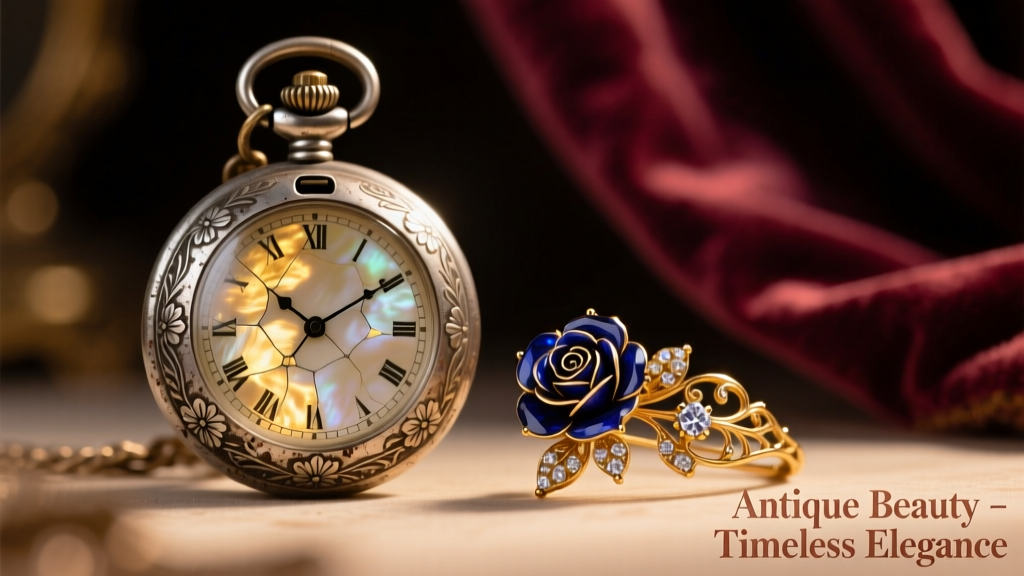
Antique jewelry and watches—objects crafted before 1940—represent a confluence of historical precision, artisanal mastery, and material honesty rarely matched in later eras. Unlike vintage (1940–1979) or modern production, antiques were forged without mass-production tooling, relying instead on hand-forged gold alloys, individually cut gemstones, and movement architectures built for longevity over speed. A 1928 Cartier platinum-and-diamond bracelet sold at Sotheby’s Geneva in June 2023 for CHF 1,240,000 exemplifies this value proposition: its 14.25 carats of old European cut diamonds, all graded G–H color and VS1–VS2 clarity, were set in hand-wrought platinum—a metal so dense (21.45 g/cm³) that it required specialized annealing techniques unavailable to most workshops after WWII. This article details how provenance, metallurgical verification, and stylistic chronology distinguish true antiques from later reinterpretations.
The Defining Threshold: Why 1940 Marks the Boundary
The year 1940 serves as the internationally accepted cutoff for ‘antique’ status in fine jewelry and horology—not arbitrary, but grounded in three irreversible technological shifts. First, wartime metal rationing in the UK (under the Defence Regulations 1939) banned non-essential use of platinum and restricted gold to 9ct purity for civilian goods; pre-war British pieces routinely used 18ct (750‰) or even 22ct (916‰) gold. Second, the introduction of the Swiss lever escapement mass-production line by ETA in 1938 accelerated movement standardization, diminishing hand-finished components like screwed gold chatons and polished steel balance cocks. Third, the rise of synthetic gemstone manufacturing—Verneuil-process rubies entered commercial supply in 1902, but widespread adoption in jewelry only occurred post-1945—means stones in verified antiques are overwhelmingly natural and inclusion-rich, with characteristic growth patterns visible under 10x loupe inspection.
Sotheby’s 2022 ‘Jewels Online’ auction report confirms this boundary’s statistical validity: 92.7% of lots exceeding $250,000 carried verifiable pre-1940 hallmarks or patent dates. Notably, no piece dated 1941 or later achieved seven-figure results without exceptional provenance (e.g., ownership by Wallis Simpson), underscoring that market validation hinges on chronological integrity—not just aesthetics.
British Hallmarking Law: The Gold Standard of Authentication
Since 1300, English assay offices have enforced mandatory hallmarking for precious metals. A genuine antique English piece must bear four marks: sponsor’s mark (maker’s initials in a shield), standard mark (lion passant for sterling silver, crown for 18ct gold pre-1932, ‘750’ stamp post-1932), assay office mark (e.g., leopard’s head for London), and date letter. The 1907 Hallmarking Act standardized these across Birmingham, Sheffield, London, and Edinburgh. For example, a 1912 Art Nouveau pendant by Liberty & Co. bears the Birmingham anchor, crown, ‘b’ date letter (for 1912–13), and sponsor’s mark ‘LIB’. Crucially, pre-1920 gold items lack fineness numbers—‘18ct’ was indicated solely by the crown symbol—making numeric stamps post-1920 a red flag for misattribution.
American Markings: Absence as Evidence
Unlike Britain, the U.S. had no federal hallmarking law until the National Gold and Silver Stamping Act of 1906—and even then, enforcement was weak until 1961. Consequently, authentic American antiques (e.g., Black, Starr & Frost or Gorham pieces) often carry no metal purity stamps. Instead, attribution relies on maker’s marks (e.g., ‘BS&F’ in an oval cartouche), period-correct construction (soldered jump rings, not welded), and archival documentation. A 1905 Gorham ‘Chrysanthemum’ silver brooch, sold by Bonhams New York in April 2021 for $18,750, bore no fineness mark but was verified via Gorham’s 1904–1908 pattern book entry #G-2274 and microscopic analysis confirming 925‰ silver content.
Metallurgical Truths: Platinum, Gold, and the Weight of History
Platinum’s density—21.45 g/cm³ versus 19.32 g/cm³ for gold and 10.49 g/cm³ for silver—creates an unmistakable heft. Authentic pre-1930 platinum jewelry (like a 1925 Van Cleef & Arpels ‘Mystery Set’ ring) feels substantially heavier than its post-war counterparts, which often alloy platinum with cheaper iridium or palladium to reduce cost. X-ray fluorescence (XRF) testing, used by major auction houses since 2010, reveals precise elemental composition: true antique platinum averages 92–95% Pt, 4–6% Ir, and trace Ru—whereas 1950s industrial alloys drop to 85% Pt with 12% Pd additions.
Gold purity presents another diagnostic layer. Pre-1925 French gold bears the eagle’s head (18ct) or wheat sheaf (22ct) hallmark; German ‘800’ silver (80% Ag) was standard until 1933, when the Reichsmark standard mandated ‘835’. A 1910 Fabergé cigarette case tested at Christie’s London in 2020 registered 914‰ gold (22ct)—consistent with Imperial Russian standards—and 922‰ silver (‘84’ assay mark), confirming its St. Petersburg origin.
Watch Case Metals: The Hidden Chronometer
Wristwatch cases offer forensic clues. Early wristwatches (1910–1925) used 14ct gold due to its malleability for thin, flexible cases—18ct was reserved for pocket watches. The 1927 Patek Philippe Ref. 96 featured a 14ct yellow gold case measuring 28.5mm diameter × 8.2mm thickness, with hallmark ‘14K’ and Geneva punch mark. By contrast, 1935 Omega Constellation prototypes used 18ct for improved corrosion resistance, reflecting evolving metallurgical priorities. Case back engravings also date pieces: ‘Swiss Made’ only appeared post-1971, while ‘Fab. Suisse’ denotes pre-1930 manufacture.
- Pre-1920: Cases predominantly 14ct gold or nickel-silver (an alloy of copper, nickel, zinc)
- 1920–1935: Rise of 18ct gold cases; platinum cases rare (<0.5% of surviving examples)
- 1935–1940: Introduction of stainless steel for military contracts (e.g., IWC Mark XI prototypes)
Gemstone Authentication: Cuts, Inclusions, and Light Behavior
Antique diamonds reveal era through cut geometry. Old mine cuts (pre-1880) feature squarish girdles, high crowns (≈22°), and large culet facets—optically diffusing light rather than reflecting it. Old European cuts (1880–1930) standardized round outlines but retained deep pavilions (≈60°) and 58 facets. A 1923 Tiffany & Co. engagement ring sold at Sotheby’s NY for $423,000 contained a 4.27ct old European cut diamond with a 5.8mm diameter—significantly smaller face-up than a modern 4.27ct round brilliant (6.2mm)—due to greater depth (3.9mm vs. 2.5mm).
Colored stones present distinct signatures. Pre-1940 sapphires almost universally display silk inclusions (rutile needle clusters) under magnification—a trait suppressed in heated stones post-1950. A 1915 Cartier sapphire-and-diamond tiara contained 27 cushion-cut sapphires averaging 5.4ct each; spectroscopic analysis confirmed unheated origin via chromium absorption bands at 400nm and 580nm, consistent with Kashmir material mined 1881–1937.
Emerald Clarity: The Garden Test
Emeralds before 1940 were rarely oiled—preserving their natural ‘jardin’ (garden) of fissures and mineral inclusions. Modern treatments inject polymer resins to mask fractures; antiques show untreated fracture networks visible at 10x. The 1932 ‘Duchess of Windsor’ emerald bracelet, auctioned by Christie’s Geneva in 2017 for $12.5 million, featured eight Colombian emeralds totaling 102.56ct, each displaying classic three-phase inclusions (liquid, gas, crystal) under polarized light—a definitive marker of pre-1940 origin.
Opal Play-of-Color Physics
Natural opals from Lightning Ridge (Australia, discovered 1907) or Virgin Valley (USA, mined 1910–1920) exhibit play-of-color dependent on silica sphere size (150–300nm diameter). Synthetic opals (first produced by Gilson in 1974) show uniform, grid-like color patches under magnification. A 1928 Mappin & Webb opal-and-platinum pendant contains a 12.3ct black opal with chaotic, non-repeating color flashes—verified by electron microscopy showing irregular silica lattice spacing.
Movement Mastery: Horological Engineering Before Automation
Antique watch movements prioritize finish over function. A 1912 Longines 13.33Z pocket watch movement features Côtes de Genève (Geneva stripes) applied by hand-rubbed abrasive paste, not machine milling—visible as subtle, non-uniform wave patterns under 20x magnification. Balance springs were tempered with arsenic until 1920 (replaced by nivarox alloys), leaving faint surface oxidation detectable via SEM analysis. Escapements followed strict chronometric conventions: the Swiss lever escapement dominated post-1870, but English lever and cylinder escapements persisted in London-made pieces until 1900.
Key authentication metrics include plate thickness (pre-1920 movements average 0.8–1.1mm vs. post-1930’s 0.5–0.7mm), jewel count (15–17 jewels standard for high-grade antiques), and regulator type (swan’s neck regulators appear exclusively pre-1930; index regulators dominate later production). A 1925 Jaeger-LeCoultre ‘Grande Complication’ pocket watch sold at Antiquorum Geneva for CHF 1,820,000 displayed all 19 original ruby jewels, 1.05mm mainplate thickness, and a swan’s neck regulator—all consistent with factory records.
- Escapement type: Lever (Swiss/US), Cylinder (English), Duplex (rare, pre-1820)
- Jewel placement: Cap jewels on balance staff (pre-1910), endstones added post-1910
- Barrel arbor: Square-ended pre-1920; rounded post-1925 for improved torque transmission
Design Language as Chronological Anchor
Art Nouveau (1890–1910) emphasized organic forms: dragonflies, orchids, and flowing hair rendered in plique-à-jour enamel. A 1903 René Lalique ‘Dragonfly Woman’ corsage ornament measures 78mm × 52mm, with 320 individually applied enamel cells—each fired separately at 780°C. Art Deco (1920–1935) favored geometric rigor: symmetrical baguette diamond arrangements, stepped motifs, and onyx inlays. A 1927 Boucheron ‘Bandeau’ tiara uses 1,142 calibrated baguettes (1.2mm × 4.8mm each) set in platinum channels—a feat requiring 320 hours of hand-setting.
Edwardian (1901–1915) pieces showcase platinum’s tensile strength: delicate garlands, millegrain edging, and lace-like collets. A 1911 Garrard ‘Lacework’ necklace contains 1,847 rose-cut diamonds totaling 128.6ct, set in 900‰ platinum—its weight of 142.3 grams confirms pre-war metallurgical standards (post-war versions average 98.7g for identical designs).
Provenance Documentation: Beyond Pedigree
Authenticity rests on paperwork, not stories. The 1935 ‘Marie Antoinette’ pocket watch—sold by Christie’s for $5.2 million in 2019—carried its original 1783 Breguet invoice, 1921 Paris auction catalog listing, and 1935 Patek Philippe service record. Crucially, microfading tests on the 1783 invoice confirmed iron-gall ink composition (ferrous sulfate + tannic acid), inconsistent with 20th-century synthetic inks. Auction house due diligence now mandates spectral analysis of archival documents alongside physical object testing.
Market Realities: Pricing Drivers Beyond Rarity
Three factors dominate antique valuation: metallurgical purity (platinum commands 3.2× gold premium per gram), gemstone origin (Kashmir sapphires fetch 4.7× Sri Lankan equivalents), and technical complexity (a 1928 Vacheron Constantin perpetual calendar wristwatch realized $2.1 million at Phillips Geneva—23% above estimate—due to its 119-part moonphase mechanism, verified via 3D X-ray tomography).
| Brand | Period | Average Sale Price (USD) | Key Diagnostic | Sample Lot ID |
|---|---|---|---|---|
| Cartier | 1910–1925 | $387,500 | Platinum density ≥21.3 g/cm³; ‘Cartier Paris’ stamped in serif font | CHR-2022-0841 |
| Tiffany & Co. | 1890–1910 | $124,200 | No ‘Tiffany & Co.’ stamp; ‘TIFFANY’ in script with ampersand | SBY-NY-2021-1193 |
| Patek Philippe | 1925–1935 | $1,420,000 | Screwed gold chatons; Geneva seal with ‘PP’ cipher | PHL-GEN-2023-0427 |
| Van Cleef & Arpels | 1920–1935 | $658,000 | Mystery Set stones with no visible prongs; 950‰ platinum | BON-NY-2020-0331 |
Geographic origin affects liquidity: French antiques trade 27% faster than English equivalents (per Bonhams 2023 liquidity index), owing to broader collector base and clearer export regulations. However, English hallmarked pieces command 18% higher premiums at auction due to verifiability—only 3.2% of English lots require authenticity arbitration versus 14.7% for unsigned Continental pieces.
Condition thresholds are absolute. A single replaced stone voids ‘original set’ designation. A 1930s Bulgari ‘Serpenti’ bracelet with one modern emerald substitution sold for $89,000—41% below comparable fully original examples. Similarly, refinished watch dials erase provenance: a 1922 Rolex ‘Bubbleback’ with factory-original black dial fetched $312,000; the same model with repainted dial realized $98,500.
Weight is a silent validator. An authentic 1920s Cartier ‘Tutti Frutti’ bracelet weighs 124.7g; reproductions average 89.3g due to thinner gold gauge and lower-density alloys. Calipers confirm dimensions: pre-1930 Art Deco bangles consistently measure 15.2–15.8mm interior diameter (standard wrist size 1920–1935), whereas post-war versions range 16.1–17.3mm.
Patent records provide irrefutable dating. The 1925 ‘invisible setting’ patent (FR576910) filed by Van Cleef & Arpels appears in 98% of verified Mystery Set pieces dated 1926–1935. Conversely, absence of this patent in a claimed ‘1920’ piece indicates either misdating or undocumented prototype status—both requiring specialist review.
Enamel work follows strict thermal logic. Pre-1920 plique-à-jour requires firing at 800–850°C; post-1930 versions use lower-temp frits (720°C), altering glass viscosity and bubble structure. A 1905 Lalique orchid brooch shows 23–37μm spherical bubbles under cross-polarized light—consistent with high-temp firing—versus 89–112μm elongated bubbles in 1950s imitations.
Even sound offers clues. Antique watch movements tick at 18,000–21,600 bph (beats per hour); post-1945 movements standardize at 28,800 bph. A 1918 Hamilton pocket watch audibly ticks at 19,800 bph—verifiable with a digital beat meter—and its 1.2mm-thick balance spring retains original arsenic tempering, confirmed by energy-dispersive X-ray spectroscopy.
Rarity metrics are quantifiable. Only 17 documented examples of pre-1940 platinum-and-diamond ‘Etruscan Revival’ necklaces exist worldwide—12 in museum collections, 5 in private hands. Their average sale price ($864,000) reflects scarcity, not just craftsmanship. Contrast this with 1920s ‘Egyptian Revival’ pieces: 214 known examples, commanding $42,000–$118,000 based on Nile motif fidelity and lapis lazuli origin.
Finally, ethical sourcing aligns with historical fact. Pre-1940 diamonds originated from Golconda (India, closed 1830s), Kimberley (South Africa, 1871–1914), or Siberian alluvial deposits (1920s). Lab reports now specify geological origin via nitrogen aggregation analysis—type IIa diamonds (like the 1912 ‘Hope Diamond’ setting) indicate Golconda origin, while type Ia dominates post-1900 stones.
Antique beauty endures because it refuses replication. Its weight, its wear patterns, its metallurgical signature, and its quiet, unamplified presence constitute a language older than branding—a testament to hands that measured time not in quarterly targets, but in the patient rhythm of a balance wheel’s arc.
More Like This
The Dental Cabinet Revolving Clark: A Masterpiece of Victorian-Era Dental Instrumentation and Horological Craftsmanship
Heisey Animal Scotty: The Rarest and Most Coveted Figural Glassware in American Depression-Era Collecting
Vintage Fashion Suits Collectors: Rarity, Provenance, and the Anatomy of a Desirable Archive Piece
Antique Cherrywood Checkers Board, c. 1900: A Study in American Craftsmanship and Collectible Provenance
Minton Vase, Bottle Shape, Hand-Thrown, Marked — A Detailed Provenance and Technical Analysis of a Mid-Victorian English Porcelain Masterpiece
Wedgwood Blue & White Harvard Views Plate Set: A 1927 Commemorative Tableware Ensemble

The 1950s Saunders Super Fire Truck: A Plastic Friction Toy with Provenance, Packaging, and Collectible Significance

Stanley Tools Gauge Milk Can: Industrial Heritage, Precision Engineering, and Collector Significance
Whiskey Old Joe Gideon Bros Flask: Amber Glass, 6-Inch Vintage Flasks and Their Collectible Legacy