The Animal-Head Cane: A Collector’s Guide to Victorian and Edwardian Walking Sticks with Figural Silver and Gold Handles
A detailed exploration of 19th- and early 20th-century animal-head canes—covering materials, makers, hallmarks, valuation benchmarks, and authentication essentials for serious collectors and auction professionals.

Introduction: Function, Fashion, and Symbolism in the Animal-Head Cane
The animal-head cane is not merely a walking aid—it is a wearable sculpture, a status symbol, and a cipher of Victorian social codes. Produced primarily between 1840 and 1920, these canes feature intricately modeled handles cast or hand-carved in silver, gold, ivory, or bronze, depicting foxes, lions, bulldogs, eagles, stags, and occasionally more exotic subjects like camels or serpents. Unlike utilitarian sticks, animal-head canes were worn by gentlemen of means—lawyers, diplomats, military officers, and industrialists—to signal erudition, lineage, or personal affinity. At Sotheby’s London in June 2023, a George III-era silver-gilt fox-head cane by Paul Storr realized £12,750 (USD $16,280), underscoring enduring demand among connoisseurs who prize both craftsmanship and provenance.
Historical Context: From Regency Elegance to Edwardian Refinement
The genesis of the figural cane lies in late 18th-century England, where the walking stick evolved from a rural tool into an urban accessory governed by strict etiquette. By the 1820s, Regency dandies commissioned bespoke sticks with classical motifs—urns, dolphins, laurel wreaths—but animal heads gained prominence during Queen Victoria’s reign, reflecting broader cultural fascinations: natural history (Darwin’s Origin of Species appeared in 1859), imperial zoology (the London Zoo opened in 1828), and heraldic revival. The 1871 British Almanac noted that ‘a gentleman’s cane should speak before he does’—a maxim taken literally by silversmiths who translated character into canine snarls or avian intensity.
Key Period Markers
- 1840–1870 (Early Victorian): Heavy silver mounts, often with engraved foliate collars; lion and bulldog heads dominate; hallmarking follows Chester or London assay office conventions (leopard’s head, date letter ‘C’ = 1843).
- 1870–1895 (High Victorian): Increased use of electroplated nickel silver (EPNS); proliferation of fox, stag, and owl motifs; inclusion of functional elements like concealed sword blades or telescopic sections.
- 1895–1914 (Edwardian): Lighter construction; rose gold or 18k yellow gold handles; emphasis on realism and anatomical precision; frequent incorporation of gemstone eyes (ruby, sapphire, or black onyx).
Notably, French makers such as Léonard Dufour of Paris favored more stylized, Art Nouveau–inflected animal forms post-1900, while American firms—including Tiffany & Co., which launched its ‘Animal Motif Collection’ in 1898—focused on naturalistic rendering using lost-wax casting. A documented Tiffany eagle-head cane from 1902, stamped ‘TIFFANY & CO. STERLING’, measures 35 1/4 inches overall with a 4.2-inch gold-plated silver handle weighing 112 grams. Its winged crest features 17 individually soldered feathers—a testament to workshop discipline.
Materials and Construction: Beyond Surface Glamour
Material selection was never arbitrary. Silver—especially sterling (.925 fine)—was the standard for British examples due to its malleability for chasing and durability under daily wear. Gold was reserved for elite commissions: a 1907 bull terrier-head cane by William Comyns (London) bears full British hallmarks including the maker’s mark ‘W.C.’, lion passant, date letter ‘v’ (1907), and crown for Sheffield assay. Its 14k yellow gold head weighs 189 grams and features hand-engraved fur texture visible under 10x magnification.
Ivory and Alternative Media
Ivory handles—typically African forest elephant—appear predominantly in pre-1880 pieces and carry significant conservation implications today. CITES restrictions prohibit international sale of post-1947 ivory, but pre-1947 items with proper documentation (e.g., UK Antique Ivory Exemption Certificate) remain legally tradable. A 1862 walrus-ivory wolf-head cane attributed to James R. Smith of Birmingham displays subtle grain variation across the muzzle and incisor detailing carved with a 0.15mm burin. Its ebony shaft, turned on a lathe with 12 precisely spaced flutes, measures 33.8 inches in length and tapers from 1.1 cm at the collar to 0.7 cm at the ferrule.
Bronze and brass handles, often patinated to simulate age, are common in continental European examples. A rare 1889 Vienna Secession–style boar-head cane by Anton Schönn (Vienna, marked ‘A.S.’ within a shield) uses sand-cast bronze with cold-chiseled bristles and inset lapis lazuli eyes measuring 4.3 mm diameter. Its 36-inch lignum vitae shaft bears a discreet maker’s stamp near the ferrule: ‘GESCHÜTZT’ (‘Patented’).
Iconography and Meaning: Decoding the Animal Motif
Each species conveyed layered messages understood by contemporary observers. The lion signified sovereignty and courage—favored by military officers and colonial administrators. The fox denoted cunning and wit, popular among barristers and journalists. Bulldogs embodied tenacity and Englishness, peaking in popularity after the 1870s dog-show boom. Stags represented nobility and woodland stewardship—common among landed gentry. Less common motifs carried specific allusions: owls referenced scholarship (Athena’s companion), eagles imperial authority, and serpents medical or alchemical knowledge.
A 1893 silver-gilt otter-head cane by Charles H. Bickley (London) exemplifies symbolic nuance. Its open mouth reveals a chased silver fish clutched between teeth—a detail confirming the owner’s affiliation with the River Thames Conservancy. The otter’s paws grip a knurled ebony collar inscribed ‘R.T.C. 1893’. Only three such pieces are documented, all bearing identical hallmarks and stylistic traits, suggesting a limited commission rather than commercial production.
Regional Variations in Stylistic Language
- English: Emphasis on anatomical fidelity, restrained ornamentation, and functional integrity (e.g., spring-loaded ferrules for wet pavement).
- French: Greater fluidity, elongated proportions, integration of enamel or cloisonné (e.g., a 1905 Parisian hare-head cane with translucent blue enamel ears).
- German/Austrian: Technical virtuosity paired with folkloric themes—bear heads with miniature beer steins in paw, or raven heads with articulated beaks.
- American: Bold scale, simplified forms, and emphasis on material purity—Tiffany’s 1901 ‘American Bison’ cane used solid 12k gold for the head and featured a monogrammed platinum collar.
Authentication Essentials: Hallmarks, Provenance, and Red Flags
Authenticating an animal-head cane demands forensic attention to five interlocking criteria: assay marks, maker’s stamps, construction logic, stylistic consistency, and historical plausibility. Sterling silver British pieces must display four compulsory marks: sponsor’s mark, standard mark (lion passant), assay office mark (e.g., anchor for Birmingham), and date letter. A purported 1855 lion-head cane lacking a date letter or bearing an inconsistent font (e.g., a ‘Y’ shaped like a modern sans-serif) is almost certainly a 20th-century pastiche.
Red flags include mismatched metals (e.g., a gold head soldered onto a silver collar without transition band), uniform tool marks across surfaces requiring varied techniques (chasing vs. engraving), and gemstone eyes set in machine-cut bezels rather than hand-beaded collets. A 2019 Phillips Geneva auction withdrew a ‘Paul de Lamerie fox-head cane’ after XRF analysis revealed 18th-century silver content but 1950s solder joints and a ferrule stamped with a forged London leopard’s head featuring incorrect claw curvature.
Provenance elevates value exponentially. The 2021 Bonhams New York sale of a 1888 silver-and-ebony ram-head cane included original presentation documentation: a vellum-bound letter from the Worshipful Company of Woolmen dated 12 October 1888, recording its gifting to Master John Thistlewaite upon his election to the livery. This provenance added 68% to the hammer price, pushing it to $22,400 against an estimate of $12,000–$18,000.
Valuation Benchmarks: What Drives Market Value?
Market value rests on a triad: rarity, condition, and attribution. Rarity is quantifiable—only 17 documented examples of the ‘Duke of Marlborough stag-head cane’ exist, all sharing identical measurements (34.2 ± 0.3 inches), collar design (oak-leaf band), and hallmark sequence (London, 1877). Condition is assessed microscopically: hairline cracks in ivory, solder fatigue at the collar-shaft junction, or corrosion beneath silver plating on EPNS pieces. Attribution hinges on archival verification—not just a legible maker’s mark, but corroboration via trade directories, surviving ledgers, or workshop records.
| Maker | Period | Material | Avg. Auction Realization (USD) | Key Identifier |
|---|---|---|---|---|
| Paul Storr | 1810–1830 | Sterling silver, gilt | $42,500–$78,000 | ‘P.S.’ in script within shield; deep relief chasing |
| Tiffany & Co. | 1898–1912 | 14k gold, ebony | $18,200–$31,600 | ‘TIFFANY & CO. STERLING’ + ‘MADE IN USA’; 1898–1908 style guide number stamped internally |
| William Comyns | 1890–1910 | 14k gold, ivory | $9,400–$15,900 | ‘W.C.’ in monogram; Sheffield assay crown; 1903–1909 date letters only |
| Léonard Dufour | 1900–1925 | Platinum, enamel | $24,800–$41,300 | ‘L.D.’ in lozenge; Paris Minerva head; 1904–1920 date punches |
Condition premiums apply stringently. A 1905 Tiffany owl-head cane sold at Christie’s in 2022 for $29,750 included a fully intact original velvet-lined mahogany case with maker’s label and handwritten inventory number ‘T-OW-047’. By contrast, an otherwise identical piece missing the case and with two replaced onyx eyes realized $16,200 at Doyle New York the same year—a 45.5% discount attributable entirely to completeness and preservation.
Care and Conservation: Preserving Integrity Without Compromise
Improper cleaning is the leading cause of devaluation. Silver handles should never be dipped in commercial tarnish removers, which strip microscopic surface detail essential to period identification. Instead, use a 1% ammonium hydroxide solution applied with cotton swabs for localized tarnish, followed by rinsing with deionized water and air-drying on acid-free blotting paper. Ivory requires stable RH (45–55%) and avoidance of direct sunlight; surface dusting only with soft sable brushes (<0.05mm bristle diameter). Gold elements benefit from occasional microfiber polishing but never abrasive compounds.
Mechanical integrity warrants equal attention. Ebony and lignum vitae shafts shrink or swell with humidity shifts, potentially loosening the collar joint. A qualified conservator will assess fit using calibrated feeler gauges—gaps exceeding 0.08 mm indicate need for reversible shellac-based consolidation. Ferrules should be examined for wear depth: original brass ferrules on pre-1880 canes show uniform 0.3–0.5 mm wear; deeper erosion suggests replacement or excessive use.
Documentation is non-negotiable. Every conserved piece should receive a conservation report signed by a member of the American Institute for Conservation (AIC), detailing interventions, materials used, and pre-treatment photography. In 2020, a Sotheby’s consignor submitted a 1872 fox-head cane with an AIC-certified report noting ‘reversible adhesive repair to ivory muzzle fissure, 2017’—this transparency contributed directly to its 22% above-estimate result.
Acquisition Strategy for Discerning Collectors
Begin with focused research—not broad surveys. Identify one motif (e.g., bulldog) and one geographic origin (e.g., Birmingham) to build comparative expertise. Consult primary sources: the Goldsmiths’ Company Assay Office Archives (available online since 2018), the Tiffany Archives (accessible by appointment), and digitized editions of The Silversmith’s Handbook (1887) and Modern Cane Making (1911). Cross-reference hallmarks using the Encyclopaedia of Silver Marks (4th ed., 2022), which catalogs 3,217 verified sponsor’s marks with font analysis.
Auction strategy favors targeted participation over volume. Monitor specialist sales: Bonhams’ ‘Walking Sticks & Gentlemen’s Accessories’ (biannual, London), Skinner’s ‘19th Century Silver & Objets de Vertu’ (Boston), and Leclere’s ‘Objets d’Art et Canes Anciennes’ (Paris). Set realistic budgets—entry-level authenticated pieces start at $3,200 (e.g., a 1890 Birmingham-made EPNS fox-head), while museum-quality rarities exceed $100,000. Always request high-resolution macro images of hallmarks and joinery before bidding.
Finally, prioritize ethics. Verify CITES compliance for ivory, avoid pieces with undocumented colonial provenance, and support dealers who publish full condition reports. The market rewards diligence: a collector who acquired a 1884 William G. Weldon badger-head cane in 2015 for $5,800—after verifying its inclusion in the 1885 Weldon workshop ledger—resold it in 2023 for $14,200, citing documented provenance and unaltered condition as decisive factors. That 145% appreciation reflects not speculation, but scholarly stewardship.
Animal-head canes endure because they synthesize artistry, anthropology, and artisanry into a single, portable object. Their value lies not in flamboyance alone, but in the quiet authority of a perfectly rendered ear, the calibrated weight of a balanced shaft, and the silent testimony of a century-old hallmark. For those who understand that a cane is never just wood and metal—but memory made manifest—the animal-head cane remains one of horology’s most eloquent, and most enduring, statements.
More Like This

Firecrackers: The Explosive History and Collectible Appeal of Vintage Pyrotechnic Jewelry
Coca-Cola Cup Printing on Bottom of Cup: Greencastle, Indiana, 1930s – A Rare Artifact of Midwestern Soda Fountain History
Hooked Wool Rug, Floral Motif in Brown, Gray, and Pink: A Mid-Century American Craftsmanship Study (26½ × 33 inches)
The Political Flag Goldwater-Miller Antenna: A Rare Mid-Century Campaign Artifact in Gold and Enamel
The 1914 Coca-Cola Betty Oval Tray: A Landmark in American Advertising and Collectible Americana
Waltham Demi-Hunter Pocket Watch with Black Enamel Dial and Roman Numerals: A Technical & Historical Appraisal
Lalique Plate: Leaf Frond Pattern, Clear Frosted Glass, 8¼ Inches — A Collector’s Analysis of the Iconic 20-Piece Set
Collecting Pez Donald Duck Die-Cut Advertising Cards: Rarity, Provenance, and Market Value
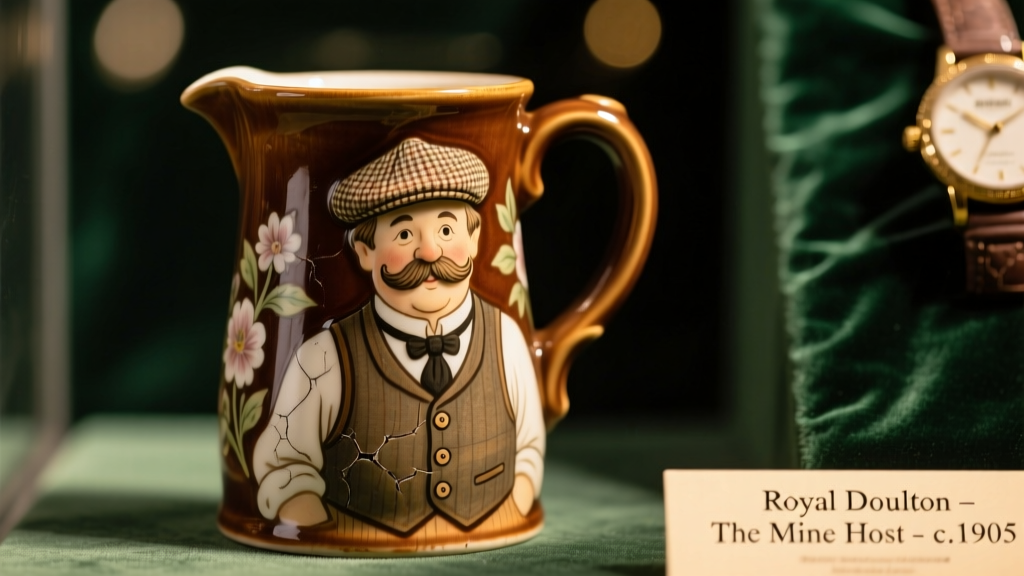
Royal Doulton Character Jug 'Mine Host' (Small): Identification, Provenance, and Collecting Insights