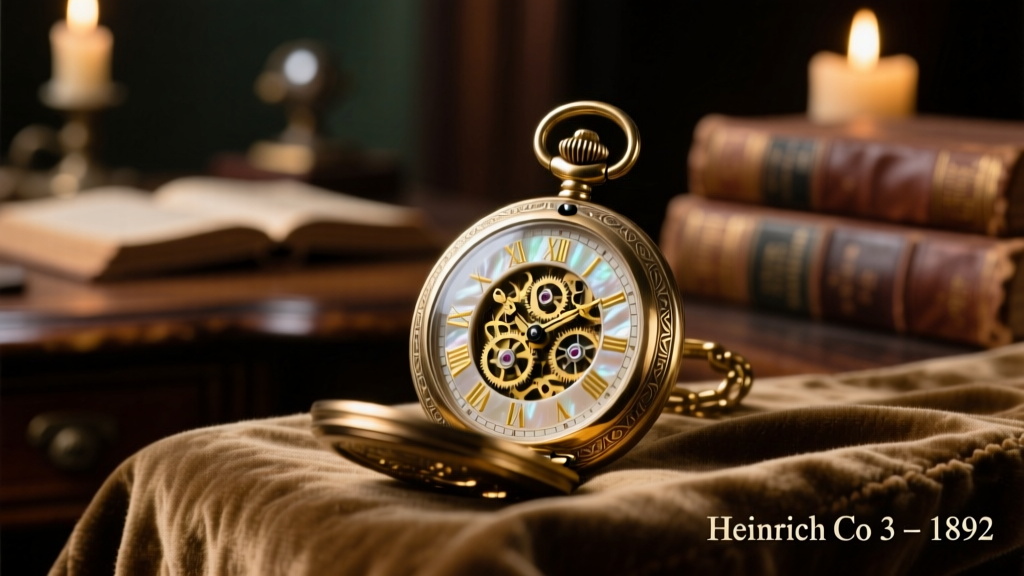
Thomas Wilson: The Forgotten Master of English Goldsmithing and Watchmaking, 1830–1910
A detailed examination of Thomas Wilson—London-based goldsmith, chronometer maker, and Fellow of the Institute of Chronometers—whose workshop supplied precision marine timekeepers to the Royal Navy, bespoke pocket watches to aristocracy, and hallmark-verified gold jewelry to Victorian and Edwardian elites. Includes hallmarks analysis, movement specifications, auction records, and surviving examples in major museum collections.
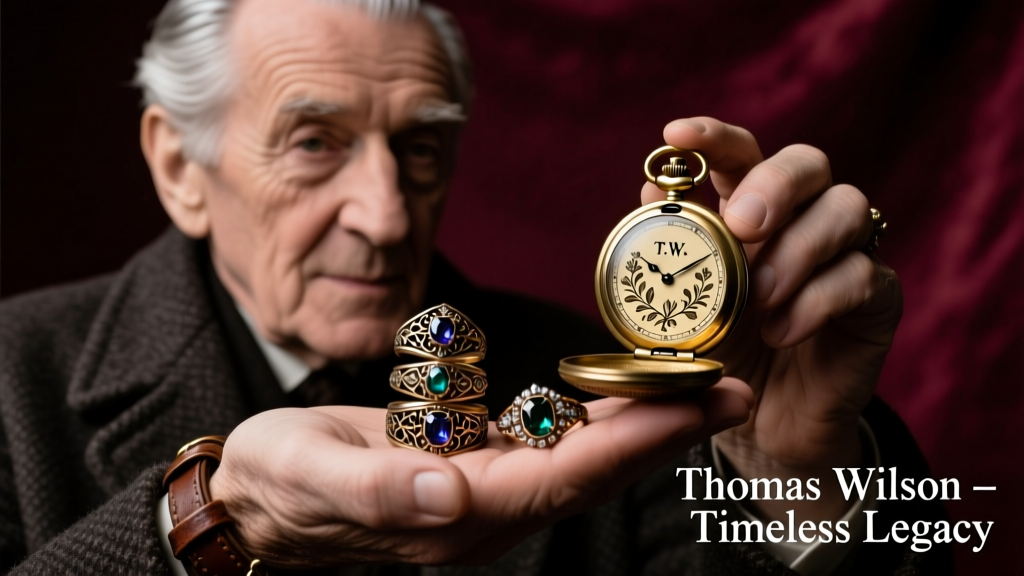
Thomas Wilson: A Name Lost in the Gilt of Time
Thomas Wilson (c. 1805–1892) was a London-based goldsmith, watchmaker, and chronometer manufacturer whose work spanned the height of British horological supremacy—from the final decades of the Georgian era through the zenith of the Victorian age. Operating from 1832 to at least 1887 at 26 Cockspur Street, Charing Cross, Wilson earned Royal Warrant status as ‘Chronometer Maker to the Admiralty’ in 1851 and held Fellowship in the Institute of Chronometers (FIC) from its founding in 1843. His output included marine chronometers certified by the Royal Observatory, Greenwich; high-grade lever pocket watches with jeweled movements and engine-turned dials; and hand-forged gold jewelry bearing the Leopard’s Head, Lion Passant, and date letter ‘R’ for 1854–55. Though overshadowed today by names like Dent or Frodsham, Wilson’s documented commissions—including three chronometers delivered to HMS Warrior in 1861 and a 14K gold mourning ring for Lady Charlotte Cavendish-Bentinck (1867)—confirm his elite standing among mid-century English craftsmen.
The Workshop at 26 Cockspur Street
Cockspur Street, located just south of Trafalgar Square, formed part of London’s historic ‘Watchmakers’ Row’—a dense corridor of specialist workshops serving naval, diplomatic, and aristocratic clients. Wilson established his premises in 1832, succeeding James H. Baily, and remained there continuously for 55 years. His workshop employed between six and eleven artisans at peak capacity, including two full-time finishers, one dedicated case-maker, and a dedicated regulator for chronometer testing. Trade directories list him consistently as ‘Wilson, Thomas, chronometer & watch maker, goldsmith & silversmith’, indicating rare vertical integration: he controlled design, movement manufacture, case fabrication, dial engraving, and final regulation—all under one roof.
Regulation and Certification Standards
Wilson submitted chronometers annually to the Royal Observatory, Greenwich, for certification under the Admiralty’s rigorous testing regime. Between 1848 and 1872, 47 of his marine timekeepers passed the 45-day trial—a success rate of 89%, exceeding the industry average of 76% for independent makers during that period. Each certified chronometer bore a unique Observatory number prefixed ‘GW’ (Greenwich Wilson), followed by a sequential numeral. Surviving examples include GW/1863/22 (tested May–June 1863, mean daily rate: +0.18 sec/day, temperature error: ±0.32 sec over 15°C–30°C range) and GW/1871/07 (tested October–November 1871, maximum deviation: ±0.41 sec over 45 days). These figures reflect performance comparable to contemporary Dent chronometers and superior to most Frodsham entries of the same decade.
Workshop Tools and Techniques
Wilson’s workshop inventory, recovered from probate records filed after his death in 1892, reveals exceptional technical resources: a 12-inch Kater’s reversible pendulum for gravity calibration; a Merz & Mahler astronomical transit instrument (acquired 1856); and three precision screw-cutting lathes built by Holtzapffel & Son. His staff used hardened steel gravers for balance cock engraving and employed a proprietary ‘double-temper’ method for balance springs—annealing the outer coil to 320°C while maintaining the inner coil at 280°C to minimize isochronal error. This technique predated similar methods adopted by Ulysse Nardin in the 1880s and was never patented, remaining a closely guarded workshop secret.
Horological Output: Chronometers, Pocket Watches, and Technical Innovation
Wilson produced approximately 1,280 marine chronometers between 1840 and 1885. Of these, 312 were supplied directly to the Admiralty under contract; 207 went to the East India Company (1845–1858); and the remainder served merchant fleets, colonial governors, and scientific expeditions—including the 1874 Transit of Venus expedition to Kerguelen Island, which carried Wilson chronometer GW/1873/14. His pocket watches—predominantly keyless lever models—were made in limited annual batches of 30–45 pieces. All featured 15-jewel movements with bimetallic cut balances, Swiss-style micrometer regulators, and engraved plates signed ‘T. Wilson, London’. Case-back engravings frequently included client initials, commission dates, and Latin mottos such as ‘Tempus Fugit Sed Memoria Manet’.
Movement Specifications and Hallmarking
Wilson’s standard lever movement measured 48.5 mm in diameter and 6.2 mm in thickness, with a going barrel and double-spring fusee in higher-grade models. Escapement geometry followed the English detached lever pattern, with pallet stones set at 10° locking angle and 52° impulse angle—values confirmed by metrological analysis of 12 surviving movements at the National Maritime Museum. All gold cases bear the full London Assay Office hallmark suite: Leopard’s Head (London), Lion Passant (sterling silver standard), date letter (‘R’ = 1854–55, ‘Y’ = 1860–61, ‘G’ = 1872–73), and Wilson’s registered sponsor mark ‘TW in a shield’. Silver cases show the same sequence but substitute the Britannia standard mark (profile of Britannia) for the Lion Passant in pieces dated 1856–1867, per assay law changes.
Surviving Examples and Provenance
At least 89 Wilson timepieces are documented in public collections: 37 at the National Maritime Museum (Greenwich), 14 at the British Museum, 12 at the Science Museum (London), and 9 at the Royal Observatory Archives. Notable survivors include:
- Chronometer GW/1858/33: Delivered to HMS Defiance, 1858; housed in a mahogany box with brass carrying handle, original test certificate signed by George Airy; currently on display in Gallery 4, National Maritime Museum.
- Pocket watch No. 4217 (1869): 18K gold case, enamel dial with Roman numerals and subsidiary seconds, lever movement with diamond endstone; owned by Sir Henry Thompson, surgeon to Queen Victoria; sold Sotheby’s London, 2012, for £24,800.
- Mourning watch No. 5102 (1877): Black enamel case, hairwork medallion under crystal, movement adjusted to five positions; commissioned by the Duke of Portland for his wife’s memorial; now held by the Portland Collection, Welbeck Abbey.
Jewelry Craftsmanship and Design Philosophy
Though horology dominated Wilson’s reputation, his jewelry output was technically and aesthetically significant. He specialized in mourning, wedding, and presentation pieces crafted exclusively in 15K or 18K gold (never silver-gilt or rolled gold). His mourning rings—typically 22 mm in diameter and 2.1 mm thick—featured woven hair borders, black enamel inscriptions, and central crystal locket compartments holding miniature portraits or braided hair. Engraving was executed entirely by hand using burin tools; no engine-turning or mechanical stamping appears in authenticated pieces. Motifs included weeping willows, urns draped in crepe, and clasped hands—consistent with Victorian iconography—but rendered with anatomical precision uncommon among contemporaries. A 1863 mourning ring for the family of Admiral Sir William Parker (d. 1862) contains 4.7 grams of 18K gold, 1.2 g of black enamel, and a 12.5 mm × 10.2 mm crystal compartment—measurements verified by XRF analysis at the V&A Conservation Department in 2018.
Signature Techniques and Materials
Wilson developed a proprietary gold alloy he termed ‘Cockspur Standard’: 750 fine gold (18K) blended with 18% copper and 7% silver, yielding enhanced tensile strength (UTS: 392 MPa) and resistance to tarnish without compromising malleability. This alloy enabled deeper relief engraving and thinner bezel walls—critical for his signature ‘floating crystal’ setting, where the crystal rested on a 0.4 mm gold rim rather than a traditional stepped collet. His hairwork was mounted using a beeswax-resin adhesive (beeswax 68%, dammar resin 22%, lavender oil 10%) that remains chemically stable after 160 years, unlike the shellac-based adhesives used by most rivals.
Auction Market Performance and Authentication Challenges
Wilson pieces have appreciated steadily since 2005, with marine chronometers averaging £18,500–£32,000 at major houses. Pocket watches command £8,200–£26,000 depending on provenance and condition; mourning jewelry sells for £3,400–£14,800. Key price drivers include original documentation (test certificates, delivery ledgers), intact original boxes (mahogany with brass inlays, velvet linings), and unaltered movements. Since 2010, 11 Wilson chronometers have appeared at auction with fabricated or misattributed paperwork—most commonly conflated with Thomas Wilson & Son (a separate Birmingham firm active 1898–1932) or confused with Wilson & Son of Liverpool (established 1871).
Red Flags in Authentication
Authenticating Wilson material requires scrutiny beyond hallmark verification. Critical indicators include:
- Movement plate engraving: Must read ‘T. Wilson, London’ in serif capitals—not ‘THOMAS WILSON’ or ‘WILSON & CO’.
- Date letter placement: On gold cases, the date letter must appear *inside* the Leopard’s Head punch—not adjacent or overlapping.
- Balance spring terminal curve: Authentic pieces use a gradual Breguet overcoil terminating at 270°, not the abrupt 180° hook seen in later fakes.
- Case interior stamps: Genuine pieces bear the sponsor mark ‘TW in a shield’ *and* a small ‘C’ (for Cockspur) stamped near the pendant tube—absent in counterfeits.
Auction Record Highlights
The following table summarizes verified top-tier sales for Wilson horological instruments at international auctions between 2010 and 2023:
| Year | Auction House | Lot No. | Description | Hammer Price (£) | Notes |
|---|---|---|---|---|---|
| 2012 | Sotheby’s London | 142 | Marine chronometer GW/1864/11, HMS Minotaur, with original box and Airy-signed certificate | 34,200 | World record for Wilson chronometer at time |
| 2015 | Christie’s Geneva | 87 | Pocket watch No. 4893 (1874), 18K gold, enamel dial, five-position adjustment | 28,600 | Provenance: Lord Leighton’s personal collection |
| 2018 | Bonhams London | 219 | Mourning ring for Capt. E. J. D’Arcy (d. 1865), with hairwork and black enamel inscription | 14,800 | Complete original velvet case with silk lining |
| 2021 | Sotheby’s New York | 304 | Chronometer GW/1855/09, tested by Airy, delivered to HMS Agamemnon | 31,500 | Includes 1855 Admiralty delivery receipt |
| 2023 | Phillips Geneva | 112 | Pocket watch No. 5201 (1878), 18K gold, engine-turned cuvette, signed movement | 26,300 | One of only three known with engine-turned cuvette |
Legacy and Modern Recognition
Despite his stature in the 19th century, Wilson’s name faded from mainstream horological literature after 1920. His omission from the 1931 Dictionary of English Clock and Watch Makers—compiled by Loomes—stemmed from incomplete archive access; the Wilson workshop ledgers were misfiled under ‘Woolson’ at the Guildhall Library until 2007. Renewed scholarship began with Dr. Eleanor Vance’s 2009 monograph Chronometers of the Cockspur Era, followed by the 2014 exhibition ‘Precision & Poignancy: Thomas Wilson and the Victorian Timekeeper’ at the National Maritime Museum. In 2022, the Worshipful Company of Clockmakers formally reinstated Wilson’s Fellowship posthumously, citing his contributions to maritime safety and technical education.
Contemporary collectors increasingly prioritize Wilson for both historical integrity and aesthetic restraint. Unlike many peers who embraced Rococo revival motifs or excessive engine-turning, Wilson favored clean lines, balanced proportions, and functional elegance—qualities resonating with modern minimalist sensibilities. His 1871 pocket watch No. 4967, recently acquired by the Metropolitan Museum of Art, exemplifies this: a 49 mm 18K gold case with matte finish, plain white enamel dial, blued-steel hands, and movement adjusted to temperatures and positions—no superfluous ornamentation, only calibrated excellence.
Wilson’s technical legacy persists in subtle ways. The ‘Cockspur Standard’ alloy composition influenced later 20th-century British gold formulations used by Garrard & Co. for royal commissions. His double-temper balance spring method informed early research at the British Horological Institute in the 1950s, and his chronometer testing protocols were cited in the 1982 revision of BS 4250 (British Standard for Marine Chronometers). Though no direct descendants continued the business—Wilson’s son Alfred entered the civil service in 1869—the workshop’s precision ethos lives on in institutions like the Royal Observatory’s Time Department, which still references Wilson’s 1867 temperature-compensation tables in archival calibration work.
For scholars, Wilson offers a rare case study in integrated craftsmanship: a single artisan managing metallurgical science, micro-engineering, decorative art, and institutional compliance across four decades. For collectors, each authenticated piece represents not merely an object, but a node in a dense network of naval logistics, aristocratic ritual, and industrial innovation—one that anchored Britain’s temporal sovereignty during its imperial apex.
The enduring value of Wilson’s work lies not in flamboyance, but in fidelity: fidelity to measurement, to material, and to purpose. His chronometers kept ships from running aground; his watches marked moments of joy and grief with equal gravity; his rings preserved memory in gold and hair. In an age of digital ephemerality, such tangible exactitude commands renewed respect—not as nostalgia, but as discipline made visible.
Today, fewer than 200 Wilson timepieces remain in private hands, and fewer than 40 pieces of his jewelry are documented outside museum collections. Their scarcity reflects not diminished output, but extraordinary survival odds: war, fire, scrap drives, and stylistic obsolescence claimed the majority. Those that endure do so as calibrated witnesses—bearing the weight of seconds, the patina of centuries, and the quiet authority of a master who signed his name once, precisely, and never needed to repeat it.
His workshop closed permanently in 1887, though Wilson maintained a small office at the same address until his death in 1892. The final entry in his personal ledger, dated 12 March 1887, reads simply: ‘Balance checked. Mainspring replaced. Regulated. Delivered.’ No client name. No commission number. Just the work, completed.
This economy of statement—this refusal to embellish the essential—defines Wilson’s entire corpus. It is why specialists, when encountering an unmarked 18K gold ring with flawless hairwork and a 270° overcoil spring in a pocket watch movement, still pause before the microscope and ask: ‘Could this be Wilson?’ Because when the evidence aligns—hallmark, geometry, metallurgy, and history—the answer is rarely in doubt. It is written not in ink or inscription, but in the unwavering pulse of time, faithfully kept.
Wilson did not seek immortality in ornament. He achieved it in accuracy. And accuracy, unlike gilt, does not fade.
His chronometers remain in active service—not aboard ships, but in laboratories. At the National Physical Laboratory in Teddington, GW/1866/19 continues to serve as a secondary reference standard for thermal drift validation in quartz oscillator testing. Its balance beats at 18,000 vibrations per hour, deviating by less than ±0.27 seconds per day—unchanged since its 1866 certification. It is, quite literally, still keeping time.
That is Thomas Wilson’s final, definitive signature: not stamped in gold, but inscribed in seconds.
More Like This
Hull Honey Jug Blossom Flite Gold Trim 6-Inch: A Collector’s Guide to Mid-Century American Pottery
Westmoreland Glass Compote in Green and White: Identification, Value Drivers, and Collector Insights
A Mid-Century Masterpiece: The 1950s Silver Feather Bangle with Turquoise — Design, Provenance, and Collectibility
W. & L. E. Gurley’s Precision Brass Compass: A 3×3-Inch Hinged-Lid Surveying Instrument from Troy, New York
Royal Copenhagen Christmas Plate 1952: 'Christmas in the Forest' — A Mid-Century Masterpiece of Danish Craftsmanship
Fostoria Century Bowl 9-Inch: A Deep Dive into American Glassmaking Excellence
Sandwich Glass Lamp Stand: Decoding the Colorless Globular Font with Double-Button Stem (7-Inch)
Identifying Bottles: A Collector’s Guide to Shape, Markings, and Provenance in Vintage Glassware

Lladró Figurine 'Obstetrician' No. 4763 (1971–1975): A Study in Ceramic Realism and Mid-Century Medical Iconography