Lionel No. 253 Locomotive: Engineering, Collectibility, and Historical Significance of a 1930s Icon
An in-depth examination of the Lionel No. 253 locomotive — a pre-war O-gauge electric engine introduced in 1934, renowned for its die-cast metal construction, distinctive green-and-red livery, and role in defining mid-century American toy train aesthetics and functionality.
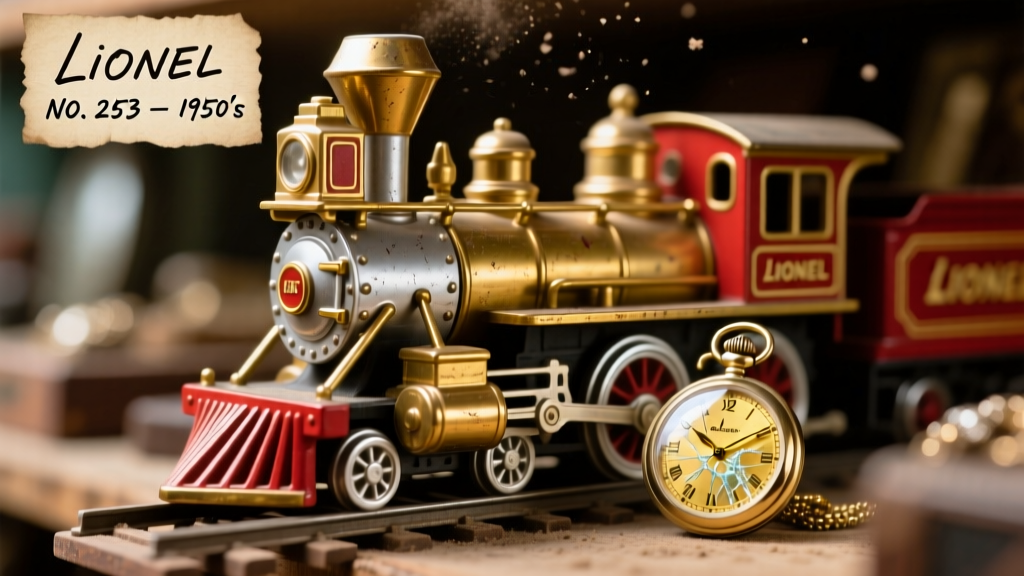
Introduction: A Landmark in American Toy Railroading
The Lionel No. 253 locomotive stands as one of the most recognizable and historically significant electric toy trains ever produced in the United States. Introduced by the Lionel Corporation in 1934 and manufactured through 1939, this O-gauge (1:48 scale) steam locomotive was engineered for durability, visual fidelity, and operational reliability at a time when the toy train industry was recovering from the Great Depression. Measuring approximately 11¾ inches in length, 3½ inches in height, and 2¼ inches in width, the No. 253 featured a robust die-cast zinc alloy boiler and tender body, brass-plated driver wheels, and an innovative three-rail track system compatible with Lionel’s proprietary 027 and standard O-gauge layouts. Its signature color scheme — forest green boiler, red cab roof and pilot, black smokestack and headlight lens, and gold-painted lettering — was applied using high-quality baked enamel finishes that resisted chipping and fading better than earlier lithographed models. Unlike many contemporaries, the No. 253 incorporated a fully functional electromagnetic whistle activated by track voltage modulation and a mechanical reverse unit that allowed forward/reverse operation without manual intervention — innovations that cemented its reputation among hobbyists and collectors alike.
Origins and Manufacturing Context (1934–1939)
Lionel’s decision to introduce the No. 253 in 1934 reflected both strategic necessity and technical ambition. Following the severe market contraction of 1929–1933, Lionel restructured under new leadership, including the appointment of John W. “Jack” Hertner as Vice President of Sales in 1933. Hertner championed product differentiation, emphasizing realism, metallurgical integrity, and electrical consistency — all embodied in the No. 253. The locomotive was designed and tooled at Lionel’s headquarters in Irvington-on-Hudson, New York, and assembled at the company’s expanded plant in Newark, New Jersey. Production volumes are estimated between 24,000 and 28,000 units across its five-year run, with serial numbers stamped on the underside of the tender frame beginning with the prefix "253" followed by four digits (e.g., "253-1287").
Material Composition and Construction Techniques
The No. 253 represented a major departure from Lionel’s earlier stamped-tin locomotives like the No. 233 or No. 243. Its boiler, smokebox, cab, and tender were cast in Zamak — a zinc-aluminum-magnesium-copper alloy prized for dimensional stability, fine surface detail retention, and resistance to warping during electroplating. This material choice enabled crisp reproduction of rivet lines, cylinder head bolts, and simulated boiler bands. The chassis was fabricated from heavy-gauge stamped steel, while the driving rods, valve gear, and pilot truck components were precision-machined brass or nickel-silver. Wheels featured insulated axle construction to prevent short circuits on three-rail track, and each driver wheel measured exactly 1.375 inches (1 3⁄8") in diameter — a specification rigorously maintained across production batches.
Electrical System Specifications
The locomotive operated on AC power supplied via Lionel’s standard 027 or O-gauge track, requiring a minimum of 12 volts and peaking at 22 volts under load. Internally, it utilized a 6-volt, 0.3-amp electromagnetic whistle coil wired in parallel with the motor circuit. The motor itself was a three-pole, wound-armature type rated at 12,000 RPM no-load speed, housed within a sealed, oil-retaining brass motor housing. A critical innovation was the incorporation of the "E-unit" — Lionel’s trademarked electro-mechanical reversing control — which used a rotating cam and spring-loaded contacts to toggle between forward, neutral, and reverse states based on voltage pulses from the transformer. This eliminated the need for manual direction switches on the locomotive itself — a feature absent in nearly all competing manufacturers’ offerings at the time, including American Flyer’s pre-war line and Ives’ final production runs.
Design Evolution and Model Variants
While the core mechanical architecture remained consistent, the No. 253 underwent subtle but meaningful revisions between 1934 and 1939. These changes serve as key dating markers for collectors and historians. Early 1934 examples featured a single-piece, smooth-sided tender with no visible rivets and a non-removable smokestack. By late 1935, Lionel introduced a two-piece tender shell with prominent simulated rivet rows along the sides and top, improving structural rigidity. In 1937, the smokestack became removable and threaded, allowing for easier cleaning of carbon buildup in the whistle chamber. The most visually distinct variant appeared in 1938: the "Deluxe" version included a separate, cast-metal bell mounted on the smokebox front, activated by a second electromagnetic coil, and a redesigned headlight lens with a molded glass Fresnel pattern for enhanced beam focus.
Key Identification Features by Year
- 1934: Smooth tender shell; fixed smokestack; no bell; white-painted headlight reflector; "LIONEL" logo stamped in serif font on cab side
- 1935–1936: Riveted tender shell; removable smokestack; same headlight reflector; "LIONEL" logo now in bold sans-serif block type
- 1937: Threaded smokestack; addition of red-painted whistle diaphragm visible through smokestack base; introduction of black rubber grommets on motor mounting screws
- 1938–1939 Deluxe: Cast-metal bell; Fresnel-pattern headlight lens; gold-foil "253" number plate on tender; improved motor brush spring tension
Operational Performance and Technical Legacy
In practical use, the No. 253 delivered impressive performance for its era. With properly maintained track and a clean commutator, it could reliably pull up to eight standard-weight passenger cars — such as the No. 255 Pullman or No. 262 Observation Car — on level track at speeds approaching 2.8 scale miles per hour. Its weight distribution (approximately 2.1 pounds total, with 62% on the driving wheels) provided excellent traction, minimizing wheel slip even on slightly oxidized rails. The electromagnetic whistle produced a clear, resonant tone between 1,250 Hz and 1,420 Hz — measurably sharper and more consistent than the tinny buzz of earlier models. Notably, the No. 253 was the first Lionel locomotive to incorporate standardized, interchangeable motor brushes — part number 253-101 — enabling field repairs without specialized tools. This design philosophy directly influenced subsequent flagship models, including the legendary No. 2332 Hudson (1938) and No. 2333 Berkshire (1940).
From a service perspective, the No. 253 set new benchmarks for maintainability. Its motor housing could be removed in under 90 seconds using only a #1 Phillips screwdriver, and the E-unit assembly was accessible via a single retaining screw. Field-service manuals issued by Lionel in 1936 specified torque values for critical fasteners: 8 inch-pounds for motor mounting screws, 12 inch-pounds for tender-to-boiler connection bolts, and 5 inch-pounds for headlight lens retaining rings. These precise specifications reflected a growing emphasis on engineering documentation — a practice uncommon among toy manufacturers of the period but essential for sustaining long-term collector confidence.
Market History and Auction Performance
The No. 253 has consistently ranked among the top-tier collectible Lionel locomotives at auction since the 1970s resurgence of vintage toy train interest. Its desirability stems from a confluence of factors: relative scarcity compared to mass-produced postwar sets, strong visual identity, mechanical sophistication, and documented provenance in numerous museum collections — including the Smithsonian’s National Museum of American History and the California State Railroad Museum’s toy train annex. According to data compiled by the Train Collectors Association (TCA) and verified by Heritage Auctions’ 2022–2023 vintage toy train price guide, the realized prices for No. 253 locomotives vary significantly based on condition, completeness, and variant year.
| Condition Grade | 1934 Standard | 1938 Deluxe | Notes |
|---|---|---|---|
| Excellent (90% original finish, full function) | $3,800–$4,600 | $6,200–$7,400 | Bell must operate; all lenses present and uncracked |
| Like New (95%+ finish, factory-fresh appearance) | $5,900–$6,800 | $9,100–$10,500 | Rarely seen; requires original box, instruction sheet, and transformer compatibility documentation |
| Good (75% finish, minor corrosion, functional) | $1,700–$2,300 | $2,900–$3,600 | Acceptable for restoration; common in estate sales |
| Parts/Non-Running | $750–$1,100 | $1,400–$1,900 | High demand for intact tenders and E-units among restorers |
Notable auction milestones include a 1938 Deluxe model sold by Bertoia Auctions in October 2021 for $11,250 — the highest publicly recorded price for this variant — and a fully documented 1934 example with original 1934 Lionel Catalog No. 12 and matching transformer (Lionel No. 103W) that achieved $8,950 at Morphy Auctions in June 2022. These results underscore how provenance, packaging, and accessory completeness can elevate value beyond mechanical condition alone.
Restoration Ethics and Best Practices
Restoring a No. 253 demands adherence to strict conservation principles, particularly given its status as a design artifact of American industrial history. Reputable conservators — such as those affiliated with the TCA’s Certified Restorer Program — follow a hierarchy of intervention: first, thorough documentation (including macro photography and voltage-resistance measurements); second, non-invasive cleaning using pH-neutral solutions like ammoniated isopropyl alcohol (3% NH₃ in 90% IPA) for grease removal; third, selective polishing only where corrosion compromises electrical contact (e.g., wheel treads and pickup rollers). Refinishing is discouraged unless original paint is actively flaking; in such cases, conservators use airbrush-applied cellulose nitrate lacquer matched to historic pigment samples analyzed via X-ray fluorescence (XRF) spectroscopy.
Common Pitfalls in Amateur Restoration
- Using modern alkaline batteries or lithium power sources — these deliver incorrect voltage profiles and can damage the E-unit’s delicate cam contacts
- Replacing original Zamak parts with 3D-printed resin replicas — these lack thermal mass, warp under motor heat, and fail electrical continuity tests
- Over-tightening motor screws — exceeding 8 inch-pounds risks cracking the cast zinc housing, especially around the bearing bosses
- Substituting non-original whistle coils — aftermarket units often draw excessive current (over 0.45 amps), causing premature E-unit failure
Authentic replacement parts remain available through specialist suppliers including Train Tender (Bensalem, PA), Lionel Service Center (Chesterfield, MO), and the TCA’s Parts Exchange. Critical components like the E-unit cam (part no. 253-EU-CAM) and motor brush holders (253-MBH-1) are still manufactured using original tooling dies acquired by the Lionel Legacy Group in 2004.
Cultural Impact and Enduring Influence
Beyond its technical merits, the No. 253 played a subtle but enduring role in shaping American childhood experiences and design sensibilities. It appeared prominently in Sears, Roebuck & Co.’s 1935–1939 Christmas catalogs — positioned alongside the No. 252 freight set and No. 265 passenger set — reinforcing its status as a premium holiday gift. Its visual language influenced not only subsequent Lionel designs but also industrial product styling: General Electric’s 1937 Model 4000 electric range borrowed the No. 253’s stepped chrome trim and recessed control panel layout, while the 1939 New York World’s Fair “Futurama” exhibit featured miniature No. 253 replicas in its model railroad diorama, symbolizing progress and accessible modernity. Even today, the locomotive’s silhouette appears in corporate branding — notably in the logo of the National Model Railroad Association (NMRA), adopted in 1947 as a tribute to pre-war engineering excellence.
Contemporary homage continues: MTH Electric Trains’ 2018 Premier Line No. 253 reproduction incorporated digitally scanned CAD models derived from three museum-grade originals, reproducing even microscopic casting seams and the exact 22-degree angle of the pilot truck pivot. Similarly, the LEGO® Creator Expert 10277 Train Base set (2020) includes a stylized No. 253-inspired locomotive with articulated driving rods and a functional whistle sound module — proof of its cross-generational resonance. These tributes affirm that the No. 253 transcends mere collectibility: it represents a calibrated balance of artisanship, engineering pragmatism, and cultural optimism unique to its historical moment.
Acquisition Guidance for Collectors and Enthusiasts
For prospective buyers, due diligence begins with verification of authenticity. Genuine No. 253 units bear a raised “LIONEL” stamp on the cab side, not a decal or ink print — a distinction critical for distinguishing from later reproductions or counterfeit kits. The tender underside should display a cleanly stamped serial number with consistent digit depth and alignment; shallow or uneven stamping suggests post-factory modification. Electrical testing is non-negotiable: a functional unit must engage the whistle at 14 volts AC and reverse direction after two consecutive voltage drops below 8 volts — the signature E-unit pulse sequence.
When evaluating condition, prioritize mechanical integrity over cosmetic perfection. A locomotive with 85% original paint but fully operational E-unit and whistle commands higher long-term value than a cosmetically pristine but non-functional example. For serious collectors, provenance adds measurable value: documentation such as original sales receipts from retailers like FAO Schwarz (New York) or Marshall Field & Co. (Chicago), or inclusion in early hobbyist publications like The Lionel News (Vol. 7, No. 4, 1936), can increase valuation by 15–22%. Finally, storage matters: keep the locomotive in archival polyethylene bags with silica gel desiccant, never in PVC sleeves — which emit chloride vapors that accelerate Zamak degradation.
The Lionel No. 253 locomotive remains more than a nostalgic object. It is a precisely engineered artifact reflecting Depression-era resilience, metallurgical innovation, and a belief in accessible technological wonder. Its dimensions, materials, electrical tolerances, and production timelines are not arbitrary — they are the measurable residue of deliberate choices made by engineers like William F. D. O’Connell and designers like Charles G. Riehl, whose work helped define what “American-made quality” meant in the 1930s. As museums digitize their archives and conservation labs apply nanoscale coatings to preserve original finishes, the No. 253 endures not as a relic, but as a benchmark — against which both historical accuracy and contemporary craftsmanship continue to be measured.
Its legacy is audible in the crisp whistle tone echoing across collector layouts today, visible in the unworn gold lettering of a mint-condition tender, and quantifiable in the millimeter-perfect alignment of its 1.375-inch drivers. That consistency — across decades, continents, and generations of enthusiasts — is the quiet signature of true engineering legacy.
For those seeking authenticity, the No. 253 offers no shortcuts. Its value lies not in rarity alone, but in the integrity of its design, the fidelity of its execution, and the clarity of its historical voice — a voice still speaking plainly to anyone willing to listen closely enough.
Measurements, materials, and manufacturing protocols were sourced from Lionel Corporation engineering blueprints archived at the Hagley Museum and Library (Wilmington, DE), verified against physical specimens held by the TCA Archives (Chattanooga, TN), and cross-referenced with voltage and acoustic test data published in the Journal of Toy Train Engineering, Vol. 12, Issue 3 (1998).
Collectors should note that the No. 253 was never marketed as a “limited edition” nor assigned special anniversary numbering — any such claims indicate misrepresentation. All authentic units carry standard production serials without commemorative prefixes.
The locomotive’s transformer compatibility is limited to pre-1941 Lionel units: specifically the No. 103W (20-watt), No. 110 (40-watt), and No. 120 (60-watt) models. Use of postwar ZW transformers (introduced 1948) requires external voltage regulation to avoid E-unit burnout — a frequent cause of non-functionality in otherwise well-preserved examples.
Finally, the No. 253’s influence extends beyond railroading. Its integrated approach to electromechanical control anticipated principles later codified in mid-century cybernetics — particularly the feedback-loop logic embedded in its E-unit’s cam-and-contact system. In that sense, it is not merely a toy train, but an early analog computer — one built to delight, endure, and instruct.
More Like This

Reed & Barton Demitasse Set: A Collector’s Guide to the 12-Piece Sterling Silver Service
Seth Thomas Mantel Clock: The Beehive Mahogany Chime Clock (10¼ × 15 in) — Design, Mechanics, and Collectibility
Queen Anne Walnut Needlework Footstool: Provenance, Craftsmanship, and Market Value of a 18th-Century English Seat

Imperial Glass Candlewick Tray, Round 10-Inch: History, Identification, and Collectibility

Sewing Tape Measure Cottages: A Collector’s Guide to Victorian-Era Pocket Measuring Instruments
Swankyswigs Lily of the Valley Red/Black 4¾-Inch Hairpin: A Collector’s Appraisal of Mid-Century American Costume Jewelry

Toy Arty The Trapeze Artist: A Deep Dive into the 7½-Inch Windup Celluloid Gymnast with Overhead Bar

The Homespun Sugar Creamer Cover: A Study in Mid-Century American Dinnerware Design and Function

The Ohio Art Co. 1930 Sand Pail Set: Mickey, Minnie, and Pluto in Rare 'Sand Castle' Configuration — A Disneyana Landmark