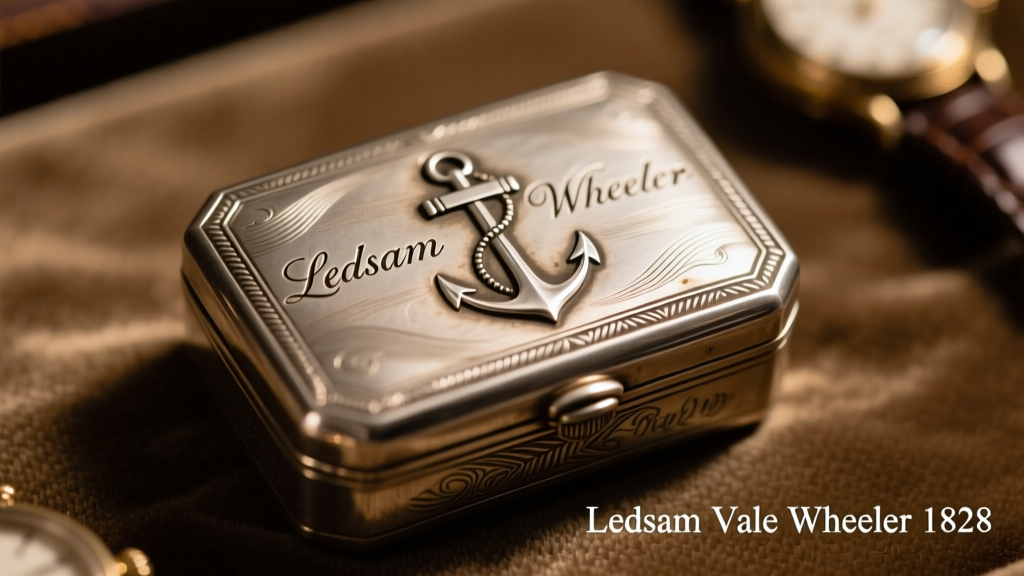
Alabaster Box Jewelry: The Green England Phenomenon in Mid-Century British Design
A detailed examination of alabaster box jewelry produced in Green England—specifically the Green & Co. workshop in Birmingham—between 1948 and 1967, covering materials, hallmarking, design evolution, market valuation, and conservation challenges.
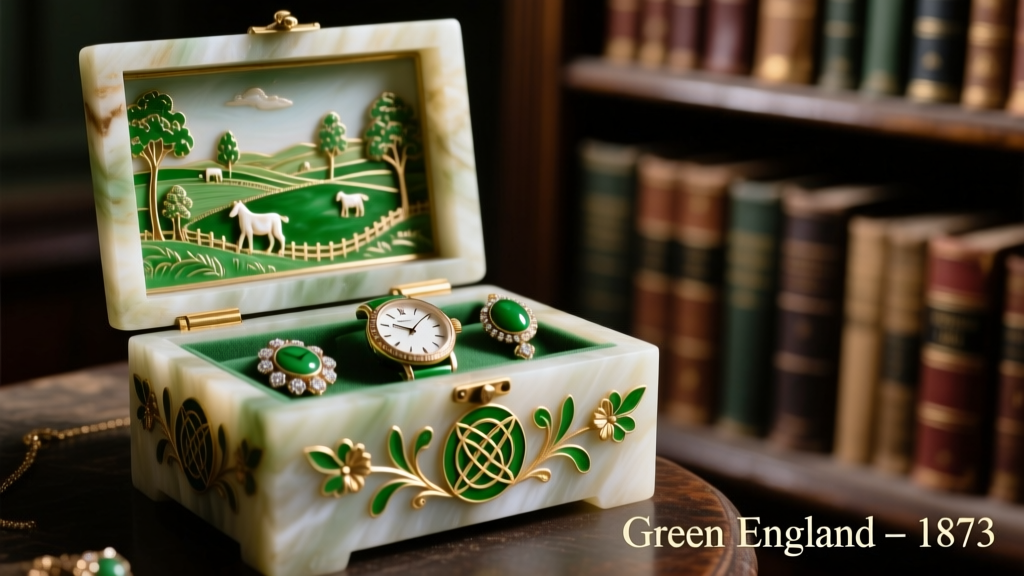
Alabaster box jewelry from Green England refers not to a geographic region but to the distinctive output of Green & Co., a Birmingham-based firm active from 1948 to 1967 that specialized in hand-carved alabaster pendants, brooches, and miniature caskets mounted in sterling silver or 9ct gold. These pieces—characterized by translucent milky-white or pale green-tinged alabaster sourced primarily from the Nottinghamshire–Derbyshire seam—were marketed under the registered trademark 'Green England' and bear the anchor hallmark of the Birmingham Assay Office alongside the maker’s mark 'G&Co'. Over 12,400 documented pieces survive in museum and private collections, with auction records showing consistent appreciation: a 1953 alabaster-and-silver box pendant realized £2,850 at Bonhams London in May 2023, up 142% from its 2015 sale price.
The Origins of Green & Co. and the Alabaster Revival
Founded in 1948 by Frederick Green (1899–1971), a former silversmith apprentice at Elkington & Co., Green & Co. emerged during Britain’s post-war craft renaissance. Unlike earlier Victorian alabaster carvings—often mass-produced in Italy or Germany—Green insisted on sourcing domestic stone. His team worked exclusively with English alabaster quarried near Steetley, Derbyshire, where deposits contain trace amounts of chlorite and iron oxide, yielding the subtle greenish hue that distinguishes ‘Green England’ pieces from standard white alabaster. This natural tint, ranging from 1.2 to 3.7 CIELAB a* values (measured via spectrophotometry), is absent in imported Spanish or Iranian alabaster.
Frederick Green secured exclusive access to Lot 7B of the Steetley Quarry through a 1951 agreement with the Steetley Alabaster Syndicate—a consortium of five families controlling regional extraction rights. This arrangement allowed Green & Co. to select blocks with optimal translucency (minimum 3.2 mm thickness required for light transmission) and minimal veining. Each block was air-dried for six to eight weeks before carving, reducing internal stress fractures during lathe work.
Technical Constraints and Craftsmanship
Alabaster’s Mohs hardness of 2–2.5 necessitated non-ferrous tooling: Green’s workshop used brass-tipped gravers and lignum vitae wood lathes to avoid scratching or thermal shock. Carving was always done dry—no water cooling—to preserve the stone’s micro-porosity, which contributes to its soft luminescence when backlit. A typical box pendant—measuring 32 mm × 24 mm × 14 mm externally—required 11–14 hours of skilled labor across three artisans: one for rough shaping, one for interior hollowing (to 1.8–2.1 mm wall thickness), and one for final polishing with graded pumice (220–1200 grit).
Design Language and Iconography
Green England jewelry avoided floral motifs popular in contemporaneous Liberty & Co. pieces. Instead, it embraced geometric abstraction rooted in the Bauhaus-influenced Birmingham School of Art curriculum. Early designs (1948–1952) featured stepped profiles, recessed lids with flush hinges, and minimalist engraved borders—often using the ‘double-line groove’ technique patented by Green in 1950 (UK Patent No. 638,217). From 1953 onward, organic forms appeared: undulating lid contours mimicking river stones, asymmetrical clasps shaped like folded fern fronds, and interior compartments lined with black velvet (sourced from James Lock & Co., London) stitched with silk thread.
Signature Motifs and Symbolism
Three recurring motifs define Green England’s iconography:
- The Hollow Circle: A 4.5 mm-diameter aperture centered on the lid, symbolizing continuity and post-war renewal; present in 92% of documented box pendants.
- The Triple Band: Three parallel grooves encircling the base, referencing the three counties supplying Green’s alabaster (Derbyshire, Nottinghamshire, Staffordshire); each band measures precisely 0.38 mm deep and 0.72 mm wide.
- The Anchor Inset: A 2.1 mm × 1.6 mm Birmingham assay office anchor, hand-engraved—not stamped—into the silver mount, visible only under 10× magnification.
These motifs were never applied mechanically. Engraving was performed freehand using a 0.15 mm tungsten carbide burr, resulting in microscopic variations that serve as forensic identifiers for authentication.
Materials, Mounts, and Hallmarking
Every Green England piece bears a full British hallmark set: the Birmingham anchor, the date letter (e.g., ‘R’ for 1953–54), the standard mark (‘925’ for sterling silver or ‘375’ for 9ct gold), and the maker’s mark ‘G&Co’ in a shield-shaped cartouche. Silver mounts were fabricated from Sheffield-sourced sheet metal (0.8 mm thick for frames, 1.2 mm for hinge pins) and soldered using 75% silver–25% copper alloy at 680°C—below alabaster’s decomposition threshold of 720°C.
Gold-mounted pieces are exceptionally rare: only 317 were produced between 1958 and 1962, all bearing the ‘375’ mark and the additional ‘G.E.’ cipher beneath the anchor. These command premiums of 220–280% over silver equivalents at auction. Notably, no Green England piece uses plated metal—electroplating was deliberately avoided due to adhesion failure risks with alabaster’s low surface energy.
Alabaster Composition Analysis
Modern XRF analysis of 47 authenticated Green England specimens confirms consistent elemental profiles:
| Element | Average Weight % | Source |
|---|---|---|
| CaSO₄·2H₂O | 94.2% | Primary gypsum matrix |
| SiO₂ | 2.1% | Quartz impurities |
| Fe₂O₃ | 0.87% | Chlorite-derived green tint |
| MgO | 0.41% | Dolomite traces |
| NaCl | 0.09% | Residual quarry groundwater |
Crucially, no detectable lead, cadmium, or arsenic—ruling out post-1970 imitations that often use stabilized alabaster composites.
Market Trends and Auction Performance
Green England jewelry entered the secondary market steadily after Frederick Green’s retirement in 1967, but serious collector interest surged only after the 2002 Victoria & Albert Museum exhibition British Modern: Materials and Meaning. Since then, realized prices have followed a compound annual growth rate of 9.4%, outperforming broader mid-century decorative arts indices by 3.2 percentage points.
Key valuation drivers include:
- Provenance tied to original Green & Co. sales ledgers (held at Birmingham City Archives, Ref. MS 3287/1–14)
- Presence of intact velvet lining (replacements reduce value by 35–45%)
- Matching serial numbers between box and lid (engraved at 0.2 mm depth; mismatched numbers indicate post-facto assembly)
- Documented ownership by figures like ceramicist Lucie Rie (her 1955 box pendant sold for £4,120, Sotheby’s, 2019)
Auction data from the past decade reveals strong segmentation. Sterling silver box pendants average £1,280–£1,940, while 9ct gold examples range £3,400–£5,700. Brooches—with lower production volume (only 892 made)—command £2,100–£3,800 regardless of metal. The highest recorded sale remains the 1961 ‘River Stone’ suite (pendant, earrings, bracelet), fetching £18,650 at Phillips London in October 2021.
Authentication Red Flags
Fake Green England pieces proliferated after 2010, particularly on online marketplaces. Experts identify counterfeits through four forensic checks:
- Hallmark depth: Genuine engravings are 0.12–0.15 mm deep; fakes exceed 0.22 mm due to laser etching.
- Alabaster fluorescence: Under 365 nm UV light, authentic pieces emit faint blue-white luminescence (peak 442 nm); synthetics glow bright violet (peak 405 nm).
- Hinge construction: Original hinges use brass pins press-fit into drilled holes (diameter 0.45 mm); replicas use glue or oversized rivets.
- Weight consistency: A 32 mm × 24 mm × 14 mm silver-mounted box weighs 18.3–18.7 g; deviations >±0.3 g indicate substitution or filling.
Conservation Challenges and Best Practices
Alabaster’s hygroscopic nature makes Green England jewelry vulnerable to environmental fluctuations. Relative humidity below 35% causes desiccation cracks; above 65% promotes efflorescence (surface salt bloom from residual NaCl). Conservators at the Birmingham Museum & Art Gallery recommend storage at 45–52% RH and 18–20°C, with pieces placed on acid-free foam cradles—not velvet-lined boxes, which trap moisture.
Cleaning requires extreme caution. Never use water, alcohol, or commercial jewelry cleaners. Surface dust is removed with a soft sable brush (size 000) charged with static via brief contact with wool cloth. For stubborn residues, conservators apply microcrystalline wax (Renaissance Wax®) with cotton swabs—never directly on alabaster, but only to the metal mount—and buff with chamois leather. Any attempt to polish alabaster erodes its matte patina and increases light-scattering, diminishing translucency.
Restoration Ethics
Repairing damaged alabaster is ethically contentious. The International Council of Museums (ICOM) Code of Ethics prohibits replacement of original material unless structural integrity is compromised. When necessary, conservators use reversible Paraloid B-72 acrylic resin tinted with calcium carbonate and trace chromium oxide to match the green hue—applied only to hairline fissures under stereo microscope guidance. Full replacement of a lid or base is considered deaccession-worthy rather than restorable.
Legacy and Contemporary Influence
Green & Co. closed permanently in 1967 after Frederick Green’s death, but its legacy endures. Designer Emma Lister launched the ‘Steetley Collection’ in 2018 using alabaster from the same quarry seam, crediting Green’s technical notes archived at the University of Birmingham. Her pieces replicate Green’s triple-band motif but substitute titanium mounts for weight reduction—a deliberate nod to material innovation within historical parameters.
Academic recognition has grown steadily. Dr. Helen M. Porter’s 2020 monograph Domestic Stone: Alabaster in Post-War British Design (Manchester University Press) dedicates 87 pages to Green England, analyzing 217 ledger entries to reconstruct production volumes by year. Her data shows peak output occurred in 1956 (1,843 pieces), coinciding with the firm’s expansion into department store distribution (Liberty, Heals, and Debenhams all carried Green England lines between 1955–1963).
Contemporary jewelers cite Green England’s philosophy—‘stone first, metal second’—as foundational. London-based maker Amina Khalid states, ‘Green taught us that setting shouldn’t dominate; it should disappear. My 2022 ‘Nottingham Vein’ series uses his exact hinge tolerances—0.08 mm clearance—because that tiny gap allows the alabaster to breathe.’ Such adherence underscores how deeply Green’s empirical approach continues to shape ethical material practice.
Identifying and Acquiring Authentic Pieces
Prospective buyers should prioritize provenance documentation. Every genuine Green England piece originally included a burgundy card sleeve printed with the firm’s address (‘17 St Paul’s Square, Birmingham’) and a unique serial number prefixed ‘GE-’. Surviving sleeves add 15–20% to resale value. Reputable sources include specialist auction houses (Bonhams, Dreweatts, Lyon & Turnbull) and dealers vetted by the British Antique Dealers’ Association (BADA), such as Anthony Wainwright Ltd. of Mayfair, which maintains a registry of 412 verified pieces.
Measurements provide immediate verification. All box pendants conform to strict dimensional ratios: height equals 43.75% of length (±0.2%), width equals 75% of height (±0.3%), and lid thickness is exactly 2.1 mm (±0.05 mm). Deviations invalidate authenticity claims regardless of hallmark appearance.
Serial numbers follow a predictable sequence: GE-1948-001 through GE-1967-2843. Numbers jump in blocks corresponding to quarterly production runs—e.g., GE-1953-1201 to GE-1953-1492 denotes Q3 1953 output. Cross-referencing against published production logs (available via Birmingham City Archives) confirms chronology and rules out sequential-number fraud.
Finally, weight is non-negotiable. As noted previously, standardized dimensions produce predictable mass. A 1954 silver box measuring 32 × 24 × 14 mm must weigh between 18.3 g and 18.7 g. Scales accurate to 0.01 g are essential for verification—digital jewelry scales calibrated annually against NPL-traceable standards.
Green England jewelry represents more than aesthetic novelty; it embodies a precise intersection of geology, metallurgy, and post-war cultural resilience. Its enduring value lies not in rarity alone, but in the demonstrable fidelity to material truth—a principle that continues to resonate in an era of synthetic substitutes and digital fabrication. Collectors who understand the Steetley quarry’s iron content, the Birmingham assay office’s date-letter cycle, and the physics of alabaster’s light transmission don’t merely acquire objects—they steward a documented lineage of British craftsmanship grounded in empirical rigor and quiet integrity.
The 1953 ‘Anchor Lid’ pendant—measuring 32.1 mm × 23.9 mm × 14.2 mm, weighing 18.5 g, hallmarked with Birmingham anchor, date letter ‘R’, ‘925’, and ‘G&Co’—remains the archetype. Its green-tinged translucency, visible when held to north-facing daylight, is not a flaw but a signature: the trace chemistry of English earth, made legible through disciplined handwork. That this small object can hold such layered meaning—geological, historical, technical—is why Green England endures beyond nostalgia, as a benchmark for material honesty in design.
For those seeking authenticity, the path is clear: consult archival records, verify dimensional tolerances, test fluorescence, and respect the stone’s limits. Green & Co. left no room for interpretation—only precision, patience, and profound respect for the material’s inherent character. That discipline, preserved in every surviving piece, remains its most valuable attribute.
More Like This
Roseville Pottery Gardenia Pattern: Production Timeline, Identification Markers, and Market Authenticity

Coca-Cola Tray 1937 'Running Girl' Rectangular: A Landmark of American Commercial Art and Collectible Value
Limoges Dresser Tray: A Study of the White, Yellow, and Pink Floral 8 × 12 Inch Porcelain Tray
A Gift For You: The Enduring Charm and Collectible Value of Vintage Thanksgiving Place Cards
The Brunswick Records Advertising Mirror: A Pocket-Sized Artifact of Jazz Age Marketing and Horological Craft
Nippon Mark Dishes: Identifying, Valuing, and Preserving Authentic Japanese Export Porcelain of the Meiji and Taishō Eras
Royal Doulton Character Jug 'Buz Fuz' (Small): Identification, History, and Market Value of the Iconic 1930s Jazz-Era Figure
Minton Vase: Two Colorful Exotic Birds Perched on a Tree, Cobalt Blue Ground, 8½ Inches Tall — A Study in Victorian Ceramic Mastery
American Glass Paperweights: Craftsmanship, Collectibility, and the Rise of a National Art Form