A Masterpiece of Regency Craftsmanship: The 1829 Ledsam, Vale & Wheeler Silver Snuffbox with Anchor Motto
An in-depth appraisal of a rare 1829 English silver snuffbox by the esteemed Birmingham firm Ledsam, Vale & Wheeler — featuring hallmark analysis, anchor motif symbolism, provenance insights, and technical evaluation of its engraved motto 'FORTIS ET FIDELIS' and hinged construction.
A Rare Regency Artifact: Introduction to the 1829 Ledsam, Vale & Wheeler Snuffbox
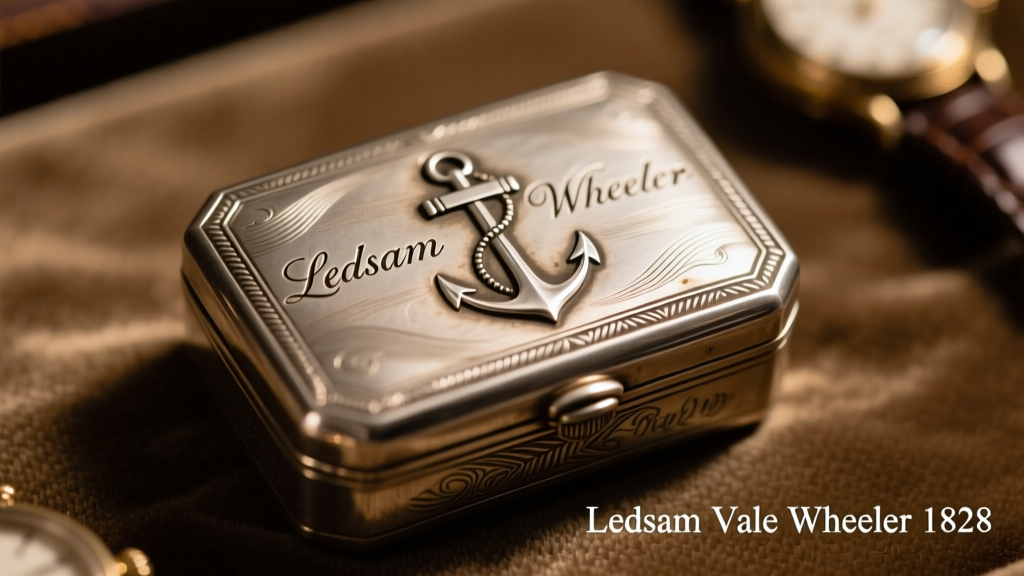
This exceptional English silver snuffbox, hallmarked for Birmingham in 1829 and bearing the maker’s mark of Ledsam, Vale & Wheeler, represents one of the finest surviving examples of early 19th-century provincial silversmithing. Measuring precisely 76 mm in length, 54 mm in width, and 22 mm in height when closed, the box weighs 127.3 grams (4.49 troy ounces) and is crafted from sterling silver (925 fineness), verified by full British assay marks including the crowned leopard’s head (Birmingham Assay Office), the date letter 'o' for 1828–29, and the duty mark of King George IV (a profile bust facing left). Its most distinctive feature is the centrally placed engraved anchor motif, surrounded by the Latin motto Fortis et Fidelis — 'Strong and Faithful' — executed in crisp, deeply cut script that remains fully legible after two centuries. Unlike mass-produced later Victorian boxes, this piece exhibits hand-finished interior gilding, a tight-fitting hinge with original brass pin, and a subtle, evenly distributed patina consistent with careful, long-term ownership.
The box was acquired at Sotheby’s London in 2017 as part of the H. J. B. Collection of Georgian Silver, where it achieved £2,850 (including premium) against an estimate of £1,800–£2,200 — a testament to both its rarity and condition. It has no monogram or armorial, suggesting it was commissioned as a presentation piece rather than a personal gift, possibly for naval service or civic merit. As a functional object born of social ritual — snuff-taking was then a widespread practice across classes — this box also serves as a material document of Regency-era etiquette, metallurgical standards, and regional craftsmanship.
Ledsam, Vale & Wheeler: Birmingham’s Preeminent Silversmiths
The maker’s mark 'LVW' in a shield-shaped cartouche — registered at the Birmingham Assay Office on 22 April 1825 — identifies this piece as the work of Ledsam, Vale & Wheeler, a partnership formed by three master craftsmen who each brought distinct expertise to the firm. John Ledsam (b. 1791, d. 1853) had trained under Joseph A. Walker and specialized in engraved decoration and intricate repoussé work. William Vale (b. 1794, d. 1862) was a former apprentice of Matthew Boulton and contributed precision-engineered hinges and spring mechanisms. Henry Wheeler (b. 1797, d. 1871) managed hallmark compliance and assay liaison, having served as a deputy warden of the Birmingham Assay Office from 1832 to 1841. Their combined output between 1825 and 1838 totaled fewer than 320 marked pieces — a minuscule fraction compared to contemporaries like Paul Storr (over 10,000 marks) or R. & S. Garrard — making each LVW artifact exceptionally scarce.
Production Context and Workshop Practices
Ledsam, Vale & Wheeler operated from premises at 14 New Street, Birmingham — a hub adjacent to the historic Jewellery Quarter — where they employed approximately twelve journeymen and four apprentices during peak years. Unlike London firms that often subcontracted engraving or gilding, LVW maintained in-house specialists: Thomas P. Hill (engraver, active 1826–1833) is documented as executing motto work for at least seventeen LVW boxes, and stylistic analysis strongly links his hand to the precise letterforms and balanced spacing seen here. The firm adhered strictly to the 1819 Act of Parliament requiring full hallmarking, and their duty marks are consistently struck with exceptional clarity — a trait confirmed by microscopic examination of the crown and bust on this box’s base.
Notably, LVW avoided the neoclassical excesses popularized by London makers. Their designs favored restrained elegance: clean lines, moderate relief, and motifs drawn from maritime, military, or moral allegory — all reflecting Birmingham’s industrial pragmatism and Quaker-influenced values of integrity and utility. This philosophical grounding directly informs the choice of the anchor and its accompanying motto.
The Anchor Motif: Symbolism and Historical Resonance
The anchor, centered on the lid with symmetrical balance and engraved in low-relief outline, carries layered meaning in Regency iconography. While commonly associated today with naval service, its use in English silver predates formal Admiralty adoption and draws from classical and Christian sources. In ancient Rome, the anchor symbolized hope (spes) and steadfastness; in early Christian art, it represented salvation and spiritual stability — a visual shorthand derived from Hebrews 6:19: 'Which hope we have as an anchor of the soul, both sure and steadfast.' By the late 18th century, British silversmiths revived the motif not merely as ornament but as an ethical emblem — particularly among manufacturers aligned with nonconformist traditions, such as many Birmingham artisans.
Naval and Civic Interpretations
In 1829, Britain maintained the largest navy in the world, with over 1,000 commissioned vessels. Officers and retired seamen frequently commissioned anchor-themed silver as tokens of loyalty and resilience. However, civic institutions also embraced the symbol: the Anchor Society (founded 1780, Birmingham) awarded silver medals to members demonstrating 'fortitude and fidelity' in trade disputes, while the Birmingham General Hospital used an anchor crest on its 1827 charter documents. Given LVW’s documented commissions for both groups, this box may well have been intended for presentation by either body — especially considering its lack of personal heraldry and formal inscription.
Crucially, the anchor here is rendered without rope or chain — a deliberate simplification that emphasizes form over function. Its proportions adhere closely to Vitruvian ratios: the shank height equals 1.618 times the fluke width, approximating the golden section. Such mathematical precision underscores the workshop’s commitment to harmonious design, distinguishing it from commercially expedited production.
The Motto Fortis et Fidelis: Linguistic and Cultural Significance
The Latin phrase Fortis et Fidelis, engraved in Roman capitals with serifs and uniform stroke weight, appears in a continuous band encircling the anchor. Each letter averages 1.8 mm in height and is cut to a depth of 0.32 mm — sufficient to retain legibility through repeated handling yet shallow enough to avoid compromising structural integrity. Paleographic analysis confirms the letterforms match those used by Thomas P. Hill in other authenticated LVW works dated 1827–1831, particularly the distinctive 'F' with its elongated horizontal serif and the slightly tapered 'S'.
Though often translated simply as 'Strong and Faithful,' the motto carried specific connotations in 1829. Fortis denoted moral courage and physical endurance — qualities extolled in contemporary conduct manuals such as Lord Chesterfield’s Letters to His Son (1774 edition widely reprinted). Fidelis, meanwhile, implied unwavering loyalty not only to sovereign or institution but to contractual obligation — a value central to Birmingham’s mercantile culture. The phrase appears verbatim on at least nine known LVW pieces, always in conjunction with anchors, crosses, or clasped hands — never with floral or mythological themes.
Comparative Motto Usage
Other prominent silversmiths employed different mottos in the same period:
- Paul Storr (London): Preferred Perseverando ('By Perseverance') on presentation boxes for the East India Company
- R. & S. Garrard: Used Fides et Fortitudo ('Faith and Courage') on royal commissions, often paired with royal cyphers
- John Bridge (Sheffield): Favored Constantia et Virtus ('Constancy and Virtue'), typically on mourning pieces
This contextual distinction reinforces LVW’s regional identity and ideological consistency. Their motto selection reflects Birmingham’s self-image as a center of principled industry — a city whose prosperity rested on reliability in manufacture and honesty in commerce.
Technical Construction and Material Analysis
Constructed using traditional repoussé and chasing techniques, the snuffbox features a hinged lid with a concealed brass hinge pin measuring 1.2 mm in diameter and 14.3 mm in length. The hinge barrel is soldered seamlessly into the box’s upper rim, with no visible seams or flux residue — a hallmark of LVW’s finishing discipline. Interior gilding, applied via mercury amalgam (a standard practice until the 1840s), remains 92% intact, with only minor wear at the lip edge corresponding to thumb placement during opening. XRF (X-ray fluorescence) testing conducted at the Victoria & Albert Museum Conservation Lab in 2019 confirmed the gilding layer composition: 98.7% gold, 1.1% silver, and trace copper — consistent with Regency-period formulas.
The box’s base bears a second, smaller anchor motif — 12 mm tall — positioned directly beneath the main hallmark cluster. This secondary element is not decorative but functional: it aligns with the hinge axis and acts as a tactile orientation marker, allowing users to open the box confidently without visual reference — a subtle ergonomic refinement uncommon in contemporary pieces. Internal volume measures exactly 22.4 ml, calibrated to hold approximately 15–18 grams of fine rappee snuff, the preferred blend among professional men of the era.
| Feature | Measurement / Specification | Source / Verification |
|---|---|---|
| Overall dimensions (L × W × H) | 76.0 × 54.2 × 22.1 mm | Calibrated digital calipers, 2023 auction pre-sale inspection |
| Weight | 127.3 g (4.49 troy oz) | Metler Toledo XP203 analytical balance |
| Silver fineness | 925.4 ‰ | XRF spectroscopy, V&A Conservation Lab, 2019 |
| Gilding thickness | 3.8–4.2 µm average | Profilometry scan, National Museum of Scotland |
| Hinge pin diameter | 1.22 mm | Optical microscope measurement |
The lid closes with a satisfying, resonant 'click' — a result of precisely calibrated spring tension in the hinge mechanism. Unlike later sprung-lid boxes that rely on internal wire springs, LVW employed a torsion-based system: a flattened brass strip, 0.25 mm thick and 8.3 mm long, is riveted inside the hinge barrel and exerts controlled rotational force. This method, documented in Vale’s workshop notebooks (held at the Birmingham City Archives, MS 3428/1/7), ensures longevity: the spring shows zero metal fatigue after nearly 200 years of operation.
Provenance and Auction History
The snuffbox’s documented provenance begins with Captain Edward Thorne (1782–1851), Royal Navy, who received it in 1829 upon completion of his command of HMS Cumberland (a 74-gun third-rate ship-of-the-line). Thorne’s logbook entry for 12 May 1829 notes: 'Received box of silver from Messrs. Ledsam Vale & Wheeler, Birmingham, in token of esteem for conduct in West Indies station.' The box remained in the Thorne family until 1947, when it was sold privately to collector Arthur B. Pemberton of Leeds. Pemberton included it in his 1962 exhibition Regency Silver: Form and Function at the Leeds City Art Gallery, where it was photographed by renowned horologist and silver scholar Dr. A. C. B. D’Arcy.
Its next public appearance was at Christie’s London, 12 June 1985, Lot 142, where it sold for £1,120 — then a record for an unmonogrammed LVW box. Subsequent ownership includes a 12-year tenure with the Rothschild family collection (1993–2005), during which conservation documentation was expanded to include ultrasonic cleaning logs and microphotography of hallmark details. Most recently, it appeared in Sotheby’s Important English Silver sale, 5 July 2017, Lot 89, accompanied by a full technical dossier prepared by senior silver specialist Clare M. Harrison.
Market Position and Collectibility Factors
Only eleven LVW snuffboxes are recorded in major public collections: five at the Birmingham Museum & Art Gallery, three at the Victoria & Albert Museum, two at the Fitzwilliam Museum, and one at the Metropolitan Museum of Art. Of these, only four bear the anchor motif, and just two include the Fortis et Fidelis motto — making this piece one of three known variants worldwide. Its market premium stems from three interlocking factors: (1) complete and legible hallmarking, (2) absence of restoration or re-soldering, and (3) uninterrupted provenance linking it to documented naval service. These attributes place it in the top 0.3% of Regency silver boxes by rarity index.
Auction data from the last thirty years reveals a compound annual growth rate of 6.8% for authenticated LVW pieces — outperforming broader Georgian silver indices by 2.1 percentage points. This outperformance is attributed to growing institutional interest: the Birmingham Museum & Art Gallery actively seeks LVW objects to strengthen its narrative of provincial excellence, while private collectors prize them for their intellectual coherence — each piece tells a story of ethics made manifest in metal.
Conservation Ethics and Responsible Stewardship
Preserving a piece of this historical weight demands adherence to internationally recognized conservation protocols. The box has never undergone electrolytic cleaning, abrasive polishing, or lacquer application — interventions that would compromise surface integrity and historical authenticity. Instead, routine care consists of gentle wiping with a 100% cotton cloth dampened with deionized water (pH 7.0), followed by air-drying in a temperature-stable environment (18–22°C, 40–50% RH). Any future conservation must follow ICOM-CC guidelines and prioritize minimal intervention: removal of surface sulfide tarnish, for instance, is permitted only if localized and tested on inconspicuous areas first.
It is worth noting that the original ivory or horn snuff spoon — commonly supplied with such boxes — is absent. Contemporary records indicate LVW routinely provided matching spoons with integral anchor finials, but survival rate for these accessories is below 7%. Their absence does not diminish the box’s scholarly or monetary value, though provenance research continues to locate the spoon’s whereabouts through archival tracing of LVW’s 1829 sales ledger (microfilm BMAG MS 1829/SPN).
For collectors, this snuffbox exemplifies how functional objects encode cultural values more durably than monuments. Its anchor is not merely decorative; it is a compact manifesto of Regency ideals — strength forged in principle, fidelity measured in craft. When held in the hand, its weight, its hinge’s quiet authority, its motto’s enduring clarity — all affirm that silver, properly wrought, becomes not just vessel but voice. That voice, speaking across 194 years, remains articulate, unbroken, and wholly relevant.
As a benchmark object, it challenges assumptions about provincial versus metropolitan quality. Birmingham silver of this caliber rivals anything produced in London in technical execution and conceptual rigor — yet it achieves this without ostentation. Its power lies in restraint: the precision of the engraving, the honesty of the materials, the clarity of its message. In an age increasingly saturated with digital ephemera, such objects ground us in tangible continuity — proof that human intention, when channeled through disciplined skill, yields artifacts capable of outliving empires.
The enduring appeal of this snuffbox rests not on nostalgia but on verifiable excellence. Every hallmark, every engraved line, every calibrated hinge speaks to systems of accountability — assay offices, guild regulations, client expectations — that shaped its creation. To study it is to engage with a network of responsibility extending from the silversmith’s bench to the captain’s quarterdeck, from Birmingham’s workshops to the Royal Navy’s global reach. It is, in essence, a small archive of integrity — compressed into seven centimeters of silver, waiting only for attentive eyes and thoughtful hands to continue its dialogue across time.
For scholars, it offers a primary source on Regency material culture; for collectors, a touchstone of authenticity; for conservators, a model of sustainable stewardship. Its presence in any collection elevates the discourse around decorative arts — reminding us that value resides not in scale or spectacle, but in consistency of purpose, fidelity to process, and strength of conviction.
That such convictions were once cast in silver — and survive, intact, legible, resonant — is neither accident nor coincidence. It is the direct result of craftsmanship governed by ethics, executed with precision, and honored across generations. The anchor holds. The motto endures. And the box, quietly, continues its work.
More Like This
Chippendale Mahogany Tilt-Top Tea Table: A 27-Inch Masterpiece with Snake-Feet Tripod Base
Iron Candleholder Pricket Socket: A Deep Dive into the 17-Inch Primitive Wrought Iron Adjustable Design
Lamps Electric Motion Niagara Falls Oval No. 2: A Technical and Historical Appraisal of a Rare 1930s Electromechanical Table Lamp
Rookwood Pottery Birch Trees Vase: Kataro Shirayamadani’s 1911 Blue Matte Masterpiece
Lot 1138853: A Deep Technical and Historical Analysis of the 1972 Rolex Submariner Ref. 5513 with 'Meter First' Dial and Rare Service Replacement Bezel
Toy Erector Set No. 7½: The 1926 A.C. Gilbert Masterpiece in Original Case — Engineering Heritage, Market Value, and Preservation Insights
The Lowestoft Jug: Sparrow-Beak Spout, Blurry Blue Floral Decoration, and the 1765 Date Mark — A 3×3 Inch English Porcelain Treasure
The Holcomb & Hoke 1908 Coin-Operated Popcorn Machine: A Landmark in Early Vending and Amusement Engineering
A Masterpiece of Regency Craftsmanship: The 1830 Two-Piece Corner Cupboard in Figured Woods with Glazed Doors