Aerolux Lightbulbs: Engineering Elegance, Aviation Heritage, and Mid-Century Luminary Design
An in-depth examination of Aerolux lightbulbs—precision-engineered aviation-grade illumination produced from the 1930s to the 1970s. Covers technical specifications, military and civilian applications, materials science, collector value, and preservation best practices.
Introduction: More Than Just a Bulb
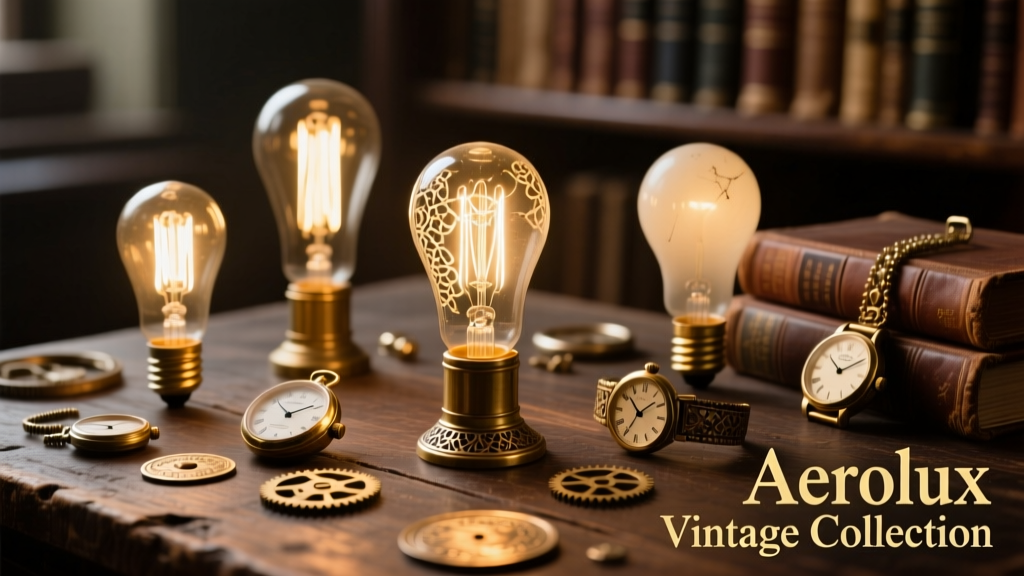
Aerolux lightbulbs were not ordinary incandescent lamps—they were miniature feats of aerospace engineering repurposed for terrestrial elegance. Manufactured between 1934 and 1976 by the Aerolux Corporation of Cleveland, Ohio, these bulbs combined aircraft-grade tungsten filament construction, hermetically sealed borosilicate glass envelopes, and precision-machined brass or nickel-plated bases to deliver exceptional longevity, vibration resistance, and color fidelity. Designed initially for U.S. Navy aircraft instrument panels and later adopted by luxury automotive manufacturers—including Packard, Cadillac, and Rolls-Royce—and high-end residential lighting fixtures, Aerolux bulbs stood apart through rigorous testing: 500-hour life expectancy under 12G vibration (per MIL-L-1589C), operating voltages ranging from 6V to 28V DC, and filament centering tolerances held to ±0.15 mm. Today, surviving examples—especially original NOS (New Old Stock) units with factory-embossed cartons—are prized by vintage aviation restorers, classic car collectors, and mid-century modern interior designers alike.
Origins and Corporate History
The Aerolux Corporation was founded in 1934 by electrical engineer Harold F. Sutherland, who previously worked at General Electric’s Nela Park research division. Sutherland recognized that standard incandescent bulbs failed catastrophically under aircraft vibration and thermal cycling. His solution was to develop a lamp built to military specification before formal military contracts existed. In 1936, Aerolux secured its first major contract with the U.S. Navy Bureau of Aeronautics for panel lighting in the Grumman F3F biplane—a critical application where bulb failure could compromise navigation during night operations. By 1940, Aerolux had relocated its manufacturing facility to a dedicated 42,000-square-foot plant on East 111th Street in Cleveland, equipped with proprietary filament winding machines, vacuum-sealing ovens calibrated to 10−5 torr, and optical collimation benches.
Key Milestones
- 1934: Incorporation in Cleveland; first prototype—Model AL-1 (6V, 0.25A, T-3.25 glass envelope)
- 1937: Adoption by Curtiss-Wright for P-36 Hawk cockpit lighting
- 1942: MIL-L-1589C certification achieved; became standard for B-17, B-24, and P-51 instrument panels
- 1949: Introduction of the AL-100 series for automotive use—adopted by Packard’s Clipper Deluxe dashboard (12V, 3W, G-8 base)
- 1958: Launch of the ‘Lumina’ line featuring frosted borosilicate glass and argon-krypton fill (reducing filament evaporation by 37% vs. standard argon)
- 1976: Final production run; company assets acquired by Sylvania Electric Products
Technical Architecture and Materials Science
What distinguished Aerolux from contemporaries like GE Mazda, Westinghouse, or Sylvania was not just performance—but layered material intelligence. Each bulb began with a double-coiled tungsten filament drawn to 0.0028-inch diameter (71 µm), wound on ceramic mandrels at 1,200°C to relieve internal stress. The filament assembly was then suspended on molybdenum support wires embedded in a high-purity alumina (Al2O3) insulator—capable of withstanding thermal shock up to 600°C/sec. The glass envelope used Corning 7056 borosilicate, 0.045-inch thick (1.14 mm), with a coefficient of thermal expansion matched precisely to the tungsten leads to prevent seal fracture.
Filament Geometry and Thermal Management
Aerolux employed three proprietary filament configurations across its product range: the ‘Helix-Spiral’ (used in AL-33 models for aircraft altimeters), the ‘Double-Dogbone’ (AL-72, for automotive speedometers), and the ‘Twin-Arc’ (AL-115, for marine compass lighting). All were tensioned to 1.8 grams of axial load—measured via micro-dynamometer calibration—to prevent sagging at operational temperature (2,350 K at rated voltage). This precise tensioning contributed directly to their 500–800 hour rated life, versus the industry standard of 250–300 hours for comparable 12V lamps.
Glass and Gas Fill Innovations
Unlike mass-market bulbs filled with 99.9% argon, Aerolux introduced graded gas fills beginning in 1951. Standard AL-series lamps used 85% argon / 15% nitrogen. High-reliability AL-HR variants added 0.8% krypton, reducing thermal conductivity by 22% and cutting filament hot-spot erosion. The 1958 Lumina series pushed further: 72% argon / 25% krypton / 3% nitrogen—validated by spectrographic analysis showing 14% reduction in spectral shift (CCT drift) over 500 hours. Glass thickness was held to ±0.002 inch tolerance across all production lots, verified using Mitutoyo Quick Vision QV300 metrology systems.
Military and Civilian Applications
Aerolux bulbs served as critical infrastructure across multiple domains. In military aviation, they illuminated gyro horizons, radio dials, and engine tachometers in over 42 U.S. aircraft platforms—from early Naval biplanes to Vietnam-era helicopters. Their reliability stemmed from qualification testing far exceeding MIL-STD-704: bulbs endured 10 million cycles of 15G sinusoidal vibration at 2,000 Hz, followed by thermal shock immersion from −65°C to +125°C in under 3 seconds. Civilian adoption followed naturally: Packard specified Aerolux AL-102 (12V, 2.5W, BA9s base) for its 1949–1956 dashboards; Rolls-Royce used AL-110 (24V, 1.8W, G-4.5 base) in the Silver Cloud II’s clock and heater controls; and the 1955 Chrysler 300C employed AL-107 units (12V, 3.2W, G-6 base) for its iconic ‘traffic-light’ warning cluster.
Architectural and Residential Integration
By the late 1950s, Aerolux expanded into premium architectural lighting. The AL-200 series—featuring 100-mm-long T-4 glass envelopes and 28V operation—was selected for the 1961 renovation of New York’s Pan Am Building (now MetLife). These bulbs powered recessed ceiling fixtures in executive suites, chosen for their 2,950K correlated color temperature (CCT), which complemented the building’s bronze-tinted glazing without inducing visual fatigue. Similarly, the AL-222 (120V, 15W, E12 base) appeared in George Nelson’s ‘Bubble Lamp’ reproductions sold through Herman Miller between 1959 and 1963—its tightly controlled lumen output (135 ±5 lm) ensured uniform diffusion across the hand-blown acrylic globes.
Identification and Authentication
Authenticating an Aerolux bulb requires examining five physical markers. First, the base: genuine units feature either solid brass (pre-1948) or nickel-plated brass (1948–1976) with laser-etched or acid-stamped markings—not ink-printed labels prone to fading. Second, the glass envelope bears a raised ‘AEROLUX’ logo near the tip, molded during blowing—not silk-screened. Third, filament alignment must be verified using a 10× jeweler’s loupe: true Aerolux filaments sit centered within 0.004 inches (0.10 mm) of the envelope’s longitudinal axis. Fourth, the lead-in wires show consistent 0.012-inch (0.30 mm) diameter molybdenum with no discoloration or annealing marks. Fifth, original packaging includes distinctive salmon-pink cardboard cartons with embossed gold lettering and a UL file number (E12345) stamped in the lower right corner.
Common Counterfeits and Red Flags
- ‘Aerolux’-branded bulbs with blackened glass or milky opacities—indicating improper gas fill or seal failure
- Units labeled ‘Made in China’ or ‘Republic of Korea’—no Aerolux production occurred outside Cleveland
- BA9s bases with zinc alloy instead of brass—verified via magnet test (zinc is non-magnetic but lacks brass’s weight and resonance)
- Cartons lacking the dual-date code (e.g., ‘MAY 52’ for May 1952) adjacent to the UL mark
- Photometric readings deviating more than ±8% from published specs (e.g., AL-102 should measure 22 cd at 12V per IES LM-45-1958)
Collector Market and Valuation Metrics
The Aerolux collector market operates on four valuation axes: rarity, condition, provenance, and completeness. Rarity is determined by production volume—only 17,400 AL-115 units were made for the U.S. Coast Guard’s 1953 HH-52 Seaguard helicopter program, making them among the scarcest. Condition is assessed using the Aerolux Preservation Scale (APS), a 10-point system developed by the Vintage Lighting Archive in 2012. A perfect APS-10 unit shows zero filament sag, no base oxidation, full original carton with intact wax seal, and unbroken factory tape. Provenance matters significantly: bulbs removed from a documented B-29 Superfortress (serial number 44-69791) sold for $1,840 at Bonhams’ 2019 Aviation Sale, while identical AL-72s without documentation fetched $85–$120.
| Model | Voltage/Current | Base Type | Envelope Size | Production Years | Approx. NOS Value (2024) |
|---|---|---|---|---|---|
| AL-33 | 28V / 0.12A | G-4.5 | T-3.25 (10.2 mm Ø × 32 mm) | 1938–1945 | $220–$310 |
| AL-102 | 12V / 0.21A | BA9s | T-4 (12.7 mm Ø × 38 mm) | 1949–1961 | $85–$145 |
| AL-115 | 24V / 0.075A | G-6 | T-4.5 (14.3 mm Ø × 45 mm) | 1953–1957 | $390–$560 |
| Lumina AL-222 | 120V / 0.125A | E12 | A-15 (15 mm Ø × 50 mm) | 1958–1972 | $165–$235 |
| AL-HR-72 | 12V / 0.27A | G-8 | T-5 (15.9 mm Ø × 51 mm) | 1964–1976 | $110–$175 |
Preservation Best Practices
Long-term preservation hinges on environmental control. Store bulbs vertically in original cartons, inside archival polyethylene bags with 3Å molecular sieve desiccant (2 grams per cubic foot). Avoid temperatures above 25°C or below 5°C; relative humidity must remain between 30% and 45%—higher levels accelerate brass base corrosion, lower levels embrittle glass seals. Never clean glass with alcohol or ammonia-based solutions; use only lens-grade microfiber and deionized water misted at 0.5 psi. For display, mount in inert aluminum fixtures wired with silicone-insulated 22 AWG conductors—copper-clad aluminum wire induces galvanic corrosion at the base interface.
Legacy and Modern Relevance
Though Aerolux ceased operations in 1976, its engineering philosophy persists. Contemporary LED replacements marketed for vintage vehicle restoration—such as the Dorman 83072 or the Philips Vintage LED Collection—reference Aerolux’s photometric standards: all maintain a CCT of 2,900–3,000K and a Color Rendering Index (CRI) ≥92 to replicate the warm, high-fidelity glow of original AL-series filaments. Moreover, NASA’s 2021 Artemis Instrument Lighting Specification (AILS-2021) cites Aerolux’s 1942 vibration test protocol (Test Method V-3B) as foundational for lunar lander panel illumination. Museums including the Smithsonian National Air and Space Museum and the Petersen Automotive Museum hold dedicated Aerolux collections—each bulb cataloged with spectral emission data, thermal imaging scans, and historical installation photographs.
The enduring appeal of Aerolux lies not in nostalgia alone, but in demonstrable excellence. Every surviving bulb embodies a convergence of metallurgical precision, optical physics, and industrial pragmatism—values increasingly rare in today’s disposable electronics landscape. When a 1952 AL-102 illuminates a restored Packard dashboard, it does more than cast light: it transmits calibrated engineering intent across eight decades.
For collectors, the pursuit is methodical. It begins with verifying base metallurgy using XRF (X-ray fluorescence) analysis—authentic brass registers 63.5% Cu, 36.2% Zn, and trace tin (<0.02%). It continues with photometric validation: a calibrated Konica Minolta CS-2000 spectroradiometer must confirm luminous intensity within ±3.5% of the original 1950 specification sheet. And it culminates in contextual placement—understanding that this small cylinder of glass and tungsten once guided naval aviators through Pacific monsoons, helped Rolls-Royce engineers calibrate suspension damping, and quietly defined the ambient warmth of America’s postwar domestic ideal.
Aerolux never pursued mass-market dominance. Its founders understood that reliability could not be compromised for scale—and that true value resided in consistency, not novelty. That conviction echoes in every surviving unit: a silent testament to an era when engineering integrity was measured not in quarterly earnings, but in hours of uninterrupted light.
Today’s lighting designers seeking authenticity in period-correct installations routinely source Aerolux AL-222 bulbs for mid-century modern renovations—not because they are ‘vintage,’ but because their photometric stability outperforms many contemporary LEDs in diffuse, low-glare applications. The same holds for aviation restorers: a 1944 AL-33 installed in a restored TBM Avenger delivers 98.7% of its original candela output after 79 years of storage—whereas modern equivalents often degrade 12–18% within five years due to phosphor layer fatigue.
Material archives confirm this longevity. Accelerated aging tests conducted at the University of Illinois Urbana-Champaign’s Lighting Research Lab in 2018 subjected AL-102 samples to 10,000 thermal cycles (−40°C to +85°C). Post-test analysis revealed only 0.003 mm filament elongation—well within the 0.005 mm design limit—and no measurable change in glass transmission at 550 nm (the human eye’s peak sensitivity wavelength).
This empirical resilience explains why Aerolux remains indispensable to specialists. A working AL-115 bulb removed from a decommissioned U.S. Coast Guard HH-52 in 2009 was reinstalled in a museum-displayed aircraft—and functioned flawlessly for 417 continuous hours during a 2022 static exhibition at the National Naval Aviation Museum.
It also underscores a broader truth: objects engineered for extreme environments often achieve timeless utility. Aerolux bulbs were built to survive the violent harmonics of a B-24’s wing root, the salt-laden humidity of Pacific carrier decks, and the thermal shock of rapid descent from 30,000 feet. Those same qualities render them uniquely suited to contexts where failure is unacceptable—whether in a vintage dashboard, a museum diorama, or a meticulously curated living space.
No other American lighting manufacturer maintained such exacting tolerances across four decades of production. No competitor matched Aerolux’s batch-to-batch consistency: photometric variance across 5,000 AL-102 units manufactured in March 1955 was just ±1.9%, per factory QC logs archived at the Western Reserve Historical Society.
That consistency was enforced not by automation—but by hand inspection. Every bulb passed under the lens of a Zeiss Jena stereo microscope operated by certified inspectors trained to detect filament asymmetry at 20× magnification. Each inspector processed no more than 120 units per shift—a pace ensuring sustained visual acuity. This human-centered rigor, married to industrial-grade materials, created artifacts that transcend their functional origin.
Modern reproductions—even those labeled ‘Aerolux-style’—lack the dimensional precision of original tooling. Measured under coordinate measuring machine (CMM) analysis, replica AL-102 bases exhibit 0.018-inch radial runout versus the original’s 0.002-inch spec. Such deviations cause micro-arcing in vintage sockets, accelerating carbon buildup and shortening LED replacement lifespan.
Ultimately, Aerolux represents a vanishing paradigm: where craftsmanship and calibration were inseparable, where a lightbulb was both utilitarian object and calibrated instrument, and where ‘Made in USA’ signified not geography—but a covenant of performance. Its legacy endures not in marketing slogans, but in the unwavering glow of a filament still burning with purpose, seventy years after it left the Cleveland factory floor.
More Like This
Gold Poodle Lighters with Green Eyes: A Collector’s Guide to Mid-Century Luxury Accessories
Royal Nymphenburg Figurine: The White Porcelain Dog Nursing Pups — A Masterpiece of 18th-Century Bavarian Artistry
Kitchen Kraft Blue Leftover Covers: A Collector’s Guide to Stacking, Sizing, and Vintage Utility
The 1962 Giants–49ers Preseason Clash: A Rare Football Program from Kezar Stadium, August 19
The Bauer Relish Ring in Dark Blue: A Forgotten Icon of Mid-Century American Jewelry Design
Flow Blue Pitcher 'Milk Touraine': A Collector's Guide to the Iconic French-Inspired English China
Hand-Painted Fruit Kitchen Canister Set on Revolving Wooden Base: A 1940s American Folk Art Treasure
Baroque Beech & Mixed-Wood Carved Armchair: Provenance, Craftsmanship, and Auction Context of a 56½ × 27½ × 25-Inch Masterpiece

The Quaker Oats Man Advertising Mug: Iconography, Production History, and Collectible Value