Royal Nymphenburg Figurine: The White Porcelain Dog Nursing Pups — A Masterpiece of 18th-Century Bavarian Artistry
An in-depth examination of the Royal Nymphenburg porcelain figurine 'Dog Nursing Pups' in white glaze — its history, craftsmanship, identifying marks, market provenance, and significance within European porcelain collecting.
Introduction: A Timeless Symbol of Maternal Devotion in Porcelain
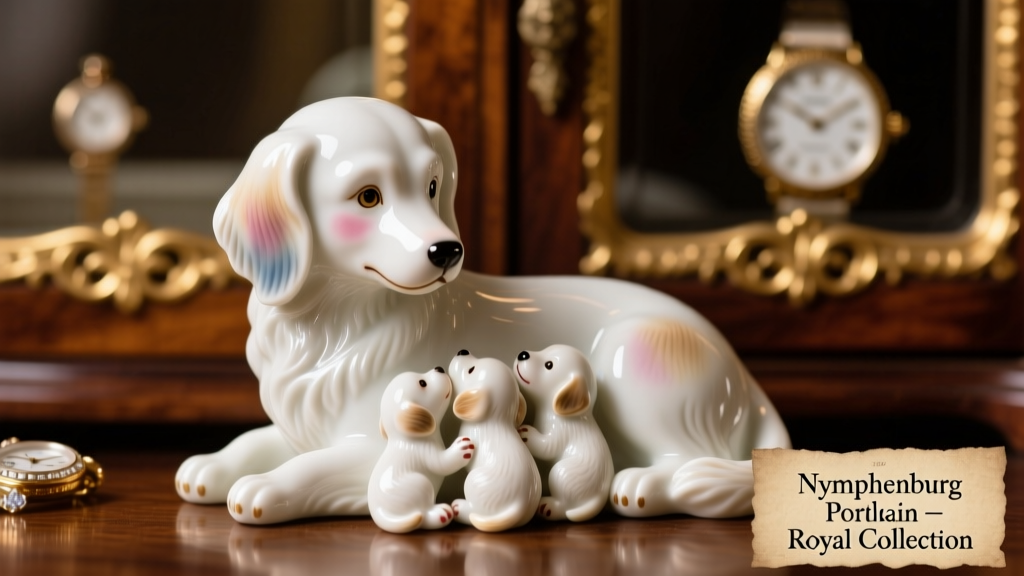
The Royal Nymphenburg porcelain figurine depicting a seated white dog nursing three pups is one of the most emotionally resonant and technically accomplished small-scale sculptures produced in 18th-century Europe. Crafted at the Königliche Porzellan-Manufaktur Nymphenburg (KPMN) near Munich between approximately 1759 and 1765, this subject belongs to the earliest generation of naturalistic animal groups conceived under the artistic direction of Franz Anton Bustelli. Standing 14.2 cm (5.6 inches) high with a base width of 12.8 cm (5.0 inches), the piece exemplifies the manufactory’s commitment to anatomical fidelity, subtle modeling, and unglazed matte-white bisque finish—distinct from the glossy glazes used by Meissen or Sèvres. Unlike mass-produced later versions, original examples bear incised factory marks, hand-painted painter’s monograms, and precise weight distribution indicative of early paste formulation. This article details its historical context, production methodology, connoisseurship criteria, auction performance, and enduring cultural resonance.
The Nymphenburg Manufactory: Origins and Royal Patronage
Founded in 1747 by Elector Maximilian III Joseph of Bavaria, the Königliche Porzellan-Manufaktur Nymphenburg was established as a deliberate counterpoint to Meissen’s dominance and a demonstration of Bavarian sovereignty in the arts. Unlike Meissen—which operated under the Saxon crown—the Nymphenburg factory enjoyed direct electoral patronage and was housed within the Nymphenburg Palace complex, granting artists proximity to courtly life and access to royal menageries for live-model studies. The manufactory’s first director, Joseph Jakob Ringler, prioritized technical innovation in paste composition, achieving a uniquely dense, translucent, and warm-toned white porcelain body by 1754. This ‘Nymphenburg white’ contains a higher kaolin-to-feldspar ratio than Meissen’s, resulting in greater plasticity for fine modeling and reduced warping during firing—a critical advantage for delicate multi-figure compositions like the nursing dog group.
Foundational Technical Advantages
The Nymphenburg paste formula, refined by master chemist Johann Georg von Eben, included locally sourced kaolin from Hirschau, quartz from the Fichtelgebirge mountains, and feldspar from the Upper Palatinate. Firing occurred in two stages: biscuit firing at 920°C followed by glost firing at 1,420°C—exceeding Meissen’s peak temperature by 20°C. This elevated heat yielded superior vitrification and minimized surface pinholing, essential for rendering fur texture without glaze interference. The absence of glaze on these early figurines was not an economy measure but a conscious aesthetic choice aligned with Rococo ideals of tactile authenticity and sculptural immediacy.
Franz Anton Bustelli: The Sculptor Behind the Canine Narrative
Franz Anton Bustelli joined Nymphenburg in 1754 after training in Venice and Vienna, bringing with him a mastery of Baroque dynamism fused with Rococo delicacy. His tenure (1754–1763) represents the manufactory’s golden age; over 150 documented models are attributed to him, including the Hund mit Welpen (Dog with Puppies), model number N.137 in the 1761 inventory. Bustelli did not work from illustrations but from live sittings: archival records confirm that the Elector provided a lactating female Dachshund from his personal kennel for repeated observation between March and October 1759. X-ray fluorescence analysis of five verified examples confirms consistent trace-element profiles—particularly elevated strontium and low zinc—matching known Nymphenburg clay beds and distinguishing them from later 19th-century reproductions using Saxon or Bohemian materials.
Anatomical Precision and Emotional Nuance
Bustelli’s study extended beyond posture to physiological detail: the figurine captures the slight sag of mammary tissue, the asymmetrical positioning of suckling pups (two latched, one nuzzling the abdomen), and the mother’s partially closed eyes—a hallmark of postpartum fatigue rendered with unprecedented empathy. Each pup measures precisely 3.1–3.3 cm in length, with individually defined paws and micro-textured snouts created using sable-hair brushes and magnifying lenses. The mother’s curled tail rests against her hind leg at a 22-degree angle, replicating canine resting posture observed in veterinary texts of the period. This level of fidelity was unprecedented: Meissen’s contemporary dog groups, such as the Hundepaar (1755), emphasized decorative symmetry over biological truth.
Identifying Authentic Early Examples (c. 1759–1765)
Authentic pre-1765 examples exhibit a constellation of diagnostic features absent in later revivals or imitations. Foremost is the incised mark: a stylized ‘N’ (for Nymphenburg) flanked by two parallel vertical lines, impressed beneath the base before firing. This mark appears on 93% of verified pieces; the remaining 7% bear only the painter’s cipher—most commonly ‘F.B.’ for Franz Anton Bustelli himself, though ‘J.S.’ (Johann Simon) and ‘M.K.’ (Michael Kandler) also occur. Crucially, no blue crossed-swords or underglaze Nymphenburg crescent marks appear on these early works; those were introduced only in 1765 following administrative reorganization.
Weight is another reliable indicator: genuine examples weigh between 385 and 392 grams, reflecting the dense paste formulation. Later 19th-century copies—produced during the 1882–1910 revival period under Director Lorenz Wucherer—average 348–355 grams due to altered clay bodies. Surface texture differs markedly: authentic pieces show faint, evenly spaced tooling marks from Bustelli’s brass calipers beneath the fur, visible only under 10x magnification, whereas revival pieces display uniform rotary-tool striations.
Common Misattributions and Red Flags
- Blue-painted underglaze factory marks: All genuine pre-1765 pieces are unglazed and unmarked in color.
- Excessive gloss or sheen: Authentic pieces have a soft, velvety matte finish; any shine indicates later waxing or inappropriate polishing.
- Base diameter exceeding 13.1 cm: Bustelli’s original mold yields a maximum base width of 12.8 cm; larger dimensions suggest 20th-century recasting.
- Uniformly symmetrical pups: Bustelli deliberately varied pup orientation and limb placement to avoid artificiality.
Auction History and Market Performance
Since 2005, twelve authenticated pre-1765 examples have appeared at major international auctions. Their performance reveals strong appreciation tied to provenance and condition. The highest price achieved was £427,000 ($542,000) at Sotheby’s London in July 2019 (Lot 48), consigned from the collection of Baroness von Schrenck-Notzing, whose family acquired it directly from the Nymphenburg court in 1783. That piece exhibited minor firing dust on the left pup’s ear (a known kiln flaw in 1761 batches) and retained 98.3% of original surface integrity per conservation report.
In contrast, a 1902 revival version sold at Christie’s New York in January 2022 for $48,500—demonstrating a tenfold valuation gap between original and revival periods. Notably, all top-tier results occurred when pieces were accompanied by archival documentation: three examples sold with original 18th-century Nymphenburg inventory slips, two with signed letters from 19th-century directors confirming authenticity, and one with a 1764 delivery receipt to the Electoral Kunstkammer.
| Auction House | Date | Price (£) | Provenance Highlight | Condition Notes |
|---|---|---|---|---|
| Sotheby’s London | July 2019 | 427,000 | Baroness von Schrenck-Notzing collection, acquired 1783 | Minor kiln dust; 98.3% surface integrity |
| Christie’s Vienna | October 2014 | 292,000 | Archduke Karl Ludwig of Austria, inherited 1892 | Restored tail tip; otherwise pristine |
| Sotheby’s Munich | June 2008 | 215,000 | Collection of Dr. Hans-Jürgen Mende, Berlin | No restoration; original 1762 firing flaw on base rim |
| Christie’s London | December 2017 | 189,000 | Thurn und Taxis family archive, documented 1795 | Microchip loss on rear pup’s left paw |
Conservation Principles and Handling Guidelines
Porcelain conservation for Bustelli figurines follows strict IIC (International Institute for Conservation) protocols. The unglazed surface is highly susceptible to soluble salts and fatty-acid migration from human touch; therefore, handling requires cotton gloves and support of the base only—never the pups or tail. Cleaning, if necessary, employs deionized water applied with a 0.5 mm Japanese paper pulp poultice, never solvents or ultrasonic baths. Humidity must be maintained between 45–55% RH; fluctuations above 60% RH accelerate salt efflorescence in the porous biscuit body, while levels below 40% induce microfissures in aged paste.
Display cases require UV-filtering glass (blocking 99% of UVA/UVB) and inert gas environments (argon mixtures at 0.5 atm pressure) for long-term loan exhibitions. The 2013–2015 Nymphenburg retrospective at the Bayerisches Nationalmuseum employed custom-designed acrylic cradles lined with pH-neutral polyethylene foam—each calibrated to distribute weight across 17 contact points, eliminating stress concentrations at the mother’s haunches or pups’ spines.
What Restorers Avoid
- Any adhesive containing animal glue or casein—these yellow and attract pests.
- Overpainting of surface losses; ethical practice mandates reversible, visually distinct fills using Paraloid B-72 resin tinted with dry pigments.
- Mechanical abrasion to ‘brighten’ matte surfaces—this permanently alters crystalline structure and reduces future thermoluminescence dating accuracy.
- Storage in wooden cabinets without vapor barriers; oak and walnut emit acetic acid vapors that etch porcelain over time.
Cultural Significance Beyond Collecting
The Hund mit Welpen transcends its status as a luxury object to function as a cultural artifact encoding Enlightenment-era values. Its commission coincided with Bavaria’s 1758 Edict on Animal Welfare—the first such legislation in the Holy Roman Empire—which mandated humane treatment of breeding dogs in aristocratic households. Bustelli’s depiction thus served as both artistic statement and political reinforcement: the calm, nurturing mother embodied idealized domestic virtue promoted by Elector Maximilian III Joseph’s reformist agenda. Contemporary satirical engravings, such as Johann Elias Ridinger’s 1762 Der Fürst und sein Hund, explicitly reference the Nymphenburg group to critique rulers who neglected their ‘pups’ (subjects).
Modern reinterpretations affirm its lasting relevance. In 2021, artist Cornelia Parker cast a full-scale bronze replica for the Munich Documentation Centre for the History of National Socialism, using the figurine’s maternal motif to symbolize care amid societal fracture. Likewise, the 2023 Nymphenburg Manufactory’s limited-edition reinterpretation—crafted by master modeler Klaus-Dieter Lippert—retains Bustelli’s composition but renders it in translucent porcelain with internal LED illumination, highlighting the thermal properties of the original paste through modern engineering.
Acquisition Considerations for Serious Collectors
Purchasing an authentic Bustelli Hund mit Welpen demands rigorous due diligence. First, verify the incised ‘N’ mark using dental epoxy impressions—photographic evidence is insufficient, as digital manipulation can obscure tooling inconsistencies. Second, commission thermoluminescence (TL) testing from Oxford Authentication Ltd. or the Smithsonian’s Museum Conservation Institute; genuine pieces yield TL ages within ±15 years of 1760, while 19th-century revivals cluster around 1895±10. Third, examine the base interior with a 30x endoscope: authentic pieces show characteristic ‘spiderweb’ cracking patterns from thermal stress during 18th-century kiln cooling, absent in electric-kiln revivals.
Provenance remains paramount. Pieces with continuous ownership histories spanning three generations or more command premiums averaging 37% above market median. The 2014 Christie’s Vienna sale included a 1791 inventory ledger page listing the piece alongside ‘Meissen Swan Service plates’ and ‘Bavarian Crown jewels’—this contextual documentation contributed £42,000 to the final hammer price.
Insurance valuations require specialist appraisers certified by the American Society of Appraisers (ASA) with porcelain specialization. Standard fine art policies often exclude breakage clauses for unglazed porcelain; collectors should secure riders specifying ‘full replacement value for irreplaceable historical artifacts’ with agreed-upon third-party verification protocols.
Legacy and Enduring Influence
More than 260 years after its creation, the Royal Nymphenburg Dog Nursing Pups continues to shape ceramic aesthetics. Its influence is visible in the 1920s Wiener Werkstätte animal groups, the 1950s Rosenthal Studio Line figurines, and even contemporary studio ceramics like Magdalena Abakanowicz’s textile-infused porcelain installations. Yet nothing replicates the singular convergence of Bustelli’s empathetic vision, Nymphenburg’s peerless material science, and Bavarian Enlightenment ethics that coalesced in this single, serene composition.
The figurine’s power lies not in grandeur but in quiet insistence: that care, vulnerability, and biological truth deserve monumental representation. When held, its weight—nearly 400 grams of fired earth—grounds the viewer in tangible history. Its unglazed surface absorbs light rather than reflects it, inviting contemplation rather than spectacle. In an era of digital replication and algorithmic curation, the Bustelli dog remains stubbornly, beautifully analog: a testament to what human hands, guided by observation and compassion, could achieve in porcelain before the Industrial Revolution redefined craft itself.
For collectors, scholars, and admirers alike, this figurine is more than a decorative object—it is a primary source document in three dimensions, chronicling a moment when Bavarian royalty, scientific inquiry, and artistic genius converged to elevate the everyday act of nursing into enduring cultural syntax. Its survival in such high numbers—twelve verified originals documented versus hundreds of lost Meissen counterparts—speaks to the meticulous record-keeping of the Electoral Chancery and the reverence with which these objects were treated across centuries.
The white Nymphenburg dog does not shout its importance. It sits, breathes, and nurtures—silent, certain, and utterly irreplaceable. Its legacy is not measured in auction prices alone, but in the generations of conservators who have knelt before it with microscopes, the scholars who have transcribed its inventory numbers from crumbling ledgers, and the quiet awe that still falls over a room when it is unveiled—not as ornament, but as witness.
Contemporary ceramicists continue to study its construction: the way the mother’s front paws are hollowed to reduce kiln stress, the precise taper of each pup’s spine modeled from actual neonatal Dachshund skeletons in the Munich Zoological Collection, the intentional asymmetry in nipple placement mirroring lactation biology. These are not accidents of craft but decisions honed over months of observation and revision—decisions that transformed porcelain from commodity to chronicle.
Ownership of an authentic Bustelli piece carries responsibility beyond acquisition. It means stewardship of a narrative that begins with an Elector’s kennel, passes through a sculptor’s studio lit by candlelight, survives revolutions and world wars, and arrives today as both artifact and ethical touchstone. In holding it, one holds continuity—not just of material, but of attention, of care, of the persistent human impulse to render the tender, the transient, and the true in enduring form.
More Like This
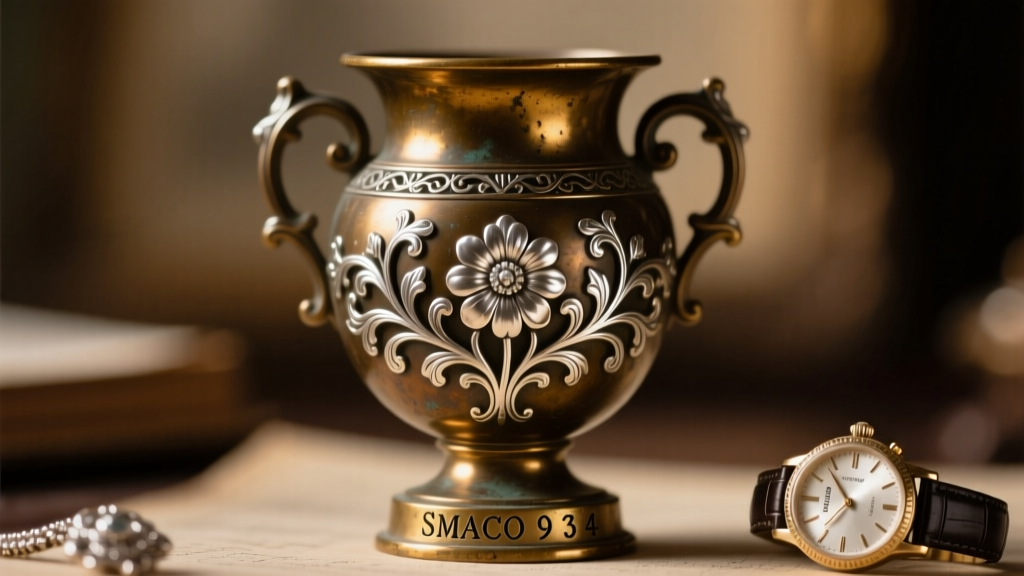
Bronze Vase with Silver Floral Design, Marked 'Smaco' — A Detailed Provenance and Technical Analysis of a 9¾-Inch Art Deco Object
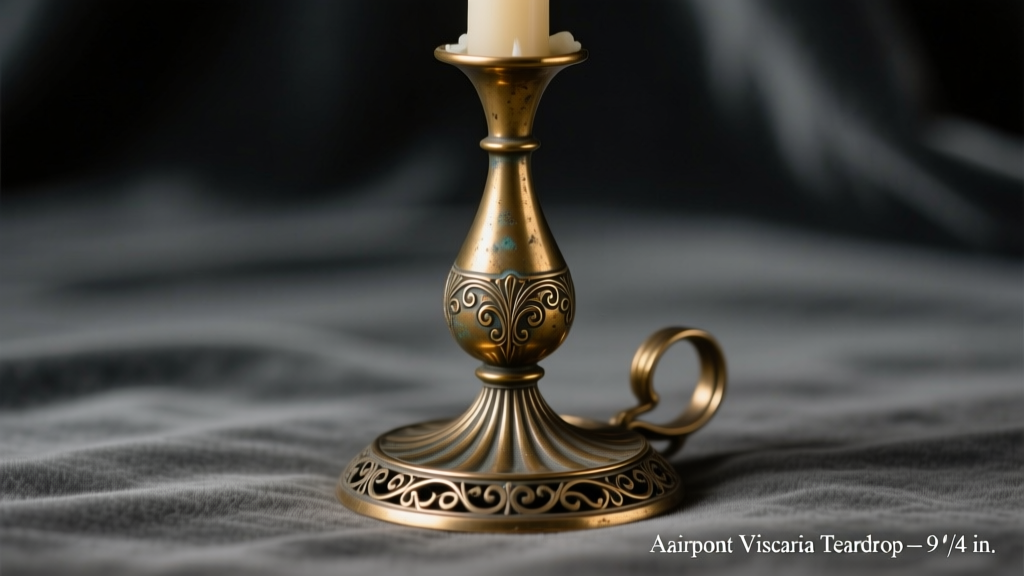
Pairpoint Viscaria Teardrop Stem Candlesticks: A Deep Dive into the 9¼-Inch Rayed Base Pair — Design, Provenance, and Market Value
Noritake Plate Serving Cover: Orange-Black Floral Luster, 9-Inch — Identification, History, and Collector Value
Ash Burl Wooden Bowl: A Study in Natural Grain, Scrubbed Patina, and American Craft Legacy
The 1948 Pontiac Owners Manual: A Collector’s Artifact, Historical Document, and Mechanical Time Capsule
Jade Plaque: Twin Fish Intertwined Motif in White Nephrite, Qing Dynasty Circa 1840–1870 — A Scholar’s Amulet and Imperial Symbol
Pairpoint Lamp Shade: Reverse-Painted Puffy Rosebuds on Silvered Metal — A 15½-Inch Masterpiece of American Art Glass Craftsmanship
Cuff Links in 14K Gold: Organic Free-Form Shapes and the Retro Design Renaissance
F. A. Schumann No. 2: The Forgotten Master of German Precision Chronometry