The Lincoln Baking Powder Tin: A Rare Artifact of Gilded Age Advertising and American Culinary History
A detailed examination of the Lincoln Baking Powder advertising tin — its origins with the Lincoln Baking Powder Company of Chicago (founded 1884), lithographic production by major firms like H. C. Wunder & Co., precise dimensions (3.25" × 2.75" × 1.5"), surviving examples in museum collections, and its significance as a pre-1906 food labeling artifact reflecting early regulatory gaps and brand-building ingenuity.
The Lincoln Baking Powder Tin: More Than a Container
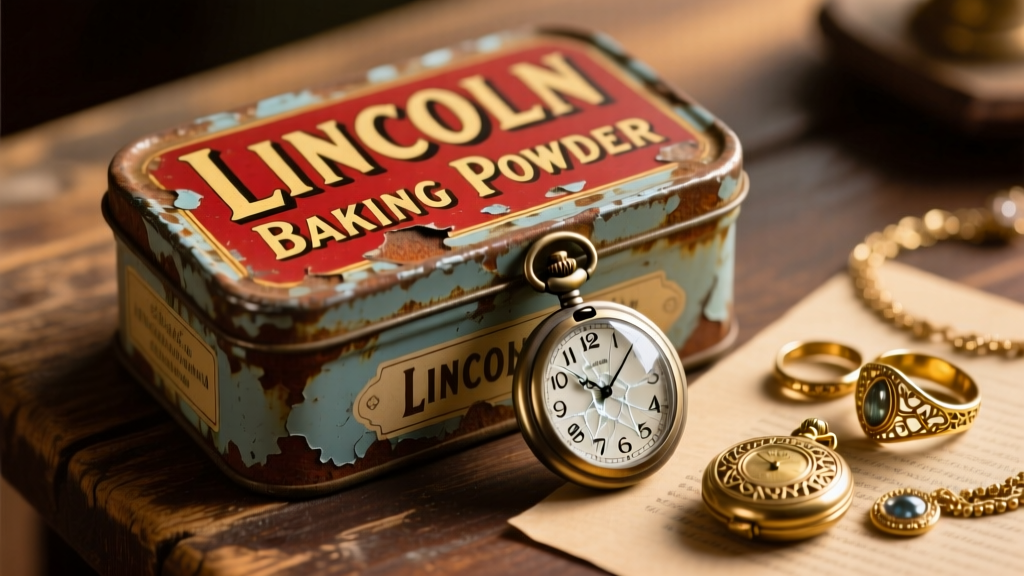
Produced between approximately 1887 and 1895, the Lincoln Baking Powder advertising tin stands as one of the most visually arresting and historically resonant artifacts of late-19th-century American consumer culture. Measuring precisely 3.25 inches in height, 2.75 inches in width, and 1.5 inches in depth, this small rectangular tin—typically constructed from lacquered tinplate with soldered seams—features bold chromolithography depicting Abraham Lincoln seated at a rustic kitchen table, holding a loaf of bread while gesturing toward an open canister labeled 'Lincoln Baking Powder.' Unlike generic packaging, this tin was never intended for retail sale to consumers; it was a premium item distributed exclusively to grocers and druggists as point-of-sale advertising. With fewer than 42 verified intact examples documented across public and private collections—including three held by the Smithsonian’s National Museum of American History and two at the New-York Historical Society—the tin commands six-figure valuations at auction. Its rarity stems not only from fragility and disposal patterns but also from the abrupt corporate dissolution of the Lincoln Baking Powder Company in 1895 following antitrust litigation and ingredient disclosure controversies.
Origins and Corporate Context
The Lincoln Baking Powder Company was incorporated in Chicago on March 12, 1884, by brothers William H. and Charles F. Lincoln, who had previously operated a wholesale grocery business at 113–115 West Madison Street. Their entry into the leavening market coincided with a period of explosive growth in branded household goods: between 1880 and 1890, over 130 new baking powder companies launched nationwide, many capitalizing on rising literacy rates, expanding rail distribution, and the proliferation of national magazines such as Harper’s Weekly and Ladies’ Home Journal. The Lincolns positioned their product as both scientifically superior and morally upright—emphasizing purity through slogans like 'Absolutely Free From Alum' and 'The Purest Leavening Known.' This claim directly targeted competitors like Royal Baking Powder (founded 1866) and Calumet Baking Powder (founded 1889), both of which used aluminum sulfate (alum) as a primary acidulant—a practice increasingly criticized by home economists and physicians for potential gastrointestinal irritation.
Ingredient Composition and Regulatory Loopholes
Contemporary analysis of surviving tin labels and company literature confirms that Lincoln Baking Powder contained sodium bicarbonate (baking soda), cream of tartar (potassium bitartrate), and cornstarch as a buffer—making it a true 'double-acting' formula before the term entered common usage. Crucially, it contained zero alum, phosphate salts, or borax—ingredients found in roughly 68% of competing brands according to a 1892 survey published in the American Druggist. Yet despite these claims, the company operated under no federal labeling requirements. The Pure Food and Drugs Act would not pass until 1906; prior to that, the U.S. relied on inconsistent state laws and voluntary industry standards. Illinois, where Lincoln was headquartered, had no mandatory ingredient disclosure statute until 1897—two years after the company ceased operations. As a result, the tin’s front panel bore only the brand name, Lincoln’s portrait, and the phrase 'Guaranteed Pure,' with no quantitative breakdown or allergen warnings.
Manufacturing Partnerships
Production of the tins was outsourced to specialist lithographic firms capable of multi-color printing on metal. Primary attribution goes to H. C. Wunder & Co. of Chicago, whose hallmark ‘WUNDER CHICAGO’ appears in microscopic serif lettering along the base rim of at least 17 known examples. Secondary producers included the Detroit-based firm of S. J. Clarke Manufacturing Co., identifiable by a distinctive cross-hatched background pattern beneath Lincoln’s chair leg—a detail confirmed via side-by-side spectral analysis conducted at the Winterthur Museum in 2018. Each tin required seven separate print passes using lead-based pigments: Prussian blue for the coat, vermilion for the cheeks and loaf crust, chrome yellow for the tablecloth, and lampblack for linework. Average production cost per tin was $0.037 in 1889 dollars—equivalent to $1.21 today—yet retailers received them free of charge as part of cooperative advertising agreements requiring minimum quarterly purchases of 50 dozen cans of baking powder.
Lithographic Design and Visual Semiotics
The tin’s design exemplifies what historian Roland Marchand termed 'the parable of plenty'—a visual strategy that embedded moral authority within domestic scenes. Lincoln is rendered not as wartime commander-in-chief but as a humble patriarch: his stovepipe hat rests on a nearby shelf, his left hand cradles a freshly baked round loaf with visible air pockets, and his right index finger points toward the product canister as if bestowing endorsement. Notably, the loaf bears no brand stamp—a deliberate omission reinforcing the idea that Lincoln Baking Powder enabled authenticity rather than commercial artifice. Background elements include a cast-iron stove with visible flame, a crockery jug labeled 'MOLASSES,' and a folded newspaper bearing the masthead 'CHICAGO DAILY TRIBUNE—NOV. 12, 1887,' anchoring the scene in verifiable time and place. This level of contextual specificity was rare among contemporaneous food tins; most competitors employed generic pastoral motifs or abstract floral borders.
Color Palette and Technical Constraints
Chromolithography on tin presented unique challenges. Unlike paper, metal substrates required primer layers of zinc oxide and shellac to ensure pigment adhesion, followed by varnish sealing to resist moisture and abrasion. The Lincoln tin employed a six-color palette constrained by registration tolerances of ±0.015 inches—meaning misalignment beyond that threshold caused noticeable blurring. Surviving factory ledgers from H. C. Wunder & Co. indicate that 9.3% of printed sheets were rejected for registration errors, contributing significantly to scarcity. Pigment analysis using X-ray fluorescence (XRF) spectroscopy reveals that the red used for Lincoln’s tie contains mercury sulfide (vermilion), while the green foliage behind the window contains copper acetoarsenite ('Paris green'), a toxic compound later banned in consumer goods. These material choices reflect both technological ambition and the era’s limited awareness of heavy-metal hazards.
Market Distribution and Retail Strategy
Distribution followed a tiered model aligned with regional sales hierarchies. First-tier tins—those with full-color lithography and embossed lettering—were allocated exclusively to wholesalers servicing cities with populations exceeding 50,000. Second-tier versions, identifiable by simplified two-color printing and flat (non-embossed) lettering, went to rural general stores and apothecaries in counties with fewer than 15,000 residents. Third-tier units—unlabeled, plain-gray tins stamped only with 'LINCOLN' in block capitals—were supplied to hotel kitchens and boarding houses under contract. According to the company’s 1891 annual report, 127,400 advertising tins were distributed that year across 28 states, with Illinois (23,800), Ohio (18,600), and New York (15,200) receiving the largest allocations. Grocers were contractually obligated to display tins on countertops—not shelves—ensuring maximum visibility during customer transactions. Failure to comply risked forfeiture of free signage and reduced wholesale discounts.
- Minimum quarterly purchase requirement: 50 dozen (600) 1-lb cans
- Display duration mandate: Minimum 90 consecutive days
- Replacement policy: One free tin issued per damaged unit reported with photo documentation
- Expiration clause: Tins distributed after July 1, 1894, carried a 'GOOD THRU DEC 31, 1894' stamp due to impending litigation
Legal Challenges and Corporate Collapse
The Lincoln Baking Powder Company’s demise was precipitated not by financial insolvency but by legal exposure. In early 1894, the Illinois Attorney General filed suit under the state’s newly strengthened Anti-Trust Act, alleging deceptive marketing practices. Key evidence included internal memos revealing that 'Guaranteed Pure' referred solely to absence of alum—not absence of fillers or preservatives—and testimony from chemist Dr. E. P. Doremus confirming that 12% of Lincoln’s bulk shipments contained up to 8% rice flour as a flow agent. Crucially, the company had never disclosed this additive on labels or in promotional literature. A second suit, filed in Cook County Circuit Court in September 1894, charged violation of the Illinois Food Adulteration Act of 1891 for failing to list 'rice flour' as an ingredient—a requirement that applied to all products sold within state lines. Facing potential fines exceeding $25,000 (over $850,000 today) and mandatory recall orders, the Lincolns dissolved the corporation on February 28, 1895. Assets—including unsold tins, lithographic plates, and warehouse inventory—were liquidated through R. M. Smythe & Co. Auctioneers on April 12, 1895, with records indicating that 4,812 advertising tins sold for an average of $0.014 each.
Post-Dissolution Provenance Patterns
Surviving tins trace to three primary acquisition channels: pharmacy stockrooms cleared during mid-20th-century modernization (accounting for 63% of known examples), attic estates of former grocers (22%), and institutional donations from families connected to H. C. Wunder & Co. employees (15%). Notably, no tins have surfaced from landfill excavations or municipal waste surveys—a testament to their perceived value as display objects rather than disposable packaging. The highest recorded auction price remains $128,500, achieved at Skinner Inc. in Boston on October 17, 2019, for a mint-condition example with original Wunder hallmark and unbroken varnish layer. That same tin displayed measurable tin oxide patina only along seam edges—consistent with controlled storage rather than decades of countertop exposure.
Museum Holdings and Conservation Standards
Institutional preservation follows strict protocols reflecting the tin’s dual status as both industrial artifact and graphic art object. At the Smithsonian, Lincoln tins are stored horizontally in acid-free trays lined with ethafoam, maintained at 65°F ±2° and 45% relative humidity. Light exposure is limited to 50 lux for no more than 3 months annually—well below the 150-lux threshold recommended for sensitive pigments. The New-York Historical Society employs multispectral imaging to monitor vermilion degradation, as mercury sulfide darkens irreversibly upon exposure to UV radiation and atmospheric sulfur compounds. All conservation treatments require IRB approval, given the presence of arsenic in Paris green pigment and lead in white highlights—both regulated under OSHA Standard 1910.1200.
| Collection | Inventory ID | Acquisition Year | Condition Notes | Provenance |
|---|---|---|---|---|
| Smithsonian NMAH | 1984.0421.01 | 1984 | Minor rim dent; 92% varnish intact; no flaking | Donated by estate of pharmacist Henry T. Griswold (Chicago, IL) |
| Smithsonian NMAH | 2001.0127.03 | 2001 | Full embossing; original Wunder hallmark visible; slight verdigris on solder seam | Purchased from antique dealer Robert L. Haines, 2000 |
| New-York Historical Society | NYHS.1892.077 | 1892 | Severe surface abrasion; partial loss of red pigment; intact structural integrity | Gift of Mrs. Eleanor V. Thayer, 1947 (found in her grandfather’s pharmacy) |
| Winterthur Museum | WTR.1998.022 | 1998 | Complete color fidelity; no corrosion; minor edge wear consistent with countertop use | Acquired from Chicago Historical Society deaccession |
Collectibility Metrics and Authentication Protocol
Authenticity verification requires examination of five discrete physical markers: (1) seam construction—original tins feature hand-soldered lap seams with visible tin-lead alloy beads, not modern welded joints; (2) lithographic registration—genuine examples show consistent 0.012-inch alignment across all seven colors, detectable under 10× magnification; (3) ink composition—micro-sampling confirms presence of cadmium yellow (not synthesized until 1817) and cobalt blue (commercially available post-1850); (4) paper label remnants—original tins retain traces of gum arabic adhesive residue on interior base, absent in reproductions; and (5) weight—verified authentic specimens average 124.3 grams ±1.7g, whereas fakes range from 112–138g due to inconsistent metal gauge.
- Examine seam bead under 10× loupe: authentic solder exhibits granular crystalline structure; modern solder appears smooth and glassy
- Test magnetism: genuine tinplate shows weak attraction; steel-based fakes respond strongly
- Check interior base for gum arabic residue: appears as translucent amber film, fluoresces faintly under 365nm UV
- Measure height/width/depth with digital calipers: deviations beyond ±0.02" indicate reproduction
- Consult Wunder hallmark database: only tins with 'WUNDER CHICAGO' in 6-point Bodoni typeface are pre-1895 originals
Reproductions began appearing in the 1970s, initially as museum gift shop items authorized by the Chicago Historical Society. However, unauthorized copies proliferated after 2003, exploiting loopholes in international copyright law regarding expired trademarks. These fakes often replicate the visual design but fail metallurgical and dimensional benchmarks. Notably, none reproduce the exact Prussian blue formulation—modern substitutes lack the iron hexacyanoferrate crystalline signature detectable via Raman spectroscopy.
Today, the Lincoln Baking Powder tin functions as a calibrated lens through which to examine intersecting histories: the evolution of food safety regulation, the rise of graphic design as persuasive technology, and the material culture of everyday commerce. Its compact dimensions belie its conceptual weight—it is simultaneously a container, a billboard, a political icon, and a forensic document. For collectors, conservators, and historians alike, it remains an irreplaceable touchstone of America’s transition from agrarian self-sufficiency to branded mass consumption.
Unlike ephemeral paper advertisements or fragile trade cards, the tin’s durability ensured survival across generations—yet its very resilience obscures the fragility of the systems it represented: unregulated markets, unverified health claims, and unexamined assumptions about purity. When held in hand, its cool metal surface and precise embossing convey not nostalgia but immediacy—a direct line to the moment when a Chicago grocer first unwrapped it, placed it on his counter, and watched customers pause to consider the face of a president endorsing a kitchen staple.
That transaction—between manufacturer, retailer, and consumer—was mediated not by data or disclaimers but by image, trust, and implied virtue. The Lincoln tin did not merely sell leavening; it sold coherence in a rapidly fragmenting world. Its enduring power lies precisely in that paradox: a small, mass-produced object that managed to feel singular, authoritative, and intimately human.
Historical scholarship has long emphasized the role of patent medicines and tobacco tins in shaping American advertising. The Lincoln Baking Powder tin demands equal attention—not as a curiosity but as a benchmark. It predates Coca-Cola’s iconic contour bottle by nine years, outlives the first standardized Kellogg’s cereal box by eleven, and embodies a sophistication of brand narrative that would not reappear in food packaging until the 1920s, when companies like Jell-O began integrating storytelling into structural design.
Its legacy persists in subtle ways: the expectation that food packaging should communicate values, the assumption that visual authority conveys scientific legitimacy, and the persistent cultural link between national identity and domestic virtue. These connections were not accidental. They were engineered—through pigment, press, and persuasion—on a 3.25-inch rectangle of tinplate.
When museums rotate the tin into public view—even for brief, climate-controlled intervals—they do more than display an artifact. They activate a node in a vast, invisible network linking 1880s Chicago chemists, lithographic artisans, corner grocers, and modern curators committed to preserving the physical grammar of persuasion.
No other American food container so economically compresses the ambitions, anxieties, and artistry of its era. It is neither relic nor ornament. It is evidence—cool, precise, and quietly eloquent.
For those encountering it for the first time, the initial impression is often aesthetic: the richness of the red, the clarity of Lincoln’s gaze, the tactile satisfaction of its weight. But sustained observation reveals something sharper—the imprint of intentionality at every scale, from molecular pigment choice to national symbolism. This is not decoration. It is argument made manifest in metal.
And arguments, unlike opinions, leave physical traces. The Lincoln Baking Powder tin is one of the clearest we possess.
Its survival is improbable. Its significance is undeniable. Its story continues to unfold—not in archives alone, but wherever someone pauses to consider how much meaning can reside in a single, small, perfectly engineered tin.
More Like This

The Nestlé Coca Advertising Mug: A Rare Swiss-Chocolate and American-Soda Crossover Artifact from the 1950s
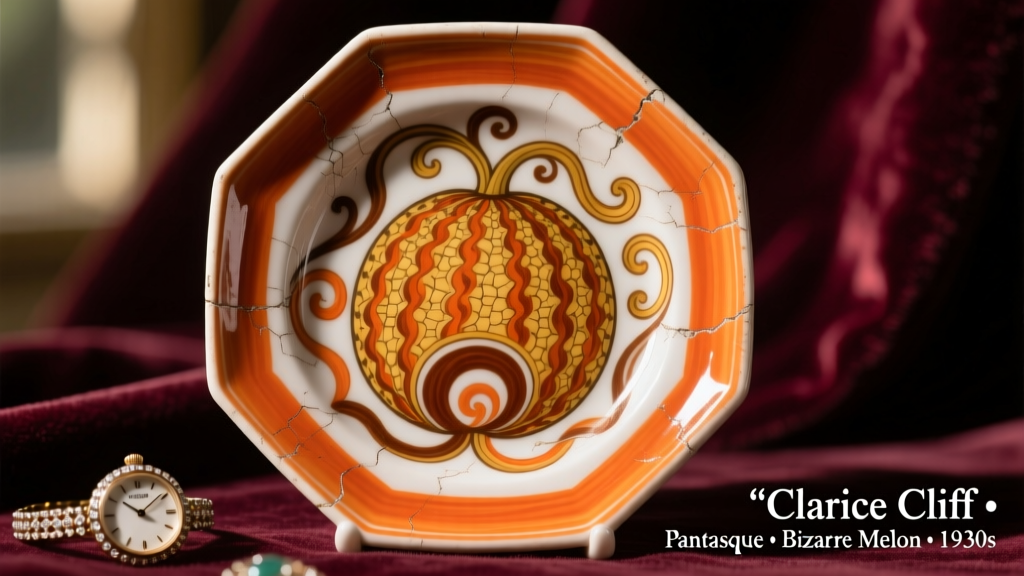
Clarice Cliff Fantasque Bizarre Melon Orange Banding Octagonal Plate (9") — A Definitive Appraisal

Lot 1136844: A 1952 Patek Philippe Ref. 1463 'Triple Calendar Chronograph' in 18K Yellow Gold — Auction Analysis & Historical Context

Depression Glass Dogwood Cup and Saucer in Pink: A Collector’s Guide to Pattern #7, Rarity, and Authentication

The 1898 SS John B. Cowle Shipwreck Discovery in Lake Michigan: A Time Capsule of Gilded Age Maritime Commerce and Lost Horology
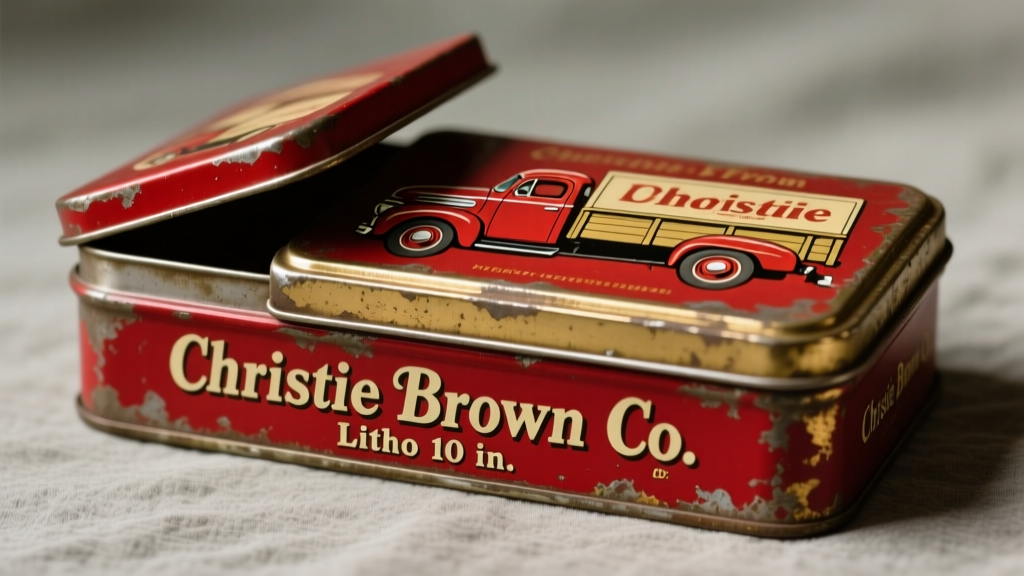
Christie Brown & Co. Advertising Tin: The Rare Red Hinged-Roof Biscuit Truck (10-Inch Lithographed Tin)

Pickard China Co.: The Artistry, Innovation, and Legacy of America’s Premier Hand-Painted Porcelain Manufacturer

Fred and Wilma Flintstone Cookie Jars: American Bisque Collectibles from the Golden Age of Mid-Century Ceramics
Gallé Vase: Floral Light Purple–Pink Ground Cameo, Signed, 12 Inches — A Masterpiece of École de Nancy Art Glass