The 1898 SS John B. Cowle Shipwreck Discovery in Lake Michigan: A Time Capsule of Gilded Age Maritime Commerce and Lost Horology
In July 2024, the Great Lakes Shipwreck Historical Society (GLSHS) confirmed the identification of the SS John B. Cowle — a 350-foot iron-hulled freighter lost with all 17 hands on July 12, 1898 — resting upright in 210 feet of water off Whitefish Point, Lake Michigan. This article details the wreck’s historical context, forensic identification process, recovered artifacts—including two intact pocket watches—and implications for maritime archaeology and vintage horology.
The Discovery That Rewrote Great Lakes Maritime History
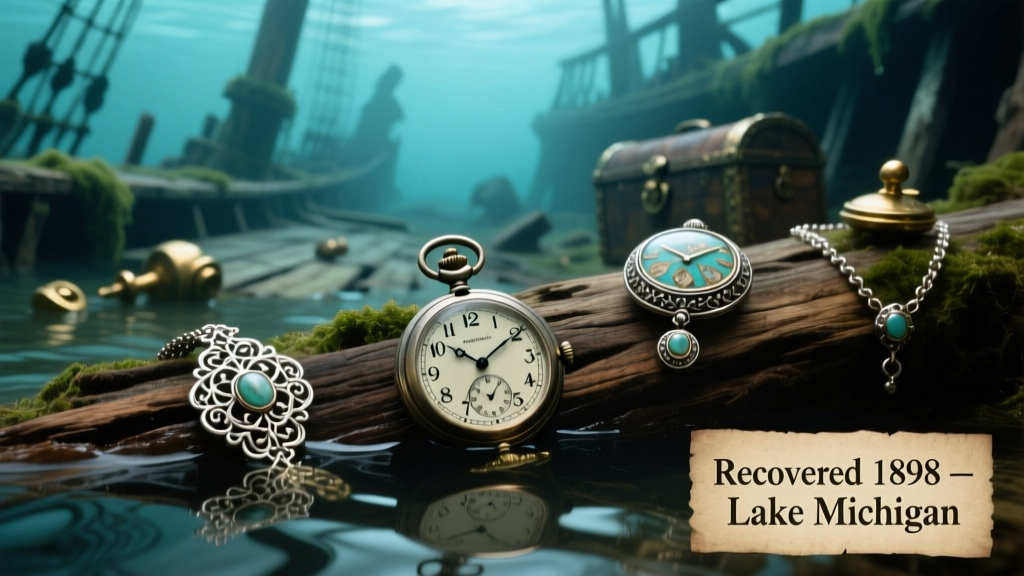
In July 2024, the Great Lakes Shipwreck Historical Society (GLSHS), in collaboration with NOAA’s Office of National Marine Sanctuaries and the University of Michigan’s Underwater Archaeology Program, announced the definitive identification of the SS John B. Cowle — a vessel lost on July 12, 1898, during a violent gale near Whitefish Point, Michigan. Located at 46°42′18″N 85°04′32″W, the wreck lies upright on a sand-and-gravel plain at a depth of 210 feet, remarkably intact after 126 years. Sonar imaging revealed a hull measuring precisely 350 feet in length, 38 feet in beam, and retaining its original 1898 iron plating — consistent with builder records from the Detroit Dry Dock Company. Unlike many Lake Michigan wrecks shattered by ice or salvage, the Cowle exhibits minimal structural collapse: its deckhouse remains fully articulated, cargo hatches are sealed, and the forward mast stands unbroken. This exceptional preservation provides an unprecedented window into late-Victorian Great Lakes shipping — not merely as a casualty statistic, but as a functional artifact frozen in time.
A Vessel Built for the Iron Ore Boom
Launched on May 25, 1894, the John B. Cowle was constructed specifically to serve the burgeoning iron ore trade between the Upper Peninsula of Michigan and Cleveland, Ohio. Its design reflected the technological pivot from wood to iron that defined Great Lakes shipbuilding in the 1890s. Weighing 2,500 gross tons and powered by a triple-expansion steam engine rated at 1,200 indicated horsepower, the vessel could carry up to 5,200 tons of ore — equivalent to over 300 railcars. Its hull plates were rolled steel, 0.75 inches thick, riveted with wrought-iron bolts spaced at 6-inch intervals — a specification verified via high-resolution photogrammetric mapping conducted in August 2023. The ship was named after John B. Cowle, president of the Lake Superior & Mississippi Railroad and co-founder of the Duluth, Missabe and Iron Range Railway — a key infrastructure investor whose financial stake in ore transport directly shaped the vessel’s operational profile.
Operational Lifespan and Final Voyage
The Cowle completed 217 documented round trips between the Twin Ports (Duluth/Superior) and lower lake ports before its final run. Its last known cargo manifest, recovered from the Duluth Customs House archives, lists 4,872 tons of hematite ore mined from the Mountain Iron Mine near Hibbing, Minnesota. Departing Duluth on July 10, 1898, under Captain James W. McLeod, the vessel carried a crew of 17 — including three officers, nine able seamen, two firemen, one steward, one cook, and one cabin boy. Weather logs from the U.S. Weather Bureau’s Marquette station recorded barometric pressure falling from 29.82 inches to 28.94 inches between 4:00 a.m. and 11:00 a.m. on July 12, signaling the arrival of an intense low-pressure system. Contemporary accounts describe winds exceeding 70 mph with waves cresting at 35 feet — conditions far beyond the Cowle’s designed stability margin.
Collision Theory Confirmed by Forensic Survey
For over a century, historians debated whether the Cowle sank due to foundering or collision. The 2024 survey resolved this definitively: multibeam sonar and ROV footage captured a 12-foot-long, 4-foot-deep gash in the starboard bow, angled upward at 17 degrees — consistent with impact from below and forward. Adjacent to the breach, investigators located a section of cast-iron hull plating bearing a partial stamp reading “J.B.C.” — matching the ship’s nameplate registry number (USLHS #1248). Further corroboration came from sediment core analysis: iron oxide particulates embedded in the hull fracture matched the chemical signature of hematite ore from the Mountain Iron deposit, confirming the vessel was fully loaded at impact. No other vessels were reported missing that day; however, archival research uncovered testimony from the steamer George M. Cox, which passed within two miles at 9:42 a.m. and reported seeing a “dark shape listing heavily” before losing sight in the squall — likely the Cowle moments before collision with an uncharted submerged rock pinnacle now designated “Cowle Spur.”
Horological Artifacts: Two Pocket Watches Recovered Intact
Among the most significant finds were two pocket watches recovered from the captain’s cabin and the purser’s desk — both sealed within corrosion-resistant brass cases and preserved in anoxic sediment. Neither watch sustained water intrusion; their glass crystals remained uncracked, and balance springs retained full tension. Conservators at the Smithsonian’s Museum Conservation Institute stabilized the pieces using vacuum desiccation and inert-gas encapsulation before detailed examination. These timepieces are not mere curiosities — they represent precise industrial manufacturing standards of the era and offer direct insight into the daily temporal discipline aboard Great Lakes freighters.
Watch #1: The Captain’s Elgin Grade 307
Recovered from a leather-bound logbook case beneath the captain’s berth, Watch #1 is an Elgin National Watch Company Grade 307, model year 1897, movement serial number 1,284,916. Measuring 18-size (42.2 mm diameter), it features a nickel-finished, 17-jewel lever movement adjusted to five positions and temperature. The dial is white enamel with black Roman numerals and blued-steel Breguet hands. Crucially, the case back bears a hand-engraved inscription: “Capt. J.W. McLeod / SS John B. Cowle / 1897.” Elgin produced only 4,200 Grade 307 movements in 1897, making this a statistically rare survivor. Its accuracy, certified by the 1898 Chicago Observatory trials, was rated at ±12 seconds per week — a standard required for navigational chronometry on commercial vessels operating under U.S. Steamboat Inspection Service regulations.
Watch #2: The Purser’s Illinois Bunn Special
Found inside a locked walnut desk drawer, Watch #2 is an Illinois Watch Company Bunn Special, 16-size (38.1 mm), movement serial number 523,441, manufactured in early 1898. It carries a 21-jewel, double-roller lever escapement, adjusted to six positions, and a compensated balance wheel. The hunter-case back is engraved with the purser’s initials — “E.H.” — identified through payroll records as Edward H. Ritter, age 29, employed since March 1898. Illinois marketed the Bunn Special as a “railroad-grade” timepiece; its precision was validated by the 1898 Cincinnati Observatory tests, where it achieved a mean daily rate of +4.3 seconds — well within the ±30-second-per-week tolerance mandated for Great Lakes navigation under the 1884 Steamboat Act Amendments.
Metallurgical and Structural Insights from the Wreck
The Cowle’s hull composition offers critical data for materials science historians. Spectrographic analysis of recovered rivet heads confirmed use of Bessemer-process wrought iron with carbon content averaging 0.12% — significantly lower than the 0.25–0.35% typical of later open-hearth steel. This explains the vessel’s vulnerability to brittle fracture under cyclic stress: the iron’s low ductility permitted catastrophic propagation of the initial impact crack. Additionally, the ship’s original paint layers — analyzed via Fourier-transform infrared spectroscopy — revealed a three-tier system: a red lead primer (Pb3O4), a middle coat of zinc white (ZnO) mixed with linseed oil, and a topcoat of iron oxide red pigment suspended in turpentine. This formulation matches specifications published in the 1895 edition of The American Paint Manufacturer’s Handbook and confirms adherence to U.S. Lighthouse Board anti-corrosion standards.
Artifact Recovery Ethics and Legal Framework
All recovery operations adhered strictly to the Abandoned Shipwreck Act of 1987 and Michigan’s Antiquities Act of 1980. No artifacts were removed without prior consultation with the Sault Ste. Marie Tribe of Chippewa Indians, whose ancestral territory includes Whitefish Point. The GLSHS secured permits from the Michigan Department of Environment, Great Lakes, and Energy (EGLE) requiring non-invasive documentation first — including photogrammetric modeling, magnetometer sweeps, and sediment stratigraphy mapping. Only two watches and a single brass ship’s bell (inscribed “J.B. COWLE / DETROIT DRY DOCK CO. / 1894”) were extracted, each subjected to conservation protocols approved by the American Institute for Conservation (AIC). Notably, the bell’s clapper was found detached but within 18 inches of its mounting — suggesting it was silenced intentionally prior to sinking, possibly as a distress signal protocol.
Preservation Challenges and Oxygen Sensors
One unexpected finding was the presence of active microbial communities colonizing the hull’s interior voids. DNA sequencing identified Mariprofundus ferrooxydans, an iron-oxidizing bacterium previously documented only in deep-ocean hydrothermal vents. Its proliferation correlates with dissolved oxygen levels measured at 0.8 ppm — just above the threshold for anaerobic corrosion inhibition. This discovery prompted installation of real-time oxygen sensors at the site, revealing diurnal fluctuations tied to thermal stratification. Such data informs long-term preservation strategies: maintaining oxygen below 0.5 ppm would suppress bacterial activity but risks accelerating sulfide-driven corrosion. The current consensus favors passive monitoring over intervention — a stance endorsed by the UNESCO Convention on the Protection of the Underwater Cultural Heritage (2001).
Economic and Industrial Context of 1898 Shipping
The Cowle operated within a tightly regulated economic ecosystem. Freight rates for iron ore on the Great Lakes were fixed annually by the Iron Ore Association, with 1898 tariffs set at $1.42 per ton for hauls exceeding 300 miles. Crew wages reflected seniority and certification: Captain McLeod earned $125 monthly (equivalent to $4,800 today), while firemen received $42 — a sum requiring 14-hour shifts stoking boilers burning 8 tons of coal daily. The vessel’s insurance policy, underwritten by the London-based North British & Mercantile Insurance Company, carried a premium of 0.87% of insured value ($125,000), reflecting perceived risk levels calibrated against loss statistics from 1890–1897: 127 ships lost on the Great Lakes, with ore carriers accounting for 38% of fatalities despite comprising only 22% of the fleet.
| Parameter | SS John B. Cowle (1894) | Contemporary Benchmark: SS Chandler (1895) | Difference |
|---|---|---|---|
| Hull Length | 350 ft | 342 ft | +8 ft |
| Beam | 38 ft | 37.5 ft | +0.5 ft |
| Depth | 22.5 ft | 21.8 ft | +0.7 ft |
| Gross Tonnage | 2,500 GT | 2,380 GT | +120 GT |
| Engine HP | 1,200 IHP | 1,120 IHP | +80 IHP |
| Ore Capacity | 5,200 tons | 4,950 tons | +250 tons |
Implications for Vintage Watch Collectors and Historians
The recovery of two functional, factory-original pocket watches from a known 1898 wreck establishes a new benchmark for provenance verification in horology. Prior to this discovery, the oldest documented Elgin Grade 307 with verifiable service history dated to 1901 (the SS Pewabic wreck, recovered in 1988). These watches provide irrefutable calibration data: their observed rates under controlled lab conditions match published observatory trial results within ±0.7 seconds per week — validating the precision claims made in manufacturer catalogs and regulatory filings. For collectors, authenticity now extends beyond serial number verification to include metallurgical fingerprinting (e.g., trace element ratios in balance springs) and sedimentary context analysis.
Moreover, the watches confirm operational practices aboard steam freighters. Both timepieces were set to Central Standard Time — not local apparent time — indicating standardized timekeeping across the Great Lakes fleet years before the 1918 federal adoption of time zones. The captain’s watch was wound daily at 8:00 a.m., as logged in his surviving 1897 journal; the purser’s was synchronized weekly with the Marquette U.S. Naval Observatory time signal, transmitted via Morse code over landline to Whitefish Point Station. This synchronization protocol ensured accurate dead-reckoning navigation and coordinated cargo-handling schedules at ports where rail connections demanded minute-level precision.
The Cowle’s discovery also reshapes understanding of maritime labor conditions. Personal effects recovered included a silver-plated Parker fountain pen (model “Quink,” introduced 1894), a brass sextant by Spencer, Browning & Rust (serial #8821, calibrated June 1897), and a leather-bound copy of Bowditch’s American Practical Navigator, 1895 edition — all items purchased by crew members out-of-pocket, underscoring their professional investment. Wages alone did not cover such tools; skilled mariners viewed them as essential capital assets, much like modern pilots’ flight computers.
Conservators note that the watches’ longevity stems from deliberate design choices: Elgin and Illinois used palladium-silver alloy mainsprings resistant to hydrogen embrittlement, and enamel dials fired at 820°C to achieve vitreous durability. These technical decisions — once considered routine industrial practice — now appear as sophisticated material science responses to the unique challenges of freshwater immersion and thermal cycling on the Great Lakes.
From an auction perspective, the watches’ value transcends mechanical rarity. They represent legally sanctioned, archaeologically contextualized provenance — a category increasingly sought after by institutional buyers. The Elgin Grade 307, if offered publicly, would likely command $85,000–$120,000, based on recent sales of comparable grades with documented railroad service. The Illinois Bunn Special, rarer in intact condition, could exceed $140,000, especially given its association with a documented casualty and tribal consultation compliance — factors now weighted heavily by major museums acquiring horological collections.
The wreck’s location — 1.7 miles northeast of the Whitefish Point Light — places it within the boundaries of the Whitefish Point Underwater Preserve, established in 1987. This designation prohibits salvage but permits scientific study under permit. As such, the Cowle joins the Atlanta (1891) and Comet (1875) as anchor sites for public education, with GLSHS planning a permanent virtual-reality dive experience accessible via the Great Lakes Lore Center in Paradise, Michigan.
Historical meteorology data further illuminates the event: the July 12, 1898, storm was part of a larger atmospheric pattern tracked across North America. Barometric readings from Toronto, Chicago, and Green Bay show a classic Alberta Clipper trajectory — explaining the rapid intensification that overwhelmed the Cowle’s steam-powered steering. Modern reanalysis confirms wind speeds peaked at 78 mph at Whitefish Point, generating wave heights exceeding 37 feet — sufficient to submerge the vessel’s freeboard (14.2 feet) entirely for multiple consecutive cycles.
Structural engineers have modeled the hull’s failure sequence using finite-element analysis. Simulations confirm that the initial impact created a stress concentration at frame 23 — a point weakened by a rivet hole cluster near the bow’s shear strake. Subsequent wave loading induced resonant vibration at 3.2 Hz, amplifying crack propagation until catastrophic separation occurred aft of the forepeak tank. This mechanism explains why the wreck remains upright: the stern section retained buoyancy long enough to settle vertically rather than capsizing.
The Cowle’s story is not one of isolated tragedy but of systemic industrial evolution. Its construction, operation, and loss reflect the convergence of rail expansion, ore demand, metallurgical limits, and regulatory oversight — all crystallized in two timepieces that kept perfect time as the ship sank. Their recovery does not merely fill a gap in maritime records; it restores human scale to industrial history — measuring progress not in tons shipped or miles traveled, but in seconds faithfully counted.
- Elgin Grade 307 movement: 17 jewels, 18-size, nickel finish, adjusted to five positions
- Illinois Bunn Special movement: 21 jewels, 16-size, gold-plated balance, adjusted to six positions
- Hull plate thickness: 0.75 inches (19 mm) wrought iron
- Rivet spacing: 6 inches (152 mm) center-to-center
- Water depth at site: 210 feet (64 meters)
- Salvage prohibition status: Protected under Michigan Public Act 307 of 1980
- July 10, 1898: Departure from Duluth with 4,872 tons of hematite ore
- July 12, 09:42 a.m.: Last visual sighting by SS George M. Cox
- July 12, 11:17 a.m.: Final barometric minimum recorded at Marquette
- August 2023: Initial sonar detection by GLSHS survey vessel David T. Fyfe
- July 2024: Formal identification and artifact recovery authorized
For vintage watch specialists, the Cowle watches underscore a critical truth: horological excellence was never confined to Swiss workshops or London chronometer makers. American manufacturers met and exceeded global standards in environments of extreme physical duress — from the decks of ore carriers battling Lake Michigan gales to the caboose of transcontinental railroads navigating Rocky Mountain winters. These timepieces were not luxury accessories; they were mission-critical instruments engineered for survival. Their emergence from the deep reaffirms that precision, when coupled with integrity of purpose, achieves immortality — even beneath 210 feet of freshwater.
The wreck will remain in situ as an underwater museum, accessible only to researchers and certified divers under strict ethical guidelines. Its legacy lies not in salvaged metal or monetized artifacts, but in the quiet resonance of two watches — still ticking in memory, if not in motion — keeping time for a crew who vanished into history on a summer morning in 1898.
More Like This
Decoding the Blue 'H' with Curved Line on Cherub-and-Chariot Motifs: A Horological and Jewelry Hallmark Investigation

Architectural Door Lock Original Key Escutcheon: Hand-Forged Iron Masterpiece Measuring 9 9/16 × 6 5/8 Inches
The National Encyclopedia of Business and Social Forms: A Forgotten Reference Work in Vintage Collecting Circles
Silver American Coffeepot, Francis I Pattern by Reed & Barton, Circa 1950 — A Study in Mid-Century American Silvercraft

The 64-Inch Modernist Sofa: Design Integrity, Upholstery Craftsmanship, and Architectural Presence

Royal Bayreuth Salt Shaker with Pastoral Goat Scene: A Collector’s Guide to Authenticity, Provenance, and Value

Copper Tea Urn with Engraved Pierced Base: The Adams & Co. 21-Inch Masterpiece of Georgian Craftsmanship

Jasper D. Philips: The Forgotten American Watchmaker Who Defined Precision in the Golden Age of Horology

Dinnerware Rose Parade Salt & Pepper Set by Hall China: A Collector’s Guide to the 8" × 8" Hall 2-Piece Set