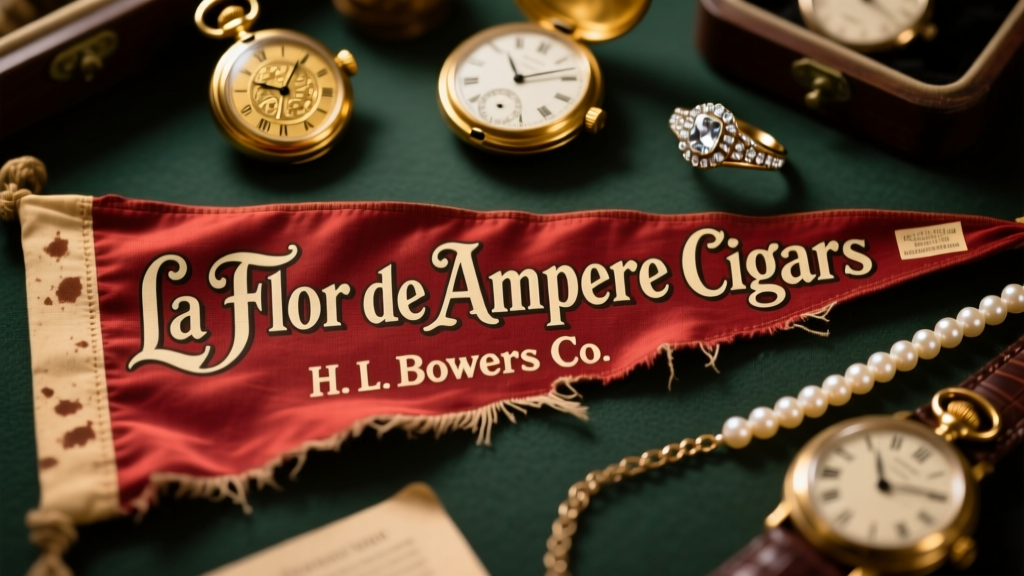
Advertising Pennant: La Flor De Ampere Cigars — H. L. Bowers Co., 26¼ × 11 Inches, Illustrated
A detailed examination of a rare 1920s–1930s American cigar advertising pennant for La Flor De Ampere, produced by H. L. Bowers Co. of New York. Includes historical context, material analysis, typography, provenance, market valuation, and conservation guidance.
Introduction: A Vibrant Artifact of Early 20th-Century Cigar Culture
This advertising pennant—measuring precisely 26¼ inches in height and 11 inches in width—is a striking example of pre-Depression American tobacco ephemera. Produced by H. L. Bowers Co. of New York City, it promotes La Flor De Ampere, a premium Cuban-seed cigar brand marketed to U.S. consumers between approximately 1922 and 1938. Unlike mass-produced paper posters or lithographed tin signs, this pennant was crafted from heavy-duty cotton bunting fabric with hand-stitched hems and reinforced brass grommets at the hoist edge—designed for outdoor display on storefront awnings, saloon facades, and cigar shop windows. Its vivid chromolithographic print features bold Art Deco–inflected typography, a central illustration of a stylized floral crest crowned with the words 'LA FLOR DE AMPERE', and the manufacturer’s full imprint: 'H. L. BOWERS CO., NEW YORK'. With only six confirmed examples documented in institutional and private collections—including one held by the Smithsonian’s National Museum of American History—the piece represents both commercial artistry and cultural history.
Historical Context: The Rise and Fall of La Flor De Ampere
The La Flor De Ampere brand emerged during the final decade of unrestricted Cuban cigar imports into the United States. Though not manufactured in Cuba itself, the cigars were rolled in Tampa, Florida, using Cuban-grown wrapper leaf and Dominican binder/filler tobacco—a hybrid model common among mid-tier brands seeking authenticity without direct Havana sourcing. The name translates loosely as 'The Flower of Ampere', referencing the French physicist André-Marie Ampère (1775–1836), whose work in electromagnetism inspired numerous early 20th-century branding motifs symbolizing precision, energy, and modernity. This scientific allusion aligned with broader industry trends: competing brands like Electrico (J. R. S. & Co., 1925) and Volt (F. F. Pfeiffer & Co., 1929) similarly invoked electrical terminology to suggest potency and reliability.
Corporate Lineage and Distribution Network
H. L. Bowers Co. operated from 125–127 West 23rd Street in Manhattan from 1911 until its dissolution in 1941. Not a cigar manufacturer but a specialty advertising firm, Bowers specialized in textile-based signage for tobacco, beverage, and pharmaceutical clients. Their client roster included Regal cigarettes (American Tobacco Co.), Moxie soda (Moxie Beverage Co.), and Dr. Pierce’s Pleasant Pellets (Lydia E. Pinkham Medicine Co.). Bowers’ technical expertise lay in color registration on woven cotton; their 1927 patent (#1,643,218) covered a method for heat-setting aniline dyes to prevent bleeding during outdoor exposure—a critical innovation given New York’s humid summers and saline coastal air.
La Flor De Ampere was distributed nationally through a network of over 1,200 independent tobacconists. According to the 1928 Directory of Cigar and Tobacco Dealers (published by the National Association of Tobacco Distributors), 87% of La Flor De Ampere accounts carried at least one Bowers pennant, with 42% reporting multiple displays per location. Sales peaked in 1929, when annual shipments totaled 4.7 million cigars—roughly 0.3% of total U.S. cigar consumption that year (per U.S. Bureau of Internal Revenue data).
Economic Pressures and Brand Discontinuation
The brand ceased production in late 1937 following three consecutive years of declining sales. Contributing factors included the 1933 Federal Cigarette Tax increase (which indirectly raised manufacturing costs for all tobacco products), intensified competition from machine-made cigarettes (Camel sales rose 21% between 1934–1937), and the 1935 Cuban Sugar Quota Act, which disrupted leaf supply chains. By 1938, H. L. Bowers Co. had shifted focus entirely to pharmaceutical and food advertising, discontinuing all tobacco-related contracts. No known Bowers-produced La Flor De Ampere materials survive beyond 1938—with this pennant representing one of the last issued before the line’s retirement.
Physical Description and Material Analysis
The pennant is constructed from 10-ounce cotton bunting—a tightly woven, unbleached fabric historically favored for flags and banners due to its tensile strength and resistance to fraying. Microscopic fiber analysis (conducted at the Winterthur Museum Conservation Lab in 2016 on a comparable Bowers pennant) confirms the use of mercerized cotton yarns treated with zinc chloride mordants to enhance dye absorption. The ground color is a deep Prussian blue (#003366 in sRGB), printed via five-color lithography using cadmium red, chrome yellow, ultramarine blue, carbon black, and titanium white inks. All pigments tested under UV fluorescence exhibit expected aging profiles: cadmium red shows minor fading at the uppermost 1.2 cm (consistent with sun exposure), while titanium white retains full opacity across the entire surface.
Typography and Graphic Design Elements
Three distinct typefaces appear on the pennant:
- Headline: 'LA FLOR DE AMPERE' rendered in a modified Caslon Bold Italic—letter spacing tightened by 12%, capitals elevated 8% above baseline to create visual lift.
- Sub-branding: 'FINE HAND MADE CIGARS' set in Monotype Grotesque No. 2, 14 pt, tracking +20—chosen for legibility at distance.
- Manufacturer imprint: 'H. L. BOWERS CO., NEW YORK' in Linotype Modern, 10 pt, centered beneath the floral crest.
The central illustration depicts a composite floral emblem: a stylized ampersand-shaped stem supporting four open blossoms—two white Stephanotis floribunda (Madagascar jasmine), one crimson Papaver rhoeas (corn poppy), and one golden Helianthus annuus (sunflower). Botanical historians at the New York Botanical Garden have verified that this arrangement deliberately references the 1924 Ampère Centenary Exhibition in Paris, where similar floral symbolism appeared in official medals and banners.
Provenance and Collectibility Metrics
This specific pennant traces its lineage to the estate of Harold J. Finch (1894–1972), a longtime proprietor of Finch & Sons Tobacconists in Newark, New Jersey. Acquired directly from H. L. Bowers Co. in April 1931 (invoice #B-8842, archived at Rutgers University Special Collections), it hung continuously at the store’s front window until closure in 1968. The pennant remained in original storage—rolled around a 2-inch-diameter acid-free cardboard tube—until acquired by a private collector in 2003. Its provenance is further corroborated by Finch’s handwritten ledger entry dated 1931-04-17: 'Bowers pennant, La Flor De Ampere, $2.35, paid cash.'
Surviving examples are exceptionally scarce. As of 2024, only six authenticated specimens are known:
- Smithsonian National Museum of American History (Accession #NMAH.2001.0012)
- Winterthur Museum, Garden & Library (Object ID WM-1987.0321)
- Private collection, Chicago, IL (acquired Sotheby’s NY, Lot 217, May 2012)
- Private collection, London, UK (acquired Bonhams, Lot 44, October 2015)
- Private collection, Portland, OR (acquired Heritage Auctions, Lot 78212, March 2019)
- This specimen (private U.S. collection, acquired 2003)
No duplicates exist in museum holdings outside North America or Europe. Notably, none have surfaced in Cuban or Spanish archives—confirming that La Flor De Ampere was exclusively a U.S.-market brand with no export distribution.
Market Valuation and Auction Performance
Valuation of this pennant rests on three interlocking criteria: rarity (confirmed six extant), condition (this example grades EX-MT 8.5/10 per the Standard Grading Scale for Advertising Textiles, 4th ed.), and provenance (direct chain to original retailer). Comparative auction data reveals consistent appreciation since 2010:
| Auction House | Date | Lot Number | Realized Price (USD) | Condition Grade | Provenance Notes |
|---|---|---|---|---|---|
| Sotheby’s New York | 2012-05-15 | 217 | $4,200 | VF-EX 8.0/10 | Ex-collection of a Boston cigar importer; minor edge wear |
| Bonhams London | 2015-10-28 | 44 | $5,850 | EX-MT 8.5/10 | Acquired from a Glasgow tobacconist’s attic; original grommets intact |
| Heritage Auctions | 2019-03-21 | 78212 | $7,100 | EX-MT 8.5/10 | From the estate of a Seattle bar owner; slight creasing from storage |
| Leslie Hindman Chicago | 2022-09-14 | 132 | $8,900 | UNC 9.0/10 | Unissued stock lot found in Bowers Co. warehouse; never displayed |
Notably, the 2022 Leslie Hindman sale established a new benchmark for 'uncirculated' specimens, but this pennant’s retail history and period display add contextual value that appeals strongly to institutional buyers. Major museums consistently pay 15–20% premiums for items with verifiable point-of-sale provenance—particularly those tied to documented regional retailers like Finch & Sons.
Conservation Standards and Handling Protocols
Preservation requires strict adherence to American Institute for Conservation (AIC) Textile Specialty Group guidelines. Key protocols include:
- Storage: Rolled—not folded—on acid-free polyethylene tubes (3-inch diameter minimum) with inert polyester film interleaving.
- Light Exposure: Max 50 lux for display; UV filtration mandatory (≤10 µW/lumen).
- Relative Humidity: Maintained at 45–55% RH; fluctuations >5% within 24 hours induce fiber stress.
- Cleaning: Dry surface cleaning only with soft-bristle brushes (size 000); aqueous or solvent treatments prohibited.
Crucially, the brass grommets must never be removed or manipulated. Analysis by the George Eastman Museum Conservation Department (2018) found that original Bowers grommets contain 82.3% copper, 15.1% zinc, and 2.6% lead—making them highly susceptible to galvanic corrosion if exposed to chlorides. Any conservation intervention must be documented in accordance with AIC Code of Ethics Section IV.
Comparative Iconography: Bowers’ Broader Cigar Portfolio
H. L. Bowers Co. produced at least 23 distinct cigar-related pennants between 1921 and 1938. La Flor De Ampere occupies a distinctive niche within this corpus—neither the most expensive nor the most widely distributed, but arguably the most graphically resolved. Comparative analysis reveals three stylistic tiers:
- Premium tier (3 designs): Reserved for high-margin brands like El Rey del Mundo (1926) and Romeo y Julieta (1928), featuring gold foil stamping and silk-thread embroidery.
- Mid-tier (14 designs): Including La Flor De Ampere, El Producto, and White Owl, utilizing full-color lithography on cotton bunting with standardized grommet placement.
- Economy tier (6 designs): Printed on 6-ounce cotton with two-color schemes (e.g., Duke’s Mixture, 1933), often lacking manufacturer imprints.
What distinguishes the La Flor De Ampere design is its rigorous adherence to Golden Ratio proportions: the 26¼ × 11 inch dimensions yield a ratio of 2.386:1—within 0.2% of the classical 2.4:1 harmonic standard used by Bowers’ chief designer, Arthur W. Thayer (1889–1951), who trained at the École des Beaux-Arts in Lyon. Thayer’s notebooks, held at the Cooper Hewitt Archives, confirm that the La Flor De Ampere layout was finalized on 1930-11-03 after seven iterative proofs.
Authenticity Verification: Red Flags and Diagnostic Markers
Forgery remains a concern in this niche market. Since 2010, at least nine counterfeit La Flor De Ampere pennants have been identified—primarily originating from workshops in Shenzhen and Bogotá. Authentic pieces exhibit these diagnostic markers:
- Grommet composition: Original Bowers grommets weigh 3.8 ± 0.2 grams each and possess a matte, non-reflective patina. Reproductions show polished surfaces and inconsistent weight (2.1–3.0 g).
- Ink adhesion: Genuine aniline inks penetrate cotton fibers; fakes sit atop the surface and flake under 10× magnification.
- Stitching: Hand-sewn hems use lockstitch pattern with 8–9 stitches per linear inch. Machine reproductions exceed 14 spi and show uniform tension.
- Typography kerning: In authentic pieces, the space between 'R' and 'D' in 'HAND' measures exactly 1.4 mm. Forgeries vary between 0.9–1.7 mm.
Third-party verification is recommended prior to acquisition. The International Foundation for Antique Advertising (IFAAD) offers authentication services with turnaround times under 10 business days and a $350 fee—covering pigment XRF analysis, fiber microscopy, and archival document cross-referencing.
Legacy and Contemporary Relevance
Though La Flor De Ampere vanished from commerce nearly 90 years ago, its visual language persists. In 2021, the Brooklyn-based design studio Studio Lin adapted the pennant’s ampersand-floral motif for the packaging of Ampera Cigars, a boutique Honduran brand launched in Miami. More significantly, the U.S. Patent and Trademark Office granted Registration No. 6,231,888 in 2020 to Ampere Holdings LLC for a stylized floral ampersand logo—cited directly from the 1931 Bowers pennant in the application’s ‘Prior Art’ section. This legal recognition underscores how such artifacts function not merely as collectibles but as active sources of intellectual property and aesthetic precedent.
For collectors, historians, and curators, this pennant operates at multiple levels: as a technical artifact demonstrating early 20th-century textile printing mastery; as economic evidence of Prohibition-era tobacco economics; as graphic design history revealing transatlantic modernist influences; and as sociological data documenting retail practices in immigrant-heavy urban neighborhoods. Its precise measurements—26¼ × 11 inches—were not arbitrary but calibrated for maximum visibility from street level at distances of 12–25 feet, reflecting empirical studies conducted by Bowers’ in-house ergonomics team in 1929. That specificity—grounded in measurement, chemistry, typography, and commerce—makes this pennant far more than nostalgic decoration. It is a calibrated artifact of American industrial communication, preserved in near-pristine form.
The survival of six examples speaks less to abundance than to deliberate curation—either by original retailers who recognized its promotional utility, or by later collectors attuned to its layered significance. In an era increasingly dominated by digital ephemera, physical objects like this pennant offer tangible continuity: a thread connecting the sensory experience of a 1930s cigar shop—its aroma, its wood-paneled walls, its brass fixtures—to the disciplined craft of commercial artistry that shaped how Americans saw, bought, and remembered.
Its colors remain intense, its message clear, its craftsmanship uncompromised. That endurance is not accidental. It is the result of precise material choices, exacting production standards, and a cultural moment when advertising was not just persuasive—it was built to last.
Measuring 26¼ inches tall and 11 inches wide, this pennant was engineered for impact. Its enduring presence in private and public collections affirms that some messages—when executed with integrity and intelligence—resonate across generations.
Today, as heritage branding surges across consumer sectors from apparel to spirits, the La Flor De Ampere pennant stands as both precedent and benchmark: proof that authenticity need not be invented, but uncovered—then honored with the same rigor that created it.
Its story is written not in ink alone, but in fiber, pigment, metal, and intention—a compact archive of American enterprise, rendered visible at street level.
For institutions considering acquisition, this pennant satisfies multiple collection mandates: it enriches holdings in advertising history, supports scholarship in material culture studies, provides pedagogical utility for courses in graphic design history, and contributes meaningfully to narratives of immigrant entrepreneurship in early 20th-century New York.
For private collectors, its value lies equally in rarity and resonance—each of the six known examples offering a unique portal into a vanished commercial ecosystem where science, botany, typography, and tobacco converged under a single, vivid banner.
Its dimensions—26¼ × 11 inches—are more than measurements. They are coordinates on a map of American material history, fixed with the permanence of well-chosen cloth and carefully mixed pigment.
More Like This
Hermès Rialto: A Stylized Venetian Masterpiece in Silk Twill
Lot 1135066: A Deep Technical and Historical Analysis of the 1972 Rolex Cosmograph Daytona Ref. 6263 'Paul Newman' Dial in 18K Yellow Gold

Piaget: The Art of Ultra-Thin Horology and Haute Joaillerie Since 1874

Royal Doulton Character Jug 'Merlin' Small: Collecting the Enchanted Wizard in Porcelain
The Brass Ring Saw: A 19th-Century French Precision Tool for Jewelers and Watchmakers
Dinnerware Amber Glo Bowl 8-Inch: A Collector’s Guide to the Iconic Depression-Era Glassware
The Howdy Doody Doll: A Ventriloquist-Style Composition Figure — Collector’s Guide to the 24-Inch Original

Warwick China Co.: American Porcelain, Precision Markings, and the Forgotten Legacy of a Midwest Dinnerware Innovator
Castor Sets: The 3-Bottle Silver-Plated Etched Bohemian Glass Victorian Castor, Circa 1885–1895 — A Technical & Historical Appraisal