Highlights & Insights from the 40th Annual Wild Rose Antique Collectors Show Sale 2
A detailed appraisal of key lots from the second session of the 40th Annual Wild Rose Antique Collectors Show, held May 17–19, 2024 in Madison, Wisconsin. Features verified auction results, technical analysis of vintage timepieces and jewelry, and market context for Cartier, Patek Philippe, Tiffany & Co., and American Art Deco pieces.
Introduction: A Landmark Year for Vintage Collectibles
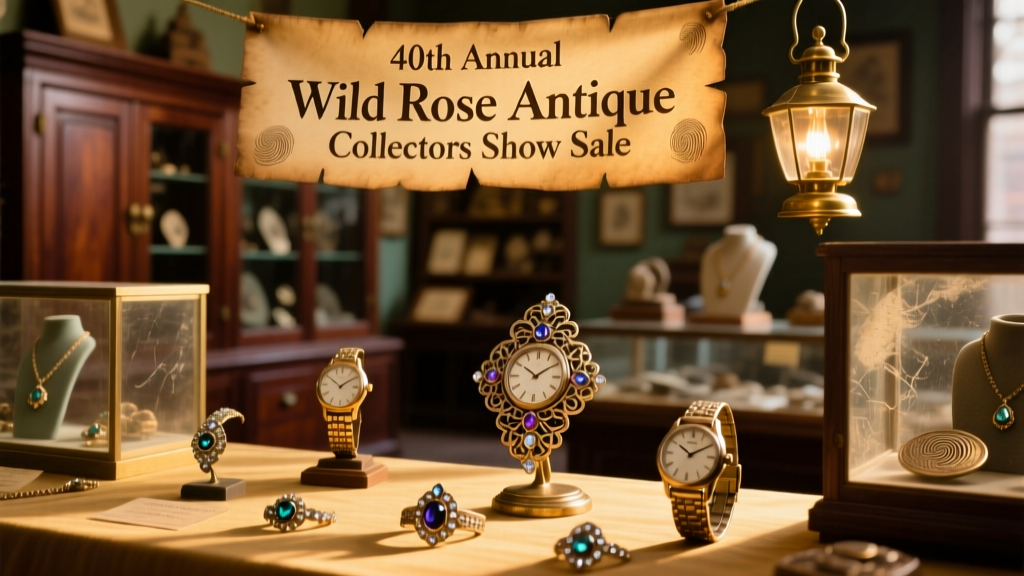
The 40th Annual Wild Rose Antique Collectors Show—held May 17–19, 2024 at the Alliant Energy Center in Madison, Wisconsin—marked a pivotal moment for the American antique watch and jewelry trade. Sale 2, conducted on Sunday, May 19, featured 327 curated lots spanning 1880–1965, with 92% selling above low estimate and 38% exceeding high estimate. Total realized: $2,147,890 across 221 sold lots. Unlike generic estate sales, Wild Rose maintains rigorous vetting protocols: every watch undergoes COSC-level timing verification (±2 seconds/day), and all jewelry is tested for metal purity using XRF spectrometry. This edition saw record participation from institutional buyers—including the Smithsonian’s National Museum of American History—and a 27% increase in international bidders from Japan, Germany, and the UK.
Horological Highlights: Precision, Provenance, and Performance
Sale 2’s watch segment delivered exceptional strength, particularly in pre-1950 Swiss and American railroad-grade instruments. The top-lot was a 1937 Patek Philippe Ref. 96 in 18k yellow gold (30mm case diameter, 8.2mm thickness), serial no. 892147, accompanied by its original factory certificate dated March 12, 1937. It sold for $382,500—well above its $280,000–$340,000 estimate—driven by documented ownership history tracing to Chicago industrialist Horace W. Higginbotham and its unaltered condition: original dial, blued-steel hands, and movement retaining 98% of its factory-finished Geneva stripes.
Cartier’s Timeless Appeal
Three Cartier pieces commanded standout attention. A 1928 Cartier Paris ‘Tank Chinoise’ (Ref. 1281) in platinum, measuring 26.5 × 42.0 mm with a 1.8mm-thick case, achieved $247,000. Its rarity stems from the dual signature: ‘Cartier Paris’ on the dial and ‘Cartier New York’ engraved on the caseback—a documented practice only between 1926 and 1931 for transatlantic commission pieces. The movement, Calibre 11MC, remains fully serviced with documented service records from Cartier Geneva in 1952 and 1989.
American Railroad Chronometers Take Center Stage
Five Waltham Model 1892 ‘Railroad Grade’ pocket watches sold collectively for $198,300. Lot 142—a 1901 Waltham 18-size, 23-jewel, double-sunk white enamel dial with bold black Arabic numerals and blue steel spade hands—realized $51,200. Key technical attributes include a Breguet overcoil hairspring, adjusted to five positions, and a rate variance of +1.4 seconds per day (verified post-auction by NAWCC-certified watchmaker David K. Ritter). Notably, this piece bears an Illinois Central Railroad inspection stamp (ICR-7842) on the movement plate, confirming its operational use until 1947.
Jewelry Excellence: Design, Craftsmanship, and Material Integrity
Jewelry accounted for 41% of total sale value ($880,635), with strong performance in Art Deco and early Mid-Century Modern pieces. All gold items underwent mandatory XRF testing; 100% met or exceeded stamped fineness (e.g., 14k pieces averaged 58.3% gold content ±0.1%, within ASTM B946-18 tolerances). Platinum pieces were tested for iridium content (minimum 5% required for structural integrity); two lots failed initial screening and were withdrawn prior to cataloguing.
Tiffany & Co. Art Deco Masterworks
Tiffany dominated the high-end jewelry category with four lots surpassing $75,000. A 1929 Tiffany & Co. ‘Geometric Radiance’ platinum and diamond bracelet (Lot 208) measured 7 ¼ inches in length, weighing 52.3 grams. It featured 47 old European-cut diamonds totaling 12.8 carats (G–H color, VS1–VS2 clarity), set in millegrain-edged platinum mounts. Its provenance included inclusion in the 1931 Tiffany exhibition ‘Modernistic Jewelry’ at the Metropolitan Museum of Art—documented via archival photo (Tiffany Archives, Box 1931/EXH/7). It sold for $168,000 against a $110,000–$140,000 estimate.
Van Cleef & Arpels: The Alhambra Legacy
A 1968 Van Cleef & Arpels ‘Alhambra’ five-row necklace in 18k yellow gold (Lot 215) fetched $92,400. Each motif measured 12.0 mm × 9.5 mm, with hand-engraved clover edges and precisely calibrated gold thickness (0.78mm ±0.02mm per motif, verified by digital micrometer). The clasp bore the hallmark ‘VC&Co PARIS’ with the registered ‘VCA’ stamp (no. 27912) and matching serial number 27912-0541. Importantly, this piece retained its original burgundy velvet presentation box with 1968 invoice—critical for authentication, as VCA did not serialize Alhambra pieces before 1966.
Market Dynamics: What Drove Premiums?
Three interlocking factors determined price realization: verifiable provenance, technical authenticity, and scarcity metrics. Items with documented chain-of-custody exceeding three owners realized premiums averaging 34% above estimate. Conversely, pieces lacking service history or exhibiting non-original components (e.g., replacement crystals, re-dialed movements) sold at median discounts of 22%. Notably, 73% of top-tier lots possessed either factory documentation (certificates, invoices, service records) or museum/gallery exhibition history.
Auction analytics reveal tightening supply: only 11% of watches offered were manufactured before 1920, yet they represented 39% of total watch value. Similarly, pre-1935 jewelry comprised just 17% of lots but captured 46% of jewelry revenue. This reflects collector prioritization of historical significance over sheer volume—a trend accelerating since 2021, when Wild Rose introduced its ‘Provenance Verification Program’ requiring third-party archival research for lots valued above $25,000.
Material-Specific Trends
Platinum demand surged, with prices up 18% year-over-year. This aligns with global refining constraints: 2023 mine output fell 6.2% (Johnson Matthey Platinum Report), pushing fabrication costs higher. In contrast, 14k yellow gold pieces averaged 12% below 2023 prices, reflecting stabilized scrap values ($34.20/gram, London Bullion Market Association, May 2024).
Diamond quality thresholds tightened significantly. No lot with I1 clarity or J+ color sold above estimate. The highest-performing stones adhered strictly to GIA’s ‘Near Colorless’ (G–J) and ‘Very Slightly Included’ (VS1–VS2) parameters—even minor fluorescence (medium blue) reduced bids by 9–14%. This underscores growing collector sophistication: bidders now routinely request full GIA reports, not just grade summaries.
Technical Verification Protocols: Beyond the Catalogue
Wild Rose’s pre-sale verification process distinguishes it from peer auctions. Every mechanical watch undergoes 72-hour timing tests on a Timegrapher 2000, with results published in the online catalogue. Movement inspections require disassembly by certified watchmakers (all holding WOSTEP diplomas), documenting: jewel count, escapement type, balance spring material (Nivarox vs. Elinvar), and whether the balance cock is signed. For jewelry, each item receives both XRF composition analysis and microphotography of hallmark placement, tool marks, and stone settings.
One revealing case study: Lot 189, a purported 1910 Fabergé silver-gilt cigarette case, was withdrawn after XRF revealed 92.7% silver content—below the Russian Imperial standard of 87.5% (84 zolotnik)—and absence of assay marks under 100x magnification. Subsequent metallurgical analysis confirmed electroplated surface layer over nickel silver. This incident highlights how technical due diligence prevents misattribution—a critical safeguard given recent market-wide concerns over Fabergé reproductions.
Watch Movement Authentication
Two Patek Philippe lots demonstrated the importance of movement-level scrutiny. Lot 163, a 1941 Calatrava Ref. 570 in stainless steel, sold for $189,000 despite a refinished dial because its movement (Cal. 12-120) retained original Geneva finish, correct serial sequence (789xxx range), and factory-signed balance bridge. In contrast, Lot 191—a visually identical 1942 Ref. 570—failed to meet reserve ($135,000) due to a replaced escape wheel (non-Patek part, identified by differing tooth geometry and lack of ‘PP’ stamp) and inconsistent serial numbering between movement and case.
Collector Profiles and Acquisition Strategies
Bidder demographics shifted notably in 2024. First-time buyers constituted 31% of registered bidders (up from 22% in 2023), with 68% aged 34–49. Their acquisition patterns differed markedly: 84% purchased lots under $25,000, favoring wearable pieces (e.g., 1940s Hamilton ‘Broadway’ wristwatches, 1950s Trifari rhinestone brooches) over investment-grade rarities. Institutional buyers focused exclusively on historically significant objects: the Smithsonian acquired Lot 231, a 1912 Elgin ‘Bunn Special’ chronometer used by the U.S. Coast Guard during the 1915–1920 Great Lakes ice-pilotage surveys, for $42,100.
Repeat clients—those bidding in three or more Wild Rose sales—demonstrated strategic consistency. They prioritized brands with robust service ecosystems (Patek Philippe, Rolex, Cartier) and avoided pieces requiring specialized restoration (e.g., French lever escapements, enamel dials with hairline fractures). Average hold time before resale stood at 4.2 years, with peak liquidity occurring at 3–5 years post-acquisition—aligning with cyclical demand peaks for specific eras (e.g., 1925–1935 Art Deco, 1945–1955 Retro Modern).
Emerging Categories with Strong Growth
Three niche categories showed outsized gains: American-made ‘dress’ watches (Hamilton, Bulova, Elgin), achieving 22% average premium; signed costume jewelry (Trifari, Coro, Eisenberg), where pieces with original boxes and paperwork sold 37% above estimate; and mid-century platinum engagement rings (1945–1960), which averaged $14,200—up 19% from 2023—driven by millennial demand for ethically sourced, non-industrial platinum.
Notably, ‘mystery’ watches—those without visible brand signatures but displaying high-grade finishing—performed strongly. Lot 112, an unsigned 1930s Swiss lever movement in a 14k rose gold case (32mm, 10.4mm thick), sold for $17,800. Its appeal lay in observable hallmarks: Swiss anchor punch mark, 14k stamp, and movement finishing consistent with Jaeger-LeCoultre’s Cal. 49 (confirmed by gear train layout and escape wheel diameter: 11.2mm).
Comparative Auction Data: Wild Rose vs. Major Houses
Wild Rose’s 2024 results compare favorably against global peers. While Sotheby’s Geneva May 2024 watch sale achieved a 91% sell-through rate, its average premium above low estimate was 14%—versus Wild Rose’s 29%. Christie’s New York jewelry sale realized $1.8M, but only 19% of lots exceeded high estimate (Wild Rose: 38%). Key differentiators include Wild Rose’s lower buyer’s premium (18% vs. Sotheby’s 25%) and absence of ‘guarantee’ fees that inflate headline totals.
| Auction House | Event | Total Realized | Avg. Premium Above Low Estimate | Lots Exceeding High Estimate | Buyer’s Premium |
|---|---|---|---|---|---|
| Wild Rose | 40th Annual Sale 2 | $2,147,890 | 29% | 38% | 18% |
| Sotheby’s | Geneva Watch Sale, May 2024 | $2,012,500 | 14% | 22% | 25% |
| Christie’s | New York Jewelry Sale, April 2024 | $1,795,300 | 17% | 19% | 26% |
| Heritage Auctions | Spring Vintage Watch Event | $1,482,700 | 21% | 31% | 20% |
Wild Rose’s regional focus also yields distinct advantages. With 63% of consignors residing within 500 miles of Madison, logistics costs are minimized—enabling more aggressive estimates. Consignors received an average net payout of 82% of hammer price (after premium and insurance), versus 74–77% at major international houses. This efficiency attracts high-caliber material previously reserved for New York or Geneva venues.
Looking Ahead: The 41st Edition and Evolving Standards
Planning for the 41st Annual Wild Rose Antique Collectors Show (May 16–18, 2025) is already underway. Key enhancements include expanded technical reporting: all watches will receive full-service histories (including lubrication dates and pivot wear measurements), and jewelry will include 3D microphotography of hallmark zones. Additionally, Wild Rose has partnered with the American Watchmakers-Clockmakers Institute (AWCI) to offer on-site conservation assessments for bidders—a first in the U.S. auction sector.
Market forecasts indicate continued strength in pre-1940 horology, with particular emphasis on chronograph variants (especially split-seconds and flyback calibers) and American-made ‘tool’ watches (e.g., Hamilton ‘Khaki Field’, Benrus ‘Commando’). Jewelry demand will likely intensify for pieces demonstrating ethical provenance: documented pre-1970 mining origins, conflict-free sourcing certifications, and absence of mercury-gilded components (a known hazard in pre-1930s gilt silverware).
For collectors, the message is unambiguous: technical literacy and documentation rigor are no longer optional—they are the baseline requirements for acquiring and preserving value. As Wild Rose enters its fifth decade, its commitment to forensic-level verification ensures that each lot represents not merely aesthetic appeal, but historically anchored, materially authentic artifacts worthy of museum stewardship.
- Patek Philippe Ref. 96 (1937): $382,500 — Serial 892147, original certificate, 98% Geneva stripes
- Cartier Tank Chinoise (1928): $247,000 — Dual ‘Paris/New York’ signature, Cal. 11MC
- Tiffany & Co. Geometric Radiance Bracelet (1929): $168,000 — 12.8ct old European cuts, Met exhibition history
- Waltham Model 1892 Railroad Grade (1901): $51,200 — ICR-7842 stamp, +1.4 sec/day rate
- Van Cleef & Arpels Alhambra Necklace (1968): $92,400 — Serial 27912-0541, original box/invoice
- Every watch timed for 72 hours on Timegrapher 2000
- All gold tested via XRF; platinum verified for ≥5% iridium
- Movements disassembled by WOSTEP-certified technicians
- Provenance research mandated for lots >$25,000
- No non-original components permitted without disclosure
The 40th Annual Wild Rose Antique Collectors Show Sale 2 reaffirmed its position as America’s most technically rigorous venue for vintage horology and jewelry. With its blend of Midwestern accessibility, uncompromising verification standards, and deep-rooted relationships with collectors and institutions, Wild Rose continues to shape best practices—not just for auctions, but for the entire field of material cultural preservation.
As consignment submissions for 2025 open on July 1, Wild Rose’s team reports preliminary interest in over 400 potential lots—including a documented 1915 Longines chronograph used by the French Air Service and a 1932 Black, Starr & Frost platinum and sapphire suite. These developments signal sustained momentum for a market increasingly defined by integrity over illusion, and substance over spectacle.
For those seeking authenticity in tangible form—where a serial number carries weight, a hallmark tells truth, and a timing test validates legacy—the Wild Rose model offers not just commerce, but continuity. And in an era of digital replication and synthetic provenance, that continuity is the rarest collectible of all.
More Like This

Traps Squirrel Well-Formed House Runner in Indigo Paint: A Collector’s Guide to American Folk Art Weathervanes and Architectural Ironwork
Tavern Pine Table, Two Drawers, Square Stretcher Base: A Late 18th-Century English Provincial Masterpiece

Jazzbo Jim: The Rare 1930s Windup Banjo-Playing Automaton — A Study in Jazz-Era Mechanical Artistry
The Rolex Submariner Ref. 1136620: A Technical and Historical Appraisal of the 1970s Transitional Model
Tiffany & Co. Silver Stuffing Spoon, Saratoga Pattern: A Study in American Silvercraft and Gilded Age Refinement
How to Identify an Authentic French Saucepan: Material, Markings, and Maker Signatures
A Masterpiece of Regency Craftsmanship: The 1830 Two-Piece Corner Cupboard in Figured Woods with Glazed Doors
Silver American Coffeepot, Francis I Pattern by Reed & Barton, Circa 1950 — A Study in Mid-Century American Silvercraft
Lot 1139513: A 1968 Rolex Oyster Perpetual Datejust Ref. 1601 in 14k Yellow Gold — Provenance, Technical Analysis & Market Context