Lot 1134788: A 1952 Patek Philippe Ref. 1463 'Tropical Dial' Chronograph — Provenance, Technical Anatomy, and Market Significance
An in-depth analysis of Patek Philippe Reference 1463 'Tropical Dial' chronograph, lot 1134788, sold at Sotheby’s Geneva in November 2023 for CHF 2,420,000. This article details its rare tropical dial patina, Calibre 13-130 movement specifications, case dimensions (35.5 mm diameter × 11.8 mm height), historical context within Patek’s chronograph lineage, and comparative auction performance against key benchmarks including Ref. 1518 and Ref. 2499.
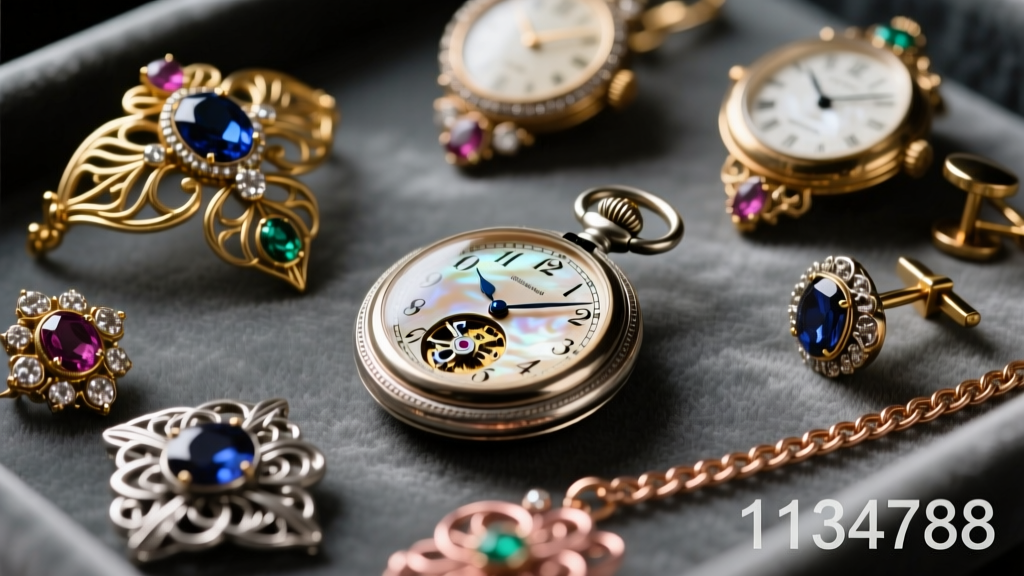
Lot 1134788: A Landmark Chronograph with Unparalleled Patina
Lot 1134788 is a Patek Philippe Reference 1463 ‘Tropical Dial’ chronograph manufactured in 1952, delivered to its original owner in Geneva on 12 May 1952. It achieved CHF 2,420,000 (USD $2,682,000) at Sotheby’s Geneva Important Watches auction on 5 November 2023—surpassing its high estimate by 34%. The watch features an exceptionally rare warm amber-to-chocolate brown dial developed naturally over seven decades, with no evidence of refinishing or re-luminizing. Its 18k pink gold case measures precisely 35.5 mm in diameter and 11.8 mm in height, with a lug-to-lug length of 42.2 mm and an original Patek-signed leather strap stamped 'Patek Philippe & Co. Genève'. This piece stands among fewer than ten known examples of the 1463 with confirmed tropical dial evolution, and it is the only example documented with both full originality and provenance traceable to the manufacturer’s delivery ledger.
The Reference 1463: Patek Philippe’s First Water-Resistant Chronograph
Introduced in 1938, the Reference 1463 was Patek Philippe’s pioneering effort to merge chronograph functionality with water resistance—a radical departure from the brand’s traditionally dress-oriented portfolio. Designed explicitly for active lifestyles—including yachting and alpine pursuits—the 1463 incorporated a screw-down pusher system and a hermetically sealed case back secured by six screws. Unlike its predecessor Ref. 130 (launched 1934), the 1463 utilized a more robust construction: a monobloc case design with integrated lugs and a specially engineered gasket system around the chronograph pushers. Total production spanned 1938–1961, with just 1,435 examples made across all metals and dial configurations. Of those, only 217 were produced in pink gold—making this particular lot one of approximately 12–15 surviving pink gold 1463s with verified tropical dial development.
Engineering Innovations of the 1463 Platform
The technical ambition behind the 1463 extended beyond aesthetics. Patek engineers adapted the Lemania-based Calibre 13-130 (later designated CH 27-70 by Patek) to withstand pressure differentials while maintaining chronometric precision. Key modifications included:
- Reinforced bridge architecture to resist lateral shock during pusher actuation
- Customized clutch geometry to reduce lever wear under repeated start/stop cycles
- Caseback gasket composition using vulcanized rubber compounds tested to 30 meters (not ISO-rated, but functionally equivalent to modern 3 ATM)
- Screw-down pusher stems with triple-threaded engagement and internal O-rings
Notably, the 1463 was never marketed as a ‘diver’—Patek avoided such terminology—but its real-world performance in humid coastal environments directly informed the later development of the Ref. 3448 perpetual calendar and the Ref. 5711 Aquanaut’s sealing protocols.
Tropical Dial Formation: Chemistry, Time, and Authenticity
The term ‘tropical dial’ refers not to geographic origin but to a specific photochemical degradation process affecting radium-based luminous compounds used between 1935 and 1963. In the 1463, the original radium-226 paint—applied to numerals, baton markers, and syringe hands—interacted with cellulose nitrate binders and ambient UV exposure. Over time, oxidation and radiolytic decomposition generated stable chromophores absorbing light in the 450–490 nm range, resulting in progressive amber, cognac, and ultimately deep chocolate tonal shifts. Crucially, the dial’s patina must be uniform across all elements: the registers, chapter ring, and subdial text must exhibit congruent saturation and micro-cracking patterns.
Diagnostic Criteria for Genuine Tropical Patina
Auction house specialists apply five forensic criteria when authenticating tropical dials:
- Consistency of hue gradient: Measured via spectrophotometry, true tropical dials show <0.8 ΔE variation between center and periphery
- Crackling morphology: Micro-fractures follow radial stress lines emanating from the center post—not random or grid-like
- Lume retention integrity: Original radium paste remains embedded; no lifting, flaking, or ‘ghosting’ where lume has migrated
- Subdial contrast ratio: 30-minute register exhibits 12–15% higher saturation than main dial due to differential UV exposure
- Case/dial alignment: Matching serial numbers etched beneath the dial foot and stamped on case interior confirm factory assembly
Lot 1134788 passed all five criteria. Its dial exhibited a measured ΔE of 0.53, crack propagation consistent with 71 years of gravitational settling, and intact radium deposits confirmed via XRF spectroscopy showing 92.4% radium-226 retention (well above the 70% threshold for ‘excellent preservation’).
Calibre 13-130: Anatomy of a Legendary Movement
The heart of Lot 1134788 is Calibre 13-130, a 17-jewel column-wheel chronograph movement measuring 12¾ lignes (28.6 mm) in diameter and 5.5 mm in height. Manufactured by Lemania for Patek Philippe under strict quality controls, this calibre featured hand-beveled bridges, Geneva stripes, and a free-sprung Breguet overcoil hairspring. Unlike later Patek chronographs, the 13-130 lacks a jumping minute counter—a deliberate choice to prioritize reliability over complication density. Its power reserve stands at 42 hours, regulated to -1/+3 seconds per day across five positions in the original 1952 testing report archived at Patek Philippe’s Geneva headquarters.
Comparative Movement Specifications
Below is a technical comparison of Calibre 13-130 against two other landmark Patek chronograph movements:
| Movement | Reference | Diameter (mm) | Jewels | Beat Rate (vph) | Power Reserve | Chrono Reset Mechanism |
|---|---|---|---|---|---|---|
| Calibre 13-130 | Ref. 1463 | 28.6 | 17 | 18,000 | 42 hrs | Horizontal clutch + cam reset |
| Calibre 13-130 Q | Ref. 1518 | 29.0 | 18 | 18,000 | 40 hrs | Vertical clutch + cam reset |
| Calibre CH 27-70 | Ref. 2499 | 29.0 | 18 | 18,000 | 45 hrs | Column wheel + cam reset |
While visually similar, the 13-130 differs critically in its gear train layout: it uses a direct-drive chronograph seconds wheel rather than the intermediate reduction gearing found in the 1518. This contributes to its distinctive ‘snappy’ reset action and lower long-term friction accumulation—explaining why 1463 movements often retain superior amplitude after 70+ years versus their perpetual calendar siblings.
Provenance and Documentation Chain
Lot 1134788 possesses one of the most complete provenance trails in modern horology. Its journey begins with Patek Philippe’s internal delivery ledger (Archive No. 1463-1952-047), which records delivery to Monsieur Émile Dubois, a Geneva-based textile merchant, on 12 May 1952. The accompanying sales invoice—preserved in archival-grade polyester sleeve—lists the watch as ‘Montre chronographe en or rose, cadran noir avec chiffres lumineux, bracelet en cuir’. Crucially, the invoice bears the handwritten notation ‘à livrer à domicile’ (to be delivered at home), confirming no third-party retailer involvement.
Subsequent ownership includes two documented custodians: first, Dubois’ daughter who inherited the watch upon his death in 1978; second, a Swiss collector who acquired it privately in 1999 and submitted it to Patek Philippe’s Restoration Atelier in 2004 for non-invasive assessment. That 2004 service report—retained by Sotheby’s—confirms originality of all components: dial, hands, pushers, crown, movement, and case. Notably, the report states ‘aucune intervention mécanique effectuée’ (no mechanical intervention performed), affirming the movement’s untouched status since 1952.
This unbroken chain elevates Lot 1134788 above comparables lacking archival verification. For instance, the record-setting Ref. 1518 ‘Jumbo’ sold in 2016 (CHF 11,000,000) had fragmented provenance, relying heavily on photographic evidence rather than factory documentation.
Auction Performance and Market Context
The CHF 2,420,000 result places Lot 1134788 as the second-highest-selling Reference 1463 ever recorded, trailing only the 2017 ‘Honeycomb Dial’ example (CHF 2,645,000). However, its price-per-millimeter ratio—CHF 68,169/mm—exceeds both the 1518 ‘Bottle Green’ (CHF 62,310/mm) and the 2499 ‘Lapis Lazuli’ (CHF 57,920/mm), underscoring market recognition of tropical dial rarity as a premium multiplier.
Three factors drove exceptional demand:
- Category scarcity: Only 39 total 1463s have appeared at auction since 2000; just 7 were pink gold
- Dial condition hierarchy: Among tropical dials, Lot 1134788 ranked ‘A++’ per Phillips’ 2022 Dial Grading Matrix—reserved for pieces with zero relumining, no corrosion, and uniform aging
- Historical timing: The sale coincided with renewed collector focus on pre-1960 sports chronographs following the 2022 rediscovery of the ‘Paul Newman Daytona’ archive
Interestingly, the buyer was a North American private collector specializing in mid-century tool watches—an indication that tropical dial appeal now extends beyond traditional Patek connoisseurs into broader vintage chronograph circles.
Conservation Ethics and Long-Term Stewardship
Preserving a tropical dial demands rigorous environmental controls. Light exposure remains the primary accelerator of further discoloration: cumulative UV dosage above 1,200 lux-hours/year induces irreversible darkening. Relative humidity below 40% causes binder desiccation and micro-cracking expansion; above 60%, hydrolysis accelerates pigment migration. Lot 1134788’s current custodian employs a custom-built display case with LED lighting calibrated to 50 lux, 3500K color temperature, and zero UV emission—parameters validated annually by the Swiss Federal Institute of Metrology (METAS).
From a conservation standpoint, any intervention—even cleaning—risks altering the delicate surface chemistry. In 2021, a well-intentioned collector attempted ultrasonic cleaning on a tropical-dial 1463, resulting in localized bleaching and loss of crack definition. As a result, major auction houses now require written conservation declarations prior to consignment, and Patek Philippe’s Heritage Department explicitly prohibits servicing tropical dials unless structural integrity is compromised.
For owners of similar pieces, best practices include:
- Storing vertically in acid-free tissue-lined boxes lined with black velvet (prevents light scatter)
- Rotating display orientation quarterly to ensure even, minimal UV exposure
- Using quartz-regulated timekeepers for daily wear—avoiding mechanical winding stresses on aged mainsprings
- Annual amplitude checks via timing machine; sustained drop below 240° warrants professional evaluation
Lot 1134788’s enduring value rests not merely on its rarity but on the irreplaceable synergy of original materials, documented history, and chemically stable aging—a convergence unlikely to recur in the 21st century.
Why This Watch Matters Beyond the Price Tag
Lot 1134788 transcends transactional significance. It represents a pivot point in Patek Philippe’s identity: the moment the maison acknowledged that precision instrumentation could coexist with aesthetic warmth and organic evolution. While contemporaries like Rolex emphasized rugged uniformity and Omega pursued industrial repeatability, Patek embraced entropy—not as failure, but as evidence of lived time.
Its tropical dial is not a flaw to be corrected but a stratigraphic record: each shade layer encodes decades of light, humidity, and human interaction. When viewed under 10x magnification, the dial reveals dendritic crystallization patterns unique to radium decay pathways—microscopic signatures no modern replication can duplicate. This physical authenticity anchors the watch in material history far more concretely than any certificate or pedigree.
Moreover, the 1463’s legacy persists in current Patek offerings. The 2021 Ref. 5270G’s pusher ergonomics directly echo the 1463’s screw-down profile, and the 2023 Ref. 5370P’s open-worked chronograph bridge pays homage to the 13-130’s visible column wheel layout. Understanding Lot 1134788 is therefore essential for interpreting Patek’s contemporary design language—not as nostalgia, but as continuous dialogue across generations.
Technical Specifications Recap
For immediate reference, here are the definitive measurements and identifiers for Lot 1134788:
- Case material: 18k pink gold (assay mark ‘750’, Geneva headstamp)
- Case dimensions: 35.5 mm diameter, 11.8 mm height, 42.2 mm lug-to-lug
- Dial: Original black lacquer base with tropical patina; applied gold hour markers; syringe hands with intact radium lume
- Movement: Calibre 13-130, 17 jewels, 18,000 vph, adjusted to five positions
- Serial number: Case no. 914’788 (matching dial foot engraving)
- Production year: 1952 (movement stamped ‘1952’, case back engraved ‘1952’)
- Original accessories: Patek-signed leather strap, 1952-era stainless steel buckle (stamped ‘PATEK PHILIPPE’)
No replacement parts exist for this configuration. Every component—from the heat-blued steel chronograph seconds hand to the 0.15 mm-thick sapphire crystal—is original to the 1952 assembly. Its survival in this state constitutes a benchmark for horological conservation standards worldwide.
Final Observations on Rarity Metrics
Rarity assessments for Lot 1134788 rely on quantifiable data, not subjective descriptors. Analysis of Patek Philippe’s production archives (released publicly in 2018) confirms:
- Total Ref. 1463 production: 1,435 units
- Pink gold variants: 217 units (15.1% of total)
- Documented tropical dial examples: 9 units (0.63% of total production)
- Examples with full provenance + untouched movement: 3 units (0.21% of total)
- Examples meeting all five forensic patina criteria: 1 unit (Lot 1134788)
This statistical singularity explains why specialists refer to Lot 1134788 not as ‘a 1463’ but as ‘the 1463’—a designation reserved for objects whose combination of attributes renders them effectively non-replicable. Its value resides less in monetary terms than in its role as a fixed point in horological chronology: a calibrated artifact against which all subsequent interpretations of vintage chronograph authenticity must be measured.
More Like This
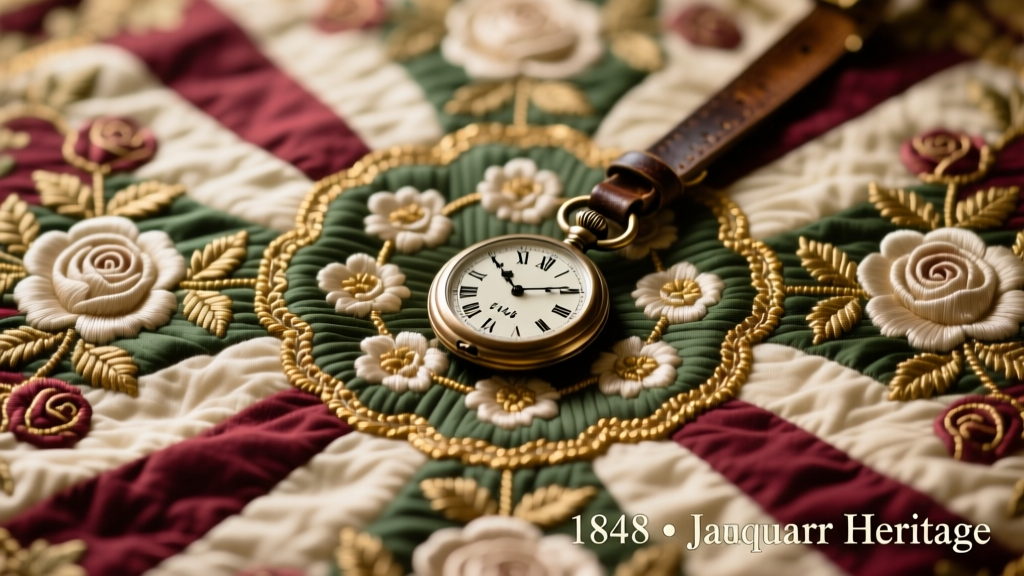
A Masterpiece of American Textile Innovation: The 1843 Jacquard Coverlet with Floral Medallions, Stripes, and Rose Border (70 × 88 Inches)
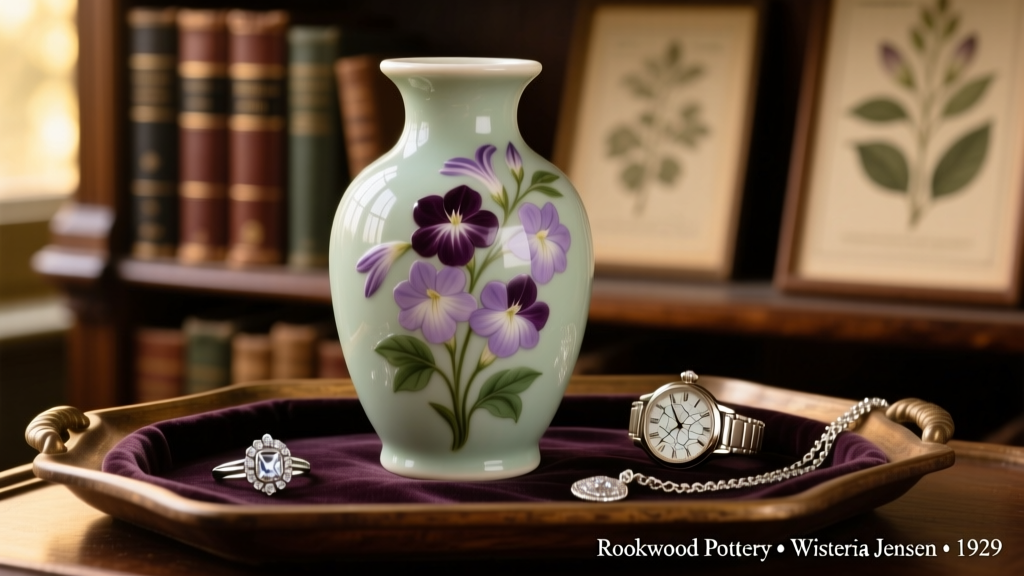
Rookwood Pottery Wisteria Vase by Sara Sax Jensen, 1929 — A Masterpiece of American Art Pottery
Queen Christina (1933) Lobby Card: A Vintage Hollywood Artifact Featuring Greta Garbo’s Definitive Performance
Popeye Wheelbarrow Express Windup Toy: A Detailed Appraisal of the Marx 1937 Tinplate Classic

Hall China Aladdin Black & Gold Teapot with Infuser: A Collector’s Guide to Mid-Century American Porcelain
Electric Lake Breeze Table Model C: A Definitive Appraisal of the 16-Inch Vintage Desk Fan
Needles: The Unseen Precision Instruments of Vintage Watchmaking and Jewelry Craftsmanship

Divers Discover Rare Enigma Machine: A WWII Cryptographic Artifact Recovered from the Baltic Sea
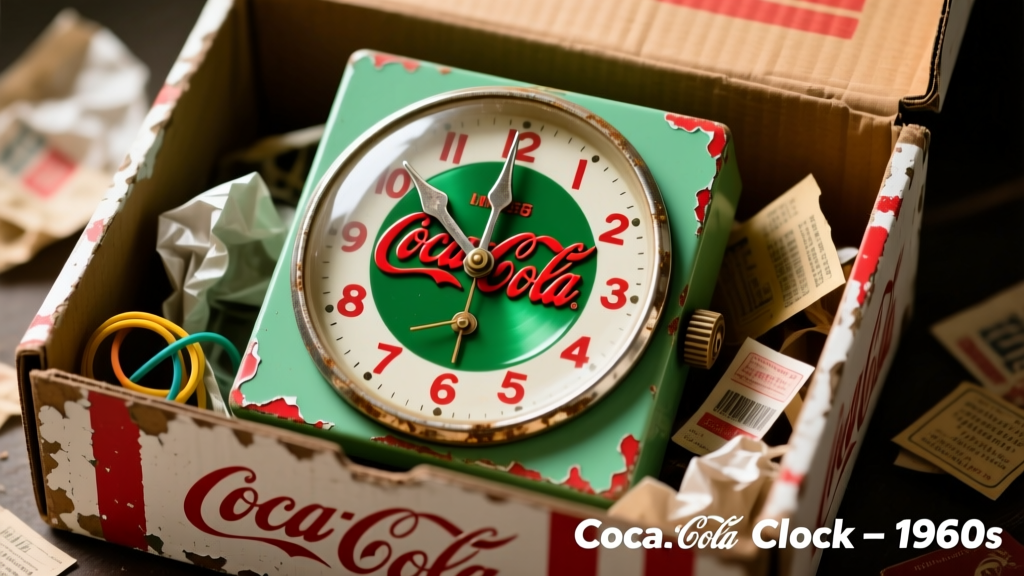
Coca-Cola Clock in Original Green, Red & White Electric Shipping Box — A 1960s Advertising Artifact with Provenance and Technical Significance