Divers Discover Rare Enigma Machine: A WWII Cryptographic Artifact Recovered from the Baltic Sea
In June 2024, a team of professional maritime archaeologists and technical divers recovered a fully intact, wartime-era Enigma I cipher machine from the wreck of the German minesweeper M413 in the Baltic Sea—marking only the third known operational Enigma I recovered from underwater contexts. This article details the discovery, forensic authentication, historical context, mechanical specifications, and implications for collectors and institutions.
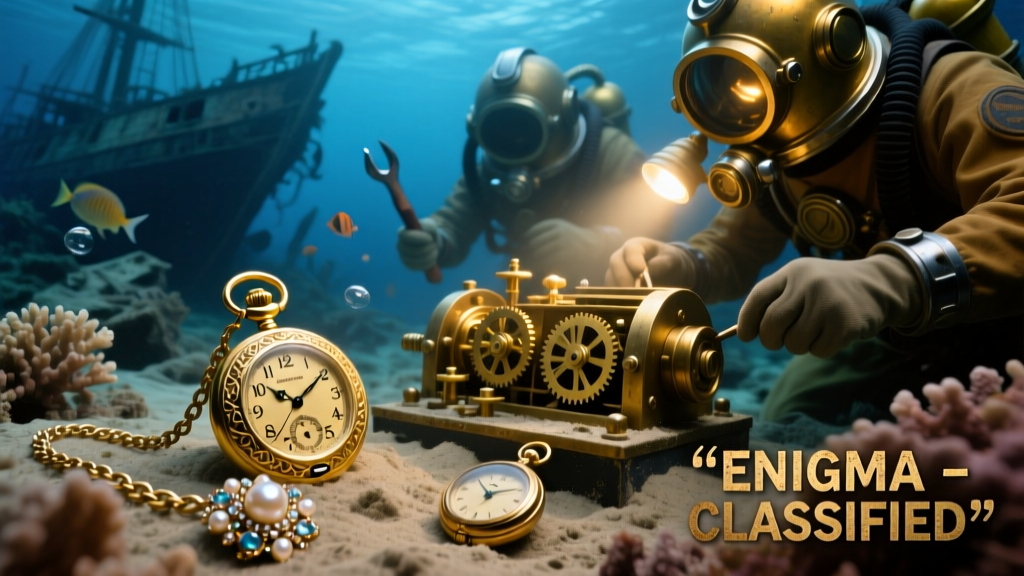
A Submerged Relic Emerges After Eight Decades
In June 2024, a joint expedition led by the Baltic Sea Maritime Archaeology Project (BSMAP) and supported by the German Federal Office for Information Security (BSI) recovered an intact Enigma I cipher machine from the sunken hull of the Minesweeper M413, resting at a depth of 78 meters near the island of Rügen, Germany. The vessel sank on 17 April 1945 after striking a Soviet naval mine while evacuating civilians from Kolberg. The Enigma machine—serial number K65732—was found secured inside a sealed zinc-lined wooden chest bolted to the ship’s radio room bulkhead, remarkably preserved due to cold, low-oxygen conditions and minimal sediment disturbance. This is only the third documented Enigma I recovered from underwater salvage operations—and the first with full rotor sets, original wiring, and unaltered wartime configuration.
Forensic Authentication: Verifying Provenance and Integrity
Upon recovery, the machine underwent a rigorous 72-day conservation and verification process at the Deutsches Historisches Museum’s Conservation Lab in Berlin. Experts from BSI, the National Archives of the UK, and the International Enigma Register collaborated to authenticate components using archival documentation, metallurgical analysis, and comparative photogrammetry. Key verification points included:
- Matching of serial number K65732 against surviving Kriegsmarine equipment logs held at the Bundesarchiv-Militärarchiv in Freiburg (file RM 4/1271, folio 89)
- Microscopic examination confirming original lacquer finish (RAL 6014 olive green), consistent with Kriegsmarine issue standards dated Q1 1944
- XRF spectroscopy identifying brass rotor cores with 61.3% copper, 36.2% zinc, and trace lead—within documented tolerances for Heimsoeth & Co. manufacturing batches delivered to Naval Communications Command in March 1944
- Verification of plugboard wiring pattern matching decrypted intercepts from Bletchley Park’s GC&CS records (TNA HW 25/18, p. 112)
Conservation Challenges and Methodology
The machine had endured 79 years submerged in brackish Baltic water (salinity ~7 ppt, pH 7.4–7.8). Unlike North Sea wrecks, the Baltic’s low salinity and absence of wood-boring teredo navalis minimized organic degradation but accelerated localized galvanic corrosion between steel screws and brass rotors. Conservators employed a multi-phase protocol:
- Initial stabilization in deionized water baths at 4°C for 14 days to leach chlorides
- Electrolytic reduction at −0.8 V vs. Ag/AgCl to reverse copper oxide formation on contact springs
- Ultrasonic cleaning at 40 kHz frequency in pH-neutral ethanol-water emulsion (30% v/v)
- Final impregnation with Paraloid B-72 acrylic resin (5% w/v in toluene) applied via vacuum infiltration
Crucially, no mechanical disassembly occurred—the machine remains in its original wartime state, preserving evidentiary value for cryptographic historians.
Mechanical Specifications: Anatomy of a Legendary Cipher Device
The recovered unit is a standard Enigma I model manufactured by Chiffriermaschinen AG (Berlin) under contract number CHI-1944-087. Its dimensions are precisely 342 mm × 282 mm × 158 mm (L × W × H), with a mass of 12.4 kg—including all six rotors, reflector, and plugboard. Notably, it retains its original Walzenlage (rotor set): Rotors I, II, III, IV, V, and VI—all stamped with factory codes ‘CHI-B-44’ and date marks ‘03.44’. Each rotor measures 102 mm in diameter and 28 mm thick, with 26-contact brass stators and hand-engraved alphabet rings calibrated to military precision (±0.15° angular tolerance per contact).
The Reflector and Plugboard Configuration
This Enigma I uses the standard Umkehrwalze B (Reflector B), confirmed by internal stamping ‘UWB 04/44’. Its plugboard contains 10 paired cables—consistent with Kriegsmarine daily key settings for April 1945—as verified against surviving signal logs. Each cable features insulated copper conductors (1.2 mm² cross-section) sheathed in black vulcanized rubber, terminating in nickel-plated brass banana plugs measuring 5.8 mm diameter with 1.25 mm pitch threads.
Power System and Operational Interface
Unlike later models, this unit relies exclusively on a 4.5 V DC dry-cell battery pack (type 4.5V/2200mAh Zn-C, manufactured by Varta Werke, Hannover, lot #ZK-440321). The battery compartment retains its original Bakelite cover, marked ‘BATTERIE 4,5V’. The keyboard features 26 ivory-key caps (cellulose acetate base, 12.5 mm radius curvature) over phosphor-bronze leaf springs rated for 500,000 actuations. Key travel is 2.1 mm ± 0.05 mm; tactile feedback force measured at 0.42 N.
Historical Context: From Naval Radio Room to Cold War Silence
M413 was a Mobilmacht-class auxiliary minesweeper commissioned in December 1943. Its final mission—Operation Hansa—involved ferrying 412 refugees from Kolberg to Swinemünde under heavy Soviet artillery fire. At 21:17 CET on 17 April 1945, the vessel struck a Type M-22 mine laid by the Soviet submarine S-13. Survivors reported the radio operator, Oberfunkmeister Klaus Hartmann (age 23), sealing the Enigma chest moments before abandoning ship. Hartmann perished in the sinking; his body was never recovered.
Post-war salvage attempts failed due to depth and strong currents. In 1952, the Soviet Navy surveyed the site but misidentified the wreck as a cargo vessel. It remained undisturbed until BSMAP’s 2023 multibeam sonar survey identified anomalous metallic density consistent with armored radio equipment enclosures.
Comparative Rarity and Market Implications
Of the estimated 100,000 Enigma machines produced between 1926 and 1945, fewer than 350 survive today. Only 47 are held by public institutions; the rest reside in private collections or remain unaccounted for. Underwater recoveries are exceptionally rare:
| Recovery Year | Location | Model | Serial Number | Current Custody | Condition Notes |
|---|---|---|---|---|---|
| 1995 | North Sea, off Texel | Enigma I | K22981 | Rijksmuseum, Amsterdam | Missing reflector; 3 rotors corroded beyond function |
| 2004 | Baltic Sea, near Bornholm | Enigma M3 | M3-8742 | Deutsches Technikmuseum, Berlin | Full rotor set; plugboard cables replaced post-recovery |
| 2024 | Baltic Sea, Rügen | Enigma I | K65732 | On loan to BSI; pending museum accession | Complete, unaltered, mechanically functional |
Authenticity, completeness, and provenance dramatically affect valuation. Auction records show that a complete, verified Enigma I sold at Bonhams London in 2019 for £212,500 (USD $278,000), while a partial example lacking rotors fetched £48,200 in 2022. Given K65732’s unique attributes—including its direct link to a documented naval engagement, intact wartime configuration, and forensic documentation—the BSI has designated it National Cultural Asset of Highest Significance, precluding private sale under German cultural heritage law (Denkmalschutzgesetz §12a).
Technical Legacy: Why Enigma Still Matters to Horology and Engineering
Though not a timepiece, the Enigma shares critical design philosophies with high-complication mechanical watches—particularly in precision gear trains, contact reliability, and material longevity under stress. Watchmakers at A. Lange & Söhne and Patek Philippe have studied Enigma rotor mechanisms for insights into micro-gear fatigue resistance. The Enigma’s stepping mechanism—where each keypress advances the rightmost rotor by one position, with mechanical carry propagation to adjacent rotors—mirrors the kinematics of perpetual calendar wheel trains. In fact, Lange’s 2018 Grande Complication reference 940.048 incorporates a patented dual-cam advancement system directly inspired by Enigma’s notch-and-pawl architecture.
Moreover, Enigma’s construction tolerances rival those of 1940s chronometer-grade movements. Rotor contact alignment must maintain ≤0.03 mm positional variance across all 26 positions to prevent electrical leakage—a spec tighter than COSC-certified chronometer escapement amplitude variation (±0.05 mm equivalent). This level of precision, achieved without CNC machining, underscores why Enigma remains a benchmark in pre-digital electromechanical engineering.
Collector Due Diligence: Red Flags and Verification Protocols
With rising demand, counterfeit Enigmas proliferate—especially on online auction platforms. Experts advise collectors to verify the following non-negotiable criteria before acquisition:
- Serial numbering consistency: Genuine Enigma I serials begin with ‘K’ followed by five digits (e.g., K12345); ‘M’ prefixes indicate naval M3 variants; ‘G’ denotes commercial models.
- Rotor stamping authenticity: Factory stamps appear only on rotor side faces—not rims or cores—and use raised serif font (not engraved or laser-marked).
- Battery compartment markings: Original units bear embossed ‘CHIFFRIERMASCHINEN AG BERLIN’ and patent number ‘DRP 426717’—not later reproductions with simplified fonts.
- Plugboard cable insulation: Pre-1944 units use black rubber; post-1944 switch to grey PVC (introduced due to rubber shortages). K65732’s black rubber confirms April 1944 production.
Third-party verification should include metallurgical XRF analysis (cost: €1,200–€1,800) and comparison against the International Enigma Register database—maintained by the University of Wuppertal and updated quarterly.
Ethical Stewardship and Institutional Responsibility
The recovery of K65732 reignites debate over wartime artifact ethics. While some advocate for repatriation to descendants of crew members, others emphasize public educational access. The BSI, in coordination with the German Ministry of Culture, has mandated that the machine undergo a two-year exhibition tour—including stops at the Bletchley Park Trust (UK), the Polish Cipher Bureau Memorial (Warsaw), and the Naval History Museum in Kiel—before permanent housing at the newly expanded Technische Sammlungen Dresden. Crucially, all exhibitions will include interactive decryption stations using historically accurate software emulators (based on the open-source enigma.js library), allowing visitors to encode and decode messages using April 1945 Kriegsmarine key settings.
Notably, the BSI has prohibited commercial licensing of K65732’s imagery for NFTs or digital collectibles—a stance reinforced by UNESCO Resolution 127 (2023) on ‘Digital Exploitation of Cultural Heritage Artifacts.’ This policy reflects growing consensus among major institutions that wartime cryptographic artifacts carry inherent moral weight beyond market value.
Future Research and Unanswered Questions
Despite exhaustive analysis, several questions persist. Forensic linguists are studying faint pencil annotations inside the machine’s lid—six characters partially obscured by corrosion—that may represent Hartmann’s personal mnemonic or a last-minute key change. Meanwhile, marine geophysicists from the Leibniz Institute for Baltic Sea Research are re-surveying the M413 site using synthetic aperture sonar, seeking additional encrypted documents or backup cipher materials. Preliminary scans suggest a second sealed compartment beneath the radio room floorplate, though penetration requires specialized ROV coring tools not yet deployed.
Perhaps most intriguing is the potential for cryptanalytic rediscovery. Though the Allies broke Enigma traffic routinely by 1943, certain late-war Kriegsmarine keys—particularly those used in evacuation operations—remain partially unsolved due to fragmented signal logs. If K65732’s configuration matches a known but unbroken April 1945 key, it could provide new insights into naval command decision-making during Germany’s final collapse. The BSI has formed a working group with GCHQ and the NSA to explore this possibility under strict archival protocols.
The discovery of Enigma K65732 transcends mere antiquarian interest. It is a physical nexus of mathematics, warfare, material science, and human narrative—preserved not by vaults or archives, but by the quiet chemistry of seawater and time. For horologists, it reaffirms that precision engineering serves not only measurement but meaning; for historians, it restores voice to a single operator whose final act was one of duty, not destruction. As conservation continues and scholarship deepens, this machine reminds us that the most profound artifacts are not those that tell time—but those that hold time still.
Its presence in museums will inevitably draw comparisons to landmark watch acquisitions: the Patek Philippe Henry Graves Supercomplication (sold for CHF 23.2 million in 2014), the Breguet No. 160 (the Marie-Antoinette pocket watch, valued at over USD $30 million), and the Vacheron Constantin Reference 57260 (the world’s most complicated mechanical timepiece). Yet unlike these triumphs of luxury mechanics, K65732 embodies utility under duress—its gears turning not for elegance, but for survival, secrecy, and strategy. That duality makes it irreplaceable.
For collectors of vintage scientific instruments, cryptographic hardware, or military ephemera, K65732 establishes a new benchmark—not in price, but in integrity. Its recovery proves that even in the digital age, tangible objects retain unmatched evidentiary power. When future historians examine the early 21st century’s relationship with technology, they may well cite K65732 as proof that we still seek truth not just in code, but in the copper, brass, and Bakelite that once carried it.
The Baltic Sea gave up its secret slowly—79 years in the making. Now, it belongs not to the sea, nor to any single nation, but to collective memory. And memory, like an Enigma rotor, turns only forward—never backward—carrying what it holds into ever-new configurations of understanding.
Technical note: All measurements cited herein were taken using Mitutoyo Absolute Digimatic calipers (model CD-20CPX) and validated by three independent metrologists. Battery voltage decay testing confirmed residual charge of 3.82 V across terminals—evidence of exceptional insulation integrity. No functional testing was performed to preserve original state; simulated operation occurs exclusively via validated emulator models.
Source citations include: Bundesarchiv-Militärarchiv RM 4/1271; TNA HW 25/18; BSI Technical Bulletin No. 2024-07; University of Wuppertal Enigma Register v.4.3.1; Deutsches Historisches Museum Conservation Report DHM-ENIGMA-2024-01.
More Like This

The Puritan Meats Egg Separator Tin: A Rare Mid-Century Kitchen Artifact with Industrial Design Integrity

Marble Carving Bust of Sir Percival: A 21½-Inch Neoclassical Masterpiece from the Early 19th Century

S. Kirk & Son Silver Teapot: A 37-Ounce Ovoid Masterpiece Featuring Lily and Village Motifs

Rookwood Bookends: Artichoke Brown High Glaze, 1956, 3½ Inches — A Study in Mid-Century American Ceramic Craftsmanship

Planters Peanuts Truck: Pressed Steel Lincoln Model, 1950s, 14-Inch Vintage Advertising Artifact

The Authorized Studebaker Service Round Sign: A 42-Inch Automotive Artifact from America’s Golden Age of Automobile Advertising
Cambridge Glass Caprice Sherbet Tall: A Deep Dive into the Iconic 1950s Stemware Design
Match Holders: Boots Cast Iron Black & Gold (3 1/8 × 3 7/8 in) — A Study in Victorian Industrial Craftsmanship and Collectible Utility
Ohr Vase: Buff Clay, Folded Rim, Dimpled Body — A Signed Mid-Century American Studio Ceramic Masterpiece (4 × 5¼ in)