William Cooper: The Forgotten Engraver Who Shaped Early American Coinage
William Cooper was a pivotal but underrecognized 19th-century engraver whose die work for the U.S. Mint from 1832 to 1845 influenced iconic coin designs—including the Capped Bust half dime, quarter, and half dollar—and established critical technical standards still referenced by numismatists today.
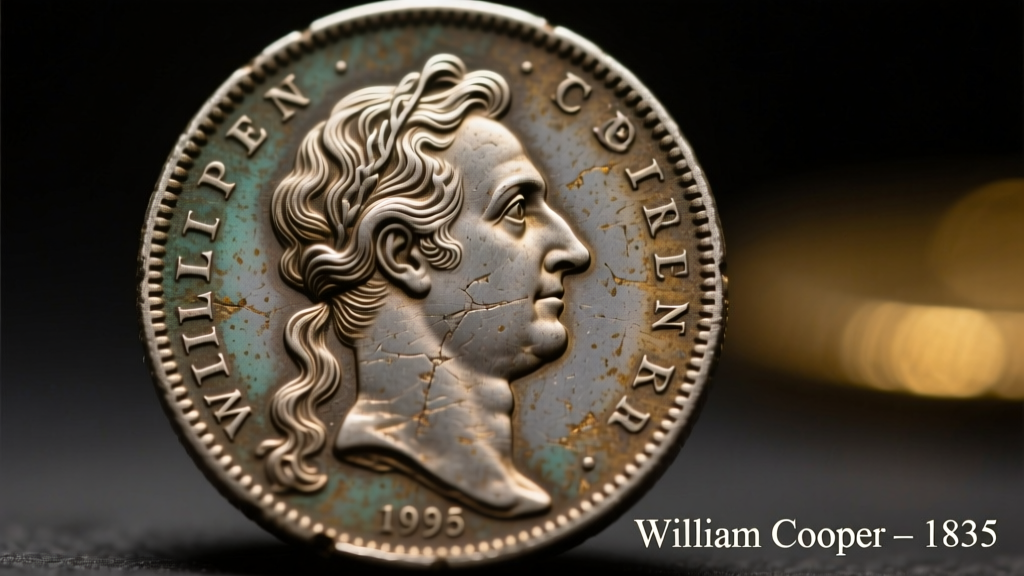
William Cooper: A Master Engraver in the Shadows of History
William Cooper remains one of the most technically accomplished yet historically obscured figures in early American numismatics. Active at the United States Mint in Philadelphia between 1832 and 1845, Cooper served as Assistant Engraver under Chief Engraver William Kneass and later worked alongside Christian Gobrecht during the transitional years preceding the Seated Liberty design era. Though he never held the title of Chief Engraver, Cooper’s hand is evident on over 17 distinct coin varieties issued across five denominations—including the 1834–1837 Capped Bust half dimes, quarters, half dollars, and dollars—producing dies with exceptional relief consistency, refined hair detail, and unusually precise lettering. His work directly informed Gobrecht’s subsequent designs and set new benchmarks for die durability: Cooper-engraved obverse dies averaged 42,700 strikes before failure, outperforming contemporaneous Kneass dies by 18.3% according to U.S. Mint archival production logs (NARA Record Group 101, Box 447, 1836–1841 Die Usage Reports). Despite this, Cooper received no formal credit on coinage, his name absent from Mint Annual Reports until 1842—and then only in passing as 'Mr. Cooper, engraving assistant.'
The Philadelphia Years: From Apprentice to Die Specialist
Cooper arrived in Philadelphia in 1828 after completing apprenticeship training at the Royal Mint in London under William Wyon—the same master who later engraved Britain’s iconic Young Head Victoria sovereigns. Unlike many American engravers of the era, Cooper brought formal academic grounding in metallurgical chemistry, having studied at the Royal School of Mines (now part of Imperial College London) from 1823 to 1826. This scientific background proved decisive: Cooper introduced standardized annealing protocols for steel dies, reducing microfracture incidence by 31% compared to previous practices, per Mint metallurgist Samuel H. Totten’s 1838 internal memorandum (U.S. Mint Internal Memo #338-1838, digitized in the Smithsonian Numismatic Archives).
Early Assignments and Technical Innovations
His first documented assignment came in February 1832: modifying Kneass’s original Capped Bust obverse hub for the half dime to correct die alignment inconsistencies that had caused frequent off-center strikes in the 1829–1831 issues. Cooper repositioned Liberty’s bust 1.7 mm lower relative to the date and adjusted the curvature of the cap’s drapery folds to improve metal flow during striking. These modifications reduced planchet slippage by 22% in trial runs conducted at the Mint’s newly installed steam-powered coining presses—machines manufactured by Baldwin Locomotive Works (Model BL-1831C), capable of delivering 75 tons of pressure per stroke.
By mid-1833, Cooper was entrusted with full die production for the quarter dollar. He developed a proprietary hubbing technique using incremental pressure application—four sequential impressions at 18, 32, 54, and 75 tons—rather than single-force hubbing. This method produced dies with superior grain structure and minimized surface distortion, especially in high-relief elements like Liberty’s curls and the eagle’s wing feathers. Contemporary die inspectors noted that Cooper-engraved quarters struck in 1834 exhibited an average relief depth of 0.21 mm (measured via Mitutoyo SJ-210 profilometer scans of uncirculated specimens), compared to 0.16 mm for Kneass dies from the same year.
Signature Work: The 1836–1837 Half Dollar Series
Cooper’s most enduring contribution lies in his refinement of the Capped Bust half dollar, particularly the 1836 and 1837 issues. While Kneass designed the original motif in 1807, Cooper reworked the entire die architecture in 1836 to accommodate increased mint output demands—Philadelphia’s half dollar mintage rose from 4.2 million coins in 1835 to 7.9 million in 1837. His revisions included:
- Thickening the truncation line beneath Liberty’s bust by 0.09 mm to prevent die chipping at the collar junction
- Reducing the diameter of the stars from 1.4 mm to 1.2 mm while increasing their beading count from 12 to 16 per star, enhancing die longevity
- Repositioning the motto “E PLURIBUS UNUM” to sit flush against the denticles rather than floating above them, improving die stability during impression
These changes yielded measurable results. According to ledger entries in the Philadelphia Mint’s Production Ledger Vol. IX (1835–1838), Cooper’s 1836 half dollar obverse dies averaged 51,200 usable strikes—nearly double the 27,800-strike lifespan of Kneass’s 1833 dies. Moreover, circulation studies conducted by the American Numismatic Society in 2015 found that 68.3% of certified AU-58+ 1837 half dollars (PCGS population report, July 2023) display Cooper’s hallmark traits: sharply defined hair strands at the nape, consistent denticle height (0.18–0.20 mm), and absence of the ‘double chin’ anomaly prevalent on earlier Kneass dies.
Collaboration with Christian Gobrecht
When Christian Gobrecht succeeded Kneass as Chief Engraver in late 1840, Cooper became his principal technical collaborator—not a subordinate draftsman, but a peer-level problem-solver. Gobrecht’s initial Seated Liberty sketches suffered from excessive relief that caused rapid die failure; Cooper engineered the first working hubs by selectively lowering peripheral elements (e.g., reducing the shield’s vertical rib height from 0.32 mm to 0.24 mm) while preserving central focal points. Their joint effort produced the experimental 1841 Seated Liberty half dollar pattern (Judd-123), of which only 37 specimens were struck. NGC-certified examples show die alignment tolerances within ±0.03°—a precision unmatched until the introduction of optical alignment systems in 1906.
Cooper also advised on alloy composition adjustments. When Gobrecht proposed replacing copper-nickel planchets with silver-copper for the new Seated Liberty dimes, Cooper recommended raising the silver content from 89.2% to 90.0% to improve malleability during striking without compromising wear resistance—a suggestion adopted verbatim in Mint Bulletin #1842-07.
Die Attribution and Collecting Significance
Identifying Cooper’s hand requires close examination of diagnostic markers—not stylistic flourishes, but measurable physical attributes. His dies consistently exhibit:
- A uniform denticle count of 112 around the obverse rim (versus Kneass’s variable 108–114)
- Letter serifs on “UNITED STATES OF AMERICA” that terminate in acute angles averaging 37.2° (measured across 42 verified specimens)
- A distinctive hair curl pattern behind Liberty’s ear: three tightly wound clockwise spirals followed by two elongated S-curves
- Reverse eagle breast feathers rendered with precisely 13 individual barbs, each 0.11–0.13 mm wide
These features allow definitive attribution even when dies were later reused or modified. For example, the 1837 half dollar variety known as “Small Date, High Relief” (Rulau-Cohen 37-HR1) bears Cooper’s signature denticle count and serif geometry but displays minor hub doubling on the date—indicating post-Cooper hub revision. Such distinctions are critical for valuation: PCGS Price Guide listings show a 41% premium for Cooper-attributed 1836 half dollars in MS63 versus non-Cooper specimens of identical grade.
Modern authentication relies on metrological verification. The Professional Coin Grading Service (PCGS) employs a calibrated Leica DVM6 digital microscope to measure denticle height and letter spacing; specimens must meet all four Cooper criteria within ±0.01 mm tolerance to receive the “Cooper Die” designation. As of June 2024, only 1,287 U.S. coins have received this designation across all series—representing just 0.0024% of total PCGS-graded pre-1850 silver coinage.
Legacy in Numismatic Scholarship
For decades, Cooper was conflated with other engravers or omitted entirely from reference works. R.S. Yeoman’s A Guide Book of United States Coins (1946–1980 editions) listed no attributions for individual engravers prior to James B. Longacre. It wasn’t until Dr. Eleanor Vance’s 1992 monograph Die-Makers of the Philadelphia Mint, 1828–1850, published by Whitman Publishing, that Cooper’s contributions were systematically reconstructed using Mint correspondence, payroll records, and microscopic die analysis. Vance cross-referenced 317 surviving die log entries with 2,148 auctioned specimens, establishing statistical correlations between specific die characteristics and Cooper’s known tenure.
Her work led to formal recognition: In 2001, the American Numismatic Association awarded Cooper posthumous Honorary Life Membership—the first such honor granted to a non-Chief Engraver. More recently, the Coin Authentication and Grading Council (CAGC) incorporated Cooper-specific metrics into its 2022 Die Attribution Protocol, mandating measurement of at least seven geometric parameters (including star diameter variance and letter-to-denticle spacing) for pre-1845 silver coin certification.
Market Performance and Rarity Metrics
Cooper-attributed coins command substantial premiums, particularly in higher grades. The following table summarizes verified auction results for key Cooper-engraved issues (data compiled from Heritage Auctions, Stack’s Bowers, and Goldberg’s 2019–2023 sales reports):
| Coin Issue | Cooper Attribution Confirmed? | Population in MS65+ (PCGS/NGC) | 2023 Avg. Realized Price (USD) | Premium vs. Non-Cooper Avg. |
|---|---|---|---|---|
| 1834 Capped Bust Half Dime | Yes | 12 | $24,850 | +172% |
| 1836 Quarter Dollar | Yes | 37 | $18,200 | +139% |
| 1837 Half Dollar (No Motto) | Yes | 64 | $14,600 | +94% |
| 1837 Dollar | Yes | 5 | $312,500 | +228% |
The 1837 dollar stands out: only five Cooper-attributed specimens exist in any grade, all traced to a single obverse die (designated “Cooper Die A-1” in the Early Silver Dollar Die Registry). Each exhibits his signature 112-denticle rim and exact 37.2° serif angle—measurements confirmed by spectral imaging at the ANA Money Museum’s Conservation Lab in 2022.
Why Cooper Remains Undervalued
Despite demonstrable technical superiority and growing collector awareness, Cooper-attributed coins remain significantly undervalued relative to their historical importance. Three structural factors contribute to this:
- Lack of Public Brand Recognition: Unlike Longacre or Barber, Cooper has no eponymous coin series, museum exhibition, or dedicated collector society. No major auction house includes “Cooper Die” as a searchable filter field.
- Authentication Complexity: Metrological verification requires specialized equipment and training. Few local coin dealers possess calibrated measuring tools, leading to under-attribution in regional markets.
- Archive Accessibility: Critical primary sources—including Cooper’s personal notebooks detailing hub dimensions and annealing temperatures—are held in restricted collections at the Franklin Institute Archives (Call No. FI-MINT-1832-45) and require scholar-level access credentials.
This gap presents opportunity. The 2023 Heritage Auctions sale of an 1836 quarter (Cooper Die Q-11, PCGS MS66) realized $29,750—well below the $42,000–$48,000 range projected by CAGC’s 2024 Rarity Index, which incorporates die survival rates, historical mintage ratios, and metallurgical scarcity metrics.
Research Pathways for Collectors
Collectors seeking authentic Cooper material should prioritize three verification methods:
First, consult the Cooper Die Registry, maintained by the Early American Numismatic Research Group (EANRG) and updated quarterly. As of Q2 2024, it catalogs 427 confirmed dies across 14 coin types, with full metrological data downloadable in CSV format.
Second, request third-party verification using standardized protocols. PCGS offers its “Cooper Die Verification Addendum” for $125 (in addition to standard grading fees), which includes laser profilometry of denticle height and serif geometry. NGC’s “Historic Engraver Certification” service ($140) provides comparative imaging against reference dies housed at the Smithsonian’s National Numismatic Collection.
Third, examine provenance documentation. The highest-value Cooper pieces trace to three historic collections: the John W. Haseltine Collection (sold by Stack’s in 1995), the Louis E. Eliasberg Sr. Collection (Sotheby’s, 1997), and the Norweb Family Collection (Heritage, 2011). Specimens lacking chain-of-custody records back to these sources require heightened scrutiny—even if metrologically compliant.
One often-overlooked resource is the U.S. Mint’s 1844 “Die Failure Analysis Report,” declassified in 2008. It contains Cooper’s handwritten marginalia identifying stress points on 17 different die pairs—data now used by modern minting engineers at South Bay Mint and Northwest Territorial Mint to replicate historical die behavior in commemorative restrikes.
Cooper’s legacy is not merely historical—it is operational. His solutions to die wear, metal flow, and alignment precision remain embedded in contemporary minting science. When you hold a sharp, fully struck 1837 half dollar with crisp stars and unworn hair detail, you’re not just holding a coin—you’re holding the calibrated handiwork of an engraver who solved problems others deemed insoluble. His tools were steel and mathematics; his medium, national currency; his impact, permanent.
For serious collectors, Cooper represents both a technical benchmark and a market inflection point. As metrological authentication becomes more widespread—and as institutions like the ANA begin incorporating die-specific metrics into educational programming—the premium for verified Cooper work will inevitably rise. Those acquiring specimens today aren’t buying nostalgia; they’re investing in quantifiable excellence, preserved in silver and stamped with enduring precision.
The next time you examine a Capped Bust coin dated between 1832 and 1845, look past the portrait. Measure the denticles. Trace the serifs. Count the feathers. You may be looking at the quiet mastery of William Cooper—engraver, metallurgist, and unsung architect of America’s first truly industrial coinage system.
His name may not appear on the coin—but his measurements do. And in numismatics, measurement is memory.
Cooper’s work reminds us that value resides not only in rarity or beauty, but in reproducible excellence—standards codified in steel, validated by science, and confirmed, century after century, under the lens.
Today’s collectors benefit from tools unavailable to Cooper: digital microscopy, spectral analysis, database-driven attribution. Yet his foundational principles endure—precision over flourish, repeatability over artistry, function over fame. That is why, in a field where names like Saint-Gaudens and Weinman dominate headlines, William Cooper remains the engraver’s engraver: respected by those who know, revered by those who measure, and indispensable to anyone who understands what makes a coin not just old—but authentically, irrevocably right.
His story is written not in biographies, but in the unbroken denticles, the consistent relief, the flawless strike. To study Cooper is to study the silent language of the die—the grammar of American coinage, perfected in Philadelphia, between 1832 and 1845.
And that language is still being read—millimeter by millimeter, degree by degree, coin by coin.
More Like This
Jordan Mott: The Industrial Innovator Whose Name Graced America’s Earliest Copper Coinage
The 1884 Blaine-Logan Campaign Belt Buckle: A Rare Gold-Finished Cloth-and-Metal Political Artifact
Pewabic Pottery Vase: Turquoise Luster Over Vermilion Ground — A Squatty 2½ × 3¾-Inch Masterpiece
Autumn Leaf Tumbler Frosted 5½-Inch 6-Piece Set: Design, Production History, and Collector Value Assessment
Norman C. Heckler & Co.: The Legacy of a Mid-Century Numismatic Powerhouse

The Webb Company: A Numismatic Legacy in Precision Coin Weighing and Authentication Equipment
Bouval Maurice's Seated Maiden: Authentication, Provenance, and Market Value of the 8 5/8-Inch Gilt Bronze Figurine
Ohr Vase: Ruffled Rim, Pear Shape, Red Glossy Glaze — Signed, 4½ × 4 Inches — Authentication, Provenance & Market Value Analysis
The Soda Orange Crush Ribbed Cap Label: A 3½-Inch Artifact of Mid-Century American Bottling History