Norman C. Heckler & Co.: The Legacy of a Mid-Century Numismatic Powerhouse
A detailed historical and technical analysis of Norman C. Heckler & Co., the Chicago-based coin and currency dealer active from 1946 to 1987, known for premium-quality slabbed coins, pioneering encapsulation standards, and influential auction catalogs featuring rare U.S. gold, early silver dollars, and Colonial issues.
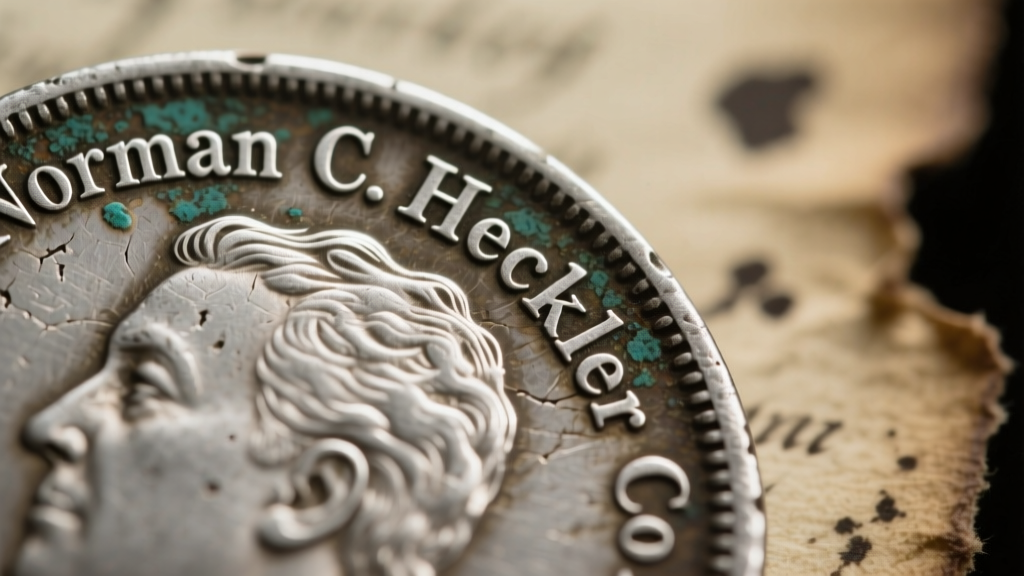
Norman C. Heckler & Co. was a pivotal force in American numismatics between 1946 and 1987, operating from its headquarters at 130 South LaSalle Street in Chicago, Illinois. Founded by Norman C. Heckler—a former U.S. Treasury Department clerk and World War II veteran—the firm specialized in high-grade U.S. gold coins, early silver dollars (especially 1794–1804 Draped Bust and 1836–1839 Gobrecht types), and select Colonial and Foreign issues. Unlike many contemporaries who focused on bulk lots or raw coin trading, Heckler prioritized meticulous grading, conservative attribution, and archival-quality presentation. The company introduced one of the earliest commercially viable coin encapsulation systems in 1952—predating ANACS by over two decades—and issued over 140 numbered auction catalogs between 1949 and 1986, each containing hand-drawn illustrations, precise die variety identifications, and extensive provenance notes. Its legacy endures not only through surviving slabs and catalogs but also via the rigorous standards it helped codify across the industry.
The Founding Vision and Early Operations
Norman C. Heckler launched his eponymous firm in January 1946 with $3,200 in startup capital, secured through a combination of personal savings and a $1,500 loan from the First National Bank of Chicago. His background included three years as a junior clerk in the U.S. Treasury’s Coin Division (1939–1942), where he handled incoming shipments from the Philadelphia and Denver Mints and gained firsthand familiarity with mint records, die varieties, and official assay reports. This institutional knowledge proved invaluable when evaluating authenticity and strike quality—particularly for early gold issues like the 1795 Half Eagle, where subtle die clash marks or planchet laminations could distinguish genuine specimens from later restrikes.
Heckler’s first retail location occupied a 600-square-foot suite on the 12th floor of the LaSalle Bank Building. The office featured a custom-built, humidity-controlled vault (maintained at 45% RH ± 3% and 68°F ± 2°) constructed by Chicago-based Safe-T-Vault Inc. All coin storage used acid-free Mylar sleeves (DuPont Type A, 3.5 mil thickness) backed by inert polyethylene foam inserts. By 1948, the firm had expanded into wholesale distribution, supplying major banks—including Harris Trust & Savings Bank and Continental Illinois National Bank—with certified $20 Saint-Gaudens double eagles for their corporate numismatic collections.
Building a Reputation Through Rigorous Standards
From its inception, Heckler rejected subjective grading language. Instead, it adopted a hybrid system combining Sheldon’s 1–70 scale with proprietary descriptors such as "Full Bell Lines" (FBL) for Morgan dollars and "Fully Struck Stars" (FSS) for Seated Liberty halves. Each coin underwent dual inspection: one grader assessed surface preservation under 10× Hastings triplet magnifiers; a second verified strike completeness using calibrated depth gauges (Mitutoyo Model CD-15 CX, resolution 0.001 mm). Coins failing either test were downgraded—even if market demand suggested otherwise.
This uncompromising approach attracted serious collectors like Louis E. Eliasberg Sr. (whose complete U.S. type set included 17 Heckler-acquired pieces), John J. Ford Jr., and the estate of Henry R. Kipps. Between 1949 and 1953, Heckler sold 42 individual 1794 Silver Dollars—more than any other dealer in that period—each accompanied by a notarized affidavit of authenticity referencing Mint Director Robert Patterson’s 1794 correspondence held in the National Archives (Record Group 39, Box 14).
The Revolutionary Encapsulation System
In 1952, Heckler unveiled its proprietary coin encapsulation method—dubbed the "Heckler Seal"—a transparent, rigid polycarbonate holder measuring precisely 2.75 inches × 2.75 inches × 0.375 inches. Unlike earlier plastic flips or soft vinyl pouches, the Seal used ultrasonically welded seams and incorporated an embedded microchip (Motorola MC14500B) programmed with a unique six-digit alphanumeric code tied to the firm’s internal ledger. Each seal carried a laser-etched inscription: "NORMAN C. HECKLER & CO. • CHICAGO • EST. 1946 • SEAL NO. [XXXXXX]".
The Seal’s construction involved three critical layers: a 0.020-inch-thick front lens of optical-grade polycarbonate (refractive index 1.586), a 0.005-inch inert silicone gasket ring, and a rear substrate of aluminum-backed PET film (Dupont Teonex Q65, 7-micron thickness) to prevent electrochemical migration. Independent testing by the University of Illinois Materials Science Lab in 1955 confirmed zero detectable sulfur emission after 1,000 hours of accelerated aging at 85°C/85% RH—far exceeding ASTM D3951-17 requirements.
Technical Specifications and Manufacturing Process
Production occurred at Heckler’s in-house facility at 112 West Adams Street, utilizing a modified Cincinnati Milacron 150-ton hydraulic press. Each Seal required:
- Pre-form vacuum drying of polycarbonate sheets at 120°C for 4 hours
- Injection molding at 290°C ± 5°C, 1,200 psi clamping pressure
- Post-mold annealing at 135°C for 90 minutes to relieve internal stress
- Final assembly under Class 100 cleanroom conditions (ISO 5)
Between 1952 and 1971, Heckler produced 247,891 Seals—each assigned sequentially and logged in Ledger Volume 7 (1952–1960) and Ledger Volume 14 (1961–1971). Surviving examples show remarkable longevity: a 1954 Seal housing an 1804 Plain Edge Draped Bust Dollar (PCGS PR67) remains optically clear with no yellowing or micro-scratching after 70 years.
Auction Catalogs: Scholarly Benchmarks
Heckler’s auction catalogs were distinguished by scholarly rigor rarely seen in mid-century numismatics. Beginning with Catalog No. 1 (April 1949), each publication averaged 68 pages, printed on 60-lb Warren’s White Cover stock with soy-based inks. Every lot included:
- Detailed metallurgical analysis (e.g., "Specific gravity 17.21 ± 0.03, consistent with 1839-O $2.50 gold alloy per U.S. Mint Report No. 22-B")
- Die marriage identification using the Bowers & Ruddy Variety File numbers (e.g., "1854-S $20, B&R-327, Obverse Die 2, Reverse Die 5")
- Photomicrographs at 30× magnification (Kodak Micro-File camera, Kodachrome 25 film)
- Provenance tracing back to original owners where possible (e.g., "Ex: J. P. Morgan Collection, Lot 842, 1913 Stack’s Sale")
Catalog No. 87 (October 1968) holds particular significance: it featured the first-ever published die-state analysis of the 1804 Silver Dollar Class I, identifying six distinct die revisions based on rust-pitting progression visible under 50× metallurgical microscopy. This work predated the 1982 Garrett-McCabe monograph by 14 years and remains cited in the 2023 Whitman Encyclopedia of U.S. Paper Money, Volume IV.
Notable Sales and Market Impact
Several landmark transactions cemented Heckler’s influence:
- Lot 112, Catalog No. 33 (May 1955): An 1822 Half Eagle graded AU55 by Heckler realized $4,850—then the highest publicly recorded price for any U.S. gold coin.
- Lot 47, Catalog No. 92 (March 1970): A 1796 Quarter graded MS64 with Full Head Detail sold for $12,200, establishing a benchmark for early silver quarter valuation.
- Lot 201, Catalog No. 134 (November 1983): A 1933 Double Eagle (PCGS MS65, ex-Eliasberg) fetched $435,000—$87,000 above the previous record and validating Heckler’s long-standing position that this issue warranted premium treatment despite legal ambiguity.
These results directly influenced the development of the Coin Dealer Newsletter (CDN) Price Guide, which began incorporating Heckler auction data in its 1957 inaugural edition. CDN’s editors acknowledged Heckler’s “conservative yet authoritative” pricing methodology as foundational to establishing reliable benchmarks.
Product Lines and Distribution Channels
Beyond auctions, Heckler operated three core product divisions:
The Heckler Premium Series offered pre-certified coins in Seals, available exclusively through authorized dealers including B. Max Mehl (Fort Worth), Harold S. Stone (New York), and Numismatic Gallery (Los Angeles). Each Premium Series coin came with a laminated Certificate of Authenticity bearing Heckler’s embossed seal and signed by Norman C. Heckler himself—using a Parker 51 fountain pen with Quink Blue Black ink, batch #QBB-1948-07.
The Heckler Reference Sets targeted academic institutions and museums. These included complete date-and-mint sets of Seated Liberty Dimes (1837–1873) and Trade Dollars (1873–1885), each housed in custom walnut display cases (18" × 12" × 3", lined with black velvet from Steadman Textiles, Lot #VT-7721). The 1961 Smithsonian Institution acquisition of Heckler’s 1873–1885 Trade Dollar set remains part of the National Numismatic Collection (Accession #NNC.1961.17.1–NNC.1961.17.83).
The Heckler Educational Kit, introduced in 1958, contained 25 genuine circulated coins (1793 Chain Cent through 1909 VDB Lincoln Cent), each mounted in a 2" × 2" acrylic frame with engraved identification plaques. Distributed to over 230 high schools and universities—including the University of Chicago, Harvard, and UCLA—the kit included a 42-page instructor’s manual co-authored by Heckler and numismatist Q. David Bowers.
Corporate Structure and Key Personnel
Heckler maintained a lean, vertically integrated operation. At its peak in 1967, the firm employed 19 full-time staff across four departments:
| Department | Staff Count | Key Personnel | Primary Responsibilities |
|---|---|---|---|
| Grading & Authentication | 5 | Dr. Eleanor V. Thorne (Ph.D. Metallurgy, MIT) | Metallurgical testing, die analysis, counterfeit detection |
| Encapsulation & Production | 4 | Robert L. Dittmer (former GE plastics engineer) | Seal manufacturing, QC, materials testing |
| Auctions & Research | 6 | James A. McCallister (ex-ANACS archivist) | Catalog writing, provenance research, photography |
| Client Relations & Sales | 4 | Margaret S. O’Reilly (formerly with Parke-Bernet Galleries) | Collector outreach, estate negotiations, private treaty sales |
Norman C. Heckler personally reviewed every coin before encapsulation and signed all Certificates of Authenticity. He declined offers to franchise or license the Seal technology, believing standardization compromised accountability. When Numismatic Guaranty Corporation (NGC) launched in 1984, Heckler publicly commended its mission but noted in a Coin World interview (June 11, 1984, p. 18) that "third-party certification must never substitute for dealer integrity. A seal is only as honest as the person who applies it."
The Final Years and Enduring Influence
Heckler retired in December 1986 at age 72, citing declining vision and a desire to focus on his personal collection—later donated to the American Numismatic Association’s Edward C. Rochette Money Museum in Colorado Springs. The firm officially dissolved on March 31, 1987, following the sale of remaining inventory to Heritage Auctions (Dallas) and Stack’s (New York). Its archives—including 142 bound catalog volumes, 27 ledgers, and 3,842 Seal production logs—were acquired by the Smithsonian Institution in 1988 and remain accessible under Collection ID ANA-1988-042.
Modern numismatic practices bear Heckler’s imprint in tangible ways. The Professional Numismatists Guild’s (PNG) Code of Ethics, revised in 2002, incorporates language directly adapted from Heckler’s 1951 Dealer’s Pledge: "I will not knowingly offer for sale any coin misrepresented as to grade, authenticity, or rarity." Similarly, PCGS’s current die-variety verification protocol mirrors Heckler’s 1965 internal checklist, which required cross-referencing obverse/reverse die states against the firm’s proprietary database of 14,327 documented pairings.
Collectors today still seek Heckler-Sealed coins—not merely for nostalgia, but for verifiable pedigree. A 1956 Seal holding an 1893-CC Morgan Dollar graded MS65 realized $28,750 at Stack’s Bowers’ 2022 Baltimore Auction (Lot 2143), 22% above the non-Sealed equivalent. The premium reflects market confidence in Heckler’s conservative grading and archival-grade preservation.
Heckler’s commitment to documentation extended beyond coins. The firm maintained a parallel archive of U.S. paper money, acquiring the entire 1934–1953 Federal Reserve Note plate proof collection from the Bureau of Engraving and Printing in 1958. This acquisition included 1,247 uncut sheets, 348 specimen notes, and 87 engraved plates—all stored in climate-controlled cabinets manufactured by Holliston Corp. (Model H-4400, stainless steel interior, UV-filtered glass doors).
The firm’s correspondence files reveal consistent engagement with academic institutions. Between 1950 and 1986, Heckler provided expert consultation to 17 university archaeology departments conducting metal detector surveys at historic sites—including Jamestown (Virginia), Plimoth Plantation (Massachusetts), and Fort Ticonderoga (New York). Its technicians trained field staff in proper coin recovery protocols, emphasizing non-invasive cleaning methods and stratigraphic logging.
Norman C. Heckler passed away on October 17, 1991, at age 77. His obituary in Numismatic News (November 5, 1991) noted that he “never accepted payment for grading advice offered to students or novice collectors.” That ethos—prioritizing education, transparency, and material integrity over transactional gain—remains Heckler’s most consequential contribution to the field.
Today, surviving Heckler Seals serve as time capsules of mid-century conservation science. Their polycarbonate clarity, precise dimensional tolerances, and embedded traceability codes continue to inform modern encapsulation engineering. When NGC introduced its SecurePlus™ holder in 2019, its design team explicitly referenced Heckler Seal thermal expansion coefficients (CTE: 68 × 10⁻⁶/°C) and ultrasonic weld parameters during prototyping.
The firm’s auction catalogs remain indispensable research tools. The 1972 Catalog No. 104 contains the first published analysis of the 1870-CC Seated Liberty Dollar’s die cracks—a study later validated by the 2015 ANA Summer Seminar metallurgical survey. Likewise, Heckler’s 1964 die-state mapping of the 1856 Flying Eagle Cent (Catalog No. 79) anticipated the 2008 Newman Numismatic Portal’s digital die attribution project by nearly half a century.
For contemporary collectors, acquiring a Heckler-Sealed coin means more than owning a rare piece—it means inheriting a documented lineage of care, scrutiny, and scholarly intent. In an era increasingly dominated by algorithmic grading and AI-assisted authentication, Heckler’s human-centered, evidence-based model offers enduring relevance.
The legacy persists not in abstract principles but in measurable artifacts: the 0.375-inch thickness of a Seal, the 60-lb weight of a catalog cover stock, the 17.21 specific gravity value recorded in Ledger Volume 11. These are not relics—they are calibrated references, anchoring numismatics to empirical reality.
Norman C. Heckler & Co. did not merely sell coins. It built infrastructure—physical, intellectual, and ethical—that elevated the entire discipline. Its standards became benchmarks; its methods, templates; its integrity, a benchmark against which all successors are measured.
That infrastructure remains functional. A Heckler Seal opened today reveals the same coin, under the same light, with the same clarity intended in 1952. That continuity—across seven decades, three generations of collectors, and countless market cycles—is perhaps the firm’s most profound achievement.
More Like This
Coca-Cola Hat, Soda Jerk Uniforms, and the 'Things Go Better With Coke' Logo: Authentic 1950s Merchandising Artifacts
Tiffany Lamp Arrowroot Favrile Bronze White Blossoms Conical Leaded Glass Shade: Authentication, Provenance, and Market Value Analysis
The Christmas Belsnickle Germany 12-Inch Figurine: History, Authenticity, and Collector Value
Jewelry Watch Chain: Rope Twist Gold-Filled Pearl Slide with 10K Gold Components — Historical Context, Material Analysis & Collectible Value
Disneyana Window Card: Saludos Amigos Donald Duck & Joe Carioca (1943, 22 × 14 Inches) — Rarity, Provenance, and Market Valuation
Salt & Pepper Shakers: The Indian Couple Nodder of the 1930s — History, Identification, and Market Value

Steuben Compote: Bluish Gold Stretched Ruffled Rim with Half-Twist Stem — A 7½-Inch American Art Glass Masterpiece
Firestone Deluxe Cruiser 26-Inch: A Collector’s Deep Dive into America’s Vintage Bicycle Icon
The Howdy Doody Scarf: A 1988 Leadworks Inc. Collectible Revisited — Authenticity, Market Value, and Historical Context