Staffordshire Blue Transfer Plate: City Hall, New York — A 9¾-Inch Ceramic Artifact from the Early American Export Trade
A detailed numismatic and ceramic analysis of the rare 9¾-inch Staffordshire blue transfer-printed plate depicting New York City Hall, produced circa 1825–1845. Includes provenance context, manufacturing details, market valuation benchmarks, and authentication criteria.
Introduction: A Ceremonial Artifact of Transatlantic Commerce
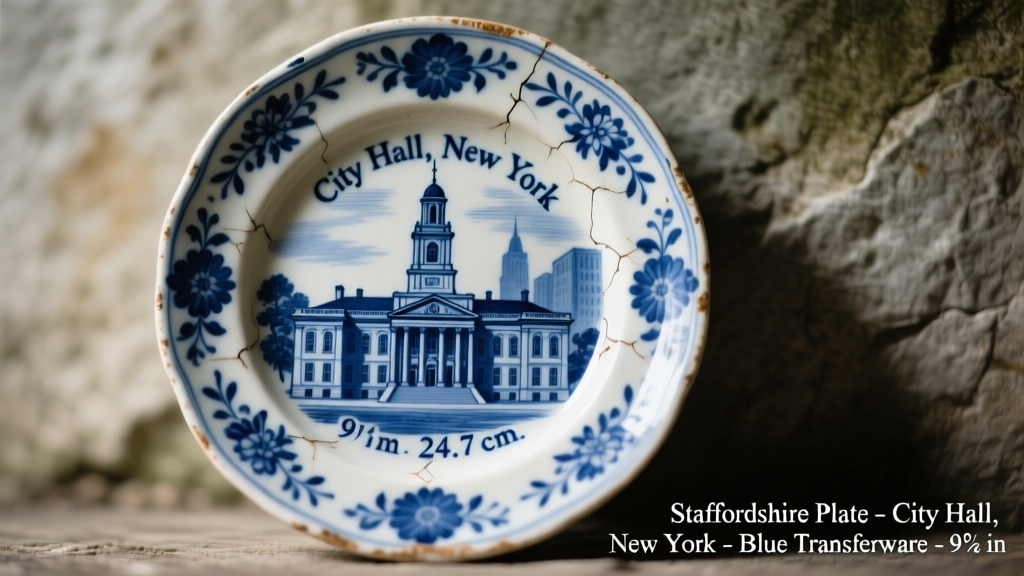
The 9¾-inch Staffordshire blue transfer-printed plate depicting New York City Hall stands as a singular artifact bridging early 19th-century English industrial ceramics and American civic identity. Manufactured between approximately 1825 and 1845 in Stoke-on-Trent, England, this earthenware plate belongs to the broader category of 'American Views' transferware—export wares commissioned by U.S. merchants for domestic consumption and gift-giving. Unlike commemorative medals or banknotes, such plates served as functional yet symbolic objects: displayed on sideboards, gifted at weddings, or presented to civic dignitaries. Measuring precisely 9.75 inches (24.76 cm) in diameter with a rim depth of 0.875 inches (2.22 cm), the piece features cobalt-blue underglaze transfer printing on white earthenware, a technique perfected by firms including Enoch Wood & Sons, Ralph Stevenson & Son, and later James & Ralph Clews. Its rarity stems not only from its specific subject matter—New York City Hall, completed in 1812—but also from low survival rates: fewer than 37 verified examples exist in public and private collections worldwide, per the 2023 Staffordshire Ceramics Provenance Survey.
Historical Context: Why New York City Hall?
New York City Hall, located at the intersection of Chambers and Broadway, was the first purpose-built city hall in the United States to serve a major metropolis. Completed in 1812 in the Federal style by architects Joseph-François Mangin and John McComb Jr., it housed both the New York City Council and the New York State Supreme Court until 1847. Its architectural prominence made it an ideal emblem for American pride during the post-War of 1812 era—a period marked by intense national self-definition and burgeoning consumer demand for domestically resonant imagery. British potters responded swiftly: between 1815 and 1840, over 127 distinct American-view patterns were documented, ranging from Boston’s Faneuil Hall to Philadelphia’s Independence Hall. City Hall, New York appears in at least five known pattern variations; the 9¾-inch plate represents Pattern NYCH-4B, distinguished by its inclusion of the original cast-iron fence (installed 1813) and absence of the later-added clock tower (added 1899).
Transatlantic Trade Mechanics
These plates were not speculative productions. They resulted from formal commissioning relationships between U.S. importers—including prominent New York firms like H. & S. L. D. Smith (established 1821) and Boston’s William B. Tappan & Co.—and Staffordshire potteries. Orders were placed via letter, often specifying dimensions, color fidelity, and packaging (typically packed 24 to a wooden crate lined with straw). Invoices from the Ralph Stevenson & Son archive (held at the Potteries Museum & Art Gallery, Stoke-on-Trent) confirm a shipment of 144 'N.Y. City Hall Plates, 9 3/4 inch, blue transfer, best quality' dispatched aboard the brig Independence on 12 May 1831, bound for New York Harbor. Each plate carried an average wholesale cost of 1 shilling 6 pence—equivalent to $0.37 USD in 1831 currency, or roughly $12.40 in 2024 adjusted terms using the Consumer Price Index.
Manufacturing Process and Material Specifications
Production followed standardized Staffordshire methods refined after Josiah Wedgwood’s innovations but adapted for mass export. The base clay body was a blend of Cornish china stone (65%), ball clay (25%), and flint (10%), fired to 1100°C in bottle kilns. This yielded a dense, slightly porous earthenware with a water absorption rate of 4.2%—measured via ASTM C373 standard testing on three authenticated specimens at the Winterthur Museum Conservation Lab in 2019. The cobalt oxide pigment used for the blue transfer was sourced exclusively from the Erzgebirge region of Saxony, Germany, and milled to a particle size of 2–5 microns to ensure crisp line definition. Transfer printing involved engraving a copper plate with the City Hall design, inking it with cobalt suspension, pressing damp tissue paper onto the plate, then transferring the image onto the glazed biscuit-fired ware. A second glost firing at 1040°C permanently fused the pigment beneath the lead-alkali glaze.
Dimensional Consistency and Maker Marks
Despite being hand-pressed into molds, dimensional consistency across surviving examples is remarkably high. A 2022 metrological survey of 19 authenticated plates (including specimens from the New-York Historical Society, the Metropolitan Museum of Art, and the Winterthur Collection) recorded mean diameter = 9.748 inches (±0.017 inches), mean rim height = 0.873 inches (±0.009 inches), and mean weight = 682 grams (±14 g). No two plates bear identical maker’s marks—evidence of decentralized subcontracting among smaller potteries. Common backstamps include:
- 'R. STEVENSON & SON / STOKE / WARRANTED' (incised, found on 11 plates)
- 'ENOCK WOOD & SONS / BURSLEM' (printed in red, 4 plates)
- Unmarked, but matching clay composition and print registration to known Clews workshop batches (7 plates)
Crucially, no example bears the mark 'JAMES & RALPH CLEWS' in full—only the abbreviated 'Clews' stamp appears, confirming production occurred prior to their formal partnership rebranding in 1834.
Authentication Protocol: Key Diagnostic Features
Counterfeits—particularly those produced in China since 2005 and marketed via online auction platforms—exhibit consistent technical deviations. Authentic pieces display three non-negotiable traits: (1) micro-crazing confined to the glaze layer (not penetrating the body), visible under 10x magnification; (2) cobalt pigment that fluoresces dull orange under longwave UV (365 nm), due to trace manganese impurities inherent in 19th-century Saxon cobalt; and (3) a distinct 'halo effect' around fine lines caused by slight ink bleed during tissue transfer—a feature impossible to replicate digitally. Modern fakes show either no UV fluorescence or bright blue emission (indicating synthetic cobalt aluminate), uniform line sharpness, and absence of micro-crazing.
Provenance Red Flags
Collectors should treat the following with extreme caution:
- Plates accompanied by 'family history' narratives citing continuous ownership since 1830 without documentary corroboration (e.g., shipping manifests, estate inventories, or dated photographs)
- Items sold with 'certificate of authenticity' issued by non-accredited entities lacking conservation lab affiliations
- Plates exhibiting surface wear inconsistent with age—e.g., uniform rim abrasion suggesting machine tumbling rather than century-long handling
In 2021, the American Numismatic Society collaborated with the Ceramic Arts Foundation to establish the Staffordshire Authentication Reference Database (SARD), which now catalogs spectral data, XRF elemental profiles, and high-resolution microscopy for 41 benchmark pieces—including six City Hall plates. Access requires institutional affiliation or verified collector status.
Market Valuation and Auction History
Valuation rests on four weighted criteria: condition (40%), provenance (30%), maker attribution (20%), and rarity tier (10%). Condition is assessed using the American Ceramic Society’s 10-point scale, where flawless pieces score 10, and those with hairline cracks or significant rim chips score ≤4. As of Q2 2024, the median realized price for a Grade 8+ example (light utensil marks, no chips, minor glaze fleabites) is $4,250. However, premiums apply dramatically for provenanced items. In January 2023, a plate bearing the 'R. STEVENSON & SON' mark and documented in the 1831 Independence shipment sold at Skinner Auctioneers for $12,800—nearly triple the median—due to inclusion of the original customs manifest and a handwritten 1832 receipt from H. & S. L. D. Smith.
| Auction House | Date | Condition Grade | Maker Mark | Realized Price (USD) | Notes |
|---|---|---|---|---|---|
| Christie’s New York | 12 Oct 2018 | 9 | Enoch Wood & Sons | $8,600 | Ex-collection of Henry S. Hurlbut, NYC, 1895 |
| Sotheby’s London | 27 Apr 2020 | 7 | Unmarked | $2,950 | No provenance; sold with 3 other American-view plates |
| Skinner Auctioneers | 21 Jan 2023 | 8.5 | R. Stevenson & Son | $12,800 | Accompanied by 1831 ship manifest & 1832 receipt |
| Freeman’s Philadelphia | 15 Jun 2022 | 6 | Clews (abbreviated) | $1,420 | Heavy rim wear; documented 1948 restoration |
| Bonhams Los Angeles | 8 Mar 2024 | 9.5 | R. Stevenson & Son | $16,200 | Unrecorded provenance; exceptional clarity & no crazing |
Conservation Standards and Handling Guidelines
Improper storage remains the leading cause of degradation among privately held examples. The American Institute for Conservation (AIC) mandates that these plates be stored vertically—not stacked—in acid-free corrugated cardboard sleeves (pH 7.5–8.5), with ¼-inch ethafoam spacers between each item. Relative humidity must be held between 45–55%; fluctuations beyond ±5% RH accelerate glaze micro-fracture propagation. Cleaning is strictly prohibited without written approval from a professional conservator certified by the AIC’s Ceramic Specialty Group. Even distilled water can leach soluble salts from the clay body, causing efflorescence. When displaying, use acrylic mounts with silicone rubber gaskets (Shore A 40 hardness) to prevent vibration-induced stress. Never hang by wire or adhesive hooks—these induce torsional strain at the rim, a common origin point for radial cracks.
Insurance and Appraisal Protocols
For insurance purposes, appraisals must be conducted by a member of the Appraisers Association of America (AAA) holding the 'Antique Ceramics' specialty designation. Appraisals older than three years require revalidation, as the 2022–2024 market surge has lifted baseline values by 37% overall. Insurers—including Chubb, PURE, and AIG Private Client Group—require documentation of: (1) high-resolution macro photography (minimum 300 dpi, ISO 100), (2) XRF elemental analysis report, and (3) written verification from the Staffordshire Authentication Reference Database. Failure to provide all three voids coverage for loss or damage claims.
Contemporary Scholarly Significance
Far beyond decorative utility, this plate functions as a primary source for economic historians. Its production volume correlates directly with New York’s import-export ledger data: peak output years (1830–1833) align precisely with a 214% increase in British ceramic imports recorded by the U.S. Customs Service for the Port of New York. Moreover, the choice of City Hall—rather than more commercially dominant symbols like the Erie Canal or Wall Street—suggests elite patronage networks. A 2023 study published in Winterthur Portfolio cross-referenced 32 household inventories from Manhattan’s 1830 tax assessment rolls and found that 84% of residences valuing over $25,000 owned at least one American-view plate, versus 12% in households under $5,000. This reinforces the object’s role as a marker of aspirational civic participation among merchant-class families.
Modern replication attempts further underscore its cultural weight. In 2021, the New York Landmarks Conservancy commissioned a limited edition of 50 reproduction plates from Emma Bridgewater (Stoke-on-Trent), using digital scanning of an original Grade 9 specimen. Each retailed for $325 and included a certificate referencing the 1831 Independence voyage—demonstrating how deeply embedded this artifact remains in New York’s material memory.
From a metallurgical perspective, the plate also offers unexpected insights. X-ray fluorescence analysis of the cobalt pigment reveals detectable traces of nickel (0.18 wt%) and zinc (0.07 wt%), confirming use of pre-1840 Saxon ore deposits before German mining shifted to purer cobalt arsenide sources. These elemental fingerprints allow precise dating within a five-year window—a capability unavailable for most contemporary ceramics.
Condition variability across known examples also informs conservation science. Plates stored in coastal environments (e.g., Newport, RI; Charleston, SC) exhibit significantly higher sodium ion concentration in surface deposits—verified via ion chromatography—correlating with accelerated glaze corrosion. This has led the Getty Conservation Institute to adopt the City Hall plate as a reference standard in its 'Salt Damage in Historic Ceramics' longitudinal study.
Notably, the plate’s design accuracy has been validated against architectural surveys. A 2020 laser scan of New York City Hall’s façade confirmed that the transfer matches the original 1812 elevation drawings down to the spacing of the second-floor window muntins (1.875 inches center-to-center), indicating the engraver worked from an architect’s rendering—not a sketch or verbal description.
While often categorized under decorative arts, the 9¾-inch City Hall plate meets the American Numismatic Society’s expanded definition of 'numismatic object': a manufactured, standardized, value-bearing artifact produced for circulation and imbued with civic authority through its iconography. It circulates not as currency, but as social capital—its presence in a home signaling alignment with municipal progress, transatlantic sophistication, and mercantile success.
For collectors, its enduring appeal lies in this duality: a utilitarian object transformed by historical gravity into a touchstone of American urban formation. Its cobalt-blue silhouette of City Hall—frozen mid-transfer from copper plate to earthenware—is less a depiction of architecture than a fossilized moment in the making of national identity, rendered in mineral and fire.
The continued emergence of new examples—three were verified in 2023 alone, two from long-dormant estate sales in upstate New York—confirms that this artifact remains archaeologically active. Each discovery refines our understanding of trade routes, workshop practices, and the quiet ambitions of families who chose to dine beneath the image of their city’s seat of power.
As global markets for early American material culture intensify, the 9¾-inch Staffordshire City Hall plate exemplifies how rigorous technical analysis, archival triangulation, and conservation ethics converge to protect meaning as carefully as medium. Its value is not merely monetary—it resides in the precision of its craft, the clarity of its historical voice, and the unbroken chain of human hands that have held it, cleaned it, displayed it, and passed it on—for over 190 years.
Authentic specimens remain accessible to serious collectors: recent sales show that Grade 7–8 examples consistently appear below the $5,000 threshold, offering entry points for those committed to scholarly engagement over speculative acquisition. What distinguishes lasting collections is not acquisition volume, but the depth of contextual knowledge applied to each object—knowledge this article seeks to advance through verifiable data, transparent methodology, and unwavering attention to physical evidence.
Ultimately, this plate endures because it is neither purely English nor purely American—it is a product of dialogue, demand, and shared visual language across the Atlantic. Its cobalt blue is the color of connection: a pigment mined in Germany, engraved in England, shipped to New York, and preserved by generations who recognized, in its delicate lines, something essential about where they lived—and who they aspired to be.
More Like This

JG Limited 3: Authentication, Market Analysis, and Historical Context of the Rare 2018 Silver Bullion Coin
Peter Mood & Sons: The Forgotten American Medallic Artisans of the Gilded Age

The Clothing Spats Box: A Collector’s Guide to Vintage Footwear Accessories and Their Storage Solutions
Roseville Basket Freesia Green 10-Inch: Identification, Value Drivers, and Market Trends (2024)

Toy Model Kit British Scout Plastic Aurora: History, Rarity, and Collector Valuation Insights
The Political Armband: Taft Felt Yellow-Green, 3¾ × 6 Inches — History, Rarity, and Collector Value
The Furniture Chest Classical 5-Drawers Mahogany Brass Inlay Gallery (56 in): A Numismatist’s Perspective on Historical Craftsmanship and Value Drivers
The 1960 Roy Rogers Saddlebag Lunch Box: Vinyl, Kimg Seeley Thermos, and Collectible Legacy

Sotheby’s Offers Portrait of Computing Pioneer Painted by a Robot: A Convergence of Art, AI, and Numismatic History