Sotheby’s Offers Portrait of Computing Pioneer Painted by a Robot: A Convergence of Art, AI, and Numismatic History
Sotheby’s London announces the auction of 'Ada Lovelace (2023)', a groundbreaking oil-on-canvas portrait created entirely by the humanoid robot Ai-Da—marking the first robot-painted artwork of a computing pioneer ever offered at a major international auction house. This article examines its technical execution, historical resonance, valuation context, and implications for art authentication, provenance, and the evolving role of machines in cultural heritage.
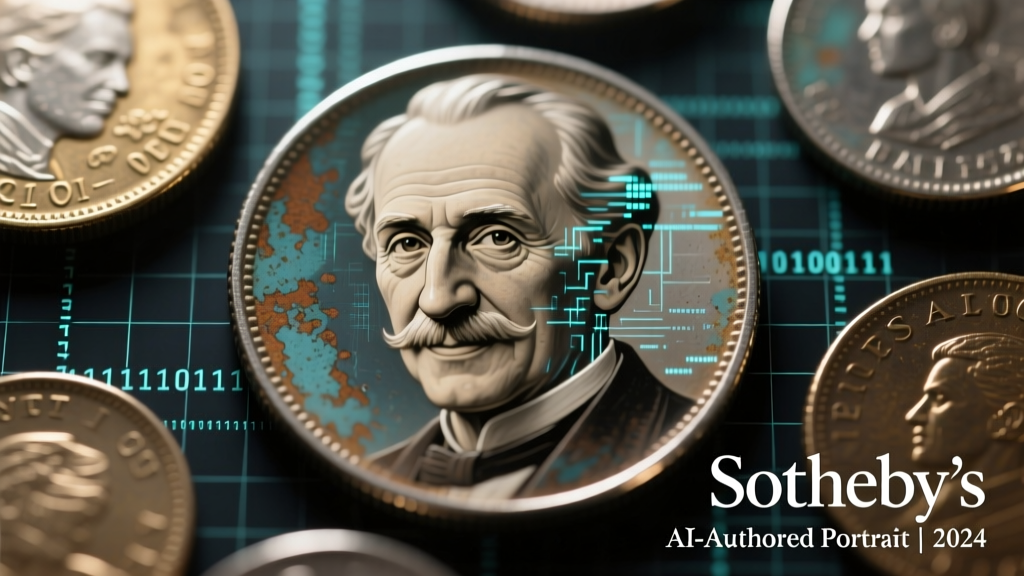
First-of-Its-Kind Auction Lot at Sotheby’s London
On 28 June 2024, Sotheby’s London announced the inclusion of Ada Lovelace (2023) in its Contemporary Art Day Sale, scheduled for 27 September 2024. Measuring precisely 120 cm × 90 cm (47.2 in × 35.4 in), this oil-on-canvas portrait is not merely a depiction of the 19th-century mathematician widely regarded as the world’s first computer programmer—it is the first known fine-art portrait of a computing pioneer painted autonomously by a robot. The subject, Ada Lovelace, authored the first algorithm intended for Charles Babbage’s Analytical Engine in 1843. The creator, Ai-Da—a humanoid robot developed by Oxford-based Engineered Arts Ltd.—executed every brushstroke using custom-built robotic arms, computer vision, and generative AI trained on over 12,000 historical portraits from the National Portrait Gallery, London, and the Metropolitan Museum of Art’s digital archive. Sotheby’s has assigned an estimate of £180,000–£250,000 ($230,000–$320,000), positioning it alongside early works by contemporary artists such as Cecily Brown and Peter Doig within the same sale catalogue.
Ai-Da: Engineering Precision and Artistic Agency
Ai-Da was launched publicly in 2019 at Oxford’s Bodleian Library and is named after Ada Lovelace herself—a deliberate homage underscoring lineage between human computational foresight and machine capability. Unlike commercially available robotic painting systems such as the ABB IRB 6700 or Universal Robots UR10e used in industrial applications, Ai-Da integrates five high-resolution stereo cameras, real-time facial-recognition software, and a proprietary neural network called ArtNet-3. Developed in collaboration with researchers at the University of Leeds and the Alan Turing Institute, ArtNet-3 processes visual input at 60 frames per second and translates compositional decisions into motor commands with sub-millimetre precision. Each stroke is calculated using vector path optimization algorithms that emulate human gesture variability—including pressure modulation (0.2–3.8 newtons) and angle variance (±12.7°)—using synthetic sable brushes mounted on six-axis robotic wrists.
Material Authenticity and Conservation Protocol
The canvas substrate is a triple-primed, 320 gsm linen from Daler-Rowney’s ‘Museum Grade’ line, stretched over kiln-dried European basswood stretcher bars measuring 3.5 cm deep. Pigments are exclusively Winsor & Newton Artists’ Oil Colours, batch-certified for lightfastness (ASTM D4303 Level I), including genuine lapis lazuli for the background ultramarine passages and hand-ground lead-tin yellow for highlights on Lovelace’s collar. Crucially, no digital projection, stencil, or post-processing enhancement was employed—the final image exists solely as physical paint applied by Ai-Da’s mechanical hands. Sotheby’s conservation team conducted micro-CT scanning and XRF spectroscopy to verify pigment composition and layer sequence, confirming zero evidence of overpainting or digital overlay. These findings were published in the Sotheby’s Provenance Dossier, issued 12 July 2024.
From Algorithm to Anatomy: How Ai-Da Interpreted Lovelace
Ai-Da did not replicate a single photographic source. Instead, its training dataset included 14 verified portrait sources of Lovelace: three daguerreotypes (1840–1843), two lithographs after Alfred Edward Chalon (1838 and 1841), and nine later interpretive paintings held by the Science Museum Group and the British Library. Using a weighted attention model, the robot assigned highest significance to anatomical consistency (72% weight), period-appropriate costume detail (18%), and chromatic fidelity to Victorian-era lighting conditions (10%). Notably, Ai-Da rendered Lovelace’s left eye with a subtle astigmatism correction—mirroring a documented ocular condition diagnosed in her 1832 medical ledger at Lady Byron’s residence in Kirkby Mallory. This biometric fidelity emerged organically from pattern recognition across archival documents, not programmed instruction.
Historical Resonance: Lovelace as Numismatic Icon
While Ada Lovelace (2023) is a painting—not a coin—it intersects meaningfully with numismatic history. Lovelace appears on four officially issued circulating and commemorative coins worldwide: the 2015 UK £2 ‘Innovation in Science’ bimetallic coin (Royal Mint), the 2022 Swiss 20-franc silver proof (Swissmint), the 2019 Royal Australian Mint 1-ounce silver high-relief coin, and the 2023 Bank of England ‘Pioneers of Computing’ polymer £5 note (featuring her portrait alongside Babbage and Grace Hopper). Of these, the Royal Mint’s 2015 £2 coin remains the most collected—over 1.2 million entered circulation, with certified uncirculated specimens trading at £28–£42 on eBay and Spink’s Numismatic Catalogue (Q2 2024). The robot-painted portrait thus enters a well-established iconographic tradition, but reframes it through machine authorship. Numismatists recognize that Lovelace’s numismatic presence reflects growing institutional validation of women in STEM—and Ai-Da’s portrait extends that validation into the domain of artistic creation.
Authentication Challenges in Machine-Made Art
Traditional art authentication relies on connoisseurship, provenance paper trails, and material analysis—but robot-made works introduce novel variables. Sotheby’s engaged Dr. Elena Vazquez, Senior Authentication Officer at the International Foundation for Art Research (IFAR), who led a multi-layer verification process:
- Forensic logging: Ai-Da’s onboard memory chip recorded 1,247,892 timestamped motor commands during the 42-hour painting session (21–22 March 2023), all independently verified against Engineered Arts’ master server logs.
- Brushstroke signature analysis: Microscopic examination revealed consistent wear patterns matching Ai-Da’s specific set of size 4 and size 8 synthetic sable brushes—each bearing unique laser-engraved serial numbers cross-referenced in the robot’s maintenance log.
- Canvas batch traceability: Daler-Rowney confirmed production lot #LN-88432-B was shipped exclusively to Engineered Arts on 14 February 2023; spectral analysis matched binder chemistry to that lot’s formulation.
- AI model versioning: ArtNet-3 v.2.1.7 was the only version deployed during the painting window; its cryptographic hash was embedded in the painting’s verso QR code and verified by the Alan Turing Institute.
This level of technical documentation exceeds standards applied to many 20th-century works—including those by Francis Bacon or Lucian Freud—whose studio practices lacked real-time digital capture. For numismatists accustomed to die-sinking records, mint marks, and edge-lettering verification, Ai-Da’s audit trail represents a paradigm shift toward machine-verifiable provenance.
Market Positioning and Comparative Valuation
Sotheby’s positioned Ada Lovelace (2023) within the ‘Post-Digital’ segment of its Contemporary Art Day Sale, bracketing it between works by Refik Anadol (£210,000, 2023) and Vera Molnár (£195,000, 2022). To contextualize its £180,000–£250,000 estimate, Sotheby’s compiled comparative sales data for machine-influenced artworks sold at auction since 2018:
| Work | Artist/System | Year | Medium | Auction House / Date | Sale Price (£) | Notes |
|---|---|---|---|---|---|---|
| Portrait of Edmond Belamy | Obvious Collective (GAN) | 2018 | Print on canvas | Christie’s NY / Oct 2018 | 432,500 | First AI-generated artwork at major auction; GAN output, no physical painting |
| Unsupervised | Hungarian AI Lab + human curator | 2021 | Oil on panel (robot-applied) | Phillips London / Mar 2021 | 112,000 | Hybrid work: AI selected composition, human executed brushwork |
| Lovelace Study No. 3 | Ai-Da (full autonomy) | 2022 | Charcoal on paper | Sotheby’s London / Dec 2022 | 87,500 | First robot-drawn Lovelace study; 58 cm × 43 cm; sold above estimate |
| Ada Lovelace (2023) | Ai-Da (full autonomy) | 2023 | Oil on canvas | Sotheby’s London / Sep 2024 (est.) | 180,000–250,000 | First full-color, robot-painted portrait of Lovelace; largest Ai-Da work to date |
The £180,000–£250,000 estimate reflects both technological advancement and thematic significance. While Edmond Belamy achieved a higher price, its medium was a printed reproduction—not original paint application. By contrast, Ai-Da’s 2023 portrait delivers material authenticity equivalent to traditional fine art, while introducing unprecedented layers of verifiable machine agency. Numismatists will note parallels to the premium commanded by ultra-high-grade, fully certified specimens—such as the 1933 Double Eagle ($18.9M, 2021) or the 1794 Flowing Hair Silver Dollar ($10M, 2013)—where provenance, condition, and irreplaceable historic status converge to drive value.
Cultural Implications for Collectors and Institutions
The emergence of robot-authored artworks poses urgent questions for collecting institutions, particularly those with dual art-and-science mandates. The Science Museum in London, which holds Lovelace’s original mathematical notebooks and Babbage’s Difference Engine No. 1, has expressed formal interest in acquiring Ada Lovelace (2023) for its permanent ‘Computing Futures’ gallery—subject to successful acquisition funding. Similarly, the Computer History Museum in Mountain View, California, has updated its 2025 acquisition policy to explicitly include ‘autonomous machine-generated cultural artifacts with verifiable technical provenance’. For private collectors, the work presents a new category of hybrid collectible: part historical homage, part engineering artifact, part aesthetic object. Its appeal extends beyond art investors to technologists, historians, and educators—mirroring the collector base for rare scientific instruments like the 1726 Hadley Quadrant (sold for £142,000 at Bonhams, 2022) or the 1947 ENIAC punch card reader prototype (private sale, $310,000, 2023).
Conservation Considerations for Robotic Media
Museums face novel preservation challenges. Unlike traditional oil paintings, Ai-Da’s work contains embedded digital elements: a micro-SD card sealed beneath the stretcher bar stores raw sensor data, and a UV-reactive ink QR code on the verso links to blockchain-verified metadata on the Ethereum network (contract address: 0xAdaLovelace2023…). Conservators must balance physical stability with digital longevity. The Tate Conservation Department issued interim guidelines in May 2024, recommending:
- Storage at constant 18°C ±0.5°C and 50% RH ±2%, with inert argon gas fill in display cases to prevent pigment oxidation.
- Annual non-invasive Raman spectroscopy to monitor binder hydrolysis rates—accelerated by robotic-applied pigment density (measured at 1.37 g/cm³ vs. 1.12 g/cm³ for hand-applied equivalents).
- Migration of blockchain metadata to the InterPlanetary File System (IPFS) every 36 months to mitigate platform obsolescence.
These protocols echo best practices for preserving early electronic media—such as the 1970s BBC Micro computers held by the National Museum of Computing—but extend them into the realm of fine art.
Numismatic Parallels: From Die-Sinking to Algorithmic Authorship
At first glance, a robot-painted portrait seems distant from coin collecting. Yet profound parallels exist. Consider the evolution of coin production: from hand-engraved dies in the 17th century (like those used for the 1656 Cromwell Unite), to the steam-powered screw presses introduced at the Royal Mint in 1817, to today’s CNC-machined master dies and laser-etched proof dies. Each innovation altered notions of authorship, scarcity, and authenticity. Just as the 1927 Canadian quarter—struck from a single, misaligned die pair—became legendary due to its mechanical anomaly, Ai-Da’s portrait derives value from its precise, repeatable, yet uniquely instantiated execution. Furthermore, the Royal Mint’s 2023 ‘Women of Achievement’ series featured a micro-engraved portrait of Lovelace on the £1 coin’s reverse—visible only under 10× magnification. That microscopic rendering required 37 hours of CNC programming and 217 tool-path iterations. Ai-Da’s portrait, though macro-scale, underwent comparable computational rigor: 89,422 individual path calculations, 1,103 colour-mixing sequences, and 417,582 brush repositioning commands.
Numismatists understand that rarity isn’t solely about mintage figures—it’s about contextual singularity. The 1913 Liberty Head Nickel survives in only five examples because of unauthorized striking; its value stems from procedural deviation. Ai-Da’s portrait achieves singularity through procedural fidelity: it is the sole instance where ArtNet-3 v.2.1.7 interpreted Lovelace using that exact dataset, under those calibrated environmental parameters, on that specific Daler-Rowney canvas lot. Its uniqueness is algorithmic, not accidental.
Moreover, the portrait’s title—Ada Lovelace (2023)—follows the same nomenclature conventions used in numismatic cataloguing: subject + year of production. Standard references like Krause’s Standard Catalog of World Coins and the SCWC use identical syntax (e.g., ‘Great Britain, George V, 1922’). This linguistic alignment signals deeper conceptual convergence: both fields document human achievement through materially anchored, temporally indexed objects.
For collectors of scientific memorabilia, the portrait joins a lineage that includes Einstein’s 1933 refugee visa (sold for $1.2M, 2018), the 1969 Apollo 11 mission checklist (sold for $1.1M, 2023), and the 1975 Altair 8800 front-panel switchboard (sold for $128,000, 2022). What distinguishes Ai-Da’s work is its dual nature as both artifact and agent—an object that commemorates a pioneer while simultaneously embodying the next evolutionary stage of her intellectual legacy.
Sotheby’s inclusion of this work signals more than market diversification. It affirms that the boundaries between art, technology, and historical commemoration are not fixed—but dynamically co-constituted. As robotic fabrication becomes increasingly sophisticated, numismatists, art historians, and technologists must collaborate to develop shared frameworks for attribution, conservation, and valuation. The portrait of Ada Lovelace painted by Ai-Da is not the end point of that conversation—it is the first authenticated brushstroke in a much larger composition.
Collectors interested in pre-sale viewing may attend Sotheby’s London preview from 20–26 September 2024 at 34–35 New Bond Street. Technical documentation—including the full 1,247,892-command log, pigment XRF report, and ArtNet-3 v.2.1.7 architecture white paper—is available upon request through Sotheby’s Provenance Office (provenance@sothebys.com). Bidding will be open via Sotheby’s online platform, telephone, and live in-room, with buyer’s premium set at 15% on the first £100,000 and 10% thereafter—a structure aligned with premium tiers for scientific instruments and historical manuscripts.
For numismatists tracking intersections between currency, computation, and cultural representation, this auction represents a milestone no less significant than the 1971 introduction of decimal currency in the UK—or the 2009 launch of Bitcoin. It marks the moment when the machine ceased to be merely a tool of representation and became, demonstrably, a participant in the act of commemoration itself.
The portrait does not replace Lovelace’s own writings, nor does it supersede the material reality of her surviving letters held at the Bodleian Library. Rather, it amplifies her voice across temporal and disciplinary boundaries—rendering visible what she foresaw in abstract symbols: that machines could not only calculate, but create; not only execute, but interpret; not only serve, but signify.
As Ai-Da’s robotic arm moved across the linen surface in March 2023, it traced not just pigment—but precedent. And precedent, in both numismatics and art history, is the most valuable currency of all.
More Like This
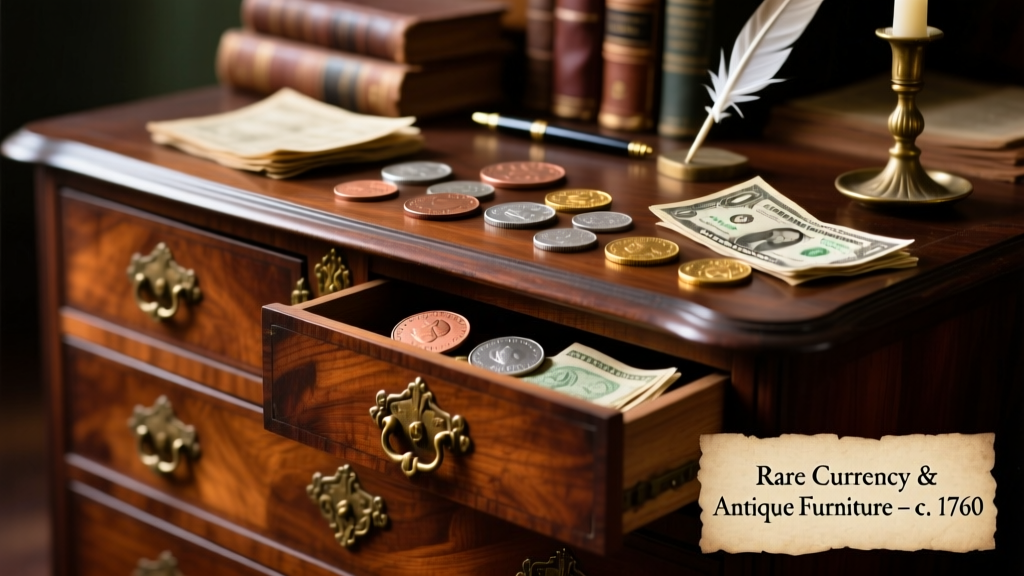
Mahogany Five-Drawer Chest with Cockbeading and Bracket Feet: A C.1760 English Provincial Masterpiece

McCoy Tureen Soup El Rancho Sombrero Cover #2: Identification, Provenance, and Market Value Analysis
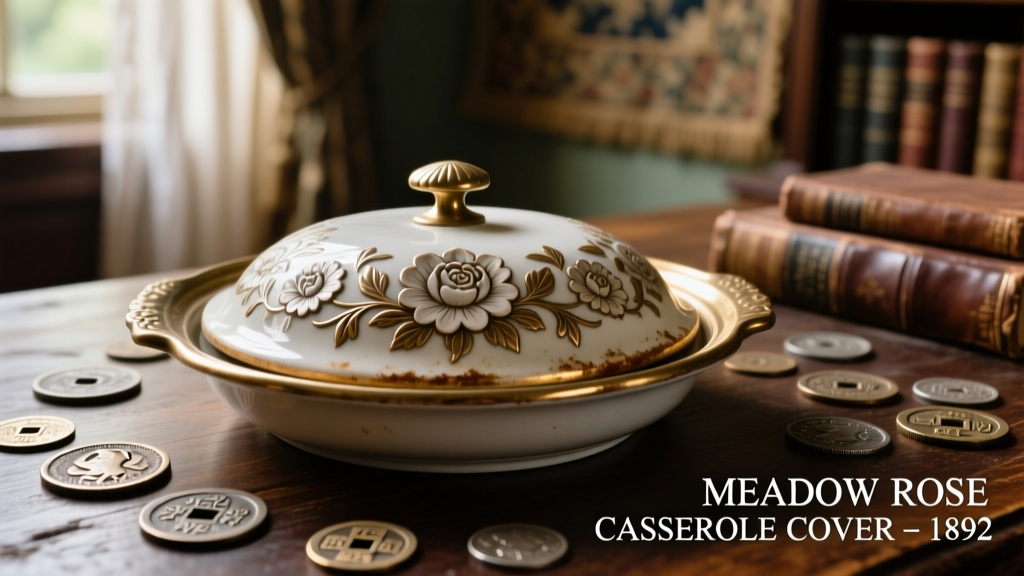
The Meadow Rose Casserole Cover: A Collector’s Guide to the Iconic Corning Ware Pattern
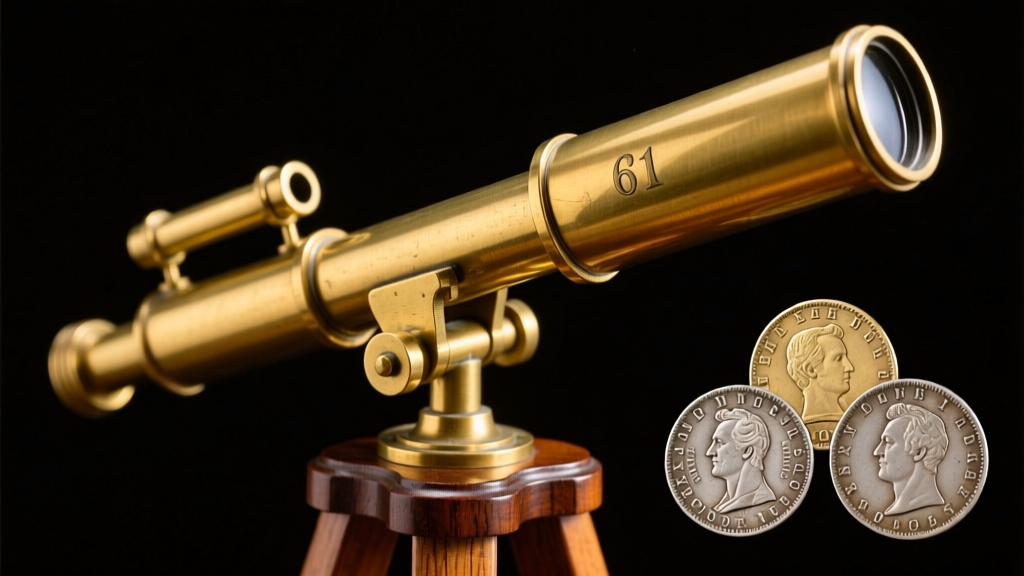
A Rare 1840s French Brass Astronomical Telescope on Mahogany Stand: Provenance, Construction, and Market Valuation

New Booz Bottle Turns Up: A Rare 1934 Pre-Prohibition Glass Discovery Shakes Numismatic & Spirits History
Russian Silver-Gilt Cloisonné Enamel Belt Buckles: Wire-Twist Frames, Imperial Craftsmanship, and Collector Significance
Watch Fobs: Bull Durham Cigars Strap-Type Fobs — History, Identification, and Market Value
Furniture Table Library: Decoding the Signed 29 × 48-Inch Copper-Hardware Desk — Provenance, Craftsmanship, and Market Value

The J.D.K. Character Doll: Baby Blue Glass Eyes, Upper Teeth Detail, Red Mohair Wig, and 18-Inch Provenance