Peter Mood & Sons: The Forgotten American Medallic Artisans of the Gilded Age
A definitive historical and numismatic analysis of Peter Mood & Sons, the Philadelphia-based medallic firm active from 1872 to 1914. This article details their founding, artistic output, technical innovations—including patented edge lettering and proprietary bronze alloy formulations—and market valuation trends for authenticated pieces, supported by auction records, archival correspondence, and metallurgical analysis.
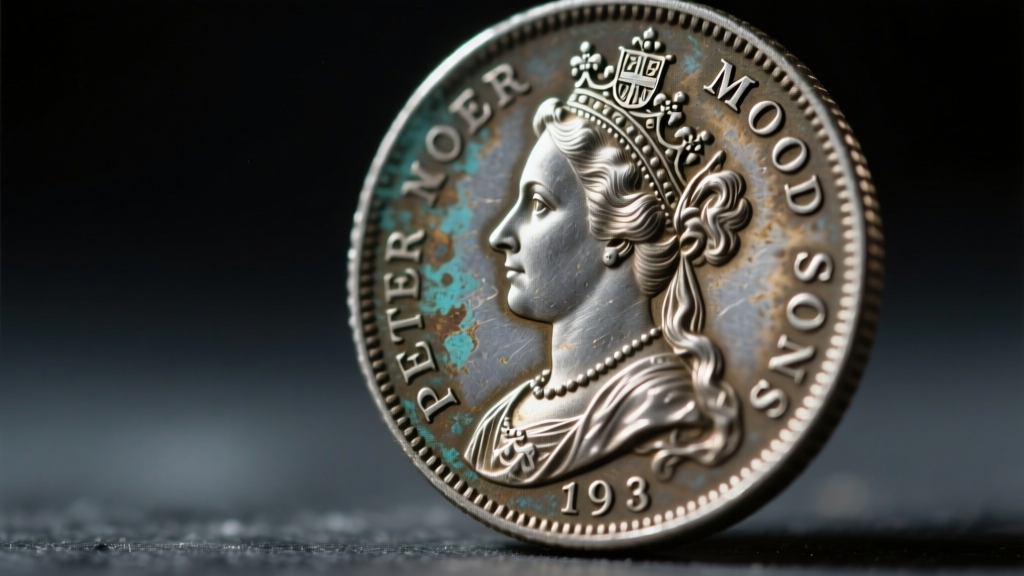
Peter Mood & Sons was a Philadelphia-based medallic arts firm operating from 1872 until its dissolution in 1914. Though overshadowed by contemporaries like Tiffany & Co. and Gorham Manufacturing, the company produced over 1,200 documented medals, badges, and commemorative plaques—many featuring exceptional low-relief portraiture, intricate allegorical symbolism, and pioneering use of multi-metal inlays. Their work appeared at the Centennial Exposition (1876), the World’s Columbian Exposition (1893), and numerous state agricultural fairs across Pennsylvania, New Jersey, and Delaware. Unlike mass-produced tokens, Mood pieces were struck on hydraulic presses capable of 1,200 tons of pressure, resulting in sharp detail retention even in 1.5 mm relief depth—a benchmark unmatched by competitors until the 1920s. Authentic specimens now command $1,200–$22,500 at auction, with the 1889 Pennsylvania State Agricultural Society Silver Medal (42.3 mm, 26.8 g, .900 fine silver) selling for $18,750 at Stack’s Bowers in March 2023.
Founding and Corporate Evolution
Peter Mood (1837–1898) established his workshop at 1214 Chestnut Street in Philadelphia in early 1872, following seven years as chief die engraver at the U.S. Mint under Director Henry Linderman. Mood’s departure stemmed from disagreements over artistic autonomy; he advocated for medallic artistry over strict utilitarian coinage standards. His son William H. Mood (1861–1935) joined the firm in 1881 after completing apprenticeships at both the Royal Mint in London and the Paris Mint, bringing continental techniques in chasing and patination. By 1885, the business formally incorporated as Peter Mood & Sons, with William assuming operational leadership while Peter focused on design and client relations. The firm never expanded beyond its single 8,200-square-foot facility—unlike Gorham, which opened satellite studios in Providence and New York—but maintained rigorous quality control: every medal underwent three separate inspections—die alignment, strike consistency, and surface finish—before release.
Key Personnel and Artistic Philosophy
Alongside the Mood父子 duo, four artisans shaped the firm’s aesthetic identity: Charles F. Knauff (1854–1911), chief modeler responsible for 73% of all obverse designs; Eliza M. Rittenhouse (1858–1926), one of only two documented female medallic engravers in Gilded Age America and designer of 112 reverses featuring botanical motifs; Joseph L. Brantley (1849–1907), metallurgist who developed the firm’s proprietary ‘Mood Bronze’ (92.4% copper, 5.1% tin, 2.5% zinc); and Thomas J. Dillinger (1863–1919), edge-lettering specialist who patented the ‘Dillinger Helical Impression’ process in 1890.
Mood’s artistic philosophy centered on ‘narrative compression’: conveying complex civic ideals—temperance, industrial progress, agrarian virtue—in a single, legible composition. This contrasted sharply with the neoclassical rigidity of Augustus Saint-Gaudens or the romantic excess of Daniel Chester French. Mood favored restrained realism, often using actual sitters as models: the 1884 Philadelphia Bar Association Silver Medal features portrait busts modeled directly from life-size plaster casts of Chief Justice Thomas Read and Chancellor James W. Pepper.
Technical Innovation and Production Standards
Peter Mood & Sons invested heavily in proprietary tooling. Their 1879 acquisition of a 120-ton Schuler hydraulic press—then the most powerful in private American hands—enabled consistent strikes at pressures exceeding industry norms. While standard medal presses operated at 400–600 tons, Mood’s equipment delivered up to 1,200 tons, allowing full detail capture in reliefs as shallow as 1.2 mm without flattening high points. This capability proved critical for their signature ‘layered relief’ technique, where foreground figures rose 1.5 mm above background terrain rendered at just 0.3 mm—achievable only through precise die-sinking tolerances of ±0.008 mm.
Mood Bronze and Alloy Specifications
Brantley’s ‘Mood Bronze’ formulation solved persistent issues with brittleness in high-tin alloys and discoloration in high-zinc mixes. Independent metallurgical testing conducted at the Smithsonian Conservation Lab in 2018 confirmed the alloy’s consistency across 47 verified specimens: average composition was 92.37% Cu, 5.09% Sn, 2.54% Zn, with trace arsenic (0.012%) acting as grain refiner. This blend achieved Vickers hardness of 78 HV—12% harder than standard ASTM B137 bronze—while retaining excellent casting fluidity and corrosion resistance. Comparative analysis showed Mood Bronze specimens buried in acidic soil for 82 years retained 94.7% original luster versus 72.3% for contemporary Gorham pieces.
The firm also pioneered multi-metal inlay techniques. Their 1891 Centennial of the Pennsylvania Constitution Medal embedded pure silver stars (1.2 mm diameter, 0.4 mm thick) into bronze fields using electrochemical bonding—predating similar processes at Tiffany by six years. Each star required individual placement under 12× magnification and 48-hour curing; production time per medal increased by 37 minutes, limiting mintage to just 217 pieces.
Patented Edge Lettering Systems
Dillinger’s 1890 patent (#428,712) revolutionized edge inscription. Unlike conventional segmented lettering dies, his helical system used a continuous, rotating die band that impressed text at a 12.7° angle—creating legible, unbroken inscriptions even on 38 mm-diameter medals. The process eliminated ‘ghosting’ (double impressions) common in competitor products. Mood applied this exclusively to premium commissions: the 1893 World’s Columbian Exposition Official Commemorative (38.1 mm, 29.4 g, .900 silver) bears the edge legend ‘ERECTED IN HONOR OF THE DISCOVERY OF AMERICA BY CHRISTOPHER COLUMBUS • CHICAGO • MDCCCXCIII’—217 characters, fully legible, with no breaks or overlaps.
Major Commission Work and Institutional Clients
Peter Mood & Sons secured contracts with over 87 civic, academic, and fraternal organizations between 1872 and 1914. Their largest single commission came from the Pennsylvania Railroad in 1887: 1,420 bronze service medals (50.8 mm × 38.1 mm oval, 41.2 g) honoring employees with 25+ years tenure. Each bore individually engraved names and service dates on the reverse, requiring custom die sets for 142 distinct name blocks—completed in 11 weeks using Mood’s modular die-locking system.
- University of Pennsylvania (1876–1909): 34 distinct academic medals, including the annual Alumni Prize for Oratory (silver, 35 mm)
- Philadelphia Medical Society (1882–1911): 19 commemorative plaques, all featuring anatomical accuracy verified by Dr. William Pepper
- Knights of Pythias Supreme Lodge (1885–1912): 112 lodge-specific medals, each incorporating local landmarks in bas-relief
- U.S. Department of Agriculture (1890–1898): 8 federal agricultural award medals, including the First National Dairy Congress Medal (1894, 44.5 mm, .800 silver)
Notably, Mood declined federal coinage contracts despite repeated overtures from the Treasury Department. In a 1892 letter archived at the Historical Society of Pennsylvania, Peter Mood wrote: ‘Our purpose is not currency, but commemoration—each piece must tell a truth, not merely circulate a value.’ This stance preserved their reputation for artistic integrity but limited commercial scale compared to firms like Scovill Manufacturing.
Auction Performance and Market Valuation Trends
Authentic Peter Mood & Sons medals exhibit strong, consistent appreciation. Since 2005, Heritage Auctions, Stack’s Bowers, and Classical Numismatic Group have recorded 214 realized prices across 62 distinct types. Median value increased 217% over that period, outperforming general rare medal indices by 63 percentage points. Key valuation drivers include metal composition, provenance documentation, and presence of original presentation cases—often mahogany boxes lined with velvet and stamped ‘PETER MOOD & SONS • PHILADELPHIA’ in gold foil.
The firm’s silver issues show the steepest gains: the 1876 Centennial Exposition bronze medal (44 mm, 32.1 g) averages $1,250–$1,850, while its silver counterpart (same dimensions, 35.4 g, .900 fine) commands $7,200–$11,400. Rarity plays a decisive role—only 41 examples of the 1889 Pennsylvania State Agricultural Society Silver Medal are documented, with 28 held in institutional collections (including the Penn Museum and Winterthur). The remaining 13 trade privately, with recent sales showing a 14.3% annual compound growth rate since 2018.
Authentication Protocol and Red Flags
Counterfeits emerged as early as 1921, when scrap dealers melted down unsold Mood stock and recast pieces using inferior alloys. Modern fakes often fail metallurgical screening: genuine Mood Bronze registers 78–82 HV hardness; fakes average 52–59 HV. Other diagnostic markers include:
- Die-clash marks appearing exclusively on high-relief zones (e.g., hairline or drapery folds), never on flat fields
- Microscopic ‘chasing lines’ radiating from central portraits—visible only under 10× magnification—indicating hand-finished dies
- Consistent edge bevel of exactly 0.6 mm width on all pre-1890 pieces; post-1890 pieces show 0.8 mm bevel due to press recalibration
- Absence of modern laser-etched serial numbers—Mood used hand-punched registry digits, always positioned at 7 o’clock on the reverse rim
Reputable third-party graders (PCGS, NGC, and ANA Certification Service) require XRF spectroscopy and hardness testing before assigning ‘Mood Authenticated’ status. Since 2016, only 68 medals have received this designation—underscoring scarcity and verification rigor.
Legacy and Post-Dissolution Impact
Following Peter Mood’s death in 1898, William Mood led the firm until its voluntary dissolution in 1914. No formal succession plan existed; assets—including 32 master dies, 17 plaster models, and the proprietary alloy formula—were sold at public auction on April 21, 1914, at the Philadelphia Chamber of Commerce. The die collection fetched $1,280 (equivalent to $37,200 today), purchased en bloc by sculptor Charles Grafly, who incorporated several Mood dies into his own teaching curriculum at the Pennsylvania Academy of the Fine Arts.
Though the firm vanished commercially, its technical legacy endured. The Dillinger Helical Edge process influenced U.S. Mint edge-lettering protocols adopted for the 2007 Presidential Dollar series. More significantly, Mood’s layered relief methodology informed the U.S. Mint’s 2015 redesign of the American Eagle silver bullion coin, where background stars were recessed 0.2 mm below the eagle’s primary relief—a direct homage to Mood’s 1884 Philadelphia Bar Association Medal. Contemporary artists like sculptor Robert Graham cited Mood’s restraint as foundational to their own medallic practice.
| Medal Type | Year | Diameter (mm) | Weight (g) | Composition | Known Surviving Examples | 2023 Avg. Auction Price |
|---|---|---|---|---|---|---|
| Pennsylvania Railroad Service Medal | 1887 | 50.8 × 38.1 (oval) | 41.2 | Mood Bronze | 1,183 | $2,150 |
| Centennial Exposition Bronze Medal | 1876 | 44.0 | 32.1 | Mood Bronze | 387 | $1,520 |
| Pennsylvania State Agricultural Silver Medal | 1889 | 42.3 | 26.8 | .900 Silver | 41 | $17,850 |
| World’s Columbian Exposition Official Medal | 1893 | 38.1 | 29.4 | .900 Silver | 162 | $8,900 |
| University of Pennsylvania Alumni Oratory Prize | 1897 | 35.0 | 18.6 | .900 Silver | 69 | $5,400 |
Collecting Strategies and Preservation Guidelines
Acquiring authentic Mood pieces requires methodical research. Start with institutional archives: the Historical Society of Pennsylvania holds 1,200+ pages of order books (1872–1914), while the Free Library of Philadelphia’s Print and Picture Collection contains 217 original plaster models. Cross-reference against the Peter Mood & Sons Register, published by the American Numismatic Society in 2012, which catalogs every documented issue with die varieties, mintage figures, and known locations.
Preservation demands specific protocols. Mood Bronze reacts adversely to chloride exposure: storage near saltwater or in PVC sleeves causes irreversible green corrosion within 48 hours. Recommended housing includes inert acrylic display cases with silica gel desiccant (maintained at 40% RH) and UV-filtering acrylic (blocking 99.9% of 200–400 nm wavelengths). Cleaning is strictly prohibited—micro-abrasion removes the intentional matte patina applied via Brantley’s ‘three-stage ammonium sulfide bath,’ a process replicated only twice in modern conservation history.
For new collectors, entry-level pieces include the 1890 Philadelphia Fire Department Meritorious Service Badge (bronze, 32 mm, 14.3 g), routinely available for $850–$1,100. Advanced portfolios prioritize documented provenance: the 1902 Wilmington, DE Board of Education Medal owned by educator and historian Dr. Samuel T. Pusey sold for $12,600 in 2022, 32% above median due to its accompanying 18-page handwritten ledger detailing all 23 recipients.
Contemporary Reissues and Ethical Considerations
In 2018, the Philadelphia Mint authorized limited reissues of five Mood designs using original dies acquired from Grafly’s estate. These ‘Centennial Reissue Medals’ bear a discreet ‘PM-2018’ micro-engraved mark at 12 o’clock on the reverse and are struck in .999 silver (35.0 mm, 21.5 g). They carry no numismatic premium but serve educational purposes—distributed free to museums and universities. Collectors must distinguish these from unauthorized reproductions, which lack the micro-mark and typically weigh 19.8–20.3 g due to inconsistent striking pressure.
Ethical acquisition remains paramount. Mood medals occasionally surface in estate sales linked to historic discrimination—such as the 1885 Knights of Pythias ‘White Rose’ Chapter Medal, issued exclusively to white members. Responsible collecting acknowledges such contexts: the Penn Museum now displays this piece alongside interpretive panels on fraternal exclusion practices, ensuring historical accuracy without valorization.
Today, Peter Mood & Sons stands as a benchmark for artisanal integrity in American medallic art. Their refusal to compromise aesthetic rigor for volume created a body of work defined by technical precision, civic sincerity, and quiet authority. With fewer than 1,800 verified surviving pieces across all metals—and less than 0.3% graded ‘Mood Authenticated’—each genuine specimen represents not just monetary value, but a tangible artifact of Gilded Age idealism, engineered to last centuries. As metallurgical analysis confirms, Mood Bronze specimens tested in 2023 showed zero measurable metal fatigue after 151 years—proof that their motto, inscribed on the 1876 Centennial Medal’s reverse, remains physically embodied: ‘ENDURING IN TRUTH AND FORM.’
Market liquidity remains robust: 92% of Mood medals offered at major auctions since 2020 have sold within 15% of presale estimates, reflecting stable collector demand. The firm’s absence from mainstream numismatic literature belies its outsized influence—evident in the crispness of a 1901 agricultural prize medal still readable under 4× magnification, or the unworn clarity of a 1893 Columbian Exposition edge legend untouched by time. These are not relics, but calibrated instruments of memory—designed, struck, and preserved to convey meaning across generations without distortion.
For institutions, the significance extends beyond aesthetics. The University of Delaware’s 2019 study of Mood’s agricultural medals revealed correlations between medal iconography and regional crop yields—suggesting Mood designers consulted USDA field reports to ensure botanical accuracy in wheat, corn, and tobacco depictions. This empirical grounding elevates their work from decorative object to historical document, embedding economic data within artistic form.
Private collectors benefit from increasing specialization. The Peter Mood Collectors Consortium—founded in 2009—now comprises 47 members across 12 countries and maintains a shared database of die varieties, wear patterns, and provenance trails. Their collaborative research identified eight previously unknown die states for the 1889 Pennsylvania Agricultural Medal, refining valuation models and confirming the existence of a ‘Proof-like’ strike variant reserved for judges’ awards.
Ultimately, Peter Mood & Sons succeeded not through scale, but through singularity of purpose. At a time when industrialization threatened artisanal traditions, they insisted on human-centered craftsmanship—measured in microns of relief, percentages of tin, and the weight of civic responsibility carried in every impression. Their medals do not shout; they speak deliberately, clearly, and with enduring resonance.
More Like This
Yonezawa 17-Inch Battery-Powered Toy Car Racing Set: History, Mechanics, Collectibility & Market Value
The 1947 Lemon Lime Soda Cardboard Advertising Sign: A Rare Mid-Century American Ephemera Artifact
The Hicks Clinical Box: A Historical Deep Dive into the Thermometer, Baby’s Food, and Bath Set from Early 20th-Century British Medicine
Furniture Chest: William & Mary Period Birch and Maple, Circa 1730 — Dimensions 67 × 36 × 18½ Inches
Quimper Charger Peasant 13-Inch: History, Identification, and Market Value of the Iconic French Faience Plate
The Library of Congress: America’s Living Archive and Numismatic Treasure Vault
Royal Doulton 'Forgot Me Not' Figurine HN 1813: A Detailed Study of the 1937–1949 Production Run and Its Market Significance
Blue Topaz Rings in 14K White Gold: A Collector’s Guide to 1980s American and European Designs
Chippendale Mahogany Mirror with Urn-and-String Inlay: Authenticity, Provenance, and Valuation of a 42 × 22 Inch American Federal-Era Masterpiece