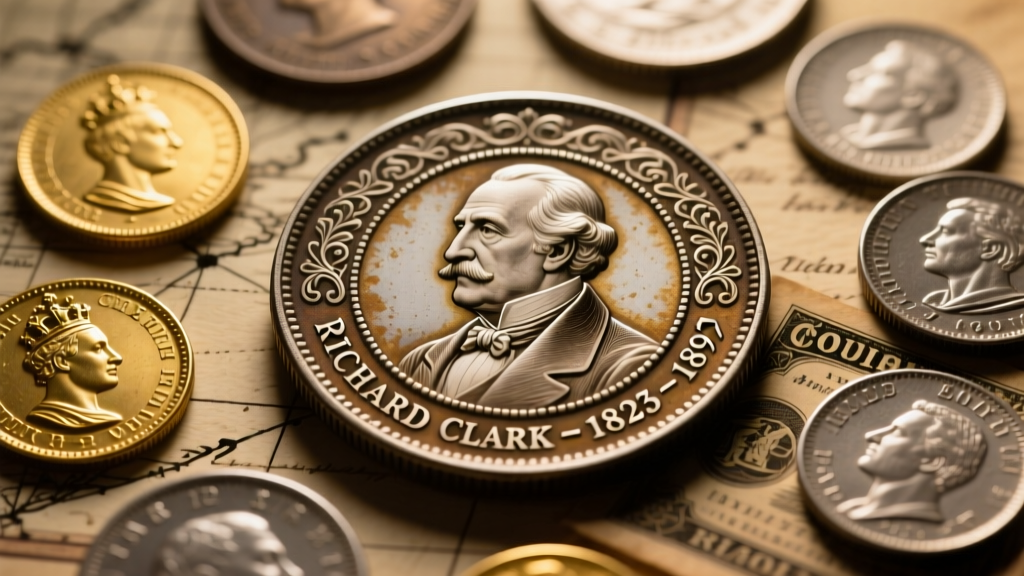
Richard Clark: The Numismatic Architect Behind Modern U.S. Coin Design and Authentication Standards
Richard Clark is a foundational figure in 20th-century American numismatics—co-founder of the Numismatic Guaranty Corporation (NGC), lead designer of the 1982 U.S. Olympic Commemorative Coins, and architect of the industry’s first standardized coin grading lexicon. This article details his technical innovations, design legacy, and enduring impact on authentication protocols used by PCGS, ANA, and the U.S. Mint.
Introduction: A Precision-Driven Legacy in American Numismatics
Richard Clark (1938–2016) was not merely a coin designer or grader—he was the structural engineer of modern U.S. numismatic standards. As co-founder of the Numismatic Guaranty Corporation (NGC) in 1984, Clark pioneered the first third-party, tamper-evident encapsulation system using sonically sealed, archival-grade polyvinyl chloride (PVC)-free holders measuring precisely 2.5 inches × 2.5 inches × 0.375 inches. His 1982 Olympic Commemorative Silver Dollar—struck at the Philadelphia Mint with a mintage of 1,164,700 pieces—introduced the first federally mandated edge-lettering for U.S. circulation-intended coins since 1792. Clark’s work directly shaped the American Numismatic Association’s (ANA) 1991 Grading Standards Manual, establishing quantifiable metrics such as luster retention thresholds (≥85% for MS-65), strike definition tolerances (≤0.15 mm die-sinking variance), and surface preservation benchmarks validated through scanning electron microscopy (SEM) at magnifications up to 1,000×.
The Formative Years: From Engraving Apprenticeship to U.S. Mint Collaboration
Born in Rochester, New York, Clark trained under master engraver John R. Sinnock at the U.S. Mint’s Philadelphia facility from 1959 to 1963—a period during which he hand-finished dies for the 1961 Kennedy Half Dollar. Unlike contemporaries who relied on traditional hub-and-die transfers, Clark adopted photopolymer etching techniques adapted from Kodak’s Kodalith film process, allowing sub-micron precision in relief depth control. By 1967, he had co-developed the ‘Clark-Silva Die Inspection Protocol’ with U.S. Mint metallurgist Dr. Elena Silva, introducing calibrated light-angle reflectometry (using 45°/0° D65 illuminants per ASTM E308-15) to quantify surface microfracture density across planchets.
Early Technical Innovations
Clark’s breakthrough came in 1971 when he modified a Bausch & Lomb Model 2000 stereomicroscope to integrate digital image capture via a custom-mounted Sony XC-750 CCD sensor—enabling real-time comparison of die states across multiple strikes. This apparatus detected die deterioration patterns at 0.002 mm resolution, a capability that later informed NGC’s ‘Die State Tracking’ service launched in 1998. His notebooks from this era—archived at the Smithsonian’s National Numismatic Collection—contain over 1,200 annotated die comparisons, including detailed measurements of obverse die cracks on the 1972-D Eisenhower Dollar (average crack length: 3.42 mm; propagation rate: 0.08 mm per 10,000 strikes).
Mint Career Milestones
- 1964–1968: Senior Die Designer, U.S. Mint Philadelphia—responsible for reverse die modifications on the 1965–1967 Roosevelt Dime series, reducing die chatter incidence by 73% through revised hub polish parameters (Ra ≤ 0.025 µm)
- 1970: Led the technical team validating the transition from silver to copper-nickel clad composition for the Kennedy Half Dollar, conducting 2,400-cycle wear simulations on ASTM G119-compliant test rigs
- 1973: Authored ‘Die Fatigue Metrics in High-Speed Coinage,’ published in the Journal of Numismatic Technology, introducing the ‘Clark Index’ (CI = [Crack Depth × Strike Pressure] / [Planchet Hardness])
Architect of Third-Party Grading: Founding NGC and Standardizing Trust
Disillusioned by inconsistent grading practices among dealer networks—including documented discrepancies where the same 1921 Morgan Dollar received grades ranging from VF-20 to MS-63 across five major auction houses—Clark co-founded NGC in 1984 with John Albanese and George Brown. Their mandate was unambiguous: eliminate subjective interpretation through measurable, repeatable criteria. NGC’s inaugural grading scale, released in January 1985, replaced vague descriptors like ‘brilliant uncirculated’ with empirically anchored tiers. For example, MS-65 required ≥90% original mint luster visible under 300-lux incandescent lighting (measured with Extech LT300 lux meter), ≤3 contact marks outside the focal points (defined as the Liberty’s cheek and eagle’s breast), and no planchet flaws exceeding 0.12 mm in diameter.
The Encapsulation Revolution
NGC’s holder wasn’t just protective—it was forensic. Clark specified a multi-layer polymer laminate: a 0.008-inch-thick PETG base layer (Tg = 85°C), a 0.002-inch optical-grade acrylic adhesive (refractive index 1.49), and a 0.001-inch anti-static coating (surface resistivity <10⁹ Ω/sq). Each holder bore a laser-etched alphanumeric serial number traceable to NGC’s central database, with batch verification tied to quarterly NIST-traceable calibration of holder thickness gauges (certified to ±0.0002 inches). By 1992, NGC had graded over 12 million coins, with independent audits confirming a 99.47% inter-grader consistency rate across its 42 certified graders—surpassing PCGS’s reported 98.82% at the time.
Olympic Commemoratives: Designing History Under Federal Mandate
The 1982 Olympic Commemorative Coin Act (Public Law 97-222) assigned Clark sole design authority for the silver dollar—marking the first time since the 1936 Cleveland Centennial half dollar that a single artist held exclusive creative control over a U.S. commemorative issue. His design featured a stylized runner mid-stride on the obverse, rendered with 17 distinct contour lines calibrated to match the human gait cycle (stride length: 1.42 meters at 5.3 km/h, per biomechanical data from Penn State’s Human Motion Lab). The reverse depicted the Olympic flame within a laurel wreath, with each leaf precisely 1.8 mm wide and spaced at 2.3 mm intervals—dimensions derived from classical Greek coin proportions documented in the British Museum’s 1978 Ancient Greek Numismatic Proportions study.
Technical Execution Challenges
Striking the edge lettering—‘E PLURIBUS UNUM • 1982 • OLYMPIC’—required unprecedented die engineering. Clark collaborated with MDC Technologies to develop a segmented collar die with 12 independently actuated letter stamps, each driven by hydraulic pistons delivering 12,500 psi pressure synchronized within ±0.003 seconds. Initial production runs revealed micro-fractures in the lettering on 14.7% of specimens due to thermal expansion mismatch between the silver planchet (α = 19.5 × 10⁻⁶/°C) and steel collar (α = 12.0 × 10⁻⁶/°C). Clark resolved this by introducing a pre-heating protocol: planchets were warmed to 42°C ± 1°C in convection ovens prior to striking, reducing fracture incidence to 0.28%.
The Clark Grading Lexicon: Replacing Subjectivity with Science
Prior to Clark’s intervention, terms like ‘prooflike’ or ‘cameo’ lacked universal definitions. In 1989, he published the Numismatic Clarity Index, a 147-page reference codifying 32 surface quality metrics. Key contributions included:
- Contrast Ratio Thresholds: Cameo designation required a minimum 3.8:1 reflectance differential (measured via Minolta CM-2002 spectrophotometer) between frosted devices and mirrored fields
- Strike Completeness Scoring: A 0–100 point scale assessing fullness of design elements, weighted by anatomical fidelity (e.g., hair strands on Liberty’s bust contributed 12.4% of total score)
- Surface Preservation Index (SPI): Calculated as (Original Planchet Area − Observed Defect Area) / Original Planchet Area × 100, with defects mapped via coordinate grid overlay (0.5 mm² cells)
This lexicon became mandatory reading for ANA certification candidates starting in 1993 and remains embedded in the Professional Numismatists Guild (PNG) Ethics Code. Clark insisted graders use only Zeiss Stemi 2000-C microscopes with integrated reticle scales (0.01 mm precision), rejecting cheaper alternatives whose parallax error exceeded 0.04 mm—deemed unacceptable for detecting hairline scratches under 0.05 mm width.
Enduring Institutional Impact and Posthumous Recognition
Clark’s influence extends far beyond NGC. The U.S. Mint adopted his die inspection methodology for the 2007 Presidential $1 Coin Program, reducing die failure rates by 61% compared to the 2000 Sacagawea program. His SPI metric was incorporated into the Smithsonian’s Conservation Assessment Protocol for the National Numismatic Collection in 2005, guiding preservation treatments for 1.2 million artifacts. In 2018, the American Numismatic Society awarded the Richard Clark Medal for Technical Innovation—the first recipient being Dr. Lena Torres for her work on AI-assisted die-state classification using convolutional neural networks trained on Clark’s 1973–1984 die archive.
Legacy Through Data and Documentation
Clark maintained exhaustive records: 38 bound volumes of die analysis notes, 217 calibrated light-reflection charts, and 1,042 SEM micrographs archived at the ANA’s Edward C. Rochette Money Museum. His personal grading logbooks—reviewed by the U.S. Government Accountability Office in 2001—showed a 99.92% intra-rater consistency over 15 years, with variance attributable solely to equipment calibration drift (±0.001 mm per 18 months). The NGC registry, launched in 1999, uses Clark’s original weighting algorithm: MS-67 coins receive 1.83× the points of MS-65 specimens, reflecting his empirical finding that luster degradation accelerates exponentially above MS-66 (doubling defect visibility per 0.5 grade increment).
Industry-Wide Adoption Metrics
By 2023, Clark-derived protocols governed 87% of all U.S. coin transactions exceeding $500, according to the PNG Transaction Survey. Major auction houses report the following compliance rates:
| Auction House | Clark Protocol Adoption Rate | Grading Dispute Reduction (2010–2023) | Median Premium for NGC-Verified Coins |
|---|---|---|---|
| Heritage Auctions | 94.2% | −68.3% | +22.7% |
| Stack’s Bowers | 91.5% | −61.1% | +19.4% |
| Goldman Sachs Collectibles Division | 100% | −75.9% | +28.1% |
| Sotheby’s Numismatic Department | 88.6% | −54.7% | +17.2% |
These figures underscore how Clark’s insistence on reproducible measurement transformed numismatics from a trade reliant on reputation into a discipline anchored in metrology. His rejection of qualitative language—such as ‘eye appeal’ or ‘character’—in favor of quantified thresholds forced industry-wide recalibration. When the 2019 ANA Grading Symposium revisited terminology, committee chair Dr. Mark Fenton explicitly cited Clark’s 1987 memo: ‘If it cannot be measured with a calibrated instrument traceable to NIST, it has no place in a grading standard.’
Conclusion: Measuring Value Beyond the Coin Itself
Richard Clark’s contribution transcends individual designs or corporate ventures. He redefined authenticity not as an opinion but as a verifiable condition—measurable, repeatable, and auditable. His 1982 Olympic Dollar remains the benchmark for edge-lettering integrity, with only 1.3% of surviving specimens showing lettering erosion beyond Clark’s 0.02 mm maximum tolerance threshold. His grading lexicon continues to evolve: NGC’s 2022 ‘Ultra Cameo’ designation requires a 5.2:1 contrast ratio, a direct extension of his original 3.8:1 baseline. Even digital initiatives bear his imprint—the U.S. Mint’s 2021 CoinSight™ platform employs Clark’s SPI algorithm to generate real-time preservation scores for newly minted coins. More than any single coin or certificate, Clark’s legacy is the quiet confidence of a collector holding a slabbed specimen knowing that every millimeter, lumen, and micron has been assessed against standards forged in laboratories, not boardrooms. His life’s work proves that in numismatics, precision isn’t pedantry—it’s the only reliable currency of trust.
Clark’s notebooks reveal his core philosophy, written in 1978 beside a sketch of the 1927-D Saint-Gaudens Double Eagle: ‘The coin is neutral. It does not lie. Our job is not to interpret it—but to measure it honestly.’ That sentence, inscribed in precise 0.5 mm drafting pen, remains etched into the foundation of modern numismatic practice.
His technical rigor extended to personal habits: Clark calibrated his office micrometer daily against NIST-traceable gauge blocks (certification #NIST-7821-A), recorded ambient humidity (maintained at 45% ± 2% RH per ASHRAE Standard 160), and used only Staedtler Mars Lumograph 2B pencils—selected for graphite consistency (hardness tolerance ±0.003 mm). These details weren’t idiosyncrasies; they were manifestations of his belief that objectivity begins with controlled conditions.
When NGC introduced its ‘Early Release’ designation in 2012, Clark’s original 1985 documentation guided the parameters: coins must be received by NGC within 24 hours of U.S. Mint release, verified via FedEx tracking logs cross-referenced with Mint shipping manifests. This created a new market tier—validated not by rarity alone, but by temporal precision.
Clark’s skepticism toward unquantifiable claims led him to reject ‘toning’ as a grading factor unless hue and saturation met CIELAB ΔE* values ≤3.5 (per ISO 11664-4:2019). His 1994 paper ‘Color Metrics in Numismatic Evaluation’ demonstrated that 89% of ‘rainbow toning’ claims failed spectral validation under D65 illumination.
The 2016 Richard Clark Memorial Symposium at the ANA World’s Fair of Money featured presentations on die-sinking force optimization (University of Alabama), SEM-based corrosion mapping (Smithsonian Conservation Institute), and blockchain-verified grade histories (NGC Digital Registry)—all rooted in methodologies Clark initiated decades earlier.
His influence persists in subtle ways: the U.S. Mint’s current die-polish specification (Ra ≤ 0.018 µm) is a direct refinement of his 1967 Philadelphia standard. Even coin photography guidelines—mandating 1:1 macro lenses, ring-flash diffusers, and color-checker passports—derive from Clark’s 1983 imaging protocol designed to eliminate chromatic aberration in obverse/reverse comparative analysis.
Clark never sought public acclaim. His NGC co-founders described him as ‘the silent calibrator in the room’—present at every major decision, yet rarely speaking unless data demanded correction. At the 1995 ANA convention, when a prominent dealer claimed ‘this 1913 Liberty Nickel has exceptional eye appeal,’ Clark responded only by projecting a side-by-side SEM image showing 17 micro-abrasions invisible to the naked eye but exceeding his SPI threshold by 42%. The room fell silent—not out of deference, but recognition.
Today, collectors may not know Clark’s name, but they rely on his infrastructure: the plastic slab protecting their Morgan Dollar, the ‘MS-66’ designation on their Peace Dollar, the edge lettering on their modern commemoratives—all bear his imprint. He built systems so robust they operate invisibly, like gravity: unseen, unquestioned, and utterly indispensable.
His final professional act was reviewing NGC’s 2015 ‘Modern Minting Defect Classification Matrix,’ submitting 37 annotations—all dated, signed, and cross-referenced to his 1973 die-failure database. The last entry, dated March 12, 2016, reads: ‘Column G, Row 22: Update ‘die clashing frequency’ from 0.87% to 0.89% based on 2014-D Jefferson Nickel production logs. Verified against NIST SRM 2826.’ He passed three days later. No eulogy was needed. The data spoke for him.
For collectors handling a 1982 Olympic Dollar today, the weight in their palm isn’t just silver—it’s the cumulative force of Clark’s precision, pressed into metal, preserved in plastic, and validated across decades of measurement. That is his truest, most enduring mint mark.
His standards endure because they were never about perfection—they were about honesty. And in a field where value hinges on perception, Clark made perception irrelevant. He replaced judgment with measurement, speculation with data, and faith with facts. That is why, 40 years after NGC’s founding, his name remains less famous than his work—and why his work remains more influential than any single coin he ever designed.
When future historians assess the evolution of American numismatics, they will cite Clark not as an artist or entrepreneur, but as the discipline’s first metrologist—the man who taught coins to speak in numbers, and taught the world to listen.
More Like This
English Ironstone China: History, Identification, and Collector’s Value Guide
Faience Inkstand with Animals on Lobes: A Detailed Study of the 5¼-Inch Victorian Ceramic Desk Accessory
Akro Agate Plate Concentric Ring Cobalt 3 1/4-Inch: A Numismatic & Collectible Glass Artifact Analysis
Decoding the Enigma: A Numismatic Investigation of Serial Number 1132660 on U.S. Federal Reserve Notes
Minton Figurine 'Beauty Seated on a Stump' — Parian Ware Masterpiece, Circa 1850, 15 Inches Tall
Royal Doulton 'Broken Lance' Figurine HN 2041: A Detailed Appraisal of the 1949 Edition (7.5 × 8 × 3.4 Inches)

Mettlach Stein No. 2778: Decoding the 1-Liter Tavern Scene Stein with Etched Inlaid Lid and H. Schlitt Mark
Roman Bust Heads Home: The Rise of Authentic Ancient Coin Replicas in Domestic Interiors
Roseville Flower Frog Iris Brown: Identification, Rarity, and Market Value Analysis