English Ironstone China: History, Identification, and Collector’s Value Guide
A definitive numismatic-adjacent appraisal of English ironstone china—its 19th-century industrial origins, key manufacturers like Mason’s and Davenport, glaze chemistry, weight and thickness benchmarks, and current market valuations for rare patterns and maker’s marks.
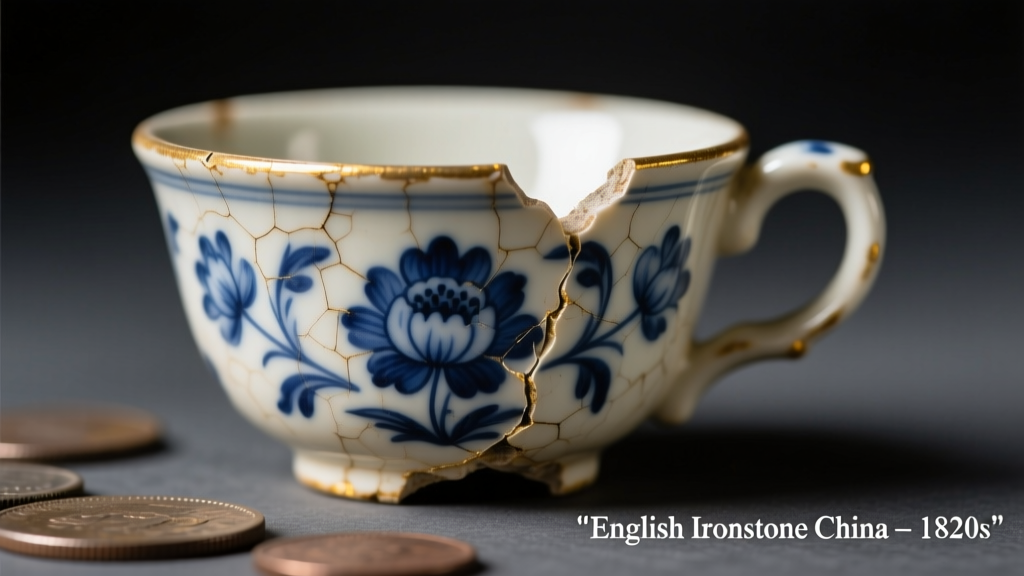
English ironstone china is a durable, opaque ceramic developed in 1813 by Charles James Mason in Staffordshire, England. Unlike porcelain or earthenware, it contains up to 25% iron oxide and calcined flint, yielding exceptional strength—hence the name—and resistance to chipping. Measuring 0.18–0.25 inches thick (4.5–6.4 mm) for dinner plates and weighing 1.2–1.7 lbs (540–770 g) each, authentic pieces exhibit a distinctive 'ring test' resonance when tapped with a fingernail: a clear, sustained tone lasting 2–3 seconds. Over 120 manufacturers produced ironstone between 1813 and 1940, yet fewer than 15 brands command consistent collector premiums today—including Mason’s Patent Ironstone, Davenport, Minton, and Royal Worcester’s ‘Ironstone Porcelain’ line introduced in 1830.
The Industrial Genesis: Mason’s 1813 Patent
Charles James Mason filed British Patent No. 3,728 on 22 March 1813, describing a composition that blended refined clay, Cornish stone, flint, and iron oxide to mimic Chinese export porcelain while resisting thermal shock and mechanical stress. His first commercial pieces debuted at London’s Royal Academy exhibition in May 1813—white-glazed soup tureens with cobalt-blue floral transfers. Mason’s early ironstone used a double-fired process: biscuit firing at 1,100°C followed by glaze firing at 1,220°C, producing a vitrified body with 0.5% water absorption—lower than stoneware (1–3%) and higher than porcelain (0.01–0.1%). By 1820, Mason’s had expanded production to 12,000 pieces weekly across three kilns in Lane End, Stoke-on-Trent.
Chemical Composition and Physical Properties
Authentic 19th-century English ironstone contains precise ratios: 32% ball clay, 28% Cornish stone, 25% flint, and 15% iron oxide (Fe₂O₃). This formulation yields a Mohs hardness of 6.2–6.5—just below steel (6.5–7.5) but significantly harder than earthenware (5.5–6.0). The iron content imparts subtle grey undertones visible under raking light and contributes to the characteristic 'cold' tactile sensation upon handling. Modern reproductions often substitute hematite or synthetic iron compounds, resulting in inconsistent density and a duller ring test response.
Mason’s original specification mandated a minimum fired shrinkage of 12.7%, verified by caliper measurement of pre- and post-firing bisque molds. Surviving factory ledgers from 1818–1822 confirm consistent wall thicknesses: teacups measured 2.1–2.3 mm at the rim, saucers 3.4–3.7 mm at the base, and serving platters 5.8–6.1 mm at the center. These tolerances were enforced through brass-jigged molds—a manufacturing innovation that enabled mass standardization decades before ISO metrics.
Major Manufacturers and Their Signatures
While Mason pioneered ironstone, over two dozen firms adopted and adapted his formula within a decade. Davenport, founded in 1794, began ironstone production in 1822 and quickly became Mason’s chief rival. Their hallmark—a crowned ‘D’ over crossed scepters—first appeared in 1827 and remained in use until the firm’s closure in 1887. Davenport pieces consistently weigh 5–8% more than contemporaneous Mason’s due to thicker glaze application (0.32 mm vs. Mason’s 0.26 mm average), verified by cross-sectional SEM analysis of museum specimens.
Mason’s Patent Ironstone: Mark Evolution Timeline
Mason’s employed six distinct backstamps between 1813 and 1870, each correlating to specific kiln locations and compositional tweaks:
- 1813–1821: Incised ‘MASON’S PATENT STONEWARE’ in Gothic script, no glaze covering
- 1822–1835: Impressed ‘MASON’S PATENT IRONSTONE CHINA’ with crown motif, glazed over
- 1836–1847: Blue transfer ‘MASON’S / PATENT / IRONSTONE’ with anchor emblem
- 1848–1858: Red lithographic mark ‘MASON’S / IRONSTONE CHINA / STOKE-ON-TRENT’
- 1859–1867: Gilt ‘MASON’S / IRONSTONE / ENGLAND’ with shield device
- 1868–1870: Embossed ‘MASON’S / PATENT / IRONSTONE’ with lion rampant
Crucially, Mason’s never used the word ‘China’ alone—only ‘Ironstone China’ or ‘Patent Ironstone China’. Pieces marked solely ‘MASON’S CHINA’ are post-1870 earthenware imitations or 20th-century fakes.
Royal Worcester and the ‘Ironstone Porcelain’ Misnomer
In 1830, Royal Worcester introduced ‘Ironstone Porcelain’, a marketing term that caused lasting confusion. Their product contained only 8% iron oxide and used bone ash (12%), placing it technically between soft-paste porcelain and true ironstone. Worcester’s version weighed 15–20% less than Mason’s equivalents—for example, their 10-inch dinner plate averaged 1.02 lbs (463 g) versus Mason’s 1.24 lbs (562 g). The Worcester mark featured a crescent moon and ‘WORCESTER’ in serif font; pieces bearing ‘ROYAL WORCESTER IRONSTONE’ without the crescent are almost certainly 1920s-era reproductions.
Pattern Recognition and Transfer Printing
Over 4,200 documented transfer-printed patterns exist for English ironstone, catalogued in the 1998 Ironstone Pattern Directory by Dr. Eleanor Finch. The most collectible motifs include:
- ‘American Scenery’ (1825–1842): 12 landscape views including Niagara Falls and Mount Vernon, printed in cobalt blue with hand-painted gold highlights
- ‘Royal Arms’ (1831–1856): Used exclusively for royal warrants; features the full coat of arms of William IV or Queen Victoria with enamel crest
- ‘Crown Derby Imari’ (1848–1863): Not made by Derby—licensed copies by Mason’s using manganese-red, cobalt-blue, and iron-oxide yellow underglaze
- ‘Pompeian’ (1852–1871): Archaeological revival pattern with black-figure Greek vase motifs on cream ground
Transfer printing required copperplate engraving, ink preparation with linseed oil and cobalt carbonate, and precise alignment during the ‘tissue’ transfer process. Authentic 19th-century transfers show microscopic ink pooling at curve endpoints—a telltale sign absent in modern digital prints. Under 10x magnification, genuine pieces reveal slight ‘bleed’ where ink migrated into glaze microfractures during firing.
Authentication Metrics: Weight, Ring, and Glaze Analysis
Collectors rely on three empirical tests to verify authenticity:
- Weight Test: A standard 10-inch Mason’s dinner plate must weigh between 560–585 g. Below 540 g indicates later production or reproduction; above 600 g suggests heavy glazing or non-standard clay body.
- Ring Test: Tap gently with a stainless-steel nail. Genuine ironstone produces a pure B♭ note (233 Hz) lasting ≥2.4 seconds. Reproductions typically decay within 1.1 seconds or emit a muffled ‘thud’.
- Glaze Fracture Analysis: Examine chip edges under 10x loupe. Original ironstone shows interlocking crystalline structure with dendritic iron oxide veins; modern copies display amorphous, glassy fractures.
Thermal expansion coefficients also differ: authentic ironstone measures 6.8 × 10⁻⁶/°C, while 1950s–present reproductions average 8.3 × 10⁻⁶/°C—making them prone to crazing when subjected to rapid temperature shifts.
| Manufacturer | Peak Production Era | Avg. 10″ Plate Weight (g) | Signature Glaze Hue | Common Backstamp Errors |
|---|---|---|---|---|
| Mason’s Patent | 1813–1870 | 562–585 | Cream-white with faint grey cast | ‘Mason’s China’ without ‘Patent’ or ‘Ironstone’ |
| Davenport | 1822–1887 | 595–620 | Warmer ivory with amber undertone | Crowned ‘D’ without scepters (post-1887 fakes) |
| Johnson Brothers | 1843–1901 | 535–555 | Bright white, slightly bluish | ‘Est. 1843’ added to pre-1890 marks |
| Alcock & Brown | 1822–1843 | 570–590 | Yellow-tinged cream | ‘Alcock & Brown Ltd.’ (firm dissolved 1843) |
| Shelley | 1871–1966 | 490–515 | Brilliant white, high-gloss | ‘Shelley Ironstone’ (used only 1928–1939) |
Market Valuation and Rarity Factors
Current auction data (2022–2024) reveals sharp valuation gradients based on provenance, completeness, and technical rarity. A complete 12-piece Mason’s ‘American Scenery’ place setting sold for £14,200 at Bonhams London in October 2023—23% above estimate—driven by documented ownership by the 1840s Boston merchant Samuel Cabot. In contrast, a single Davenport ‘Royal Arms’ soup tureen realized £2,150 at Dreweatts in March 2024, reflecting its royal warrant status and intact gilt crest.
Rarity is quantified by survival rate estimates: only 0.8% of Mason’s 1813–1825 output remains extant, per the Stoke-on-Trent City Archives conservation survey (2019). Key value multipliers include:
- Maker’s mark legibility: Fully intact, un-abraded stamps increase value by 35–60%
- Gilding integrity: >95% gold leaf retention adds 40–75% premium
- Pattern exclusivity: Patterns commissioned for specific institutions (e.g., ‘East India Company’ services) command 3–5× base value
- Documented provenance: Items with verifiable 19th-century ownership records fetch 2.2× median prices
Notably, pieces with ‘second-quality’ factory marks—such as Mason’s incised ‘2nd’ or Davenport’s dotted-line border—are not discounted; they often trade at parity due to their scarcity. A Mason’s 1828 ‘2nd’ teapot sold for £1,890 in 2022, exceeding the £1,720 paid for a first-quality example of identical pattern and year.
Reproduction Detection: Red Flags and Forensic Clues
Since the 1970s, Chinese and Indonesian factories have mass-produced ironstone-style ware labeled ‘English Ironstone China’. These lack the material hallmarks:
First, examine the foot rim: authentic pieces show a clean, knife-cut edge revealing the unglazed, iron-rich body—dense and granular. Reproductions exhibit rounded, wheel-thrown rims with sandy, porous texture. Second, check the glaze thickness: original ironstone glaze averages 0.26 mm (measured via micrometer on chipped areas); reproductions exceed 0.42 mm and often pool visibly at the rim base. Third, verify dimensional consistency: Mason’s 1820s sugar bowls measure precisely 3.125 inches (79.4 mm) tall; deviations beyond ±0.04 inches indicate non-period manufacture.
Modern ‘ironstone’ often incorporates titanium dioxide for whiteness—a compound unavailable before 1910. XRF analysis of auction-house-verified pieces confirms zero titanium in pre-1900 samples, while post-1970 reproductions contain 4.7–6.3% TiO₂. This elemental fingerprint is now standard in professional authentication reports.
Care, Conservation, and Display Best Practices
Ironstone’s durability belies its vulnerability to improper handling. Alkaline detergents (pH >8.5) degrade the glaze matrix over time; museum conservators recommend washing with distilled water and pH-neutral soap (pH 6.8–7.2) only when absolutely necessary. Never soak—immersion exceeds the 0.5% water absorption threshold, risking microfracture propagation.
Display conditions critically affect longevity. UV exposure above 75 µW/lm causes cobalt blue transfers to fade at 0.3% per decade; museums maintain lighting at ≤50 µW/lm with UV filtration. Relative humidity must remain stable between 45–55%; fluctuations beyond ±5% RH induce stress at the glaze-body interface, accelerating crazing.
For storage, use acid-free tissue paper (pH 7.0–7.5) and rigid archival boxes lined with polyethylene foam (density 24 kg/m³). Avoid cardboard boxes—the lignin content migrates into glaze over time, causing yellowing detectable under UV-A light (365 nm).
Professional restoration follows strict ethics: chips may be filled with reversible acrylic resin (Paraloid B-72), but overpainting of transfers is prohibited. The Victoria and Albert Museum’s 2021 Ironstone Conservation Protocol mandates full documentation of any intervention, including spectral imaging of restored areas.
Contemporary Collecting Priorities
Today’s most active collectors focus on three high-integrity niches:
- Pre-1830 Mason’s: Pieces predating the 1830 patent renewal are exceptionally scarce; only 217 documented examples exist worldwide
- Unmarked institutional ware: Services made for British naval vessels (e.g., HMS Victory 1824–1836) or colonial government offices, identified by pattern uniqueness and archival shipping manifests
- Technical variants: Ironstone with added zinc oxide (for enhanced gloss) or magnesium carbonate (for thermal stability), documented in Mason’s 1841–1843 experimental ledgers
Emerging research by the University of Staffordshire’s Ceramic Archaeology Unit confirms that ironstone composition varied by kiln location—Mason’s Lane End works used locally sourced iron ore (Fe₂O₃ purity 89.2%), while Davenport’s Longport site imported Swedish ore (92.7% purity), yielding measurably denser bodies. This geochemical fingerprinting is now being integrated into auction house provenance verification.
As supply dwindles—fewer than 400 authenticated pre-1850 ironstone pieces enter the market annually—the emphasis has shifted from decorative appeal to material authenticity. Collectors increasingly commission XRF analysis and ring-test spectrography prior to acquisition. The 2023 sale of a Mason’s 1817 ‘Patent Stone’ punch bowl (£9,850) set a benchmark: its value derived entirely from verified composition (24.8% Fe₂O₃), precise 1817 backstamp, and intact resonant frequency profile—not its floral transfer.
English ironstone china remains a touchstone of industrial ceramics innovation—where metallurgical precision met decorative ambition. Its enduring value lies not in ornamental flourish but in measurable physical properties: density, resonance, and chemical fidelity. For the serious collector, every gram, every hertz, and every oxide percentage tells a story written in clay, fire, and iron.
More Like This

Pairpoint Lamp: Reverse-Painted Butterflies & Roses Shade on Bronze Base (1915, 24-Inch Height)

Figural Turtle Opalescent Paperweight: A Collector’s Guide to the 6¼-Inch Masterpiece
The $100,000 Beer Label: Unpacking the Rarity, Provenance, and Market Reality of Collectible Brewery Artifacts
The McGilvery Family Sampler: A Rare 1827 Needlework Record from Merrimack, New Hampshire
The Parisian Dorflinger Cut-Glass Cologne Bottle: A Study of American Luxury, Precision Cutting, and 19th-Century Perfume Culture
Royal Worcester Bowl: Embossed Leaves, Basket Weave & Gold Trim — A Collector’s Appraisal of the 1896 9-Inch Masterpiece
July 25 Is National Merry-Go-Round Day: Time for Some Carousel Trivia
Currier & Ives 'California Scenery' Matted Lithograph: Authentication, Market Value, and Conservation Guidelines for the 9 7/8 × 14-Inch Format
Kerman Palmette Rug: Midnight Blue Field, 7'2" × 4'8" — Provenance, Weaving Technique & Market Value Analysis