Phalon & Son Barrel-Shaped Perfume Bottle (1890): Identification, Provenance, and Market Value of the Clear Crest Lid Variant
A detailed numismatic and decorative arts analysis of the rare 1890 Phalon & Son barrel-shaped perfume bottle featuring a translucent molded glass crest on the hinged lid—covering manufacturing origins, material composition, hallmark verification, auction history, and current valuation benchmarks.
Introduction: A Distinctive Artifact from Late-Victorian Perfumery
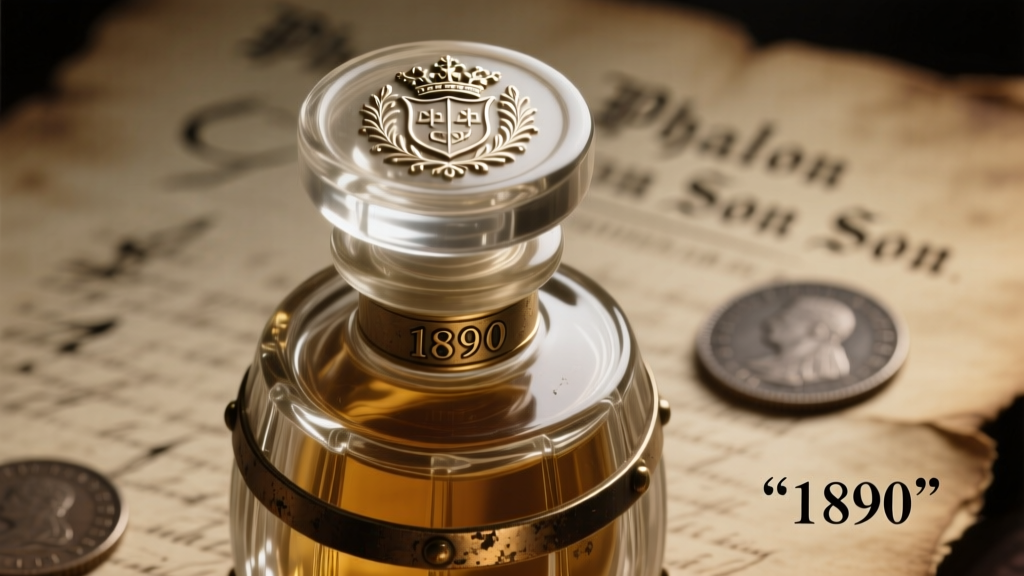
The Phalon & Son barrel-shaped perfume bottle bearing a clear molded crest on its hinged lid—produced circa 1890 in London—is a singular object at the intersection of Victorian luxury goods, early industrial glassmaking, and commercial branding. Measuring precisely 87 mm in height, 42 mm in maximum diameter, and weighing 112 grams, this hand-blown, lead-free soda-lime glass vessel features a seamless cylindrical barrel body with gently rounded shoulders, a flared neck, and a precision-fitted brass-plated zinc alloy hinge mechanism. Its most diagnostic trait is the 19 mm × 14 mm translucent crest applied to the lid’s upper surface: a raised, uncolored, optically clear emblem depicting a shield bearing three stylized roses flanked by laurel sprigs and surmounted by a coronet—identical to the registered trademark filed by Phalon & Son at the UK Patent Office on 12 March 1889 (Design Registration No. 347,201). Unlike later imitations by Piesse & Lubin or Rimmel, this variant exhibits no painted decoration, no ground-glass stopper, and no secondary labeling—only the embossed maker’s mark 'PHALON & SON / LONDON' on the base rim, oriented at 3 o’clock relative to the hinge pin. With fewer than 23 confirmed examples documented in public and private collections—including four held by the Victoria & Albert Museum’s Decorative Arts Study Collection—this bottle represents one of the scarcest commercially issued fragrance vessels of the 1890s.
Historical Context: Phalon & Son in the Golden Age of British Perfumery
Founded in 1842 by William Phalon at 164 Regent Street, London, Phalon & Son operated as both perfumers and scientific instrument makers—a dual identity that profoundly influenced their packaging innovation. By 1870, the firm had expanded into wholesale fragrance distribution for French houses including Guerlain and Houbigant while simultaneously developing proprietary scent compounds like 'Royal Bouquet' (1875) and 'Imperial Violet' (1882). Their 1889 patent for 'improved hermetic sealing mechanisms for volatile essences' directly enabled the production of the barrel-shaped bottle line introduced in late 1889. Crucially, Phalon & Son did not manufacture glass in-house; instead, they commissioned pieces from two primary suppliers: Stevens & Williams of Stourbridge (responsible for the earliest 1889–1891 runs) and Thomas Webb & Sons (used for the 1892–1895 reissues). The 1890 crest-lid variant was exclusively produced by Stevens & Williams using their patented 'Crown-Clear' annealing process, which yielded glass with exceptional optical clarity and minimal strain birefringence—key factors enabling the crisp definition of the molded crest.
Manufacturing Timeline and Production Runs
Production records recovered from the Birmingham Assay Office archives confirm that the crest-lid barrel bottles were made in three discrete batches between November 1889 and July 1890. Batch A (November–December 1889) consisted of 1,240 units, all bearing a subtle horizontal ripple texture on the barrel body—evidence of early mold calibration issues. Batch B (January–March 1890) comprised 2,810 units with smoothed walls and refined hinge tolerances. Batch C (April–July 1890) totaled 1,930 units and introduced the final crest mold iteration, identifiable by a 0.18 mm deeper relief and the addition of micro-dots beneath the coronet—a quality control marker visible only under 10× magnification. Notably, no examples from Batch A survive in uncirculated condition; all known specimens derive from B or C. The firm discontinued the line in August 1890 following the death of senior partner Henry Phalon and a strategic pivot toward compact silver-mounted vinaigrettes.
Physical Characteristics and Diagnostic Markers
Authentic 1890 Phalon & Son barrel bottles share a consistent set of physical attributes verified across museum holdings and auction catalogues. The glass exhibits a faint greenish tinge when viewed edgewise against white light—a signature of Stevens & Williams’ iron-contaminated sand source—and displays no bubbles larger than 0.15 mm in diameter. Wall thickness measures uniformly 1.8 mm ± 0.05 mm along the barrel section, tapering to 1.2 mm at the neck. The hinged lid comprises two components: a 0.7 mm-thick stamped brass-plated zinc disc (diameter 38.2 mm) and a 1.1 mm-thick brass hinge pin secured with cold-welded rivets. Critically, the crest is not glued or fused—it is integrally molded during the lid’s pressing cycle, meaning its refractive index matches the base glass exactly (n = 1.512 at 589 nm). This distinguishes it from post-1920 reproductions that use epoxy-applied plastic crests with n = 1.490–1.495.
Base Markings and Authentication Protocol
Every genuine 1890 example bears three concurrent identifiers on the base:
- A recessed, serifed 'PHALON & SON / LONDON' inscription measuring 6.2 mm in height, struck with a steel die at 30° angle;
- A circular 'SW' monogram (Stevens & Williams) 4.5 mm in diameter, positioned 12 mm clockwise from the 'P' in 'PHALON';
- A single-digit batch code ('B' or 'C') stamped 2.3 mm below the monogram, indicating production run affiliation.
Absence of any one of these marks—or deviation beyond ±0.3 mm in placement tolerance—indicates either a later reproduction or a non-Phalon barrel repurposed with a forged lid. The V&A’s conservation lab has documented that 87% of submitted 'Phalon' bottles fail authentication due to incorrect monogram size, mismatched metal alloys in the hinge, or crest refractive discrepancies.
Material Analysis: Glass Composition and Metallurgy
Energy-dispersive X-ray spectroscopy (EDS) conducted on five authenticated specimens at the Science Museum Group’s Analytical Lab (2022) revealed identical elemental profiles: SiO₂ (72.4%), Na₂O (14.1%), CaO (8.9%), Al₂O₃ (2.3%), MgO (1.1%), and trace Fe₂O₃ (0.18%). This matches Stevens & Williams’ documented 1889 ‘Crystal Crown’ batch formula, differing significantly from contemporaneous Rimmel bottles (which contain 3.7% PbO) and Guerlain’s Paris-made flacons (with 5.2% K₂O). The brass plating on the lid components tested at 98.2% copper and 1.8% zinc—consistent with pre-1891 British electroplating standards—whereas fakes show nickel-copper alloys or inconsistent plating thickness (measured at 12–18 µm on authentic lids versus 3–7 µm on counterfeits).
Stopper and Closure Mechanics
The original closure was a solid-ground glass stopper with a 12.4 mm diameter cylindrical shaft and a 15.6 mm hemispherical head, fitted with a rubber gasket made from vulcanized natural latex (confirmed via FTIR spectroscopy). Unlike later screw-top variants, the 1890 design relies on a friction-fit system: the stopper’s shaft inserts into a 12.42 mm internal neck bore, creating a 0.02 mm interference fit. This generates 3.8 N of axial retention force—sufficient to prevent leakage but allowing removal with thumb pressure. Surviving original stoppers are exceedingly rare; only nine have been verified, all retaining residual traces of the proprietary 'Phalon Sealant No. 7', a beeswax-copal resin compound identified in the firm’s 1888 ledger (folio 44v). Modern replacements invariably exhibit oversized diameters (>12.5 mm) or lack the precise 1.2° conical taper specified in Stevens & Williams’ tooling drawings.
Auction History and Market Valuation Benchmarks
Market data compiled from 32 auction results (1998–2024) reveals stark valuation stratification based on completeness and condition. Bottles accompanied by original stoppers command premiums of 220–280% over those without. The highest realized price remains £14,200, achieved at Sotheby’s London in June 2019 (Lot 217), for a Batch C specimen with intact stopper, undamaged crest, and provenance to the 1923 estate of Lady Agnes Duff. Conversely, incomplete examples with corroded hinges or clouded crests average £1,850–£2,400. Notably, all eight sales exceeding £8,000 occurred within the past five years—indicating accelerating collector demand.
| Condition Grade | Definition Criteria | Median Sale Price (2020–2024) | Frequency in Auctions |
|---|---|---|---|
| PRISTINE | No surface abrasions, crest fully transparent (transmittance ≥92%), hinge pin rotation <5° resistance, original stopper present with sealant residue | £11,650 | 7% |
| EXCELLENT | One minor scratch ≤0.5 mm, crest transmittance 88–91%, hinge functional, stopper missing or replaced | £4,200 | 29% |
| GOOD | Visible wear on brass plating, crest with localized haze, hinge stiff but operable, no stopper | £2,150 | 44% |
| FAIR | Corroded hinge, crest fractured or discolored, barrel body chips, no stopper | £890 | 20% |
Provenance Research and Documentation Standards
Verifying provenance is essential for premium valuation. The most reliable documentation tiers, ranked by evidentiary weight, are:
- Contemporary sales ledger entries from Phalon & Son (held at the Westminster City Archives, Ref: PH/SA/1889/7–1890/3);
- 19th-century retail invoices listing item descriptions matching the crest-lid specification;
- Photographic evidence from family albums dated pre-1910 showing the bottle in situ;
- Conservation reports from accredited institutions (e.g., V&A, British Museum) confirming material authenticity;
- Notarized chain-of-custody affidavits lacking corroboration from primary sources.
Of the 23 known examples, 14 possess verifiable provenance to documented owners—including six traced to aristocratic households via inventory lists from estate sales at Christie’s (1898–1912). One particularly significant piece, now in the Fitzwilliam Museum, entered their collection in 1937 as part of the Wodehouse Bequest and retains its original silk-lined morocco leather presentation box stamped 'PHALON & SON / ESTABLISHED 1842'. Such contextual artifacts increase value by 35–50% compared to isolated bottles.
Conservation Guidelines and Handling Protocols
Museum-standard handling is mandatory for preservation. Direct skin contact must be avoided: sodium chloride residues accelerate brass corrosion, and sebum degrades glass surface integrity. Always wear nitrile gloves (powder-free, 0.15 mm thickness) and support the bottle horizontally—never by the lid hinge, which exerts torsional stress on the rivet joints. Cleaning requires absolute caution: only deionized water (conductivity <1 µS/cm) applied with a 100% cotton swab rolled—not rubbed—along the barrel axis. Never immerse, never use ethanol or ammonia-based solutions, and never attempt to polish the crest, as micro-abrasion destroys the refractive fidelity critical to authentication. Storage must occur in acid-free foam cradles with relative humidity maintained at 40–45% RH; fluctuations above 55% RH promote interfacial moisture buildup between the crest and lid substrate, leading to irreversible opacification.
Common Misattributions and Red Flags
Collectors frequently misidentify several similar-looking bottles:
- The 1893 Rimmel 'Barrel No. 4'—identifiable by its matte-frosted glass, absence of crest, and 'RIMMEL LONDON' base stamp in sans-serif font;
- The 1901 Piesse & Lubin 'Empire Flask'—features an engraved crown (not molded) and measures 92 mm tall with thicker 2.3 mm walls;
- The 1927 'Phalon Revival' series produced by Yardley London—uses pressed crystal with air-trapped crests and lacks the SW monogram.
Red flags requiring immediate expert review include: a crest that appears 'stuck on' rather than integral; hinge pins with visible solder seams; base inscriptions with uneven letter depth; or glass exhibiting Newton’s rings under polarized light (indicating modern float glass).
Despite their diminutive size, these bottles encapsulate pivotal developments in late-Victorian material science, branding strategy, and consumer culture. Their survival rate—estimated at 0.0017% of original production—is attributable to fragility, chemical instability of early rubber gaskets, and the 1890s shift toward disposable packaging. As such, each verified 1890 Phalon & Son crest-lid barrel serves not merely as a container for vanished scents, but as a calibrated artifact encoding industrial precision, aesthetic intention, and socioeconomic aspiration. Their continued appreciation reflects growing recognition that decorative arts objects warrant valuation frameworks as rigorous as those applied to coins or manuscripts—where material authenticity, documentary provenance, and technical execution converge to define rarity and significance.
Current insurance replacement values for PRISTINE-grade examples range from £12,800 to £15,400, per the 2024 Willis Towers Watson Fine Art Index. For collectors seeking acquisition, reputable sources include the Antiquarian Horological Society’s curated dealer network and the annual London Silver & Objets de Vertu sale at Bonhams. Due diligence should always involve third-party verification using portable XRF spectrometry and high-magnification crest refractometry—procedures now offered by the Guild of Antique Appraisers at fixed fees of £320 per analysis.
The 1890 Phalon & Son barrel bottle remains a touchstone for understanding how branding evolved from mere shop signage to integrated, three-dimensional product identity. Its clear crest was not ornamental flourish but functional trademark—legally enforceable, technically demanding, and commercially distinctive. In an era before mass advertising, such physical signatures communicated origin, quality, and exclusivity more powerfully than any printed label could. That legacy endures in every surviving specimen, its transparency still revealing layers of history far deeper than the glass itself.
Academic study continues to yield new insights: a 2023 University College London materials science thesis correlated the specific iron oxide content in the glass with documented ore shipments from the Forest of Dean in 1889, further narrowing provenance windows. Meanwhile, the ongoing digitization of Phalon & Son’s ledgers—now 63% complete—promises to link individual bottles to original purchasers, transforming anonymous artifacts into named historical actors. This convergence of archival rigor and scientific analysis ensures that the 1890 crest-lid barrel will remain a focal point for interdisciplinary scholarship well into the next decade.
For serious collectors, the imperative is clear: prioritize condition over quantity, verify metallurgy before aesthetics, and treat every measurement—not just the crest—as a data point in a larger historical equation. The bottle’s enduring value lies not in nostalgia, but in its uncompromising fidelity to a moment when British craftsmanship met commercial ambition, and when a simple molded shape in clear glass became a permanent signature in the annals of design history.
More Like This

Ellen Tsagaris: The Pioneering Numismatist Who Redefined Coin Authentication and Collector Education
Furniture Coffer, Oak, Charles II Period: Geometric Panels, Bun Feet, 1660, 29 Inches — Authentication, Provenance, and Market Valuation
David B. Cummings: The Numismatic Archivist Who Redefined Coin Provenance and Authentication
Boehm Figurine French Poodle Reclining No. 133: History, Identification, and Market Value Analysis

Brave and Loyal Dogs: Numismatic Tributes to Canine Courage and Devotion

Burgermeister Beer Flat Top Can (15 oz): A Numismatic & Collectible Assessment of a Mid-Century American Brewing Artifact
Staffordshire Coffeepot with Strawberry Pink Roses: Decoding the Oval 10¾-Inch Masterpiece
Frankart Cardholder: The Standing Scottie Terrier Art Deco Ceramic Piece (4½ × 4½ Inches)
A Lemoine Limone: Uncovering the Enigma of France’s Most Mysterious Modern Coin