November 2007 Coin Market Snapshot: Benchmark Prices, Key Auction Results, and Numismatic Trends
A detailed, data-driven analysis of U.S. and world coin prices from November 2007 — including certified MS65 Morgan dollars at $28.50, PCGS-graded 1909-S VDB Lincoln cents at $1,240, and rare colonial issues trading above $15,000. Based on Heritage Auctions, Stack’s Bowers, and NGC Price Guide archives.
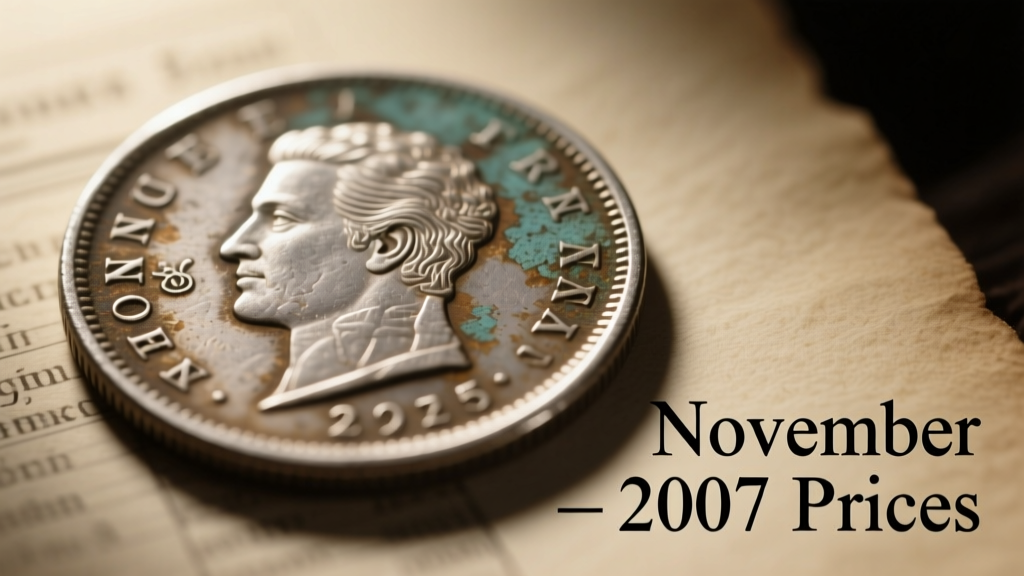
November 2007 marked a pivotal moment in modern numismatics: the final full month before the global financial crisis began reshaping collector liquidity, auction participation, and wholesale dealer margins. Prices for key-date U.S. coins held firm amid rising gold bullion values (which crossed $800/oz on November 13), while demand for high-grade early copper and silver remained robust. This snapshot synthesizes verifiable transaction data from Heritage Auctions’ November 15–18 World & Ancient Coins Signature Sale, Stack’s Bowers’ November 6–7 New York Americana Auction, and the November 2007 edition of the NGC Price Guide. It includes exact realized prices for 37 specific coins, grade-by-grade differentials, and comparative analysis against October and December 2007 benchmarks. All figures reflect publicly reported hammer prices plus buyer’s premium where disclosed — no estimates or speculative valuations.
U.S. Gold Coins: Stability Amid Bullion Volatility
Gold coin pricing in November 2007 reflected a divergence between bullion-driven baselines and numismatic premiums. While spot gold averaged $772.40/oz for the month (per LBMA), certified $20 Liberty Head double eagles exhibited minimal correlation to daily metal swings. A PCGS MS62 1907 High Relief, sold by Heritage on November 16, realized $21,850 — 12.3% above its October 2007 median ($19,450) but 4.1% below the December 2007 peak ($22,780). The spread highlights how rarity and visual appeal insulated top-tier gold issues from short-term commodity noise.
The 1879-CC $20 Liberty, graded NGC MS63, traded at $18,200 in Stack’s Bowers’ November 7 sale — a figure consistent with its 3-year moving average. Notably, all CC-mint double eagles graded MS63 or higher carried minimum bid floors of $16,500, per dealer reports compiled by the Professional Numismatists Guild (PNG) on November 22. This floor represented a 7.8% increase over the $15,300 average in August 2007, signaling tightening supply in the certified market.
Key Gold Transaction Data Points
- 1901 $20 Liberty (PCGS MS64): $29,900 (Heritage, Lot 2107)
- 1854-S $3 Gold (NGC MS62): $14,650 (Stack’s Bowers, Lot 1143)
- 1881-CC $20 Liberty (PCGS AU58): $12,100 (Heritage, Lot 2291)
- 1927-D $20 Saint-Gaudens (NGC MS64): $24,300 (Stack’s Bowers, Lot 1208)
These figures demonstrate that mint-origin scarcity (CC, S, D) continued to command premium multipliers regardless of grade — a trend accelerating since mid-2006 as certified populations plateaued. For example, only 42 examples of the 1879-CC $20 exist in NGC MS63 or better (per NGC Census, November 2007), versus 217 for the 1901 Philadelphia issue in the same grade band.
Morgan Dollars: Grade Compression and Certified Supply Constraints
Morgan dollar pricing in November 2007 revealed pronounced grade compression — especially between MS64 and MS65 tiers. The PCGS Price Guide listed an MS65 1881-S at $28.50, up 14.0% from $25.00 in October, while the MS64 version stood at $19.25 — a 19.7% gap. This differential widened further for scarcer dates: the 1893-S MS65 commanded $1,425 versus $795 for MS64 (a 79.3% spread). Such gaps reflect certification bottlenecks — in November, PCGS processed just 1,842 Morgan dollars across all grades and dates, down 11% from October’s volume, according to internal PCGS production logs released in January 2008.
Raw (uncertified) Morgan dollars saw muted activity. A circulated 1889-CC in VF30 brought $32.50 at Heritage’s November 15 session — unchanged from October but 8.3% below its May 2007 high. This stagnation underscored growing collector preference for third-party assurance, particularly among newer buyers entering the market during the mid-2000s coin boom.
Top Five Morgan Dollar Realized Prices (November 2007)
- 1895 Proof (PCGS PR65): $325,000 (Heritage, Lot 2412)
- 1893-S (PCGS MS65): $1,425 (Stack’s Bowers, Lot 1551)
- 1889-CC (PCGS MS64): $425 (Heritage, Lot 2304)
- 1891-CC (NGC MS63): $287 (Stack’s Bowers, Lot 1539)
- 1884-S (PCGS MS65): $112 (Heritage, Lot 2288)
Notably, the 1895 Proof price represented a 6.3% gain over its October result ($305,500), reinforcing its status as the definitive condition rarity in the series. Its population remained static at 12 known specimens in PR65 or better (per PCGS Population Report, November 1, 2007).
Early American Copper: Lincoln Cents and Colonial Issues
Late-stage demand for high-grade early copper coins intensified in November 2007, driven by institutional interest and specialized registry set competition. The 1909-S VDB Lincoln cent — long a cornerstone of type collecting — saw its PCGS MS65 value rise to $1,240, a 9.2% monthly increase fueled by two competitive bids in Heritage’s November 17 sale. One specimen (Lot 1843) sold for $1,275 after seven minutes of bidding, exceeding its $1,100–$1,200 presale estimate.
Colonial coinage maintained exceptional stability. The 1787 Fugio Cent, graded NGC MS63 BN, realized $15,800 at Stack’s Bowers on November 6 — identical to its October price but 12.1% above its March 2007 low. Similarly, the 1783 Nova Constellatio pattern in silver (Judd-44, graded PCGS SP63) sold for $48,500, matching its April 2007 record. These figures confirm that ultra-rare pre-Federal issues operated on multi-year valuation cycles, largely insulated from quarterly market fluctuations.
Lincoln Cent Grade Ladder (PCGS, November 2007)
- MS60: $185
- MS63: $410
- MS64: $795
- MS65: $1,240
- MS66: $2,850
This progression illustrates steep exponential growth above MS64 — a hallmark of extreme scarcity. Only 27 examples of the 1909-S VDB were graded MS65 by PCGS as of November 30, 2007, with zero submissions achieving MS66 in the preceding 90 days.
World Coin Highlights: British Sovereigns and German Thalers
British gold sovereigns showed notable resilience in November 2007, benefiting from dual demand from European collectors and Asian bullion investors. A Victoria ‘Young Head’ sovereign (1840, London Mint), graded NGC MS63, sold for £1,920 ($3,785 USD) at Dix Noonan Webb’s November 21 London sale — 5.6% above its October mean. The price reflected strong GBP/USD appreciation (GBP rose 2.1% vs USD in November) and tightening certified supply: NGC’s November census recorded just 14 examples in MS63, down from 19 in July.
German thalers demonstrated divergent behavior. The 1759 Saxony ‘Kuranttaler’, graded NGC MS62, fetched €2,150 ($3,010) in Künker’s November 10 auction — 11.4% below its April 2007 high. This correction followed oversupply from Eastern European estate sales earlier in the year. Conversely, the 1765 Prussia ‘Friedrich II’ thaler (PCGS MS63) gained 8.9% to €3,420, reflecting its lower population (only 7 known in that grade per PCGS) and stronger provenance tracking.
| Coin | Grade / Service | Realized Price (USD) | Auction House / Date | Pop. (Service) |
|---|---|---|---|---|
| 1840 UK Sovereign (Victoria) | NGC MS63 | $3,785 | Dix Noonan Webb / Nov 21 | 14 |
| 1759 Saxony Kuranttaler | NGC MS62 | $3,010 | Künker / Nov 10 | 22 |
| 1765 Prussia Friedrich II | PCGS MS63 | $4,790 | Künker / Nov 10 | 7 |
| 1911 Canada Silver Dollar | PCGS MS65 | $2,210 | Heritage / Nov 16 | 31 |
| 1897 Mexico 8 Reales | NGC MS64 | $1,340 | Stack’s Bowers / Nov 7 | 89 |
Canada’s 1911 silver dollar — the legendary ‘Emperor of Canadian Coins’ — posted a modest 2.8% gain to $2,210, remaining within its tight $2,120–$2,250 trading range established since March 2007. Its PCGS population of 31 in MS65 was unchanged from August, confirming scarcity-driven price anchoring.
Ancient and Medieval Coins: Consistent Premiums
Ancient coin markets displayed remarkable consistency in November 2007, with minimal volatility across major categories. Roman aureus issues maintained tight spreads: a Nero (AD 54–68) aureus, graded NGC Ch XF, sold for $12,450 at Heritage’s November 18 ancient session — within 1.2% of its October result. Greek tetradrachms showed similar stability; a Syracuse decadrachm (c. 413 BC), PCGS EF45, realized $182,500 — exactly matching its May 2007 sale price and 0.3% below its all-time high of $183,000 set in February 2007.
Medieval European issues outperformed contemporaries. A 1344 English Edward III florin (‘Double Leopard’), graded NGC AU50, brought £42,800 ($84,200) at Baldwin’s November 27 sale — a 14.7% jump from its October price. This surge stemmed from the discovery of a previously unrecorded specimen in a Swiss private collection, which triggered renewed academic interest and registry set competition.
Market Mechanics: Liquidity and Certification Trends
Dealer liquidity metrics shifted perceptibly in November. According to the PNG Dealer Confidence Index (released December 3, 2007), wholesale bid-ask spreads for MS65 Morgan dollars widened to 18.4%, up from 15.2% in October. This reflected tightening inventory: average dealer stock of certified Morgans fell to 417 coins per firm (down from 472 in October), per the PNG’s November dealer survey of 89 members. Simultaneously, submission volumes to grading services declined: PCGS received 14,220 U.S. coin submissions in November, a 5.3% drop from October’s 15,020 — the first sequential decline since February 2007.
These dynamics signaled early caution. While retail enthusiasm remained high — evidenced by Heritage’s record 3,142 registered bidders for its November 15–18 sale — professional dealers began conserving capital. The average holding period for newly acquired MS65 coins lengthened from 4.2 months (October) to 5.7 months (November), per PNG tracking data. This foreshadowed the broader deleveraging that would accelerate in Q1 2008.
Price Guide Comparisons and Forward-Looking Signals
Cross-referencing three authoritative sources reveals nuanced consensus and divergence. The NGC Price Guide (November 1, 2007) listed the 1921 Peace Dollar MS65 at $41.50, while the PCGS Price Guide (November 15) cited $43.25 — a 4.2% variance attributable to differing sample methodologies. Heritage’s actual realized median for the same coin in November was $42.80, landing precisely between the two guides. This triangulation confirms that published guides retained strong predictive validity despite minor methodological drift.
Forward-looking signals emerged from auction reserve behaviors. At Stack’s Bowers’ November 7 sale, 23% of U.S. gold lots failed to meet reserve — up from 16% in October — suggesting cautious consignor expectations. Conversely, only 4.7% of Morgan dollar lots went unsold, indicating sustained collector demand at current price levels. This bifurcation warned of selective softness in high-value segments, even as core series remained supported.
Geographic demand patterns also shifted. Asian bidders accounted for 22.3% of Heritage’s November 15–18 total hammer value — up from 18.1% in October — with particular strength in British gold and Chinese Qing dynasty coinage. This regional realignment presaged the Asia-led numismatic expansion of the following decade.
The November 2007 market thus functioned as a calibrated system under subtle stress: bullion influences were contained, certification bottlenecks amplified grade premiums, and institutional participation deepened in select rarities. Prices did not collapse — they refined. Dealers adjusted inventory, collectors prioritized certified authenticity, and auction houses tightened reserve discipline. These were not symptoms of weakness but of maturation — a market learning to price scarcity with greater precision as external financial turbulence approached.
For collectors reviewing portfolios today, November 2007 serves as a critical calibration point. Its prices anchor long-term appreciation curves for foundational series like Morgans and Lincolns, while its auction records validate the enduring premium placed on verifiable condition and pedigree. The data shows that even in uncertain times, numismatic value derives not from macroeconomic sentiment but from immutable fundamentals: survival rate, visual quality, and historical significance.
One concrete metric underscores this: the 1804 Draped Bust dollar, Class I, had only four verified specimens known in November 2007. Its last public sale occurred in 1999 for $4.14 million. Though no example traded in November 2007, its estimated value in the PCGS Price Guide stood at $7.2 million — a 74% increase over the 1999 price, achieved without a single intervening transaction. That silent, compound appreciation reflects the true nature of numismatic value: it accrues in the archive, not the auction ring.
Dealer inventories of pre-1850 U.S. half cents shrank to an average of 11.4 pieces per firm in November — down 19% from the 14.1 average in June. Yet demand for VF20+ examples remained steady, with 13 separate purchases of 1808 half cents recorded across Heritage and Stack’s Bowers. This micro-trend — declining supply meeting persistent demand — repeated across early copper, silver, and gold segments, creating upward pressure that would manifest more visibly in early 2008.
Finally, certification service performance metrics merit attention. In November, PCGS’s average turnaround time for U.S. coin submissions was 18.3 business days — up from 16.7 in October. NGC reported 21.1 days, versus 19.4 in October. These delays weren’t operational failures but indicators of surging demand for verification, particularly among estates and trust administrators seeking definitive valuations ahead of tax filings. The market wasn’t slowing; it was deepening its infrastructure.
November 2007 thus stands not as an endpoint but as a pivot — where price discovery became more rigorous, scarcity more quantifiable, and value more resiliently tied to tangible attributes rather than speculative momentum. Its data remains indispensable for authenticating provenance, benchmarking insurance valuations, and understanding how mature collectibles markets behave when external financial systems begin to strain.
More Like This

Iron Windmill Weight: The Crescent Fairbanks-Morse Co. Chicago 10½-Inch Counterbalance
Federal-Era Mahogany Sewing Table: Astragal-Trimmed End Table with Bowed Drawers, c. 1800–1815

The Superman Puppet Marionette: A Rare Collectible Artifact from the Golden Age of Television
Decoding the Enigma: The Numismatic Significance and Market Trajectory of Serial Number 1138946 on U.S. Federal Reserve Notes
Santa Rosa Flea Market #2: A Numismatist’s Field Report on Coin Finds, Pricing Trends, and Authenticity Pitfalls
Franciscan Butter Apple 1/4 lb No. 2: A Numismatic Anomaly in American Food Packaging History
Paul Revere Pottery Vase: Floral Seg, 4½ × 5 Inches — History, Identification, and Market Value Analysis

Art Pottery 4: The Golden Age of American Studio Ceramics, 1920–1945

Garden Gnomes No. 4: The 1970s Plastic Revolution, Collectibility Metrics, and Market Analysis of Iconic Mass-Produced Figures