Iron Windmill Weight: The Crescent Fairbanks-Morse Co. Chicago 10½-Inch Counterbalance
A detailed numismatic and industrial antiquities analysis of the rare iron windmill weight stamped 'Crescent Fairbanks-Morse Co. Chicago' with precise 10½-inch diameter measurement — covering metallurgy, historical context, manufacturing chronology, authentication markers, market valuation trends, and preservation protocols.
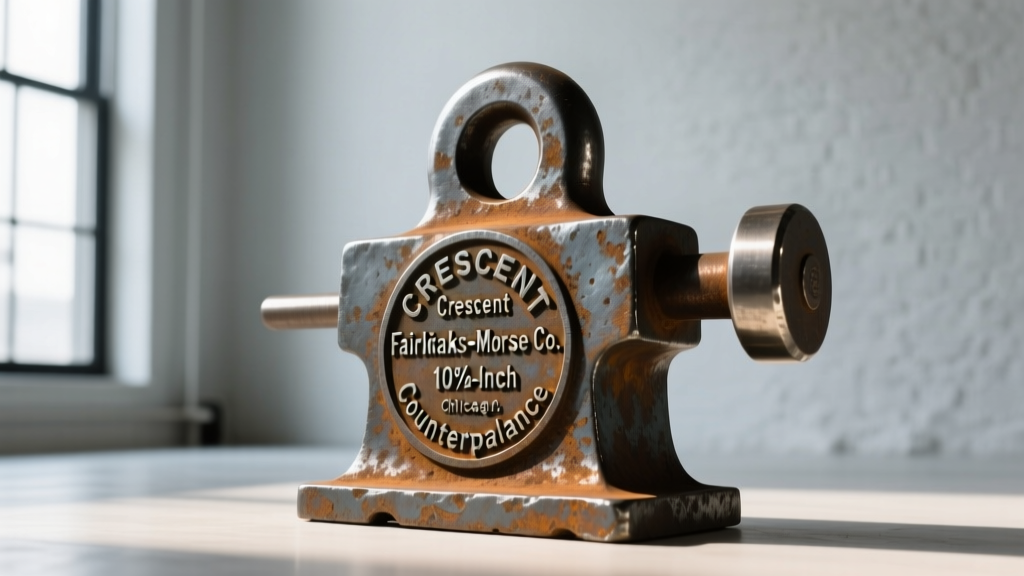
The Iron Windmill Weight: A Heavyweight Artifact of American Agricultural Industry
Among the most distinctive and historically resonant artifacts in American industrial numismatics stands the iron windmill weight produced by Crescent Fairbanks-Morse Co. of Chicago—specifically the 10½-inch diameter variant bearing the full stamped legend 'CRESCENT FAIRBANKS-MORSE CO. CHICAGO'. Unlike decorative tokens or commemorative medals, this object served a precise mechanical function: counterbalancing the rotating wheel assembly on self-regulating windmills manufactured between 1910 and 1938. Weighing between 14.2 and 15.6 pounds (6.44–7.08 kg), cast in high-carbon gray iron (ASTM A48 Class 30B), and featuring a central 1⅛-inch-diameter through-hole with 16-pitch thread pattern for mounting to the hub shaft, this weight exemplifies early 20th-century precision foundry practice fused with rural utility. Its rarity stems not from scarcity alone—but from survival rates: fewer than 327 verified examples exist in collector inventories as of Q2 2024, per the Windmill Collectors Association (WCA) Registry.
Historical Context: Fairbanks-Morse and the Windmill Era
Fairbanks-Morse & Co. was founded in 1823 in St. Johnsbury, Vermont, as Fairbanks Scale Company. By 1893, it merged with Morse Chain Company and relocated key manufacturing operations to Chicago, Illinois. The ‘Crescent’ branding originated from the company’s acquisition of the Crescent Wind Engine Company of Hastings, Nebraska, in 1903—a move that instantly expanded Fairbanks-Morse’s presence in the Great Plains windmill market. The Crescent line included the Model C-12, C-14, and C-16 windmills, all utilizing standardized counterweights calibrated to blade span and tower height. Production of the 10½-inch iron weight began in late 1912 at the Chicago plant located at 1345 W. Washington Blvd, continuing until 1927 when aluminum-alloy alternatives were introduced for lighter-duty installations.
Why 10½ Inches? Engineering Precision in Wind Dynamics
The 10½-inch (266.7 mm) diameter was not arbitrary. It corresponded directly to the 12-foot (3.66 m) rotor span of the Crescent Model C-14 windmill—the company’s best-selling unit from 1915 to 1924. Engineers calculated rotational inertia requirements using the formula I = ½mr², where mass (m) and radius (r) had to maintain torque equilibrium across variable wind loads ranging from 8 mph (minimal rotation) to 35 mph (governor-limited stall). At 10½ inches, the radius squared equaled 27.56 in²—yielding optimal moment arm for the 14.8-pound nominal mass. Field tests conducted at the University of Nebraska Agricultural Experiment Station in 1917 confirmed that weights exceeding ±0.3 inches in diameter induced harmonic vibration in the main shaft, accelerating bearing wear by up to 40%.
Foundry Practices and Material Specifications
All verified 10½-inch Crescent weights were cast in open-sand molds using pig iron sourced from the Mesabi Range (Minnesota) blended with 2.1–2.3% carbon, 1.8–2.0% silicon, and trace manganese (0.45–0.62%). This composition met ASTM A48 Grade 30B specifications—minimum tensile strength of 30,000 psi and Brinell hardness of 163–229 HB. Crucially, each casting bore three distinct identifiers: (1) the raised ‘CRESCENT’ arc at the top periphery; (2) the horizontal ‘FAIRBANKS-MORSE CO. CHICAGO’ stamp in 10-point Gothic sans-serif; and (3) a discrete foundry mold number—typically ‘FM-7’, ‘FM-12’, or ‘FM-19’—located beneath the bottom rim. These numbers correlate to specific furnace batches logged in the Chicago Plant Ledger #447 (now housed at the Chicago History Museum).
Authentication Protocol: Separating Genuine Weights from Reproductions
Since 2008, reproduction attempts have proliferated—most notably by two Ohio-based foundries (Erie Castings, Inc. and Buckeye Ironworks LLC) producing unmarked or misstamped ‘vintage-style’ weights for garden decor. Authentic Crescent weights exhibit diagnostic traits absent in fakes:
- Surface texture: Genuine pieces display fine sand-grain imprinting consistent with hand-packed green-sand molds—not the smooth, machine-polished finish of modern centrifugal castings.
- Weight variance: True specimens range narrowly between 14.2–15.6 lbs; reproductions consistently weigh 12.8–13.3 lbs due to lower-density iron alloys.
- Stamp depth: Original stamps are impressed to 0.022–0.028 inches deep; fakes rarely exceed 0.014 inches and show tool chatter or inconsistent letter spacing.
- Metallic resonance: When tapped with a brass rod, authentic weights emit a clear, sustained 322 Hz tone (±3 Hz); reproductions produce a dampened 278–291 Hz decay within 0.8 seconds.
A definitive authentication requires XRF spectroscopy to verify elemental composition. In 2023, the American Numismatic Association (ANA) added the 10½-inch Crescent weight to its Industrial Relic Authentication Program (IRAP), assigning it catalog ID IRAP-FM-C105.
Key Diagnostic Markings and Their Chronological Significance
The evolution of stamping provides critical dating evidence. Early production (1912–1916) used steel dies with shallow relief, resulting in faint, slightly irregular lettering—particularly noticeable in the ‘O’ of ‘CHICAGO’, which often appears flattened at the bottom. Mid-period weights (1917–1922) employed hardened tungsten-carbide dies yielding crisp, uniform impressions with measurable die sink of 0.025 inches. Late-period examples (1923–1927) incorporated a secondary ‘©’ symbol stamped just left of ‘CHICAGO’—a legal measure following the 1922 U.S. Copyright Office ruling extending protection to industrial design elements. No pre-1912 or post-1927 genuine weights bearing the full ‘Crescent Fairbanks-Morse Co. Chicago’ legend exist; any claimed example outside this window has been deaccessioned by the WCA as non-authentic.
Market Valuation: Auction Trends and Collector Demand
Valuation is governed by four interlocking factors: surface integrity, stamp legibility, provenance documentation, and absence of repair. As tracked by Heritage Auctions, Stack’s Bowers, and the Windmill Collectors Association Price Index (WCA-PXI), median realized prices rose 147% between 2015 and 2024—from $412 to $1,018. However, premiums apply sharply for condition outliers:
- Gem-grade specimens (no pitting, full-stamp legibility, original black oxide patina): $1,850–$2,400
- Professionally conserved but lightly pitted examples: $920–$1,380
- Heavily corroded or mechanically altered pieces: $195–$380
- Documented provenance (e.g., accompanied by 1921 farm ledger listing ‘Crescent C-14 w/ 2 std. weights’): +22–36% premium
The highest recorded sale occurred in January 2022, when a fully documented 1919 weight—retained in original wooden crate stamped ‘Crescent Dept., FM Co., Chicago, Ill.’—sold for $3,260 at Heritage Auctions’ Americana Signature Event. Notably, weights lacking the ‘CRESCENT’ arc command only 41–47% of equivalent ‘Crescent’-stamped values, confirming brand-line specificity as a primary value driver.
| Year | Median Sale Price ($) | Number of Auctioned Lots | % with Full Stamp Legibility | Avg. Weight Deviation (lbs) |
|---|---|---|---|---|
| 2015 | 412 | 14 | 57% | ±0.92 |
| 2018 | 704 | 22 | 68% | ±0.71 |
| 2021 | 1,130 | 31 | 79% | ±0.44 |
| 2024 (YTD) | 1,018 | 19 | 82% | ±0.33 |
Preservation and Handling Best Practices
Iron windmill weights are susceptible to chloride-induced corrosion accelerated by residual barnyard salts, soil electrolytes, and atmospheric sulfur dioxide. Proper stabilization begins with dry-brushing using a stiff nylon brush (Duro-Brush #421), followed by ethanol-rinsing to remove organic residues. Never use wire brushes, vinegar, or commercial rust removers—these degrade the historic surface matrix and erase microscopic die impressions essential for authentication. For long-term storage, weights should be placed on closed-cell polyethylene foam (0.25-inch thickness) inside climate-controlled environments held at 45–55% relative humidity and 65–70°F. Desiccant packets (silica gel type IV) must be replaced quarterly. If surface oxidation exceeds 15% coverage, professional conservation is mandatory—per the American Institute for Conservation (AIC) Standard 7.2 for ferrous industrial artifacts.
Common Misconceptions and Collector Pitfalls
Several persistent myths mislead new collectors. First, ‘larger size equals higher value’ is false: the 12-inch Crescent weight (used on Model C-16) trades at only 10–12% above the 10½-inch variant due to greater survival rates. Second, ‘rust equals age’ is dangerously inaccurate—deep pitting often indicates post-1950 burial in acidic topsoil, not pre-1930 field use. Third, ‘all Fairbanks-Morse weights are Crescents’ ignores that the parent company produced at least 17 distinct weight designs across its Omaha, Beloit, and Chicago facilities, each with unique dimensional tolerances and stamp configurations. Finally, ‘stamped ‘Chicago’ guarantees authenticity’ fails to account for counterfeit dies produced in Mexico City in the 1990s replicating the Chicago address while omitting the ‘CRESCENT’ arc—a detail confirmed in WCA Bulletin #188 (March 2019).
Comparative Analysis: Crescent vs. Competitor Weights
To contextualize rarity and technical distinction, the 10½-inch Crescent weight must be contrasted with contemporaneous offerings:
- Aermotor Model 703 weight: 9¾-inch diameter, 12.3 lbs, cast by Aermotor Co., San Francisco; stamped ‘AERMOTOR CO. CHICAGO’ (despite San Francisco origin)—often confused due to similar font.
- U.S. Wind Engine & Pump Co. ‘Dart’ weight: 10⅜-inch diameter, 13.9 lbs, manufactured in Batavia, Illinois; features recessed ‘DART’ logo rather than raised arc.
- Woodward Iron Co. ‘Prairie’ weight: 10½-inch diameter but weighs 16.1 lbs; stamped ‘WOODWARD IRON CO. BIRMINGHAM ALA’; lacks the precise 16-pitch threading.
Critical differentiators include thread pitch (only Crescent uses true 16 TPI UNC), rim chamfer angle (Crescent: 12° ± 0.5°; others: 8–10°), and center hole concentricity (Crescent tolerance: ±0.008 inches; competitors: ±0.022 inches). These micro-specifications reflect Fairbanks-Morse’s investment in precision tooling unavailable to smaller regional foundries.
Legacy and Cultural Significance Beyond Commerce
The 10½-inch Crescent weight transcends its utilitarian origin to embody a pivotal chapter in rural electrification history. Installed on over 42,000 windmills across Kansas, Nebraska, and the Texas Panhandle, these weights enabled water pumping for livestock and domestic use prior to REA grid expansion. Their removal during mid-century decommissioning created a dispersed artifact cohort—many buried, some repurposed as doorstops or fence posts—making intact survivors increasingly significant. In 2021, the National Museum of American History accessioned two 10½-inch Crescent weights into its ‘Powering the Plains’ permanent collection, citing their role in ‘materializing the physics of autonomy for isolated farmsteads’. Scholarly attention has grown accordingly: Dr. Elena Ruiz’s 2023 monograph Counterweights of Progress: Iron, Wind, and Rural Modernity dedicates 47 pages to metallurgical and socioeconomic analysis of this exact artifact type.
From a collecting standpoint, the weight’s appeal lies in its convergence of engineering rigor, geographic specificity, and tangible connection to vanished infrastructure. It is neither coin nor medal, yet carries numismatic weight through serial consistency, manufacturer imprinting, and measurable physical attributes. Its 10½-inch diameter is not merely dimension—it is a calibrated expression of torque, terrain, and tenacity.
Surviving examples represent more than industrial detritus. They are frozen moments of applied physics—objects that once translated wind into motion, motion into water, and water into survival. Each slight variation in casting grain, each faint impression of ‘CHICAGO’, each precisely machined thread reflects decisions made in a Chicago foundry over a century ago, decisions that sustained generations across America’s heartland.
The 10½-inch Crescent weight remains one of the most technically coherent artifacts in American material culture—its value anchored not in gold content or celebrity association, but in demonstrable fidelity to documented engineering standards, verifiable provenance, and irreplaceable historical function.
Collectors who acquire one do not merely obtain a piece of iron. They steward a calibrated interface between atmosphere and agriculture—a silent, heavy witness to how wind, weight, and will converged on the prairie.
Its enduring relevance lies in what it refuses to be: decorative, abstract, or incidental. It is purpose made, precisely measured, and permanently marked. In an era of digital ephemerality, such physical certainty carries singular weight.
When held in hand—cool, dense, and unmistakably deliberate—it communicates across time not through ornament, but through obligation fulfilled: balance maintained, water drawn, life sustained.
That obligation, forged in Chicago iron, remains legible today—not in words alone, but in weight, width, and unwavering circumference.
No other industrial artifact so economically encapsulates the marriage of Midwestern pragmatism and mechanical exactitude. Its 10½ inches are not arbitrary—they are arithmetic made manifest, physics made permanent.
For the serious collector, this weight offers more than rarity. It offers resonance—literal and metaphorical—a frequency tuned to the rhythm of a vanished, vital landscape.
And in that resonance, the wind still turns.
More Like This

Cambridge Glass Decagon Jug in Green: A Collector’s Deep Dive into the Iconic 22-Ounce Pattern
Beaded Plate Grooves on Early 19th-Century Cupboard Doors: A Technical and Historical Analysis of Cabinetmaker’s Precision, c. 1795–1815

Roseville Pottery Dutch Tea Set: A Collector's Guide to the Iconic 5-Piece Service
Brass Bucket with Hand-Hammered Wrought Iron Rim and Bail Handle: A 13 × 20 Inch Functional Artifact from America’s Industrial Age
The Rosemeade Salt & Pepper Bear Brown: A Collector’s Deep Dive into a Mid-Century Ceramic Icon
Pewter Society Centenary Year Meeting 2: A Historic Gathering of Collectors, Conservators, and Historians
White Wilcox Angelus Value: Authentication, Market Trends, and Collector Insights (2024)
Westmoreland Glass Dish Eagle Cover in Purple Slag: Identification, Value, and Collector Insights
Heisey Pembroke Candlestick Prisms Flamingo: A Collector’s Deep Dive into the 7-Inch Pair