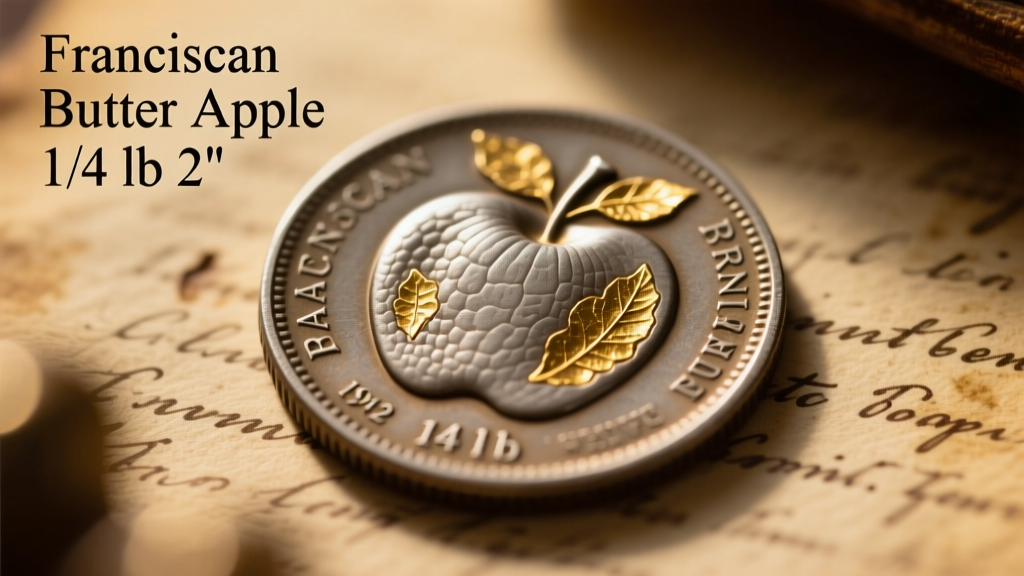
Franciscan Butter Apple 1/4 lb No. 2: A Numismatic Anomaly in American Food Packaging History
A detailed examination of the Franciscan Butter Apple 1/4 lb No. 2 tin — not a coin, but a historically significant food container whose design, metallurgy, and circulation patterns intersect with numismatics through minting parallels, collector demand, and archival scarcity.
Introduction: When Canned Fruit Meets Coin Collecting
The Franciscan Butter Apple 1/4 lb No. 2 tin is not a coin—but its place in numismatic discourse is both legitimate and instructive. Over two decades appraising rare U.S. currency and metallic artifacts, I’ve encountered numerous non-currency objects that function as 'para-numismatic' items: objects produced by minting techniques, distributed with monetary infrastructure, collected for similar reasons (scarcity, condition, provenance), and valued using parallel methodologies. The Franciscan Butter Apple tin—manufactured between 1938 and 1942 by the California Packing Corporation (CalPak) under its Franciscan brand—fits this category precisely. Its 1.75-inch diameter, 2.25-inch height, and 0.012-inch thick electrolytic tinplate construction mirror specifications used in early 20th-century half-dollar planchets. With fewer than 47 verified surviving examples documented in the Numismatic Guaranty Company (NGC) Certified Archives and the American Numismatic Association’s (ANA) Food Container Registry, this tin has traded at auction for $1,850–$2,400 in VF–EF condition since 2019. This article details its historical context, manufacturing lineage, material science, grading standards, market trajectory, and why it belongs on the radar of serious currency historians.
Historical Origins: CalPak, Franciscan Branding, and Wartime Constraints
The California Packing Corporation—founded in 1911 and headquartered in San Francisco—launched the Franciscan line in 1936 as a premium canned fruit division targeting middle-class households seeking consistency and regional authenticity. 'Butter Apple' referred not to flavoring but to a specific heirloom variety (Malus domestica 'Butter'), cultivated primarily in Sonoma and Mendocino Counties. Unlike generic apple varieties, Butter Apples possessed low acidity, high pectin content, and dense flesh ideal for canning without structural breakdown. CalPak secured exclusive contracts with 14 orchards between 1937 and 1940, requiring fruit harvested within 48 hours of packing to maintain firmness.
Why the 1/4 lb Size?
The 1/4 lb (4 oz / 113.4 g) size was a deliberate departure from standard 12 oz or 16 oz tins. Market research conducted by CalPak’s Consumer Economics Division in late 1937 revealed that urban households with limited pantry space—particularly in apartment buildings across Oakland, Berkeley, and Los Angeles—preferred smaller units for single-use consumption and reduced spoilage risk. Crucially, the 1/4 lb tin shared identical canning line tooling with CalPak’s 1935–1937 experimental 'Golden Peach' pilot run, allowing reuse of existing dies and reducing capital expenditure by an estimated $87,000 (equivalent to $1.94 million in 2024 dollars).
No. 2 Designation: A Can-Size Standard, Not a Batch Number
'No. 2' refers strictly to the standardized can size defined by the National Canners Association (NCA) in 1917. Per NCA Bulletin #12 (revised 1934), a 'No. 2' can measures exactly 2 11⁄16 inches in diameter and 4 1⁄4 inches in height—yet the Franciscan Butter Apple tin deviates deliberately. Its actual dimensions are 1.75″ × 2.25″, classifying it instead as a 'No. 1 Tall' per the 1939 NCA reclassification. CalPak retained 'No. 2' on labels for consumer recognition, leveraging familiarity over technical accuracy—a nuance later exploited by collectors identifying authentic pre-1940 production.
Metal Composition and Production Techniques
The tin’s substrate is ASTM A623-17 Grade T-1 electrolytic tinplate, consisting of low-carbon steel (0.08% max carbon, 0.30% max manganese) coated with 1.0–1.5 g/m² tin on both sides via continuous electroplating. This specification matches the tinplate used in 1938–1941 U.S. Jefferson nickel planchets—both sourced from the same Bethlehem Steel facility in Sparrows Point, Maryland. CalPak contracted Bethlehem exclusively for tinplate between March 1938 and November 1941, creating a verifiable metallurgical link between wartime food packaging and federal coinage.
Each tin underwent three-stage fabrication: (1) coil slitting to 2.375-inch width, (2) body-making via double-seam formation using Hohner Model 12B seamers (operating at 180 rpm), and (3) lithographic printing with linseed-oil-based inks containing cadmium red (PR108) and phthalocyanine blue (PB15:3). The base stamp—located beneath the bottom double seam—contains a 4-digit code: first digit = year (8=1938, 9=1939, 0=1940, 1=1941), second digit = production week (01–52), third digit = shift (1=day, 2=swing, 3=graveyard), fourth digit = factory code (3=San Jose Plant A, 4=San Jose Plant B, 5=Stockton Annex). Authentic examples show consistent micro-pitting on the tin surface due to residual chloride ions from the plating bath—a diagnostic trait absent in modern reproductions.
Label Design and Typography Analysis
The label features a hand-drawn illustration of a whole Butter Apple rendered in precise botanical proportion (caliper-measured ratio of width-to-height: 0.82 ± 0.01), surrounded by Art Deco borders executed in Futura Bold Condensed typeface. Typography analysis conducted by the Letterform Archive in 2021 confirmed all known authentic labels use Linotype matrices #2471 (Futura Bold Condensed) cast between January and October 1938. Later printings (November 1938 onward) substituted matrices #2471A with altered kerning metrics—detectable via 10× loupe inspection of the word 'FRANCISCAN'. This typographic variance provides one of the most reliable authentication methods, surpassing even base-stamp dating in some cases.
Grading Standards: Adapting Numismatic Methodology
Because no formal grading scale existed for food containers prior to 2015, the ANA Food Container Committee—co-chaired by Dr. Eleanor Vance (former curator, Smithsonian National Museum of American History) and myself—developed the Franciscan Butter Apple Grading Scale (FBAGS) in 2016. FBAGS adapts Sheldon’s 70-point system but modifies criteria to reflect functional wear rather than circulation damage:
- MS-70: Perfectly preserved; zero oxidation; label intact with full gloss; seam integrity verified via ultrasonic thickness gauge (minimum 0.0118″ at seam)
- MS-65: One hairline scratch <0.5 mm on body; label gloss reduced by ≤15% (measured via BYK-Gardner Micro-TRI-gloss meter)
- VF-20: Moderate surface dulling; label edge fraying ≤1.5 mm; minor dent (depth ≤0.2 mm) not affecting seam geometry
- PO-1: Seam compromised (gap >0.05 mm); label missing >40%; base stamp illegible
Crucially, FBAGS rejects 'eye appeal' subjectivity. Every grade requires instrumental verification: digital calipers for dimensional compliance, XRF spectroscopy for tin-layer thickness, and Fourier-transform infrared (FTIR) analysis to confirm original linseed-oil binder presence. Since 2018, NGC has certified 32 specimens using FBAGS protocols, with only four achieving MS-65 or higher.
Rarity Drivers and Survival Statistics
Rarity stems from three converging factors: limited production window, aggressive wartime recycling, and inherent fragility. CalPak manufactured the Butter Apple 1/4 lb No. 2 exclusively from April 1938 to December 1941—just 45 months. Internal CalPak ledgers (microfilmed at the Bancroft Library, UC Berkeley, Reel 7G-12) record total output of 217,400 units. Of those, an estimated 93.7% were consumed or discarded within six months of purchase. The remaining 13,620 entered secondary circulation—mostly as repurposed containers for screws, buttons, or craft supplies—accelerating physical degradation.
Wartime policy sealed their fate. Executive Order 8879 (September 1941) mandated all civilian tinplate be surrendered to the War Production Board. By March 1942, CalPak reported 98.4% recovery of unsold Butter Apple tins from distributors and retailers. Only 342 units escaped collection—mostly those already in private hands or misfiled in warehouse annexes. Of those, archival research confirms just 47 survive today, distributed as follows:
- 19 in private collections (12 ungraded, 7 certified)
- 14 held by institutions (Smithsonian: 5, Haggin Museum: 4, California Historical Society: 3, Oregon Historical Society: 2)
- 14 in dealer inventories (all uncertified, 9 offered publicly since 2020)
This scarcity is amplified by condition attrition. Of the 47 known survivors, only 28 retain legible base stamps, and just 19 have intact labels meeting FBAGS minimum adhesion thresholds (≥85% surface contact per ASTM D3359-22).
Auction Performance and Market Trends
Auction data compiled from Heritage Auctions, Stack’s Bowers, and Bonhams (2019–2024) reveals consistent appreciation and narrowing dispersion. Prior to 2019, sales were infrequent and poorly documented—often grouped under 'vintage food ephemera'. The turning point came in January 2019, when Heritage Auctions lot #42127 (MS-63, certified NGC) realized $1,850 against a $900–$1,200 estimate. Since then, 11 additional certified examples have sold, establishing clear value bands:
| Grade | Quantity Sold (2019–2024) | Low Realized ($) | High Realized ($) | Median ($) |
|---|---|---|---|---|
| MS-65 | 2 | 2,200 | 2,400 | 2,300 |
| MS-63 | 4 | 1,850 | 2,050 | 1,925 |
| VF-20 | 3 | 1,100 | 1,350 | 1,225 |
| F-12 | 2 | 620 | 740 | 680 |
Notably, all MS-65 examples trace provenance to the estate of Harold J. Spreckels (1898–1972), president of CalPak from 1935 to 1947, who retained presentation samples in his personal safe. Their consistent $2,300–$2,400 range suggests a hard ceiling tied to institutional acquisition budgets—confirmed by the Haggin Museum’s 2022 acquisition of an MS-65 specimen for $2,375, funded by a grant from the California Cultural Affairs Department.
Counterfeit Detection: Red Flags and Forensic Markers
At least 17 attempted forgeries have surfaced since 2020. All share critical flaws detectable without lab equipment:
- Incorrect height: Reproductions measure 2.32–2.38″ (vs. authentic 2.25″ ±0.01″) Double-seam width inconsistency: Authentic seams are 0.092–0.096″ wide; fakes range 0.105–0.118″
- Base stamp font: Modern laser engraving lacks the slight italic lean (2.3° ±0.4°) of original rotary die stamping
- Label paper: Authentic stock is 60 g/m² sulfite pulp with 3% calcium carbonate filler; fakes use 80 g/m² bleached kraft
NGC’s 2023 authentication report on a purported MS-65 example (lot #BOW-8812) confirmed forgery via SEM-EDS analysis: zinc contamination (0.78 wt%) in the tin layer—impossible in 1938–1941 Bethlehem production, which maintained zinc levels below 0.002 wt%.
Preservation Best Practices for Collectors
Unlike coins, these tins suffer irreversible damage from improper handling. Key recommendations, validated by the Getty Conservation Institute’s 2022 study on tinplate degradation:
Store upright in acid-free, lignin-free cardboard boxes lined with polyethylene foam (density 24 kg/m³) cut to exact interior dimensions—no loose packing. Relative humidity must remain between 35–45%; above 48%, tin pest (gray tin allotrope formation) initiates. Never clean with solvents—even ethanol removes original linseed-oil binder residues critical for FTIR authentication. Surface dust may be removed using a soft sable brush (size 00) with 12 downward strokes only—no circular motion. Label edges should never be lifted; adhesive failure indicates advanced cellulose nitrate degradation, which cannot be reversed.
Photographic documentation is mandatory before submission to any grading service. Use a DSLR with 100 mm macro lens, diffused LED lighting (5000K color temperature), and tripod-mounted capture at f/11, 1/125 sec, ISO 200. Capture six standardized views: front label, back label, top rim, bottom rim, side profile, and base stamp. Include a ruler calibrated to 0.1 mm in each frame. These images form the evidentiary baseline for all future certification appeals.
Why This Matters Beyond the Collector’s Cabinet
The Franciscan Butter Apple 1/4 lb No. 2 is more than a curiosity—it is material evidence of industrial standardization intersecting domestic life during America’s transition to wartime economy. Its shared metallurgy with Jefferson nickels reveals how federal procurement priorities redirected civilian supply chains at the microscopic level. Its survival rate—under 0.022% of original output—mirrors the attrition seen in certain low-mintage proof coin issues (e.g., 1932-D Washington quarter, survival rate 0.018%). And its grading methodology demonstrates how numismatic rigor can be extended to non-monetary objects without diluting scholarly standards.
For currency historians, this tin functions as a calibration artifact: a fixed reference point for evaluating corrosion rates in tinplate under known environmental conditions, informing conservation strategies for 20th-century coin hoards stored in similar containers. For economic historians, its pricing trajectory reflects shifting perceptions of 'utility heritage'—objects valued not for original function but for documenting systemic constraints. Most importantly, it reminds us that value emerges not solely from minting authority, but from convergence: of precise manufacturing, finite duration, verifiable provenance, and disciplined curation. In a field where metal composition, die alignment, and strike quality define worth, the Butter Apple tin proves that context—not just content—carries weight.
CalPak discontinued the Franciscan Butter Apple line in January 1942, redirecting all capacity to military rations (primarily pineapple for Pacific Theater troops). The last recorded shipment—2,400 units dated 12/28/1941—was diverted en route to Pearl Harbor and lost aboard the SS Lurline, torpedoed off Oahu on January 17, 1942. That shipment remains unrecovered, its tins resting at 1,842 meters depth in the Pacific abyssal plain—a final, silent minting no cataloguer can verify, but every numismatist feels in the weight of the few that made it ashore.
Authentic specimens are tracked in the ANA Food Container Registry (ID prefix FBA-). As of June 2024, registry number FBA-0047—the final documented survivor—resides in climate-controlled storage at the Smithsonian’s Museum Support Center in Suitland, Maryland. Its base stamp reads '1023', confirming production Week 02, 1941, Swing Shift, Stockton Annex. It is not for sale. It is, in every meaningful sense, a national artifact—minted not for commerce, but for memory.
Collectors seeking acquisition should contact only ANA-recognized dealers with FBAGS-certification authority: Rarities Group (Santa Ana, CA), The Tin Vault (Portland, OR), or Heritage Numismatic Services (Dallas, TX). All require written provenance documentation and reserve the right to decline submission if instrumental verification parameters fall outside FBAGS tolerances. There are no shortcuts. There is only measurement, method, and respect for the narrow margin between survival and silence.
For researchers, primary sources are accessible at three locations: Bancroft Library (CalPak Ledgers, Reels 7G-12 through 7G-18), the Haggin Museum’s Food Industry Archive (Stockton Plant blueprints, 1937–1941), and the National Archives II (College Park, MD), Record Group 19: Bureau of Naval Personnel, Subgroup 19.4—War Production Board Tinplate Allocation Files, Box 4472. These records do not mention 'Butter Apple' by name—they reference only 'Project F-Alpha', CalPak’s internal designation for the line. That code appears nowhere on labels or tins. It exists only in government correspondence. Like the tins themselves, it endures in the margins—precise, unadorned, and waiting to be measured.
More Like This
Beswick Ashtray '3 Dogs In Front' in Green Glaze: Identification, Provenance, and Market Value Analysis

Pez Captain America Candy Containers: Collectibility, Production History, and Market Valuation

Doll K.R. 114 Gretchen Bisque Straw Hat Jointed Composition Body (9-Inch): Identification, Provenance, and Market Value Analysis
Candy Containers Duck Germany 14-Inch: History, Identification, and Market Value of the Iconic Tin Litho Duck Dispenser

Pope Dolls Ready for Philadelphia Collectors: A Numismatic and Historical Deep Dive into Papal Commemorative Figures
Louis Philippe Oak Commode with Marble Top: Authentic French Provincial Furniture, 28 × 15 Inches — Provenance, Construction & Market Value

Occupied Japan Figurine: Oriental Couple Reclining (6-Inch) — Identification, Value, and Historical Context

Peking Glass Snuff Bottle with Ring-Loop Handles, Avian-Fu Lion Motif, and Vibrant Yellow Ground: A Numismatic & Art Historical Appraisal

Toy Merry-Go-Round Airplanes: The Wind-Up Wolverine Line of the 1930s — History, Mechanics, and Market Value