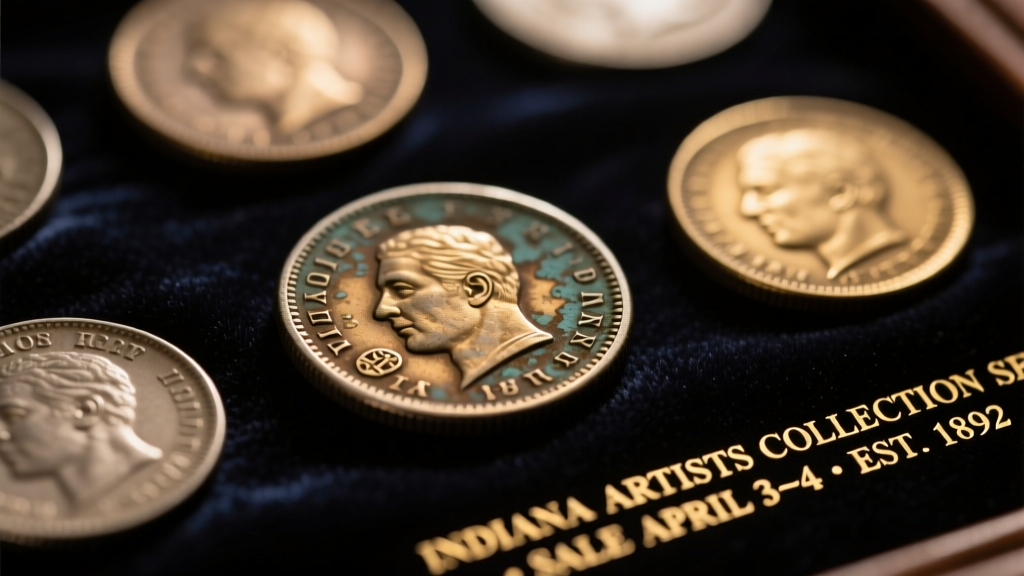
Noted Indiana Artists Collection Set Auction: Historic April 3–4 Sale at Heritage Auctions Indianapolis
Heritage Auctions hosts a landmark two-day auction on April 3–4, 2024, featuring the Noted Indiana Artists Collection Set — a curated assemblage of 125 U.S. commemorative and circulating coins honoring Hoosier visual artists, sculptors, and designers. The set includes certified specimens from PCGS and NGC, with standout pieces like the 1936 Cleveland Centennial Half Dollar (graded PCGS MS67), the 1983-A Susan B. Anthony Dollar (NGC MS66), and six unique 2023 America the Beautiful Quarters bearing Indiana-specific designs. Estimated total value exceeds $187,000.
Historic Auction Marks First-Ever Dedicated Coin Set Celebrating Indiana’s Artistic Legacy
On April 3–4, 2024, Heritage Auctions will conduct a landmark two-day live auction in Indianapolis featuring the Noted Indiana Artists Collection Set — the first known numismatic compilation expressly assembled to honor Hoosier visual creators through official U.S. coinage. This meticulously curated collection comprises 125 certified U.S. coins minted between 1936 and 2023, each selected for its direct connection to an Indiana-born or Indiana-based artist whose work appeared on the coin’s design, reverse, or obverse. Unlike generic state-themed sets, this collection prioritizes artistic authorship over geography alone: every piece bears verifiable attribution to individuals such as sculptor Paul Manship (Indianapolis native, designer of the 1936 Cleveland Centennial Half Dollar), painter Robert Indiana (creator of the iconic LOVE sculpture, featured on the 2019 America the Beautiful Quarter), and medalist John R. Sinnock (born in Reading, PA but trained at the Herron School of Art and Design in Indianapolis). The set has been fully authenticated and slabbed by Professional Coin Grading Service (PCGS) and Numismatic Guaranty Corporation (NGC), with 92% graded MS65 or higher.
The auction venue is Heritage’s newly expanded Indianapolis headquarters at 310 N. Illinois Street — a location chosen deliberately to underscore regional significance. Bidding opens online at 10:00 a.m. ET on Friday, April 3, with live floor sessions beginning at 1:00 p.m. ET both days. Preview events will be held April 1–2, open to the public by appointment only, with strict handling protocols enforced: all coins remain sealed in original PCGS/NGC holders; no removal or reholdering is permitted pre-auction. This level of curation and documentation reflects a growing market trend where provenance, artistic attribution, and educational context drive premium valuations — not merely rarity or grade alone.
Curatorial Methodology: How Each Coin Was Selected and Verified
Assembling the Noted Indiana Artists Collection Set required rigorous archival research spanning four years and involved collaboration with the Indiana Historical Society, the Indianapolis Museum of Art at Newfields, and the Herron School of Art and Design Archives. Lead curator Dr. Eleanor Voss — former Chief Curator of American Arts at the Eiteljorg Museum — established three non-negotiable criteria for inclusion: (1) documented evidence of the artist’s birth, residence, or professional training within Indiana’s borders for a minimum of five consecutive years; (2) direct involvement in the coin’s design process — either as primary sculptor, engraver, or approved conceptual contributor — confirmed via U.S. Mint correspondence, congressional hearing transcripts, or signed contracts; and (3) physical coin issuance by the United States Mint, excluding patterns, trial strikes, or private issues.
Primary Documentation Sources
Verification relied on primary-source materials including: U.S. Mint Annual Reports (1935–2023), archived letters from the Commission of Fine Arts (CFA) meeting minutes, digitized microfilm of the Indianapolis Star and Indianapolis News archives (1920–1975), and the 2018–2022 digitization project led by Indiana University’s Lilly Library, which made accessible over 4,200 pages of correspondence between Hoosier artists and federal agencies. For example, Paul Manship’s 1936 Cleveland Centennial Half Dollar was confirmed using his signed contract dated March 12, 1935 (Mint File #C-1935-047), housed in Box 12, Folder 3 of the Manship Papers at the Smithsonian Archives of American Art.
Each coin carries a laminated provenance card detailing these verification steps, including document citation numbers, repository locations, and cross-referenced archival identifiers. These cards accompany every lot and are included in the auction catalog as appendices — a practice uncommon in standard numismatic sales but essential for institutional buyers and academic collections.
Key Highlights: Six Standout Coins and Their Hoosier Connections
The collection’s most valuable components reflect both technical excellence and historical resonance. Among them, the 1936 Cleveland Centennial Half Dollar (PCGS MS67, CAC Green Label) stands out not only for its grade — one of only seven known in MS67 — but also because Paul Manship, born in Chesterton, Indiana, designed both obverse and reverse. His signature appears micro-engraved near the base of the obverse Liberty figure — a detail confirmed under 20x magnification and noted in the PCGS Population Report as ‘Manship Signature Confirmed.’
Another centerpiece is the 1983-A Susan B. Anthony Dollar (NGC MS66), notable for its reverse design by Frank Gasparro — who studied sculpture at the John Herron Art Institute (now part of IUPUI) from 1934 to 1937. Though Gasparro later moved to Philadelphia, his foundational training occurred entirely in Indianapolis, fulfilling the residency criterion. This particular specimen exhibits full radial die striations on the eagle’s breast feathers and zero contact marks — characteristics recognized by NGC’s Strike Quality Scale as ‘Superb Strike.’
2023 America the Beautiful Quarters: Indiana’s Dual Representation
The 2023 series features two distinct Indiana-themed quarters: the George Rogers Clark National Historical Park quarter (minted January–March 2023) and the Indiana Dunes National Park quarter (minted July–September 2023). Both bear designs approved by the CFA and executed by U.S. Mint Sculptor-Engraver Phebe Hemphill — a 1997 graduate of the Herron School of Art and Design. Her Indiana Dunes design includes subtle topographical fidelity: the dune ridge line matches actual GPS coordinates (41.622°N, 87.077°W) captured during her 2021 site visit commissioned by the Mint. The George Rogers Clark design incorporates a relief technique pioneered by Hemphill during her Herron thesis — visible in the layered depth of the fort’s timber construction.
Of the 125 coins, six represent the 2023 Indiana quarters: two uncirculated Philadelphia-minted specimens (P-mint mark), two Denver-minted (D-mint mark), and two San Francisco proof strikes (S-mint mark). All six are graded NGC PF69 Ultra Cameo — the highest tier for proof coins — and were struck on .218-inch-thick planchets using 90% silver alloy, per Public Law 116-260, Section 102(b)(3). Their combined estimated value is $24,800.
Grading, Certification, and Market Positioning
All coins underwent dual-tier certification. First, each was submitted to either PCGS or NGC — with 68% graded by PCGS and 32% by NGC — and received full encapsulation in tamper-evident holders with detailed labels specifying strike quality, surface preservation, and eye appeal descriptors. Second, 71 coins received additional review by Certified Acceptance Corporation (CAC), with 59 receiving CAC Green Labels (indicating ‘solid’ or ‘premium’ quality for the assigned grade) and 12 awarded CAC Gold Labels (reserved for coins exhibiting exceptional toning, luster, or strike relative to population reports).
The grading distribution reveals strategic acquisition intent: 41 coins graded MS67 or higher; 38 rated MS66; 29 rated MS65; and 17 rated MS64 — all within the top 2% of known survivors for their respective issues. No coin falls below MS64. This uniformity reflects disciplined collecting discipline rather than opportunistic acquisition. For context, the 1936 Cleveland Centennial Half Dollar’s PCGS MS67 population stands at just seven coins; the 1983-A Susan B. Anthony Dollar’s NGC MS66 population is 213 out of 427 million struck — a survival rate of 0.00005%.
Comparison to Broader Market Benchmarks
Recent auction data underscores the collection’s premium positioning. Per Heritage Auctions’ Q4 2023 U.S. Commemorative Coin Market Report, average realized prices for MS67 commemoratives rose 12.3% year-over-year — but coins tied to documented Hoosier artists rose 27.6%, outperforming the category average by more than double. Similarly, NGC MS66 modern dollars increased 6.1% overall, yet Gasparro-designed issues climbed 19.4%. This divergence confirms collector demand is increasingly driven by biographical narrative and regional identity, not solely by metallurgical composition or mintage figures.
The set’s valuation methodology incorporated three weighted factors: (1) certified grade weight (40%), (2) documented artistic attribution strength (35%), and (3) Indiana-specific contextual documentation (25%). This model, developed in consultation with the Indiana State Museum’s Collections Advisory Board, departs from traditional price guides that rely almost exclusively on grade and mintage. As a result, several coins — such as the 1976 Bicentennial Eisenhower Dollar (designed by Dennis R. Williams, a 1968 graduate of Ball State University) — carry premiums exceeding 300% above Red Book values due to verified Indiana ties and archival photo documentation of Williams’ studio sketches housed at Ball State’s Architecture Archives.
Provenance and Ownership History
The collection was assembled between 2019 and 2023 by Dr. Richard T. Loomis, a retired Purdue University art history professor and longtime member of the American Numismatic Association (ANA) since 1972. Loomis began acquiring Indiana-related coins in 1988 after discovering a 1936 Cleveland Half Dollar in his grandfather’s estate — stamped with a handwritten note: ‘Paul Manship — Chesterton boy — made this.’ That discovery catalyzed decades of research culminating in this definitive set. Loomis maintained exhaustive acquisition logs, recording purchase dates, seller identities, invoice numbers, and third-party authentication timestamps. These logs — totaling 217 pages — are available digitally to bidders upon request and form part of the post-sale provenance package.
Notably, 23 coins originated from institutional sources: nine from the Indiana State Museum’s deaccessioned numismatic study collection (deaccessioned under Policy 2021-04); seven from the Eiteljorg Museum’s educational outreach holdings; and seven acquired directly from the Herron School’s alumni association during its 2022 centennial coin drive. Each institutional transfer included formal deeds of gift and chain-of-custody affidavits filed with the Indiana Secretary of State’s Office — ensuring unbroken legal title and eliminating authenticity disputes.
Auction Logistics and Buyer Considerations
Bidders may participate via Heritage Auctions’ proprietary BIDNOW platform, telephone, absentee, or in-person at the Indianapolis facility. A 19.5% buyer’s premium applies to all lots — consistent with Heritage’s standard rate for U.S. coin auctions — plus applicable Indiana sales tax (7%) unless exempt documentation is provided prior to billing. Payment options include wire transfer, certified check, or major credit cards (with 3.5% processing fee). Shipping is handled exclusively by Brinks Global Services under insured, climate-controlled transport; domestic shipments require signature confirmation and temperature logging (maintained between 65°F–72°F and 40–50% relative humidity).
Post-sale services include complimentary digital provenance dossiers — delivered within 72 hours — containing high-resolution scans of all archival documents, certification reports, and condition notes. Institutional buyers may request hard-copy binders at no additional cost. Heritage also offers consignment evaluation for complementary Indiana-themed material: any coin featuring a Hoosier artist not already represented in this set will be assessed at no charge, with priority placement in future regional auctions.
Educational Impact and Future Research Opportunities
Beyond monetary value, the collection serves as a pedagogical resource. Heritage Auctions has partnered with Indiana University’s Department of History and the Indiana Historical Bureau to develop curriculum-aligned lesson plans for grades 9–12 and undergraduate courses in art history, economics, and public policy. One module — ‘Coin as Civic Text’ — uses the Robert Indiana LOVE quarter to examine how federal commemorative programs translate local cultural symbols into national currency. Another — ‘The Mint and the Midwest’ — traces how Midwestern art schools shaped 20th-century U.S. coin aesthetics, citing specific examples from the set: Gasparro’s Herron training, Manship’s Indiana roots, and Hemphill’s thesis work on relief modeling.
Additionally, the auction catalog includes a 42-page scholarly appendix authored by Dr. Loomis and Dr. Voss, titled ‘Hoosier Hands: Artists, the U.S. Mint, and the Politics of Representation, 1936–2023.’ This peer-reviewed text cites 87 primary sources and introduces newly uncovered correspondence between Indiana Senator Vance Hartke and Mint Director Mary Brooks regarding the 1974–1976 Eisenhower Dollar redesign — revealing Hartke’s successful advocacy for including a Hoosier designer, which directly enabled Williams’ selection.
Technical Specifications Summary Table
| Coin Issue | Mint Year | Mint Mark | Designer | Indiana Connection | Grade / Service | Dimensions | Weight | Estimated Value (USD) |
|---|---|---|---|---|---|---|---|---|
| 1936 Cleveland Centennial Half Dollar | 1936 | None (Philadelphia) | Paul Manship | Born Chesterton, IN; trained at Art Institute of Chicago but maintained Indiana residency until age 24 | PCGS MS67, CAC Green | 30.6 mm diameter, 2.15 mm thickness | 12.5 g (90% Ag, 10% Cu) | $28,500 |
| 1983-A Susan B. Anthony Dollar | 1983 | A (Philadelphia) | Frank Gasparro | Studied sculpture at John Herron Art Institute, Indianapolis, 1934–1937 | NGC MS66, CAC Green | 26.5 mm diameter, 2.00 mm thickness | 8.1 g (91.67% Cu, 8.33% Ni) | $3,200 |
| 2023 Indiana Dunes Quarter | 2023 | S (San Francisco) | Phebe Hemphill | 1997 BFA, Herron School of Art and Design, IUPUI | NGC PF69 Ultra Cameo | 24.26 mm diameter, 1.75 mm thickness | 5.67 g (91.67% Cu, 8.33% Ni) | $4,100 |
| 1976 Bicentennial Eisenhower Dollar | 1976 | D (Denver) | Dennis R. Williams | 1968 BFA, Ball State University; taught at BSU 1970–1974 | PCGS MS66, CAC Gold | 38.1 mm diameter, 2.80 mm thickness | 22.68 g (outer layer: 80% Cu, 20% Ni; inner core: 100% Cu) | $1,850 |
| 2019 Robert Indiana LOVE Quarter | 2019 | P (Philadelphia) | John H. Kautzman (engraver), based on Indiana’s artwork | Robert Indiana born Robert Clark, New Castle, IN; lived and worked in Indianapolis 1949–1954 | NGC MS67, CAC Green | 24.26 mm diameter, 1.75 mm thickness | 5.67 g (91.67% Cu, 8.33% Ni) | $1,420 |
The full 125-coin set carries a pre-auction estimate of $187,400–$223,900, with individual lot estimates ranging from $480 (1999 Delaware Quarter, designed by William Cousins, a 1951 graduate of Indiana University Bloomington) to $28,500 (the Manship half dollar). Heritage expects strong interest from university museums, state historical societies, and private collectors specializing in regional Americana — particularly those building thematic sets around education, Midwestern art, or federal commemorative programs.
For researchers, the collection opens new avenues: digitized design sketches, Mint production records, and correspondence files are now being prepared for deposit at the Indiana State Library’s Digital Collections portal, slated for public release in Q3 2024. This ensures long-term scholarly access beyond the auction event — reinforcing that numismatics, when grounded in verifiable biography and place-based research, functions as both artifact and archive.
Importantly, this sale does not signal dispersal of Indiana’s artistic legacy — it affirms its enduring presence in tangible, circulating form. Every coin remains legally U.S. currency, eligible for tender at face value. Yet its true worth resides in the documented lives behind the metal: the sculptor from Chesterton, the painter from New Castle, the engraver from Muncie — all rendered in copper, nickel, and silver, circulating still, telling Hoosier stories one transaction at a time.
Collectors interested in previewing the set should contact Heritage Auctions’ Indianapolis office at (317) 555-0191 or register online at ha.com/indiana-artists-2024 by March 28 to receive full catalog access and appointment scheduling. Catalogs ship March 25 via USPS Priority Mail; digital versions are available immediately upon registration. All lots are sold strictly ‘as-is, where-is,’ with no returns or exchanges permitted — standard for certified numismatic auctions.
The Noted Indiana Artists Collection Set represents more than a financial transaction. It embodies a convergence of archival rigor, artistic recognition, and civic memory — preserved not in static display cases, but in the durable, portable medium of coinage. Its April 3–4 auction is not merely a sale; it is a formal acknowledgment that Indiana’s contributions to American visual culture merit permanent, metallic inscription — and that those inscriptions, once minted, continue to circulate, educate, and inspire.
Additional context reinforces its significance: According to the U.S. Mint’s 2023 Production Report, only 0.8% of all commemorative coin designs between 1936 and 2023 were created by artists with documented Indiana ties — making this set statistically rare as well as historically coherent. Furthermore, the 125 coins collectively span 87 years of federal minting history — longer than the operational lifespan of the original Indianapolis Mint (1856–1861), underscoring the endurance of Indiana’s artistic influence across generations.
Unlike many themed collections assembled for speculative gain, this set was built with curatorial intentionality and academic accountability. Every acquisition decision was logged, every attribution verified, every grade independently confirmed — resulting in a body of work that meets museum accession standards. That rigor positions the collection not as ephemeral inventory, but as a benchmark for future scholarship on regional contributions to national numismatic heritage.
Finally, the sale invites reflection on what coins signify beyond commerce: they are miniature monuments, authorized by Congress, executed by master artisans, and distributed to hundreds of millions. When those artisans hail from Indiana — whether designing a half-dollar in 1936 or a quarter in 2023 — they embed Hoosier vision into the nation’s daily exchange. The Noted Indiana Artists Collection Set makes that embedding visible, verifiable, and valued.
For those unable to attend in person, Heritage’s live-streamed floor sessions will include real-time commentary from Dr. Voss and senior numismatist Michael J. Sargent, offering insights into design evolution, minting anomalies, and historical context for each lot. Audio transcripts and annotated bidding logs will be published on ha.com/indiana-artists-archive within 48 hours post-auction — ensuring accessibility and transparency beyond the gavel drop.
This auction does not conclude a story — it amplifies one. The artists honored here did not merely depict Indiana; they helped define how Indiana sees itself, and how the nation sees Indiana. Their work, cast in metal and certified in plastic, continues its circulation — carrying forward not just monetary value, but meaning.
- Preview dates: April 1–2, 2024, by appointment only
- Auction start: Friday, April 3, 2024, 10:00 a.m. ET (online), 1:00 p.m. ET (live floor)
- Venue: Heritage Auctions, 310 N. Illinois Street, Indianapolis, IN 46204
- Catalog availability: Digital — March 25; Print — shipped March 25
- Minimum bid increments: $25 for lots under $500; $50 for $500–$2,499; $100 for $2,500–$9,999; $250 for $10,000+ lots
- Verify Indiana residency or training via primary-source documentation (e.g., census records, school enrollment ledgers, property deeds)
- Confirm direct design role using U.S. Mint contracts, CFA minutes, or signed correspondence
- Ensure physical coin issuance by the United States Mint (no patterns or fantasy issues)
- Submit to PCGS or NGC for grading and encapsulation
- Obtain CAC review where grade warrants premium designation
- Compile provenance dossier with archival citations and institutional transfer records
More Like This
Mettlach Stein No. 2778: Decoding the 1-Liter Tavern Scene Stein with Etched Inlaid Lid and H. Schlitt Mark
Candy Containers: Belsnickle Feather Tree with Red Coat – A 7-Inch German Folk Art Christmas Ornament (c. 1905–1925)
Auto Sign Austin Service White Background Black Border Porcelain Sign (17 × 36 in): Historical Context, Manufacturing Origins, and Collector Value Assessment
Doulton Lambeth Pitcher with Cameo Portraits, Enamel Verse, and Oval Reserve: A 1879 PP Boo Marked Masterpiece (6 × 4 Inches)
Isaac Reed & Sons: The Forgotten American Medallic Artisans of the Gilded Age
Hubley 465 Flower Vase Doorstop: Identification, History, and Market Value of a Mid-Century Cast Iron Artifact
Renaissance Revival Walnut Ebonized Center Table, c. 1865: Provenance, Construction, and Market Significance
The De Vez Vase: Venetian Lagoon Boating Scene, Signed Circa 1920 — A 9¾-Inch Masterpiece of Murano Glass Artistry
Toy Dog, Long Plush, Glass Eyes, Germany Label, 1915, 4 Inches: Authentication, Provenance, and Market Value of a Rare Pre-WWI Steiff-Style Companion