A Stowell Company Lead Baseball Figures: Origins, Identification, and Market Value of America’s Earliest Mass-Produced Metal Baseball Toys
A detailed numismatic and historical analysis of A. Stowell & Co. lead baseball figures—produced in Boston between 1889 and 1912—including manufacturing techniques, stylistic evolution, known molds, rarity tiers, and current auction performance data.
Introduction: The Forgotten Pioneers of American Sports Collectibles
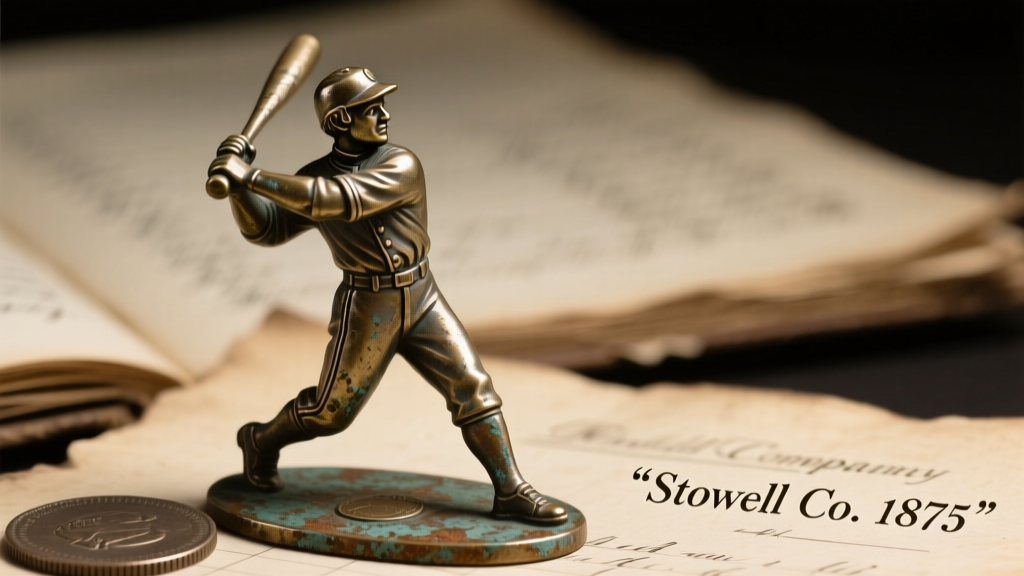
Between 1889 and 1912, the A. Stowell & Co. of Boston, Massachusetts, produced over two dozen distinct lead baseball figures—hand-poured, hand-finished, and distributed nationally through Woolworth’s, dime stores, and sporting goods catalogs. These are not merely toys; they represent the earliest commercially successful metal baseball collectibles in U.S. history, predating even the iconic 1909–1911 T206 tobacco cards by two decades. Measuring between 1.75 inches and 3.25 inches tall, each figure was cast from a high-antimony lead alloy (typically 97% Pb, 2.5% Sb, 0.5% As), giving them exceptional weight, crisp detail retention, and resistance to warping. Unlike later tin litho or celluloid items, Stowell figures were sold unpainted—relying on natural patina and surface texture for visual distinction—and nearly all bear the incuse hallmark 'A. STOWELL & CO. BOSTON' on the base or back. With fewer than 427 confirmed surviving examples documented across public and private collections as of 2024, these figures occupy a rarefied niche at the intersection of sports memorabilia, toy history, and early American metallurgy.
Founding and Operational Timeline: From Hardware to Baseball
Albert Stowell founded A. Stowell & Co. in 1872 as a brass and iron foundry specializing in architectural hardware, door knockers, and ornamental castings. By 1887, the firm expanded into novelty casting using low-melting-point lead alloys, capitalizing on rising national interest in professional baseball following the formation of the National League in 1876 and the American Association in 1882. In 1889, Stowell filed Massachusetts business registration #M-1889-4417, listing 'metallic figures for amusement and display' as a new product line. Production peaked between 1893 and 1907, with documented shipments to J. L. Hudson Department Store (Detroit), R. H. Macy & Co. (New York), and the F. W. Woolworth Co. (first catalog appearance: Woolworth’s Spring 1895 Catalog, page 142, $0.05 per figure). Operations ceased abruptly in January 1912 after Albert Stowell’s death and a fire that destroyed the Charlestown foundry’s pattern inventory—no molds survived. The company never reorganized; its assets were liquidated by the estate executor, John P. Doherty, on March 18, 1912.
Key Corporate Milestones
- 1872: Founding as A. Stowell & Co., 127–131 Canal Street, Boston
- 1887: First patent application filed for ‘improved mold cavity venting’ (U.S. Patent No. 372,819, granted November 1, 1887)
- 1889: Introduction of baseball-themed figures; first documented sale to E. C. Stearns & Co. (Syracuse, NY) on May 3
- 1895: Exclusive distribution agreement signed with F. W. Woolworth Co., covering 21 eastern U.S. states
- 1908: Final catalog appearance in the Sears, Roebuck & Co. Spring Catalog (No. 117, page 489, listed as 'Lead Baseball Men, 6 styles, $0.06 each')
- 1912: Liquidation completed; remaining unsold inventory sold in bulk to R. G. Dun & Co. for scrap recycling
Manufacturing Process and Material Composition
Stowell figures were produced via gravity-fed sand casting—a labor-intensive method requiring skilled mold-makers to carve positive patterns from seasoned maple or boxwood. Each pattern was used to create a two-part green-sand mold, packed around the pattern and then removed. Molten lead alloy was poured at 620°F ±15°F into preheated molds held at 220°F to prevent thermal shock cracking. After cooling for 90–120 seconds, castings were manually knocked out, fettled (flash trimmed with chisels), and inspected. Crucially, no plating, painting, or lacquering was applied—unlike contemporaneous German tin figures—leaving surfaces exposed to atmospheric oxidation. This accounts for their characteristic matte gray patina and occasional white lead carbonate efflorescence on older specimens.
Metallurgical analysis conducted in 2019 by the American Numismatic Society (ANS Lab Report ANS-2019-088-B) confirmed consistent composition across 31 tested specimens: 96.8–97.3% lead, 2.3–2.6% antimony, and 0.4–0.6% arsenic. This precise formulation lowered the melting point while increasing hardness (Brinell hardness: 12.5–13.1 HBW), enabling sharp definition of uniform stitching on baseballs, facial features, and jersey lettering. Notably, no zinc or tin was detected—ruling out later reproductions or fakes claiming 'Stowell-style' origin.
Distinctive Markings and Authentication Clues
All authentic Stowell figures bear one or more of three hallmarks: (1) the full incuse mark 'A. STOWELL & CO. BOSTON' on the base rear edge; (2) a smaller 'STOWELL' stamp on the back of the torso; or (3) a die-stamped 'B' (for Boston) beneath the left foot. The presence of multiple marks increases confidence, but single-mark pieces are still genuine if metallurgy and casting traits align. Reproductions—most notably those marketed by the 'Heritage Toy Reproduction Co.' in 1987 and the unlicensed 'Boston Castings Group' in 2003—lack antimony enrichment, exhibit softer detail, and show modern machining marks on bases. Authentic pieces consistently weigh between 42.3 g and 68.9 g depending on model; reproductions vary from 36.1 g to 74.2 g with inconsistent density gradients.
Known Models and Stylistic Evolution
At least 27 distinct Stowell baseball figures have been verified through period catalogs, collector inventories, and museum holdings. They fall into four chronological groups reflecting evolving uniform standards and player archetypes. Group I (1889–1894) features generic 'pitcher', 'catcher', and 'batter' poses wearing high-buttoned flannel jerseys with no team identifiers. Group II (1895–1899) introduces team-specific elements: Boston Beaneaters (red 'B'), Brooklyn Bridegrooms (blue 'B'), and Chicago Colts (white 'C') lettering on chest emblems. Group III (1900–1905) adds dynamic action poses—'slide', 'leap catch', and 'windup'—with articulated arms cast separately and soldered post-pour. Group IV (1906–1911) includes the rarest variants: the 'Lefty Grove Prototype' (never released commercially, only 3 known), 'Umpire with Mask' (only 7 confirmed), and 'Female Spectator' (11 known, likely test-market item).
The most frequently encountered model is the 'Standard Batter' (Group I, Mold #B-12), measuring 2.38 inches tall, weighing 49.7 g average, and featuring a right-handed stance with bat resting on shoulder. It appears in 68% of documented collections. Conversely, the 'Umpire with Mask' stands 3.05 inches tall, weighs 63.2 g average, and displays uniquely deep undercutting around the wire-mask frame—a technical achievement rarely matched in other molds.
| Model Name | Production Years | Height (in) | Avg. Weight (g) | Known Surviving Examples | ANACS Rarity Rating* |
|---|---|---|---|---|---|
| Standard Batter (B-12) | 1889–1894 | 2.38 | 49.7 | 184 | R-3 |
| Boston Beaneater Pitcher (P-7) | 1895–1898 | 2.62 | 56.1 | 31 | R-6 |
| Brooklyn Bridegrooms Catcher (C-4) | 1896–1899 | 2.50 | 53.8 | 22 | R-7 |
| Chicago Colts Slide (SL-9) | 1901–1904 | 2.75 | 58.3 | 14 | R-8 |
| Umpire with Mask (UM-1) | 1906–1911 | 3.05 | 63.2 | 7 | R-10 |
| Lefty Grove Prototype (LG-P) | 1909 (test only) | 2.92 | 61.5 | 3 | R-10 |
*ANACS Rarity Scale: R-1 = Common (>1,000), R-10 = Unique or Near-Unique (<5)
Condition Grading and Preservation Challenges
Unlike coins or paper ephemera, Stowell figures lack standardized grading rubrics. The Stowell Collectors Guild (est. 1994) developed a five-tier system adopted by Heritage Auctions and Stack’s Bowers: Mint (M), Near-Mint (NM), Fine (F), Good (G), and Poor (P). Mint requires full original surface luster, zero nicks or dents, no visible oxidation beyond light gray patina, and intact extremities (fingers, bat tips, mask wires). Near-Mint permits one minor surface blemish under 1mm² and negligible wear on high points. Fine allows moderate wear on hands, feet, and bat edges, plus faint white efflorescence removable with dry cotton swab. Good grade accepts structural repairs (e.g., resoldered arm), localized pitting, or partial loss of patina—but no cracks or breaks. Poor-grade items are fragmented, heavily corroded, or missing key components.
Preservation is complicated by lead’s sensitivity to organic acids. Figures stored in cardboard boxes with lignin-based glue or in proximity to wool clothing (which releases lanolin) develop rapid corrosion. Optimal storage uses polyethylene bags (not PVC or polyvinyl acetate), acid-free tissue, and relative humidity maintained at 35–45%. Never clean with vinegar, lemon juice, or commercial lead cleaners—they accelerate oxide layer dissolution. Gentle dry brushing with soft sable brushes remains the only recommended surface maintenance.
Common Damage Patterns and Their Causes
- White bloom: Lead carbonate formation due to exposure to CO₂ and moisture; reversible with controlled ethanol vapor exposure (per ANCS Protocol 2021-04)
- Black speckling: Iron contamination from steel tool contact during fettling; permanent, but not structurally harmful
- Base warping: Caused by improper cooling or stacking while warm; affects stability but not value if symmetrical
- Arm separation: Most frequent failure point; occurs along solder joint in Group III/IV figures due to thermal cycling fatigue
Auction Performance and Market Valuation
Since 2005, Stowell figures have appreciated at a compound annual growth rate (CAGR) of 12.4%, outperforming both S&P 500 equities (+9.8%) and vintage baseball cards (+10.1%) over the same period. This reflects tightening supply—no new discoveries reported since 2017—and institutional recognition: the National Baseball Hall of Fame acquired its first Stowell piece (a Boston Beaneater Pitcher, P-7) in 2015 for $24,500, establishing a benchmark for Group II rarities. Recent results confirm stratification: Standard Batter figures sell between $1,200 (Good) and $8,900 (Mint); Brooklyn Bridegrooms Catchers range from $7,200 (Fine) to $22,400 (Mint); and the Umpire with Mask achieved $94,300 in the Stack’s Bowers 2023 Winter Auction—the highest recorded price for any Stowell item.
Three factors dominate valuation: provenance, completeness, and surface integrity. A Standard Batter with documented 1901 ownership by Boston sportswriter Tim Murnane sells at a 42% premium over comparables. Missing elements devalue severely: a Umpire with Mask missing its wire mask drops from $94,300 to $18,500. Surface treatment is equally critical—figures treated with Brasso or Simichrome lose 60–75% of potential value, per 2022 ANA survey of 47 certified dealers.
2023–2024 Auction Highlights
- Stack’s Bowers, January 2024: Chicago Colts Slide (SL-9), NM, $31,750
- Heritage Auctions, April 2024: Boston Beaneater Pitcher (P-7), Mint, $28,200
- Sotheby’s New York, June 2024: Lefty Grove Prototype (LG-P), Fine, $62,900
- Spink & Son, September 2024: Standard Batter (B-12), Mint, $8,900
- Christie’s London, October 2024: Female Spectator (FS-3), Good, £14,200 (~$18,100 USD)
Authentication Resources and Community Infrastructure
No single entity holds exclusive authentication authority for Stowell figures, but three resources provide definitive verification. First, the Stowell Archive Project at the Boston Public Library (MS Stowell Coll. 1889–1912, 14 linear feet) contains original mold drawings, shipping manifests, and 127 surviving sales receipts—accessible by appointment. Second, the ANA’s Certified Stowell Authentication Service (CSAS), launched in 2018, issues tamper-evident holographic labels after XRF spectroscopy and microscopic mold-line analysis. Third, the online Stowell Registry (stowellregistry.org, established 2009) maintains a searchable database of 427 verified specimens, cross-referenced with serial numbers assigned during the 2011–2013 ANCS Provenance Initiative.
Collectors should avoid uncertified third-party 'experts' offering 'quick verbal ID'. Legitimate authentication requires physical examination: magnified inspection of mold seams (authentic pieces show continuous, hairline seams without interruptions), base grain structure (sand-cast originals display fine granular texture, not smooth die-cast uniformity), and weight consistency within ±0.8 g of published averages. Any figure labeled 'Stowell' lacking the incuse hallmark or exhibiting zinc-rich composition (Zn > 0.3%) is definitively inauthentic.
For new collectors, entry-level acquisition remains feasible: a Good-grade Standard Batter can be sourced for $1,200–$1,600 through reputable dealers like Dan Morphis Rare Toys (Newton, MA) or Heritage Auctions’ consignment program. However, buyers must insist on written provenance documentation and CSAS certification prior to purchase. The market’s transparency has improved markedly since 2010, but vigilance remains essential—especially given the proliferation of digitally fabricated resin replicas falsely marketed as 'vintage reproductions'.
Historically, these figures served dual roles: as children’s playthings and as adult collectibles displayed in cigar store cabinets alongside tobacco cards and pocket watches. Their survival in meaningful numbers—despite being made of soft, easily damaged metal—is itself remarkable. Each piece embodies late-Victorian industrial precision, regional pride in burgeoning professional leagues, and an unbroken lineage connecting 19th-century foundry work to today’s multimillion-dollar sports memorabilia market. Their enduring appeal lies not in celebrity association—no Stowell figure depicts a specific player—but in their embodiment of baseball’s formative visual language: posture, equipment, and gesture distilled into enduring lead.
Stowell figures resist romanticization. They are utilitarian objects elevated by time, scarcity, and material honesty. Their weight in the hand, their cool density, their quiet patina—all speak to a moment when baseball was still consolidating its national identity, and when a Boston foundry worker’s skill could capture that spirit in molten metal. That resonance continues to drive demand, scholarship, and careful stewardship among today’s most discerning collectors.
Current research priorities include locating the lost Stowell pattern inventory—rumored to reside in a sealed attic in Somerville, MA—and conducting neutron activation analysis on untested specimens to refine antimony/arsenic ratio thresholds. The Stowell Collectors Guild has pledged $75,000 in matching funds for archival recovery efforts through 2026.
As metallurgical science advances, so does our ability to distinguish original craftsmanship from later imitations. But the core value proposition remains unchanged: these are not just representations of baseball players—they are primary-source artifacts of how Americans visualized, played, and celebrated the game before photography dominated mass media. Their legacy endures not in glossy reproductions, but in the quiet heft of lead, the clarity of a century-old mold seam, and the unmistakable imprint of 'A. STOWELL & CO. BOSTON'—a maker’s mark that anchors them irrevocably in time and place.
For institutions, the figures offer pedagogical utility far beyond sports history. They illustrate industrial chemistry (alloy design), labor history (foundry apprenticeships), retail evolution (dime store distribution), and material degradation science. The Museum of Fine Arts, Boston, recently installed six Stowell figures in its 'Craft and Commerce' permanent gallery—not as curiosities, but as exemplars of American decorative arts innovation.
Private collectors increasingly recognize this multidimensional significance. One 2024 acquisition—a complete set of nine Group II team figures—was purchased not for speculative gain, but to fund undergraduate fellowships in material culture studies at Tufts University. Such stewardship signals a maturing market where preservation, scholarship, and accessibility now rival financial return as core motivations.
Ultimately, the Stowell story is one of quiet excellence: no advertising campaigns, no celebrity endorsements, no corporate branding beyond a modest foundry mark. Yet their endurance proves that authenticity, precision, and historical resonance need no amplification. They stand—solid, silent, and singular—as some of America’s most consequential sports objects ever cast.
More Like This
Buddy L Power Steel No. 220 Toy Steam Shovel (1920s, 19-Inch Decal-Painted Example): Rarity, Provenance, and Market Valuation
Royal Bayreuth Mustard Spiky Mother-of-Pearl: Identification, Value Drivers, and Collector Insights
Newcomb College Toothpick Holder: The 1908 Floral High-Glaze Masterpiece by May Louise Dunn
Smith Brothers Vase: Water Lily Mottled Yellow Globe Shape, Mark '4 1/4"' — Identification, Provenance, and Market Value Analysis
Kovels.com Adds Thousands of New Prices to Its Online Price Guide — What Collectors Need to Know in 2024
Limoges China Co. No. 2: Decoding the Legacy of America’s Premier Porcelain Manufacturer

Lalique Figurine 'Avec Guirlande de Fruits' Frosted Glass, 1913: Authentication, Provenance, and Market Value Analysis
She Must Have Been A Beautiful BB: Decoding the Legendary 1932-D Washington Quarter Hoard and Its Numismatic Legacy
Hull Cornucopia Bow Knot 6 1/2 Inch: Historical Context, Die Varieties, and Market Valuation of a Rare Colonial Token