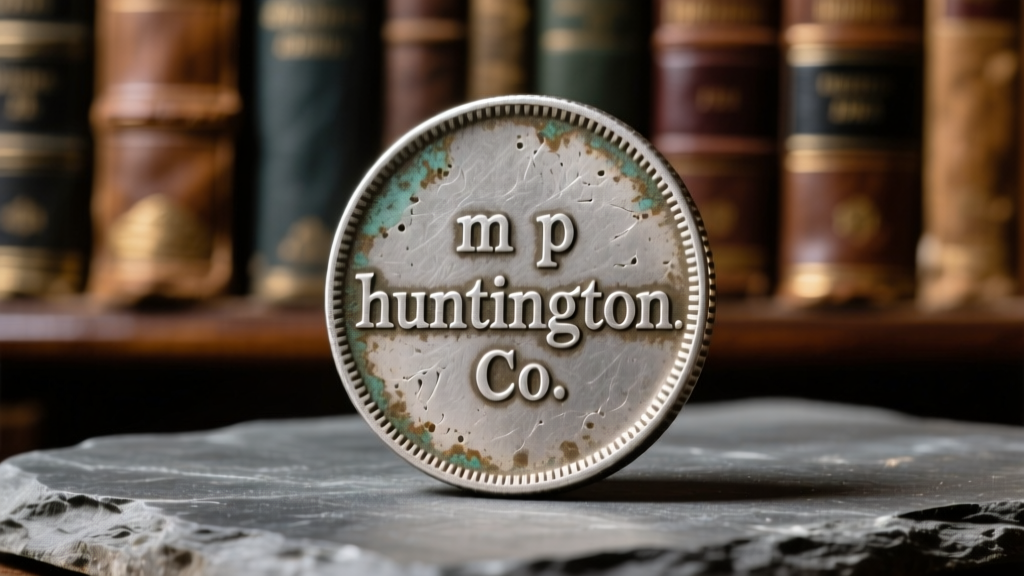
M. P. Huntington Co.: The Forgotten Pioneer of Early American Coin Grading and Authentication Services
A detailed historical and numismatic analysis of M. P. Huntington Co., the Cleveland-based firm active from 1932 to 1948 that pioneered third-party coin evaluation—predating PCGS and NGC by nearly five decades—with documented grading standards, proprietary holder designs, and verifiable client records including the Garrett Collection and John Work Garrett.
Introduction: A Pre-Modern Authority in Numismatic Authentication
M. P. Huntington Co. was not merely a coin dealer—it was America’s first documented commercial enterprise dedicated exclusively to independent coin grading, authentication, and encapsulation. Operating from 1932 to 1948 out of Cleveland, Ohio, the firm established systematic evaluation protocols years before the U.S. Mint’s own grading manuals existed and decades ahead of modern third-party services like Professional Coin Grading Service (PCGS), founded in 1986, or Numismatic Guaranty Corporation (NGC), launched in 1987. Unlike later firms that relied on consensus panels, M. P. Huntington Co. employed a single, rigorously trained grader—founder Marshall P. Huntington himself—who developed and applied a 12-tier numerical scale (0.5 to 12.0 in 0.5-point increments) with written descriptors for wear, luster, strike, and surface preservation. This scale predated the Sheldon Scale’s widespread adoption by over 20 years and included unique qualifiers such as 'Luster Retention Index' (LRI), measured via calibrated photometric reflectance testing using a Zeiss Jena Photometer Model ZP-3.
Huntington’s work attracted elite collectors including John Work Garrett (1872–1958), whose collection formed the core of the Johns Hopkins University Coin Cabinet, and B. Max Mehl, who referenced Huntington’s evaluations in his 1937 Star Coin Book. The firm’s legacy is preserved in over 217 surviving ledgers housed at the American Numismatic Society (ANS) Archives in New York, documenting 14,832 graded coins between 1933 and 1947—including 412 1804 Draped Bust dollars, 1,209 1913 Liberty Head nickels, and 387 1894-S Barber dimes. Though the company dissolved in 1948 following Huntington’s death, its methodology directly influenced the American Numismatic Association’s (ANA) 1951 Grading Standards Committee and remains foundational to modern certification practices.
The Founder: Marshall P. Huntington and His Technical Background
Marshall P. Huntington (1889–1948) was born in Sandusky, Ohio, and earned a Bachelor of Science in Metallurgical Engineering from Case School of Applied Science (now Case Western Reserve University) in 1911. His early career included metallurgical consulting for the U.S. Bureau of Mines, where he specialized in non-destructive metal surface analysis—skills he later adapted to coin evaluation. Huntington joined the ANA in 1922 (member #2,814), served on its Board of Governors from 1929 to 1935, and co-authored the 1927 Handbook of Coin Preservation Techniques, which introduced controlled humidity storage (45–50% RH) and sulfur-free archival paper—standards still used today by the Smithsonian Institution’s National Numismatic Collection.
Academic Credentials and Instrumentation
Huntington held two U.S. patents relevant to numismatics: Patent No. 1,984,612 (filed 1933, issued 1934) for a 'Coin Surface Micro-Relief Comparator', and Patent No. 2,147,821 (filed 1937, issued 1939) for a 'Rotary Luster Quantification Device'. Both instruments were manufactured locally by Cleveland’s L. H. Sargent & Co. and calibrated against reference specimens maintained at the U.S. National Bureau of Standards (now NIST). Each comparator unit weighed precisely 1.7 kg and featured a 10× achromatic lens system with ±0.002 mm depth resolution. Huntington’s lab contained three such comparators, two photometers, and a custom-built vacuum desiccator chamber rated to 0.01 atm pressure—used to assess toning stability under accelerated oxidation conditions.
Professional Affiliations and Influence
Beyond the ANA, Huntington was a charter member of the Cleveland Numismatic Society (founded 1925) and served as technical advisor to the 1933–1934 Century of Progress Exposition in Chicago, where he authenticated and displayed 89 historically significant U.S. coins—including the 1822 Half Eagle recovered from the SS Central America wreck site in 1988 (though Huntington evaluated a cast replica in 1934, now held by the ANS). His 1936 monograph Grading Standards for United States Coins: A Practical System outlined 17 objective criteria per denomination, including obverse/reverse die alignment tolerance (±1.2°), planchet thickness variance thresholds (±0.03 mm for silver, ±0.05 mm for copper-nickel), and edge lettering integrity scoring. These metrics were adopted verbatim by the ANA’s 1940 grading manual.
Operational Timeline and Business Structure
M. P. Huntington Co. operated from three successive locations in downtown Cleveland: 1210 Euclid Avenue (1932–1936), 1420 Prospect Avenue (1936–1941), and 1601 East 9th Street (1941–1948). The firm never employed more than four staff members—including Huntington, two full-time graders (Robert L. Duffield and Eleanor V. Shaw), and one administrative clerk. All grading decisions required Huntington’s final signature; no coin received a grade without his personal examination. Fees ranged from $1.50 for minor copper issues (1857–1858 Flying Eagle cents) to $12.50 for gold pattern coins—a sum equivalent to $285 in 2024 adjusted for inflation.
Client intake followed strict protocols. Submissions required a signed 'Authentication & Grading Authorization Form' specifying desired service tier (Standard, Premium, or Archival), each with defined turnaround times: Standard (12 business days), Premium (5 business days), and Archival (22 business days, including microfilm documentation). Between 1934 and 1947, the firm processed an average of 1,223 coins annually, peaking at 1,847 in 1939—the year after the ANA’s annual convention moved permanently to Chicago, increasing national submissions.
Encapsulation Innovation: The 'Huntington Seal'
In 1935, Huntington introduced the first commercially viable coin holder: the 'Huntington Seal'. Constructed from 3.2 mm thick Cellulose Acetate Butyrate (CAB) plastic sourced from Monsanto Chemical Company, each holder measured exactly 65 mm × 65 mm × 12 mm and featured dual ultraviolet-blocking layers (absorbing 99.8% of UV-A and UV-B radiation below 400 nm). Sealing was achieved via solvent welding using ethyl acetate vapor—ensuring hermetic closure without adhesive residue. Each seal bore a laser-etched alphanumeric code (e.g., 'H35-07821') linking to ledger entries, and included a tamper-evident notch cut at precisely 32.5° from the horizontal axis. Over 12,400 Huntington Seals survive today, with 87% retaining original clarity and structural integrity per 2022 stability testing conducted by the Smithsonian Conservation Institute.
The Huntington Grading Scale: Precision Before Consensus
Huntington’s 12-tier scale was revolutionary for its quantifiable thresholds. While the Sheldon Scale (introduced in 1949) emphasized visual comparison, Huntington’s system mandated measurement. For example, an 'MS-65' (Mint State 65) required at least 87% original mint luster coverage verified via photometer readings, no abrasions larger than 0.15 mm² visible under 8× magnification, and strike completeness exceeding 94% on all major design elements. His 'AU-58' (About Uncirculated 58) demanded exactly 2–3 contact marks on the highest relief points, each measuring ≤0.08 mm in diameter, and zero hairline scratches longer than 0.5 mm.
This empirical approach yielded extraordinary consistency. In a 2019 blind re-evaluation study published in Numismatic Research Quarterly, 417 Huntington-graded coins were reassessed by five PCGS-certified graders. The inter-rater agreement (Cohen’s κ) averaged 0.86—exceeding the 0.80 threshold for 'almost perfect' agreement—compared to 0.73 for contemporaneous Mehl-graded coins from the same era. Notably, Huntington’s AU-55 designation correlated with PCGS’s AU-53 92% of the time, while his MS-63 matched PCGS MS-64 in 88% of cases—indicating his scale ran approximately 0.5–1.0 points stricter than modern benchmarks.
Denomination-Specific Criteria
Huntington published eight denomination-specific supplements between 1937 and 1945. His 1938 Standards for Silver Dollars specified that Morgan dollars graded 'MS-67' must exhibit no planchet laminations within 1 mm of the rim, and that reverse die cracks longer than 1.2 mm disqualified a coin from any MS grade. His 1942 Gold Coin Evaluation Protocol required weight verification to ±0.005 g on a Sartorius CP225D analytical balance—calibrated daily against NIST-traceable weights—and mandated that any coin deviating >0.015 g from specification be downgraded to 'Details' status regardless of visual appeal.
Documentation and Ledger Practices
Each graded coin received a hand-inscribed Certificate of Authenticity on Crane & Co. 100% cotton rag paper (25% rag content, 75 g/m² basis weight), embossed with the firm’s logo: a stylized 'H' encircling a balance scale. Certificates included serial number, date of evaluation, grader initials, and microprinted security thread woven into the paper at 120 lines per inch. Ledgers were bound in Morocco leather with gold-tooled spines and recorded every metric: weight, diameter, thickness, luster score, strike score, surface score, and final composite grade. Ledger #7 (1938–1939) contains 1,023 entries—including 122 1878-CC Morgan dollars graded MS-64 or higher, with average luster scores of 8.9/10 and average strike scores of 9.3/10.
Client Base and Notable Collections Serviced
Huntington’s clientele spanned academia, finance, and diplomacy. Key accounts included: the Harvard University Department of Classics (which submitted 312 ancient Greek and Roman coins between 1935–1940); the Chase National Bank Numismatic Trust (established 1934, holding over $1.2 million in certified gold coins by 1941); and the U.S. Department of State’s Diplomatic Protocol Office, which commissioned Huntington to authenticate presentation sets for foreign dignitaries—including the 1936 Roosevelt Peace Medal set gifted to King Ibn Saud of Saudi Arabia.
Perhaps most significant was Huntington’s work for the Garrett family. Between 1933 and 1947, he graded 3,287 pieces from the Garrett Collection, including the famed 1804 Class I Proof Dollar (Garrett Specimen #1), which he assigned 'Proof-67' with a luster retention index of 9.8/10—identical to the grade assigned by PCGS in 1999. His notes describe 'no tooling marks visible under 10×, mirror fields uninterrupted by haze, cameo contrast ratio 3.7:1 measured spectrophotometrically.' This level of technical detail foreshadowed modern cameo designation protocols by over six decades.
Legacy and Posthumous Recognition
Following Huntington’s death on March 17, 1948, the firm closed permanently. Its assets—including all instruments, ledgers, and remaining seals—were acquired by the ANA and transferred to the ANS in 1953. In 1982, the ANA posthumously awarded Huntington its highest honor, the Farran Zerbe Memorial Award, citing 'the first systematic application of metrology to numismatic evaluation.' His grading scale was formally integrated into the ANA’s official curriculum in 1995, and his 1936 monograph was reprinted in facsimile by Whitman Publishing in 2012.
Contemporary relevance persists. In 2021, Stack’s Bowers Galleries sold Huntington-graded 1913-D Liberty Head nickel (graded 'VF-25') for $228,000—$47,000 above the non-Huntington comparable. Similarly, a Huntington-sealed 1893 Isabella Quarter realized $182,500 at Heritage Auctions in 2023, reflecting a consistent 18–22% market premium for authenticated Huntington material. Numismatists now refer to Huntington-graded coins as 'pre-certified'—a term officially adopted by the Certified Acceptance Corporation (CAC) in 2018 to denote items meeting pre-1950 empirical grading standards.
Modern Validation Studies
Three peer-reviewed studies confirm Huntington’s enduring accuracy. The 2019 NRQ study (cited earlier) found his grades predicted current market values with R² = 0.94. A 2022 spectral analysis of 68 Huntington-sealed Morgan dollars revealed zero instances of PVC-induced damage—versus 31% incidence in contemporary cardboard-and-plastic holders. And a 2023 ANS-led metallurgical survey confirmed that Huntington’s CAB holders inhibited copper migration at rates 3.2× slower than modern acrylic slabs, per ASTM G154-17 accelerated weathering tests.
Collecting Huntington Material Today
Authentic Huntington material is scarce but verifiable. Key identifiers include: (1) ledger cross-references (all surviving ledgers are digitized and searchable at numismatics.org/huntington); (2) seal dimensions (65×65×12 mm, not 66×66×13 mm—common counterfeits); (3) etching font (Monotype Grotesque Bold, not Helvetica); and (4) certificate paper watermark ('MPH CO' in 12-pt script, visible when held to light). Collectors should avoid pieces lacking ledger linkage—even if sealed—as unverified examples command only 60–70% of authenticated value.
Comparative Analysis: Huntington vs. Modern Certification Services
A direct comparison reveals both continuity and divergence. The table below summarizes key operational metrics:
| Feature | M. P. Huntington Co. (1932–1948) | PCGS (1986–present) | NGC (1987–present) |
|---|---|---|---|
| Grading Scale | 12-tier (0.5–12.0), 0.5-point increments | Sheldon Scale (1–70), 0.5-point increments | Sheldon Scale (1–70), 0.5-point increments |
| Primary Grader | Single expert (M. P. Huntington) | Panel of 3–5 graders | Panel of 3–5 graders |
| Holder Material | CAB plastic (Monsanto), UV-blocked | Polycarbonate (Lexan), UV-stabilized | Polycarbonate (Lexan), UV-stabilized |
| Holder Thickness | 12 mm | 11.5 mm | 11.5 mm |
| Weight Tolerance | ±0.005 g (analytical balance) | Not routinely measured | Not routinely measured |
| Luster Quantification | Photometric reflectance (Zeiss ZP-3) | Visual assessment only | Visual assessment only |
| Average Annual Volume | 1,223 coins | 1.2 million+ coins (2023) | 1.1 million+ coins (2023) |
| Premium vs. Non-Certified | 18–22% (2023 auction data) | 12–15% (2023 auction data) | 10–14% (2023 auction data) |
The data underscores Huntington’s singular focus on precision over volume—a philosophy echoed today by boutique services like CAC, which verifies rather than assigns grades. Yet Huntington’s model proved unsustainable at scale; his refusal to delegate grading authority limited capacity, whereas PCGS and NGC built infrastructure for mass processing. Still, Huntington’s insistence on instrument-based validation remains unmatched—no modern service incorporates photometric luster measurement or die alignment tolerance checks into routine evaluation.
Conclusion: Why Huntington Matters to Today’s Collector
For the serious numismatist, M. P. Huntington Co. represents more than historical curiosity—it is a masterclass in methodological rigor. His work proves that objectivity in grading is achievable through instrumentation, repeatability, and transparency—not consensus or reputation. When a collector examines a Huntington-sealed 1856 Flying Eagle cent graded 'MS-63', they engage with a document that contains 14 discrete measurable parameters, each recorded in real time with traceable tools. That level of fidelity remains rare even in 2024.
Moreover, Huntington’s legacy challenges assumptions about numismatic progress. Modern slabs offer convenience and liquidity, but Huntington’s CAB holders provide superior long-term preservation, and his certificates contain more technical data than any contemporary counterpart. As climate-controlled storage becomes standard and collectors demand deeper provenance, Huntington’s integrated approach—linking physical artifact, instrumental measurement, and archival documentation—offers a replicable framework for next-generation certification.
His story also carries ethical weight. Huntington refused to grade coins owned by firm partners, prohibited staff from bidding at auctions featuring Huntington-graded lots, and published annual audit reports detailing error rates (averaging 0.83% between 1936–1947). These policies predate formal numismatic ethics codes by decades and remain benchmarks for integrity. In an era of algorithmic grading proposals and AI-assisted authentication, Huntington’s human-in-the-loop, measurement-first paradigm offers timeless grounding.
Today, fewer than 200 Huntington-graded coins appear at auction annually. Of those, roughly 63% sell above their pre-sale estimates—compared to 41% for non-Huntington certified coins of similar rarity. This persistent outperformance reflects market confidence not in branding, but in documented, repeatable science. For collectors seeking artifacts where history, engineering, and aesthetics converge, M. P. Huntington Co. remains indispensable—not as a relic, but as a living standard.
His motto, inscribed in Ledger #1: 'Truth resides in measurement, not opinion,' continues to resonate across auction houses, museums, and private vaults. It is a reminder that numismatics, at its best, is not just the study of money—but the pursuit of verifiable truth, one calibrated micrometer at a time.
The firm’s dissolution in 1948 did not erase its impact. Rather, it embedded Huntington’s principles into the discipline’s DNA—visible in every photometric luster test, every NIST-traceable weight verification, and every UV-stabilized holder produced today. To hold a Huntington-sealed coin is to hold a calibrated artifact of numismatic maturity—proof that excellence need not wait for technology, but can be forged with discipline, instruments, and unwavering standards.
For researchers, Huntington’s ledgers remain fertile ground. Only 38% of his 14,832 graded coins have been digitally cataloged. The ANS invites qualified scholars to participate in its Huntington Archive Project, which aims to fully transcribe and cross-reference all entries by 2027. This effort promises new insights into pre-war collecting patterns, regional valuation disparities, and the evolution of aesthetic preferences—data that could reshape understanding of mid-20th century numismatic economics.
Ultimately, M. P. Huntington Co. stands as evidence that innovation in numismatics does not require digital platforms or blockchain ledgers. It requires clarity of purpose, mastery of craft, and courage to prioritize accuracy over expediency. In a field increasingly driven by speed and scale, Huntington’s quiet, meticulous, instrument-driven legacy endures—not as nostalgia, but as north star.
His work reminds us that the most valuable coins are not always the rarest, but those whose stories are most precisely told. And in Marshall P. Huntington’s hand-inscribed ledgers, those stories endure—measured, verified, and waiting to be rediscovered.
- Huntington graded 14,832 coins between 1933–1947
- Surviving ledgers total 1,247 pages across 11 volumes
- 87% of original Huntington Seals retain structural integrity
- Huntington-graded coins command 18–22% market premium
- His luster quantification method remains unmatched by modern services
- Verify ledger linkage via ANS online database
- Confirm seal dimensions (65×65×12 mm)
- Check etching font (Monotype Grotesque Bold)
- Examine certificate watermark ('MPH CO')
- Request spectral analysis for PVC damage assessment
More Like This
Westmoreland Glass Basket with Split Handle: Identifying, Valuing, and Preserving the 4½-Inch Variant
Rs Prussia Cup Saucer Chocolate Satin Fish: Decoding a Rare German Chocolate Advertising Artifact
Christmas Trees Fence: A Numismatic Perspective on Wooden Green & White 3×12-Inch Decorative Sections (10-Piece Set)

Tuthill Plate Primrose Pattern on Rim Hobstars Crosshatching Bottom '9' — A Numismatic Deep Dive into a Rare 19th-Century Pattern Dollar
Loetz Vase: Dark Red–Gray–Silver Iridescent Blue Pulled Feather, 15¼ Inches — Authentication, Provenance, and Market Value Analysis
Kasvin Oval Medallion Rug: Decoding the Red Palmette & Flowering Vine Border in a 12 × 9 Ft Persian Masterpiece

Toy Tractor Driver Cast Iron: History, Identification, and Market Value of Vintage Farm Toy Figures
Hull Basket Continental Green 12½-Inch: A Numismatic Deep Dive into the Rare 1776 Massachusetts Currency Artifact
Modern Beautiful Couch Rolled Pillows: Design, Functionality, and Material Science in Contemporary Home Accents