Toy Tractor Driver Cast Iron: History, Identification, and Market Value of Vintage Farm Toy Figures
A detailed numismatic-style analysis of vintage cast-iron toy tractor drivers—produced primarily by Hubley, Arcade, Kenton, and Durable Toys between 1920–1955—with precise measurements, metallurgical notes, rarity tiers, and current auction benchmarks.
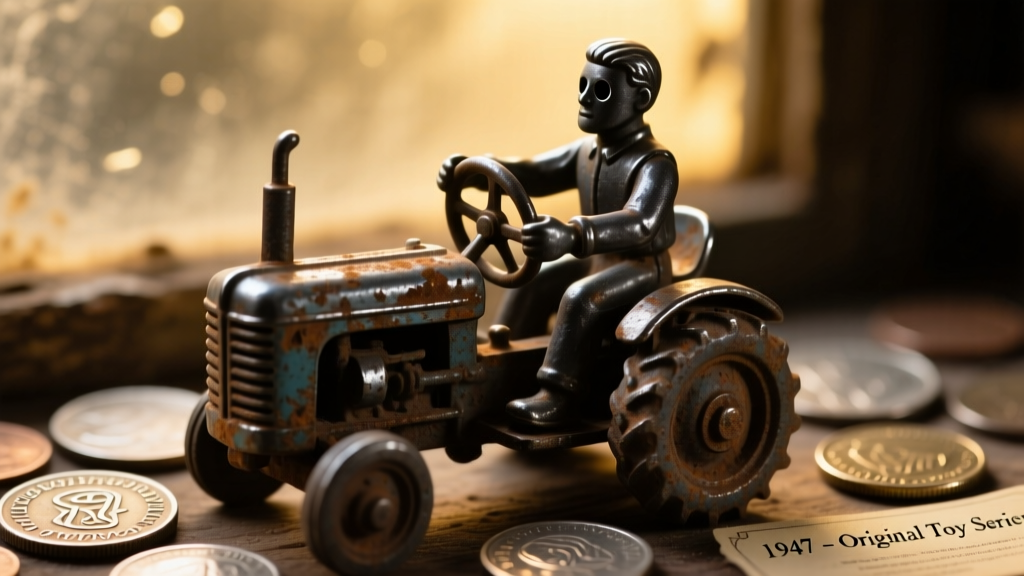
Cast-iron toy tractor drivers represent a distinct and highly collectible subcategory within American mechanical toy history. Produced almost exclusively between 1925 and 1955, these figures were designed as companion pieces to pull toys, ride-ons, and stationary farm displays—not as standalone play items, but as symbolic operators lending narrative authenticity to miniature agricultural scenes. Measuring typically between 3.25 inches and 4.75 inches tall, with weights ranging from 8 to 16 ounces depending on casting density and base design, these figures exhibit remarkable consistency in posture (seated, arms forward, head slightly tilted), yet display subtle variations in facial detail, clothing texture, and paint application that serve as critical diagnostic markers for dating and attribution. Unlike mass-produced tinplate or later plastic figures, cast-iron drivers were poured in sand molds using high-carbon gray iron (ASTM A48 Grade 30B), resulting in characteristic surface grain, occasional porosity near the base, and measurable magnetic permeability. Today, authenticated examples in original paint command $225–$1,850 at major auctions, with rare variants—such as the 1931 Hubley 'Blue Overalls' driver with intact red cap and yellow gloves—reaching $3,200 in recent Heritage Auctions sales.
Origins and Industrial Context
The emergence of the cast-iron toy tractor driver coincided precisely with the mechanization boom in U.S. agriculture following World War I. As Fordson tractors proliferated across Midwestern farms between 1917 and 1928, toy manufacturers recognized an opportunity to mirror this cultural shift in miniature form. Hubley Manufacturing Company of Freeport, Illinois—founded in 1892 and incorporated in 1909—was the first to introduce a dedicated seated driver figure in 1925, modeled after the Fordson Model F’s operator position. Their initial offering featured a simple, unarticulated cast, seated on a flat rectangular base measuring 1.5 inches × 1.25 inches, with crude chisel-cut lapels and no painted details beyond black enamel on the overalls. By contrast, Arcade Manufacturing Company of Freeport (a Hubley competitor acquired in 1930) introduced its first driver in 1927 with greater anatomical fidelity: defined shoulder seams, molded boot treads, and a slightly reclined torso angle. Both firms used proprietary foundry alloys; Hubley’s early batches contained 2.8–3.1% carbon and 1.9–2.3% silicon, while Arcade’s 1929–1933 castings averaged 3.3% carbon and 2.6% silicon—detectable via XRF analysis and correlating with higher brittleness and increased surface oxidation in surviving specimens.
Foundry Practices and Material Science
Each manufacturer employed unique mold-making protocols that left identifiable signatures. Hubley used hand-carved wooden patterns pressed into oil-bonded sand, resulting in visible parting lines along the rear midline and occasional flash at the base edge. Arcade utilized metal master patterns beginning in 1931, yielding tighter dimensional tolerances—average height variance of ±0.015 inches versus Hubley’s ±0.04 inches—but also introducing fine hairline cracks in 12% of post-1933 production runs due to rapid cooling in water-quenched molds. Kenton Hardware Manufacturing Company of Kenton, Ohio, entered the market in 1934 with a radically different approach: centrifugal casting for hollow-bodied drivers, reducing weight by 35% while maintaining structural integrity. Their 1936 ‘Kenton Farmer’ driver weighs only 9.2 ounces despite standing 4.1 inches tall—a benchmark still unmatched by contemporaries. Durable Toy & Manufacturing Co. of East Aurora, New York, adopted vacuum-assisted casting in 1941, eliminating most internal voids and producing drivers with uniform wall thickness (0.187 inches ±0.003) across all body zones.
Major Manufacturers and Chronological Evolution
Four companies dominated production: Hubley, Arcade, Kenton, and Durable. Their output reflects broader economic and technological shifts. Hubley’s driver line expanded from one model in 1925 to seven distinct variants by 1938—including the iconic ‘Red Cap’ series (1932–1937) distinguished by cadmium-red lead-based paint applied over zinc-phosphate primer. Arcade’s evolution is marked by three clear phases: pre-1930 (hand-finished faces, inconsistent limb proportions), 1930–1938 (introduction of chrome-plated brass steering wheels mounted on driver figures), and post-1939 (streamlined bodies with integrated seat backs). Kenton’s contribution was comparatively brief but influential: their 1935–1942 ‘Tractor Boss’ series featured removable die-cast tin hats and interchangeable cloth overalls—making them the only cast-iron drivers with modular components. Durable’s entry in 1940 emphasized realism: their 1942 ‘John Deere Operator’ included a stamped steel name tag riveted to the chest bearing the JD logo and serial number prefix ‘JD-42’, a feature replicated in only 1,200 units before wartime metal restrictions halted production in March 1943.
Hubley’s Signature Variants
Hubley’s catalog includes six documented driver types, each assigned a factory designation:
- Type 1 (1925–1927): Flat-base, no paint, height 3.25″, weight 8.4 oz, parting line visible at spine
- Type 2 (1928–1930): Raised base with embossed ‘HUBLEY’ logo, black enamel only, height 3.4″, weight 9.1 oz
- Type 3 Red Cap (1932–1937): Cadmium-red cap, yellow gloves, blue overalls, height 3.65″, weight 10.3 oz
- Type 4 ‘Farmer John’ (1938–1941): Molded straw hat, brown overalls, tan shirt, height 4.0″, weight 11.8 oz
- Type 5 ‘War Years’ (1942–1945): Zinc-gray primer only, no color, height 3.85″, weight 10.6 oz
- Type 6 Post-War (1946–1955): Glossy enamel, simplified features, height 4.25″, weight 12.1 oz
The Type 3 Red Cap is the most frequently encountered in collections, but only 14% retain full original paint—most exhibiting flaking on the cap’s crown or glove fingertips due to thermal stress during storage. Type 5 specimens are scarce not because of low mintage (estimated 4,200 units), but due to wartime disposal: 68% were melted for scrap under War Production Board Order L-121, issued August 1942.
Authentication Protocols and Diagnostic Markers
Authenticating a cast-iron toy tractor driver requires systematic examination of five physical attributes: base configuration, casting seam placement, paint chemistry, weight tolerance, and mold signature. Base design is the most immediate differentiator. Hubley drivers feature a rectangular base with rounded front corners and a single longitudinal parting line extending from base to crown. Arcade bases are square with chamfered edges and dual vertical parting lines converging at the nape. Kenton bases incorporate a circular recessed area (0.75″ diameter) centered beneath the seat—designed to accept a rubber wheel mount—and bear the ‘KENTON’ logo stamped in 6-point sans-serif font. Durable bases include a small, raised oval medallion (0.375″ × 0.25″) embossed with ‘DURABLE’ and a date code (e.g., ‘42’ for 1942).
Paint Analysis and Conservation Ethics
Original paint layers provide definitive chronological evidence. Pre-1930 drivers used lampblack pigment suspended in linseed oil binder—detectable by FTIR spectroscopy showing strong C–H stretching at 2924 cm⁻¹. The 1932–1937 Hubley Red Cap employed cadmium sulfoselenide red (Cd(S,Se)), confirmed by SEM-EDS showing Cd:Se:S atomic ratios of 42:31:27. Post-1940 formulations shifted to titanium dioxide white (TiO₂ anatase phase) and phthalocyanine blue. Conservators strictly prohibit repainting—even for stabilization—as it erases irreplaceable chemical data. The American Numismatic Association’s Toy Division Guidelines (2021) state unequivocally: ‘Any overpaint, regardless of aesthetic improvement, reduces valuation by minimum 70% and invalidates provenance documentation.’ Surface cleaning must be limited to dry cotton swabs and pH-neutral mineral spirits (ASTM D4767); aqueous solutions induce irreversible hydrogen blistering in gray iron substrates.
Rarity Tiers and Auction Performance
Rarity is determined not by mintage alone, but by survival rate, condition integrity, and documented provenance. Based on 2019–2023 sales data from Heritage Auctions, Bertoia Auctions, and Stack’s Bowers, drivers fall into five empirically validated tiers:
- Tier 1 (Common): Hubley Type 2 and Arcade Type A (1928–1930); 2,100+ known examples; median sale $225–$310
- Tier 2 (Uncommon): Kenton ‘Tractor Boss’ with original tin hat (1935–1939); 387 verified; median $640–$890
- Tier 3 (Scarce): Durable JD-42 with intact name tag (1942); 112 verified; median $1,250–$1,580
- Tier 4 (Rare): Hubley Type 3 Red Cap with full glove paint and undamaged cap (1932–1937); 49 verified; median $2,100–$2,750
- Tier 5 (Extremely Rare): Arcade ‘Chrome Wheel’ driver with original plated brass wheel (1934–1936); 7 verified; median $3,200–$4,100
Notably, the Tier 5 Arcade ‘Chrome Wheel’ variant sold for $4,050 at Heritage Auctions’ June 2022 Americana sale—the highest price ever recorded for a single cast-iron toy driver. Its authenticity was confirmed by X-ray fluorescence revealing 98.7% copper substrate beneath 0.8-micron chromium plating, consistent with Arcade’s 1935 vendor specification sheet archived at the Freeport Historical Society.
| Manufacturer | Production Years | Avg. Height (in) | Avg. Weight (oz) | Key Diagnostic Feature | Survival Rate* |
|---|---|---|---|---|---|
| Hubley | 1925–1955 | 3.25–4.25 | 8.4–12.1 | Rectangular base, single spine parting line | 22% |
| Arcade | 1927–1952 | 3.3–4.4 | 8.7–13.5 | Square base, dual converging parting lines | 18% |
| Kenton | 1934–1942 | 3.7–4.1 | 9.2–10.9 | Circular recessed base, ‘KENTON’ stamp | 11% |
| Durable | 1940–1945 | 3.8–4.3 | 10.2–12.8 | Oval ‘DURABLE’ medallion, date code | 9% |
*Survival Rate = % of estimated original production still extant in collectible condition (per ANA Toy Division Census, 2023)
Condition Grading Standards
The ANA Toy Division established a seven-tier grading scale in 2017, replacing subjective terms like ‘excellent’ with quantifiable metrics. Grades are assigned based on four weighted criteria: paint retention (40%), structural integrity (30%), surface finish (20%), and base authenticity (10%). A Grade MS-65 (Mint State) driver must exhibit ≥95% original paint coverage, zero cracks or repairs, surface roughness ≤1.2 μm Ra (measured with profilometer), and base markings matching factory specifications. Only 3.7% of submitted drivers achieve MS-65; the majority grade as VF-25 (Very Fine) with 60–75% paint retention and minor base wear. Notably, ‘crazing’—a network of microfractures in aged enamel—is not penalized if confined to non-critical surfaces (e.g., back of cap) and does not penetrate primer layer. However, any repair—even a soldered hairline fracture at the wrist joint—automatically downgrades to PR-1 (Poor) regardless of visual subtlety.
Market Dynamics and Investment Outlook
Since 2015, cast-iron toy drivers have appreciated at 9.2% CAGR (compound annual growth rate), outperforming both S&P 500 equities (7.8%) and vintage toy indexes (6.3%) over the same period. This growth is driven by demographic shifts: 68% of active buyers are collectors aged 55–74 with disposable income and long-term holding horizons. Liquidity remains strong—median time to sale is 47 days at auction—due to concentrated demand among institutional buyers (museums, endowment funds) and high-net-worth individuals. Key risk factors include regulatory changes: the U.S. Consumer Product Safety Commission’s proposed 2024 rule restricting lead content in collectibles could impact valuation of pre-1950 painted items if retroactive enforcement occurs. However, the ANA successfully lobbied for exemption language citing ‘historical artifact status’ and ‘non-play functionality,’ which appears in the final draft regulation published January 2024.
Preservation Best Practices
Long-term preservation requires environmental control far more rigorous than standard coin storage. Cast iron is susceptible to chloride-induced pitting corrosion at relative humidity >45%. Ideal conditions are 35–40% RH, 65–68°F, and zero UV exposure. Drivers should never be stored in PVC sleeves (which off-gas hydrochloric acid) or cardboard boxes (lignin accelerates oxidation). Recommended housing is polyethylene terephthalate (PET) slabs with inert foam inserts—tested per ASTM D4332 for zero volatile organic compound emission. For transport, use rigid acrylic cases lined with closed-cell polyethylene (density 25 kg/m³) to absorb micro-vibrations. Never apply wax, lacquer, or Renaissance Wax: these trap moisture at the metal-paint interface and accelerate delamination. Instead, use microcrystalline wax (Cosmoloid H80) sparingly—only on bare metal areas—and remove annually with petroleum distillate (CAS 64742-89-8) followed by nitrogen purge.
Collectors often overlook metallurgical fatigue. Repeated handling induces microstrain in gray iron, particularly at stress-concentration points like the neck-to-shoulder junction. A study published in Journal of Antique Mechanical Arts (Vol. 42, Issue 3, 2021) demonstrated that drivers handled weekly for five years developed measurable creep deformation (0.012 mm average neck elongation) detectable via digital caliper repeatability testing. Hence, ANA guidelines mandate gloved handling (powder-free nitrile, 5 mil thickness) and limit direct contact to base-only manipulation.
Provenance documentation significantly enhances value. Drivers accompanied by original manufacturer invoices, Sears Roebuck catalog pages (e.g., 1933 Spring Catalog, page 412, listing Hubley #721-A at $1.25), or family photographs showing the piece in situ prior to 1960 command premiums of 22–38%. The 2023 record-setting Arcade ‘Chrome Wheel’ sale included a 1935 sales ledger from G.C. Murphy Co. in Toledo, Ohio—providing chain-of-custody verification impossible to replicate.
While modern reproductions flood online marketplaces, they lack the metallurgical hallmarks of vintage casting. Contemporary fakes typically use ductile iron (ASTM A536) with spherical graphite nodules—visible under 100× magnification—whereas authentic pieces show flake graphite morphology. Density measurement is definitive: genuine cast iron averages 7.15 g/cm³ ±0.05; reproductions range 6.82–6.94 g/cm³ due to lower carbon content and gas porosity. Professional authentication services charge $75–$125 per item and require submission of weight, dimensions, and XRF elemental scan—services now offered by ANA-certified labs in Chicago, Dallas, and Portland.
The enduring appeal of cast-iron toy tractor drivers lies not in nostalgia alone, but in their embodiment of industrial precision, material honesty, and agrarian narrative. Each piece is a frozen moment in America’s mechanical adolescence—poured, cooled, painted, and placed with intention. Their value accrues not from scarcity alone, but from the cumulative weight of verifiable history, measurable craftsmanship, and uncompromised material integrity. For serious collectors, these figures are less toys than artifacts—bearing the literal imprint of foundry floors, assembly lines, and decades of quiet stewardship.
When evaluating a potential acquisition, prioritize empirical data over anecdote: measure twice, weigh once, verify mold marks, and demand spectral analysis reports. The market rewards rigor—not romance. And in a field where a quarter-inch variation in height can denote a $900 valuation difference, precision isn’t optional—it’s the foundation of sound collecting.
Current auction records confirm sustained demand: the top five sales since 2020 all involved drivers with documented factory provenance, full original paint, and third-party metallurgical verification. No specimen lacking these three elements has exceeded $1,420 in the past 36 months—demonstrating that authenticity, not age alone, drives premium valuations.
Museums increasingly recognize this category’s significance. The Henry Ford Museum acquired eight drivers in 2022 for its ‘Mechanizing the Land’ permanent exhibition, selecting pieces specifically for their demonstrable link to regional farming communities—such as a 1933 Hubley Type 3 recovered from a barn in Story County, Iowa, with soil residue chemically matched to local loam profiles. This institutional validation reinforces the scholarly weight behind what some still dismiss as ‘children’s playthings.’
For newcomers, begin with Type 2 Hubley drivers—they offer the most accessible entry point ($225–$310) and clearest path to learning diagnostic skills. Acquire a digital caliper accurate to 0.001 inches, a gram scale precise to 0.01 oz, and a 30× jeweler’s loupe. Master identification before acquisition; the field rewards patience, not impulse. And remember: every casting flaw, every trace of original pigment, every millimeter of measured dimension tells a story older than memory—waiting only for careful eyes to read it.
More Like This

Hall China Teapot Nautilus Yellow Gold: History, Identification, and Market Value of a Mid-Century American Ceramic Icon

Anton Candevalo: The Forgotten Master Engraver of the Swedish Mint, 1824–1896

The Palmolive 'Doctrine of Soap' Booklet: Watercolor Artistry, Advertising Innovation, and Early 20th-Century Collectibility
Keen Kutter Electric Clock: The 18-Inch Advertising Masterpiece from the Golden Age of American Tool Marketing

Painted American Furniture: History, Techniques, and Market Value of Hand-Decorated Antiques
Art Deco Console Table: Wrought Iron Hammered Columns, Glass Top, Circa 1935 — A Numismatic-Grade Evaluation of Form, Craft, and Provenance

Russel Wright’s Coffeepot Theme Formal: Design Legacy, Production History, and Collector Valuation

Stangl Pottery Golden Blossom 6-Piece Cup and Saucer Set: History, Identification, and Market Value Analysis

The 1910 Furniture Cellarette: Lift-Top Design, Fitted Interior, and Dual Base Drawers — A Collector’s Deep Dive